
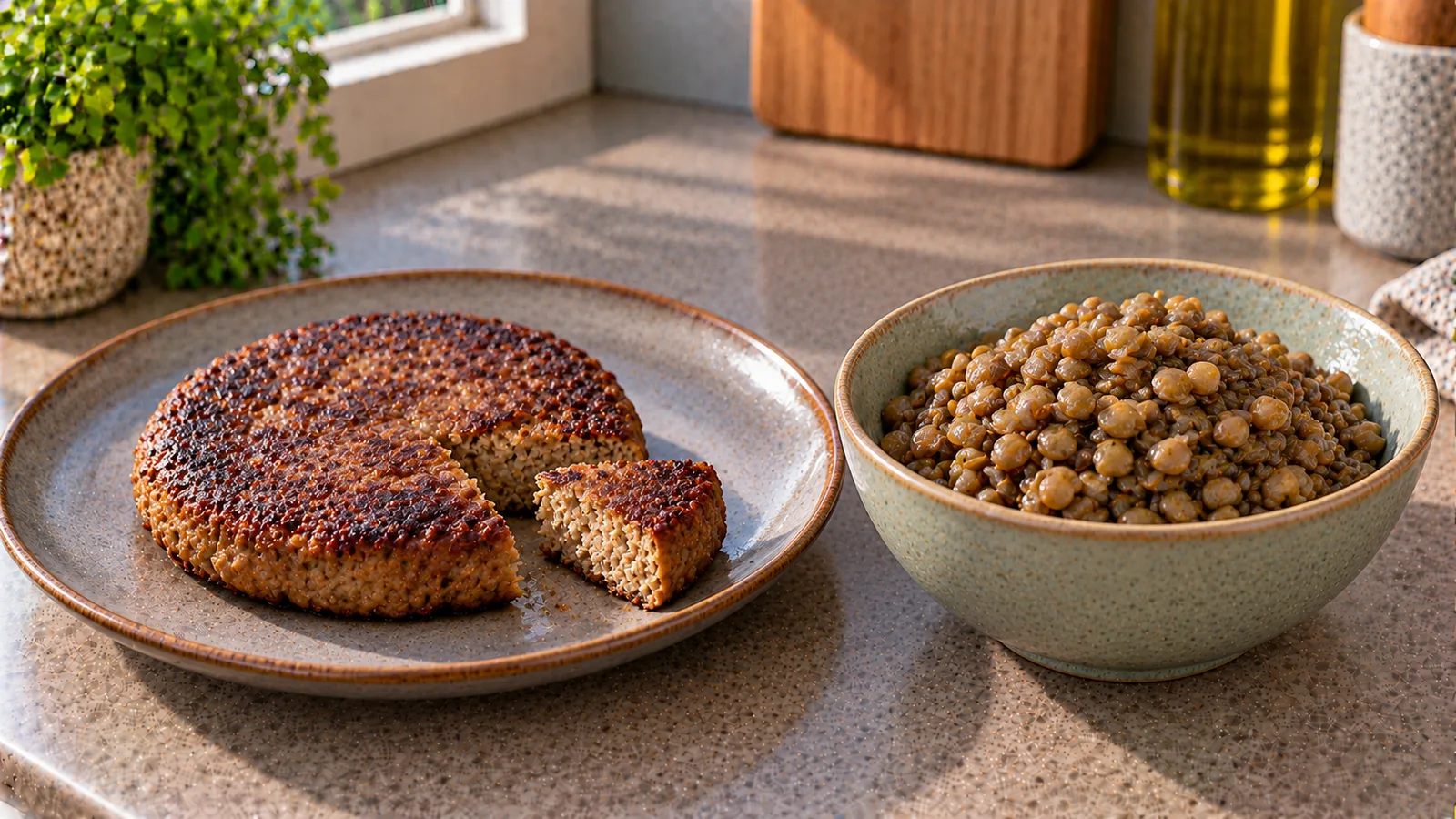
A plant-based burger and a bowl of lentils can both provide protein, but they do different jobs on a plate. Using a specific German supermarket product, REWE Beste Wahl Premium Vegan Burger Patties, the patty mixture contains 15 g protein, 8 g fiber, 203 kcal and 1.2 g salt per 100 g as sold. The USDA reference for plain cooked lentils contains 9.02 g protein, 7.9 g fiber and 116 kcal per 100 g, with almost no naturally occurring sodium. These figures describe two specific reference foods, not every vegan burger or lentil recipe.
The useful question is not whether a burger is categorically healthy or unhealthy. It is how much protein and fiber you get at a realistic serving, what else is in the product, and what the meal costs. A convenient patty can fit an eating plan; inexpensive lentils can also be a satisfying centrepiece, but they are not a direct texture or cooking-time substitute.
What exactly is being compared?
The REWE soy-protein burger label is for a 225 g pack, divided into two patties for our serving calculation. Its ingredient list starts with water and soy protein (17%), followed by rapeseed oil, vinegar, seasonings, methylcellulose and other ingredients. Values quoted here are the retailer's per-100-g as-sold figures; oil added during frying is not included in our numbers.
The USDA FoodData Central lentil reference, FDC 172421, describes mature lentils, cooked, boiled, without salt. The lentils have absorbed water. Do not compare the USDA cooked lentils with nutrient values per 100 g dry lentils and assume the difference is a nutritional advantage: water changes the denominator.
| Nutrient per 100 g | REWE vegan burger, as sold | Plain cooked lentils |
|---|---|---|
| Energy | 203 kcal | 116 kcal |
| Protein | 15.0 g | 9.02 g |
| Fiber | 8.0 g | 7.9 g |
| Total fat | 12.8 g | 0.38 g |
| Saturated fat | 1.5 g | 0.05 g |
| Carbohydrate | 3.0 g | 20.13 g |
| Salt | 1.20 g | about 0.005 g |
USDA records sodium as 2 mg per 100 g for these unsalted lentils; the salt equivalent above is estimated as sodium × 2.5. Retailer salt figures are declared directly under European labeling rules. Once lentils are salted or cooked in broth, this near-zero number no longer describes the whole dish. Different patties may use pea, soy or wheat proteins and oils in varying amounts: check your own label.
A fairer dinner comparison: one patty or a bowl of lentils
One of these REWE patties is approximately 112.5 g (225 g divided by two), giving about 16.9 g protein. A bowl of 200 g plain cooked lentils gives around 18.0 g protein. The servings are not identical by weight, but the protein amounts are close enough for a practical decision.
| Edible serving without extras | One 112.5 g patty | 200 g cooked lentils |
|---|---|---|
| Calories | 228 kcal | 232 kcal |
| Protein | 16.9 g | 18.0 g |
| Fiber | 9.0 g | 15.8 g |
| Fat | 14.4 g | 0.8 g |
| Salt | 1.35 g | about 0.01 g |
This is a comparison of the unprepared patty label and already boiled lentils, not an analysis of two finished dinners. If the patty is fried with absorbed oil or the lentils are mixed with dressing, onions, salted stock or cheese, add those ingredients separately. The bun, fries and sauce in a burger meal can matter more than the difference between the two protein components.
For a separate comparison of legumes, consult our beans-versus-lentils guide.
What happens at a 20 g protein target?
For an apples-to-apples protein comparison, divide the target by protein per 100 g. You would need about 133 g of the example burger or 222 g cooked USDA-reference lentils for approximately 20 g protein, before adding other foods.
| At roughly 20 g protein | Vegan patty mixture | Cooked lentils |
|---|---|---|
| Food needed | 133 g | 222 g |
| Energy | 271 kcal | 257 kcal |
| Fiber | 10.7 g | 17.5 g |
| Salt before seasoning | 1.60 g | about 0.01 g |
| Illustrative food cost | €1.65 | €0.41 |
The cost row is a transparent example, not a verified REWE shelf price. Its assumptions are explained below.
Cost per serving: separate the observed price from the scenario
The dmBio Beluga lentils product page lists €2.45 for 500 g dry lentils, equivalent to €4.90/kg, at the time checked. Its nutrition values refer to dry Beluga lentils and are a separate product profile from the cooked USDA reference. REWE's burger page does not show a universal checkout price; it says the price depends on location. To make a reproducible calculation, assume €2.79 for the 225 g two-patty pack solely as an illustrative local shelf price. Replace it with your actual receipt before relying on the budget comparison.
For lentils, the example assumes 75 g dry lentils yields 200 g cooked after water absorption. That is a hypothetical measured kitchen yield, not a fixed cooking ratio. At €4.90/kg, 75 g dry costs €0.37. If your 75 g yields 180 g or 225 g cooked, recalculate the portion cost using what you actually weighed.
| Cost assumption | Patty option | Lentil option |
|---|---|---|
| Purchase basis | Hypothetical €2.79 / 225 g | Listed €2.45 / 500 g dry |
| Serving | 112.5 g, one patty | 200 g cooked from 75 g dry |
| Food cost per serving | €1.40 | €0.37 |
| Cost for about 20 g protein | €1.65 | €0.41 |
The last row uses 133.3 g of burger (20 ÷ 15 × 100) and 221.7 g cooked lentils (20 ÷ 9.02 × 100); lentil cost assumes the stated cooked yield. It estimates purchase cost for the ingredient only, with no buns, vegetables, seasoning, stove energy or waste. For general household accounting, see our guide to cost per meal, which addresses full meal costing rather than a particular burger comparison.
Sodium, fats, fiber and processing: more useful than a slogan
The named burger has 1.2 g salt per 100 g, even before sauces or salty sides; the USDA plain lentils are essentially unsalted. The patty also has more total fat because its formulation contains rapeseed oil. Fat is not inherently a negative nutrient, and rapeseed oil is not equivalent to a product made mainly with coconut fat. Check both saturated fat and salt on the actual pack.
Both options provide fiber on a per-100-g basis, but the larger cooked-lentil portion in our example provides more total fiber. The German Nutrition Society's guidance on legumes highlights pulses as useful sources of protein, fiber, folate and minerals and recommends eating them regularly. Increasing fiber abruptly may cause discomfort for some people; adjusting portions gradually is reasonable. For a broader low-cost basket that contains several fiber sources, see the low-cost high-fiber grocery basket. For a second comparison of a processed soy ingredient with lentils, including cost, see textured soy protein versus lentils.
“Ultra-processed” is a description of how a food is formulated and manufactured, not a reliable numerical substitute for the nutrition label. A seasoned commercial patty is generally more processed than plain boiled lentils, but that alone does not establish that it is worse for every person or every use. A patty may help someone replace meat conveniently; lentils may suit those prioritizing low cost, low added salt and minimally processed ingredients. Examine the full meal, serving frequency and ingredients instead of issuing blanket verdicts.
Allergens, preparation and dietary details
The REWE product uses soy protein and lists barley malt extract. People avoiding soy or gluten-containing cereals need to check the entire allergen declaration, including current packaging and cross-contact statements; a “vegan” label does not mean allergen-free. Some competing patties contain wheat gluten or pea protein. For another comparison among plant proteins, our tofu-versus-seitan comparison covers tofu and seitan with their distinct soy and wheat considerations.
Dry lentils should be rinsed and cooked according to package directions; do not treat raw dried lentils as ready to eat. The DGE also advises cooking legumes rather than eating them raw. Ready-to-eat canned lentils may already be salted; check drained weight and nutrition per 100 g. Refrigerate cooked leftovers promptly and follow storage directions for refrigerated burger patties. Never assume a chilled patty is safe to eat raw just because it contains no meat.
Which option makes more sense?
Choose the packaged burger if you need a patty-like texture, short preparation time and an easy measured serving, while checking oil, salt, allergens and price. Choose cooked lentils if you want a flexible base for soups, salads or bowls, often with lower ingredient cost and no added salt when prepared plainly. If neither alone makes a complete dinner for you, add vegetables, whole grains and other ingredients according to your needs.
For tracking, log the patty using the branded label and as-sold weight, plus any added oil. Log lentils using cooked edible weight if using USDA's cooked entry; if you track a homemade batch from dry ingredients, log those dry ingredients once and divide the recipe into weighed portions. Never count both the dry and cooked amount as two foods. The most defensible winner is the food that fits the portion, budget and recipe you actually eat.
Sources and method: REWE 225 g vegan burger label; USDA FoodData Central cooked lentils, FDC 172421; dmBio Beluga dried lentils label and price; DGE guidance on pulses. Food values are compared for the stated reference products; prices for REWE patties and cooking yields are explicitly illustrative, not verified purchases.