
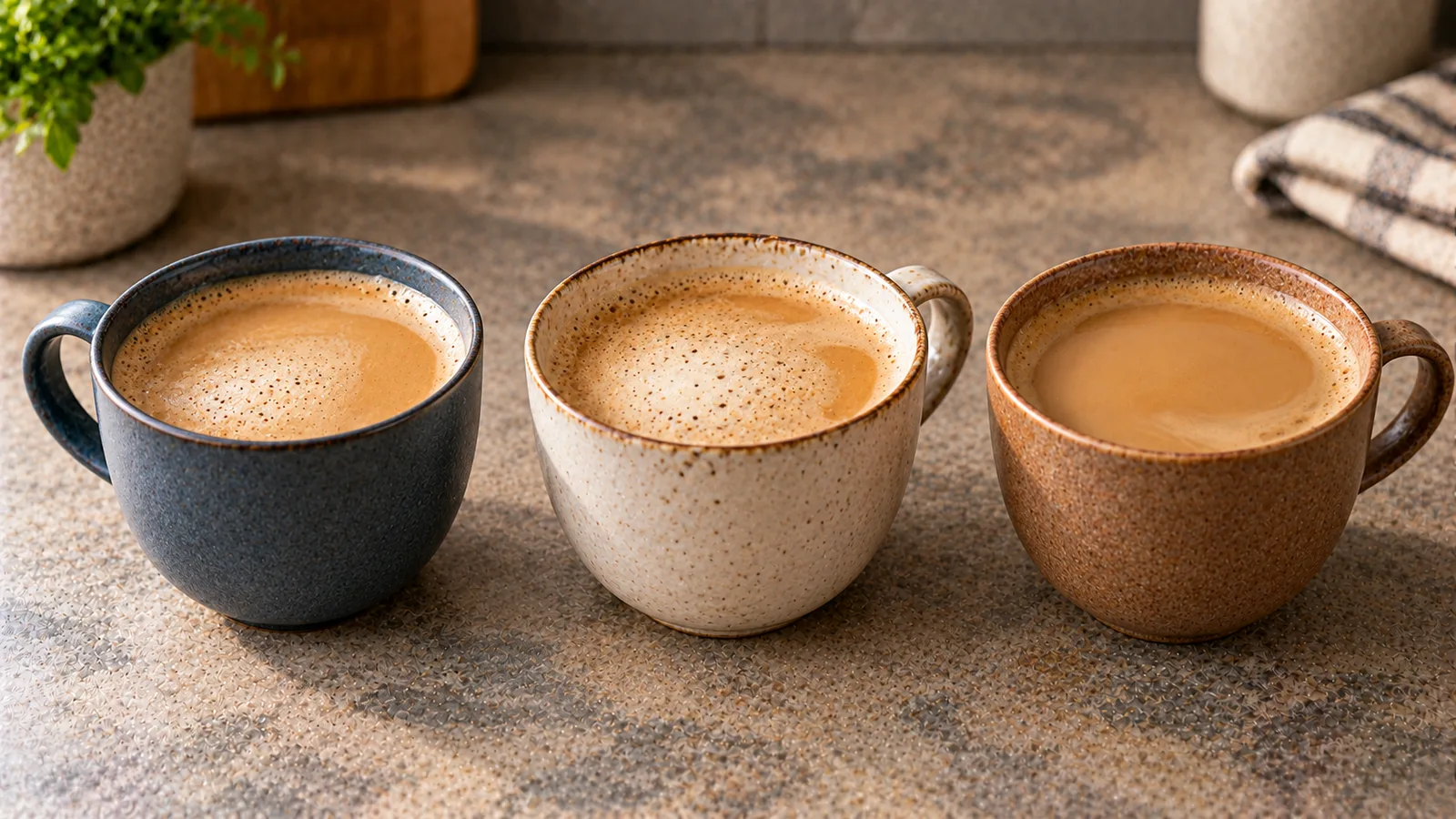
For a splash of milk in an espresso, the most useful comparison is what 30 ml actually adds. For a latte, the same question may involve 200 ml. Those are very different nutritional and financial decisions. A carton labelled “barista” can foam convincingly yet contain relatively little protein; a basic soy drink can offer substantially more protein than an oat drink without being marketed as a sports food.
This comparison uses three specifically identified dmBio plant drinks—oat Barista, plain soy and plain oat—and ja! semi-skimmed dairy milk as a reference. It does not pretend that every plant milk has the same recipe, or that an espresso contains zero calories. Figures below cover the added drink only, excluding coffee itself, syrups, sugar and toppings. Product details and retail prices can change; check the carton before purchasing.
The answer depends on your coffee
If you add only a dash to black coffee, flavour, whether the drink curdles, convenience and finishing an opened carton may matter much more than a difference of a few calories. If you prepare a large milk-based coffee daily, the protein, sugars and price become more significant. The reasonable conclusion is not that one plant drink wins every category. The choice depends on what you want the addition to do.
For protein: the selected unsweetened-style plain soy drink is the closest plant alternative to the protein in conventional semi-skimmed milk. For a barista texture: the selected oat Barista is formulated for frothing, but that feature says little about its protein or sugar content. For a relatively inexpensive oat option: plain oat drink may suffice if you are not making elaborate foam. These statements describe the particular products in the table, not all brands or recipes.
Four real products, one consistent unit
The product labels report nutrient values per 100 ml, allowing direct comparisons. The selected dmBio oat Barista, dmBio plain soy and dmBio plain oat products come from one retailer; the dairy reference is ja! H-Milch 1.5% from REWE. Its local shelf price is not publicly fixed, so the dairy price calculations below explicitly assume €1.10 per litre. For the plant drinks, the published dm online prices at checking were €1.45, €0.95 and €0.90 per 1-litre carton respectively. These prices exclude delivery and offers.
| Product (per 100 ml) | kcal | Protein | Sugars | Price per litre |
|---|---|---|---|---|
| dmBio oat Barista | 54 | 0.8 g | 3.4 g | €1.45 |
| dmBio plain soy | 34 | 3.3 g | 0.6 g | €0.95 |
| dmBio plain oat | 40 | 0.6 g | 5.2 g | €0.90 |
| ja! milk 1.5% | 47 | 3.4 g | 4.9 g | €1.10 assumed |
The underlying labels are the dmBio oat Barista product, dmBio soy product, dmBio plain oat product and REWE ja! milk product. Do not substitute a different “oat Barista” carton and assume identical numbers. In particular, the oat Barista contains added sunflower oil and its own stabilising ingredients, whereas the soy product lists water and soybeans. Check allergens and the version sold in your shop.
The 30 ml coffee-splash calculation
Multiply each per-100-ml number by 0.30. For example, 0.8 g protein per 100 ml of oat Barista becomes 0.24 g in 30 ml. Price is calculated as litre price × 0.03. These figures are precise arithmetic on rounded label values, not laboratory measurement of your poured splash.
| Added drink: 30 ml | kcal | Protein | Sugars | Cost |
|---|---|---|---|---|
| Oat Barista | 16.2 | 0.24 g | 1.02 g | €0.0435 |
| Plain soy | 10.2 | 0.99 g | 0.18 g | €0.0285 |
| Plain oat | 12.0 | 0.18 g | 1.56 g | €0.0270 |
| Dairy milk 1.5% | 14.1 | 1.02 g | 1.47 g | €0.0330* |
Dairy price uses the hypothetical €1.10/litre assumption; nutritional values use the actual ja! label. For one occasional coffee, these are small amounts. Even the protein difference between soy and oat Barista is only 0.75 g at this volume. Do not inflate that into a claim that one splash will determine a person's daily protein adequacy. The comparison does show why selecting a liquid solely because it says “oat”, “vegan” or “barista” does not tell you what goes into your cup.
The 200 ml latte calculation
A milk-based coffee changes the scale of the comparison. The following example assumes exactly 200 ml of the selected drink added to coffee; real café cup volumes differ and some foam may remain in the jug. Multiply each 100 ml label value by 2. Prices equal litre price × 0.20.
| Added drink: 200 ml | kcal | Protein | Sugars | Cost |
|---|---|---|---|---|
| Oat Barista | 108 | 1.6 g | 6.8 g | €0.29 |
| Plain soy | 68 | 6.6 g | 1.2 g | €0.19 |
| Plain oat | 80 | 1.2 g | 10.4 g | €0.18 |
| Dairy milk 1.5% | 94 | 6.8 g | 9.8 g | €0.22* |
The soy-to-oat protein difference becomes obvious at latte volume: 6.6 g for the selected soy versus 1.2 g for ordinary oat. On these labels, the selected plain soy also has much less sugar. That does not imply a soy latte replaces breakfast or that all soy drinks are sweetener-free. The carton, serving size and any coffee additions still determine the outcome. A helpful starting point is the broader milk calorie guide when you want to compare dairy nutrition independently of café preparation.
Why a 100 ml label is not a cup of coffee
Food packaging commonly standardises nutrition to 100 ml. A café recipe may use 20–40 ml in a short coffee, 120 ml in a cappuccino or much more in a large latte. Those are examples, not official standard serving sizes. Measure the amount you actually pour for several mornings if your goal is accurate tracking; a visual guess at what “a dash” means is rarely consistent.
If you add 30 ml twice daily for seven days, the weekly volume is 420 ml. If you make one 200 ml latte per day, the weekly volume is 1,400 ml. Those habits not only change weekly nutritional contributions; they change whether you can finish an opened carton before its use-by guidance. Our serving-size guide helps distinguish the label's reference quantity from the amount you actually consume. Neither the 100 ml label nor a marketing serving suggestion overrides the quantity in your mug.
Coffee compatibility: foaming, splitting and flavour
Barista drinks are commonly designed to be aerated or mixed into hot coffee, but “barista” is not a harmonised promise of a particular protein content or guaranteed foam performance. Foam depends on the formulation, temperature, steam wand, technique and acidity of the coffee. A plain oat carton might be satisfactory for a small splash and less predictable for microfoam. A soy drink can also foam well, yet some combinations split in very acidic coffee, especially if added cold to a very hot cup.
If your plain drink separates, try warming it gently, pouring coffee more slowly or using a product intended for hot coffee. Do not claim that a foamier drink must have more protein: oil, processing and other ingredients can affect texture. Taste is personal. Oat drinks may taste naturally sweeter, soy can have a legume note, and cow's milk has its familiar dairy character. A home tasting of small volumes is more useful than treating one review as a universal result.
Sugar on the label is not the same as added sugar
The label column “of which sugars” includes sugars present in the finished product, regardless of whether someone added table sugar. The selected oat Barista reports 3.4 g sugars per 100 ml while saying it has no added sugar. The selected plain oat has 5.2 g per 100 ml. Oat processing can create sugars from starch. Dairy milk naturally contains lactose; ja! lists 4.9 g sugars per 100 ml. Conversely, the selected soy drink reports only 0.6 g.
Under EU Regulation (EC) 1924/2006, “with no added sugars” has specific conditions; it is not the same as sugar-free. The regulation's sugar-free threshold for liquids is no more than 0.5 g sugars per 100 ml. On its labelled value of 0.6 g, the selected soy drink is not a sugar-free product under that threshold merely because it has no sugar added. Also distinguish an unsweetened coffee from a syrup-flavoured beverage, where the syrup can dominate the sugar total.
Protein matters more when the drink is substantial
A simple rule prevents exaggeration: multiplying protein concentration by the actual volume gives the amount consumed. The 200 ml soy example provides 6.6 g protein; 30 ml gives less than 1 g. The same percentage difference can matter substantially in a latte and little in a short espresso.
If increasing total dietary protein is your primary goal, consider your entire meal rather than buying a drink solely for a couple of extra grams. In a breakfast with eggs or yogurt, the difference might be less relevant; in a fully plant-based breakfast with otherwise modest protein, soy can be a practical contributor. Our soy versus oat milk comparison article explains the separate category-level comparison of soy drinks and their serving sizes. The present guide is about coffee quantities, foam and spending, not a repeat of a generic soy-versus-oat review.
Calcium, iodine and fortified alternatives
A plant drink is not automatically nutritionally equivalent to cow's milk. For someone replacing all dairy rather than simply changing one splash of coffee, the ingredients and fortification become much more important. The German Nutrition Society's position on dairy and plant alternatives highlights calcium, iodine, riboflavin and vitamin B12 among nutrients to consider. The DGE FAQ also explains why fortified calcium can settle and why cartons should be shaken.
The chosen organic dmBio drinks do not list an added calcium fortification in the ingredients quoted here. Do not infer from their similar colour that they supply dairy-like calcium. If plant milk is your principal milk replacement, check specific added amounts and make a wider dietary plan. This is not a claim that everyone needs supplements, nor that one small latte guarantees a deficiency. A dietitian can help if several foods are excluded for allergies or medical reasons.
What about allergies, lactose and gluten?
The plain soy drink contains soy, a relevant allergen. The oat products contain oat; the Barista product's listed allergen disclosure includes gluten-containing cereals. Anyone needing a gluten-free product should look for suitable explicit certification rather than assuming an oat drink is automatically gluten-free. Dairy milk contains milk proteins and lactose. Lactose intolerance is not the same condition as milk-protein allergy, and lactose-free dairy milk would still contain milk protein.
Plant milk is naturally lactose-free, but this does not make every plant formulation appropriate for a person with soy or cereal allergies. Do not substitute one carton for another without reading the allergen disclosure. Coffee itself may be acidic or uncomfortable for some people; switching the added drink is not a reliable treatment for digestive symptoms. Select based on confirmed tolerances and your dietary pattern.
Which option costs less over a week?
At a single 30 ml pour, the difference between the most and least costly selected plant drinks is about 1.65 euro cents. Over two such coffees daily, seven days cost approximately €0.609 for oat Barista, €0.399 for soy and €0.378 for plain oat. At one daily 200 ml latte for seven days, cost is €2.03, €1.33 and €1.26 respectively. Using the assumed €1.10/litre price, dairy would cost €0.462 for fourteen splashes and €1.54 for seven lattes. These are liquid-use costs, not coffee-bean costs, household electricity or take-away café prices.
The cheapest per-litre carton is not necessarily the cheapest choice for a household that wastes most of it. The oat Barista and soy product labels advise consuming within four days after opening; storage directions matter. If you use only 30 ml daily, a litre would take about 33 days to finish, far longer than those after-opening recommendations. Consider smaller cartons, shared use in breakfast recipes, or a product that fits your actual consumption rather than saving a fraction of a cent at purchase.
A practical selection checklist
Start with the amount of drink, not the marketing badge. For a 30 ml splash, decide whether taste, plant-based preference or easy storage matters most. For 200 ml latte milk, read protein and sugar per 100 ml and multiply by two. Check the ingredients for soy, oat and added oils and whether the product is designed to foam. If you replace dairy regularly, also check calcium and other fortification. Finally, convert the shelf price into cost for the volume you genuinely use and think about what remains in the carton.
For shoppers comparing milk products beyond coffee, oat milk nutrition guide covers the general nutrition and serving context of oat drinks. For another head-to-head dairy comparison, dairy versus soy milk comparison discusses dairy and soy as foods rather than just additions to espresso. Both are related reading within the article, not automatic recommendations of a winner. A small amount of ordinary dairy may fit one person's needs, while plant choices are central to someone else's preferences.
Limits of the comparison
This is a snapshot of specific German retail SKUs, not a ranking of every available almond, pea, soy or oat beverage. Nutrient labels are rounded and products can be reformulated. We did not test foam stability in a controlled kitchen, measure vitamin bioavailability, or survey national retail prices. The dairy cost is an explicit scenario because REWE prices depend on location; only the three dm prices are the online prices displayed at the time of checking. Café drinks have additional ingredients, and volume can change significantly with cup size.
Neither calcium fortification nor protein concentration alone determines the healthiest beverage. Choose a product that matches your coffee method, budget, allergies and overall nutrient intake. The most reproducible comparison is always actual volume × current nutrition label, with a separate cost calculation.
Sources
- dmBio oat Barista, official nutrition and price.
- dmBio natural soy drink, official nutrition and price.
- dmBio natural oat drink, official nutrition and price.
- REWE ja! semi-skimmed milk 1.5%, nutrition label; variable shop price.
- German Nutrition Society: dairy and plant alternatives.
- DGE: FAQ on plant-based milk alternatives.
- EU Regulation (EC) No 1924/2006: conditions for nutrition claims.