
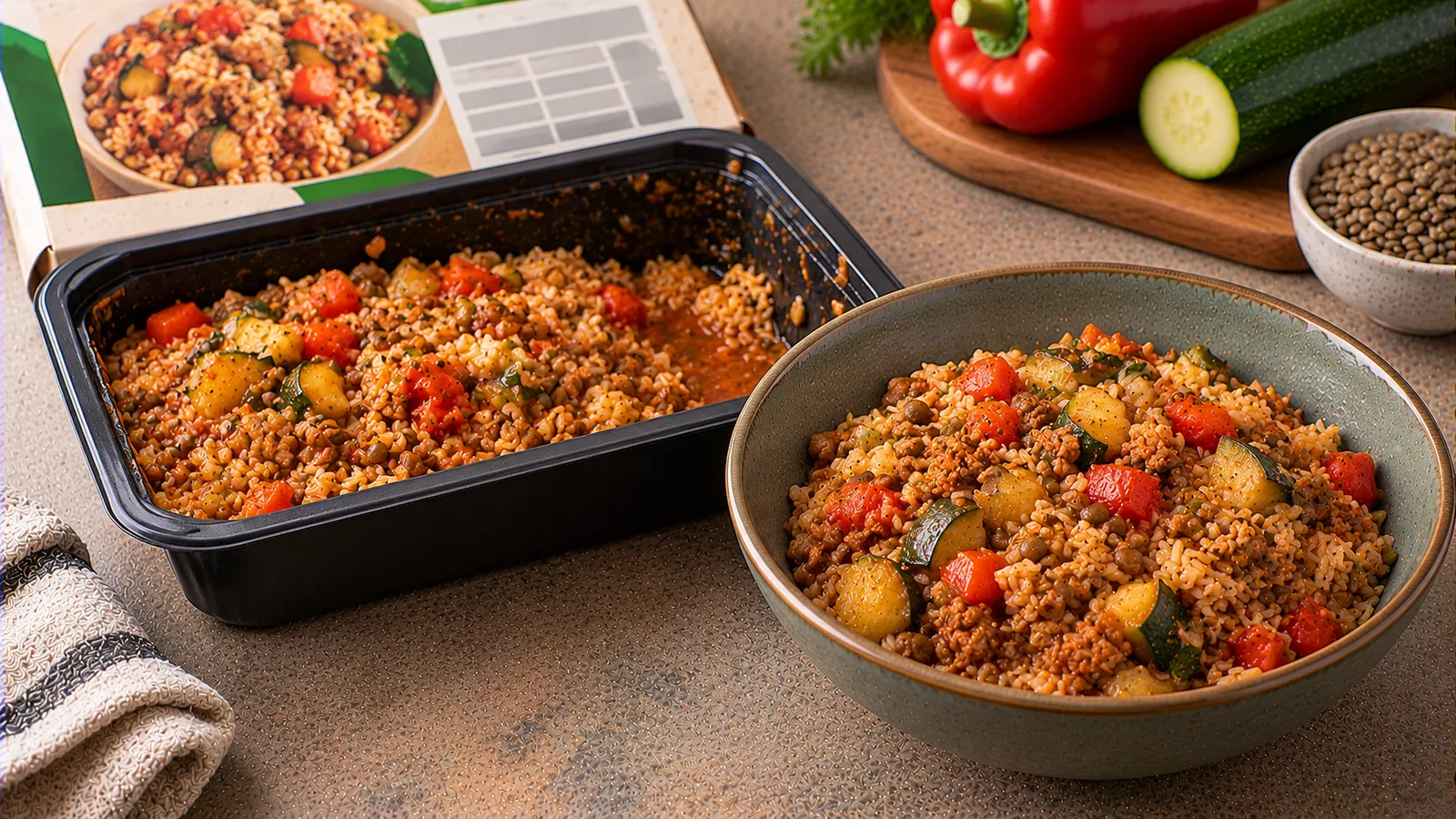
A plant-based ready meal can look modest on its nutrition panel and still supply a substantial amount of protein when you eat the whole tray. That is because the European nutrition declaration normally starts per 100 g, while a typical ready-meal tray contains several hundred grams. The useful shopping question is not simply “How many grams of protein per 100 g?” It is “How much protein will I actually eat, from the portion I plan to serve?”
This guide uses four specific 400 g products listed by REWE to explain that distinction. They are examples of different recipes—not a ranking of every vegan meal, an endorsement, or a claim that the same labels apply everywhere. Formulas and packaging can change. Recheck the physical label, especially if a retailer description and a manufacturer's pack disagree.
Start with the unit printed on the label
The EU explanation of nutrition declarations describes the required declaration of energy, fat, saturates, carbohydrate, sugars, protein and salt per 100 g or 100 ml. A producer may additionally declare a serving, but it must be clear what that serving means. For a frozen meal, check whether the declared values refer to the food as sold or a prepared product made according to instructions.
Find three entries before doing any mathematics: protein per 100 g, net weight of the pack, and number or size of servings. A label saying 5 g protein per 100 g and a net weight of 400 g implies 20 g protein for all 400 g. If the pack contains two genuinely equal 200 g servings, each contributes 10 g. If you eat 300 g, it contributes 15 g. The product has not changed—only the amount you ate.
Do not treat “400 g” as automatically one prescribed serving. The tray can be intended for one person, shared, or served with other foods. Its declared portion and your actual portion are separate facts. If sauce or rice is part of the package, it counts in both net weight and the per-100-g mixture declaration.
Four real 400 g labels: the full-pack comparison
The examples come from the following retailer product pages: REWE Beste Wahl High Protein red-lentil dal with vegetables and rice, Prima vegan tikka masala, REWE Bio plant-based vegetable ravioli, and iglo Green Cuisine vegetarian chicken-style fricassee. The iglo dish contains plant-based pieces but its product name says vegetarian; check ingredients and preparation directions rather than assuming every version of a named product is vegan.
| Labelled ready meal | Protein / 100 g | Net pack | Protein / full pack | Protein / 200 g |
|---|---|---|---|---|
| REWE Beste Wahl red-lentil dal | 5.0 g | 400 g | 20.0 g | 10.0 g |
| Prima vegan tikka masala | 6.7 g | 400 g | about 26.8 g* | 13.4 g |
| REWE Bio vegetable ravioli | 2.2 g | 400 g | 8.8 g | 4.4 g |
| iglo Green Cuisine fricassee | 4.9 g | 400 g | 19.6 g | 9.8 g |
*The Prima label separately declares 26.6 g per portion. Multiplying its rounded 6.7 g/100 g by 400 g gives 26.8 g; the 0.2 g difference is normal rounding of two declared figures. When recording that specific product in a food diary, its stated pack/portion value is the more direct label reference. The iglo pack total is calculated from its 100 g value, not quoted as a manufacturer-declared 400 g column.
The main lesson is visible immediately: two 400 g packs can provide 8.8 g versus approximately 26.6–26.8 g of protein. “Vegan” describes ingredients, not a guaranteed protein amount. Look at the finished meal, which can include a large share of rice, sauce or vegetables as well as beans, tofu or plant-based pieces.
The calculation for any amount you eat
Use this formula with grams in both places:
Protein eaten (g) = protein per 100 g × grams eaten ÷ 100.
For the dal, 5 g × 300 ÷ 100 = 15 g from a 300 g portion. Half the 400 g tray gives 10 g, while the full tray gives 20 g. For the vegetable ravioli, the same 300 g portion is 2.2 × 300 ÷ 100 = 6.6 g. Neither calculation requires guessing at how many tablespoons of lentils are visible through the packaging.
If you share one Prima tray evenly, half is 200 g. Its rounded per-100-g column gives 13.4 g protein per half. If instead you want the manufacturer-declared 26.6 g per full portion, half that total is 13.3 g. Both are reasonable label-based estimates; do not imply the 0.1 g difference represents laboratory precision.
Use your portion's weight, preferably measured before cooking when the label is for the frozen product as sold. If you heat everything, distribute sauce and solids evenly before dividing, or compare the finished servings by weight as fractions of the entire prepared pan. Unevenly dividing solid protein pieces can make two equal-weight plates differ in actual protein.
What happens when the meal is cooked?
Heating a ready meal does not turn its originally declared protein into another amount simply because steam leaves the tray. For example, if a 400 g product with 20 g protein finishes weighing 370 g, the entire finished meal still has approximately 20 g protein under the simplifying assumption that no protein-containing food was discarded. The concentration becomes about 5.4 g per 100 g cooked (20 ÷ 370 × 100), not 5 g per 100 g cooked.
The opposite can happen if you add water: the cooked dish weighs more but does not acquire protein from the water. If you add 100 g water to the hypothetical 400 g dal, the mixture would have about 4 g protein per 100 g of the 500 g finished weight, while the pot still contains 20 g before other additions. Real dishes may also leave residue in the pan, so these are accounting examples, not measured laboratory values.
Follow the product's own directions. In particular, the iglo fricassee page mentions adding milk during pan preparation. Milk adds protein and other nutrients; do not silently attribute the resulting extra protein to the original frozen 400 g label. Check whether the label explicitly reflects a prepared dish and use one consistent basis. Likewise, oil changes calories but contributes essentially no protein; an added tofu portion requires its own label-based calculation.
Do not let a protein number hide the rest of the package
Protein matters, but it is one entry on a multi-nutrient label. A full 400 g REWE dal declares 372 kcal, 12.6 g fibre, and 2.56 g salt. The REWE Bio ravioli declares about 269 kcal, 4.8 g fibre, and 4.28 g salt for its 400 g pack. These figures are product-specific. They do not show that every lentil meal is nutritionally superior to every ravioli product.
The Prima tikka masala gives 447 kcal and 4.21 g salt per labelled portion. Multiplying the rounded 112 kcal/100 g by four would yield 448 kcal; again the manufacturer's portion column differs slightly because of rounding. It is misleading to compare its 1.05 g salt per 100 g with 2.56 g per entire tray of the dal. Keep both products on the same basis.
| Same full-pack basis (400 g) | Protein | Energy | Salt |
|---|---|---|---|
| REWE dal | 20.0 g | 372 kcal | 2.56 g |
| Prima tikka masala (label portion) | 26.6 g | 447 kcal | 4.21 g |
| REWE Bio ravioli | 8.8 g | about 269 kcal | 4.28 g |
| iglo fricassee (calculated) | 19.6 g | 396 kcal | 2.68 g |
The table is for reading labels, not for declaring one product “healthy” or “unhealthy” from a single value. Note the allergen and ingredient lists too: the ravioli use wheat, the dal lists soybeans, and the iglo product includes wheat protein. Ingredient restrictions cannot be inferred merely from the front-of-pack phrase “plant-based.”
Does “high protein” mean 20 g in the pack?
No. “High protein” is a regulated energy-share claim in the EU, not a guarantee of 20 g per tray. The European Commission's claims guidance states that at least 20% of a food's energy must come from protein for the “high protein” claim; for “source of protein” the threshold is 12%. Grams per 100 g and grams per meal answer a different question.
A rough screen using 4 kcal per gram of protein gives the REWE dal 5 × 4 ÷ 93 × 100 ≈ 21.5% of labelled energy from protein. This is an illustration using rounded label numbers, not a regulatory compliance determination. The Prima tikka masala would give 6.7 × 4 ÷ 112 × 100 ≈ 23.9% on the same approximate basis. A pack can therefore satisfy a protein-related marketing threshold while its absolute protein contribution depends on portion size.
There is a reverse trap: a product can have only a modest protein ratio but still provide a useful number of grams because the serving is large. Conversely, a 100 g serving of a concentrated product may look impressive per 100 g yet deliver relatively little total protein if you eat just a small piece. Read both the claim and the grams you will consume.
How to compare packs of different sizes
Imagine a 300 g meal declaring 8 g protein per 100 g. The full pack would supply 24 g, despite the smaller size. A 500 g meal listing 4 g per 100 g would supply 20 g. Comparing only 8 against 4 makes the first product seem twice as useful, but the actual full-pack difference is only 4 g. These are hypothetical figures for practising the method, not labels of real products.
To compare two lunches fairly, choose your real eating situation. If you eat an entire tray of each product, compare grams per tray. If you normally eat only 250 g of each, compare grams per 250 g. If you are interested in protein density without considering serving size, compare grams per 100 g. Each comparison is valid only for its chosen question.
If the label says “two servings,” do not assume you will eat exactly half. Weigh or estimate the actual fraction of the content used. For a 400 g pack, 150 g corresponds to 37.5% of its contents. A listed 20 g protein per pack therefore corresponds to about 7.5 g in that 150 g serving, assuming the mixture is divided representatively.
A reliable label-reading routine in the shop
Read the product title and net weight first. Then turn to the back and find protein per 100 g, the preparation basis, and any explicit per-pack or per-portion declaration. Multiply only if the pack amount is not already supplied; a labelled full-pack figure avoids excessive reliance on rounded 100 g values. Finally look at energy, salt, fibre if declared, ingredients and allergens. A four-field note in your phone—product, pack weight, protein/100 g, protein/pack—is enough for an initial shortlist.
For readers comparing plant proteins in a more general food context, see ready meals compared with homemade portions. For readers who want to understand the way figures are presented in snack packages, see protein and fibre on packaged snack labels. These related articles cover adjacent questions; this guide's calculations specifically concern complete prepared-meal packs and portions, not homemade cost comparisons or individual snack claims.
Common scenarios that change the answer
You eat half now and half later. Count half the label-based pack protein today and half later if the portions are approximately equal. Keep safe storage and reheating instructions in mind rather than assuming every opened tray is suitable for indefinite refrigeration.
You top the dal with 150 g vegetables. Count the extra vegetables separately; they add mass and possibly a small amount of protein but cannot be credited to the original packaged meal's 20 g. A bigger bowl does not retroactively change the pack's nutrition label.
You add an unweighed scoop of tofu. The final protein total is unknown until you identify the tofu's protein per 100 g and portion mass. Record it as a separate ingredient instead of guessing that a plant-based dish must already contain enough.
The manufacturer changes the recipe. The newest package is the best source. Do not compare two versions sold months apart as if the contents were unchanged. Even product titles and sizes can stay the same while labels change.
The retailer page shows slightly different full-pack and multiplied values. Check the serving basis and rounding. A small difference such as Prima's 26.6 versus 26.8 g does not mean the larger number is “more accurate.”