
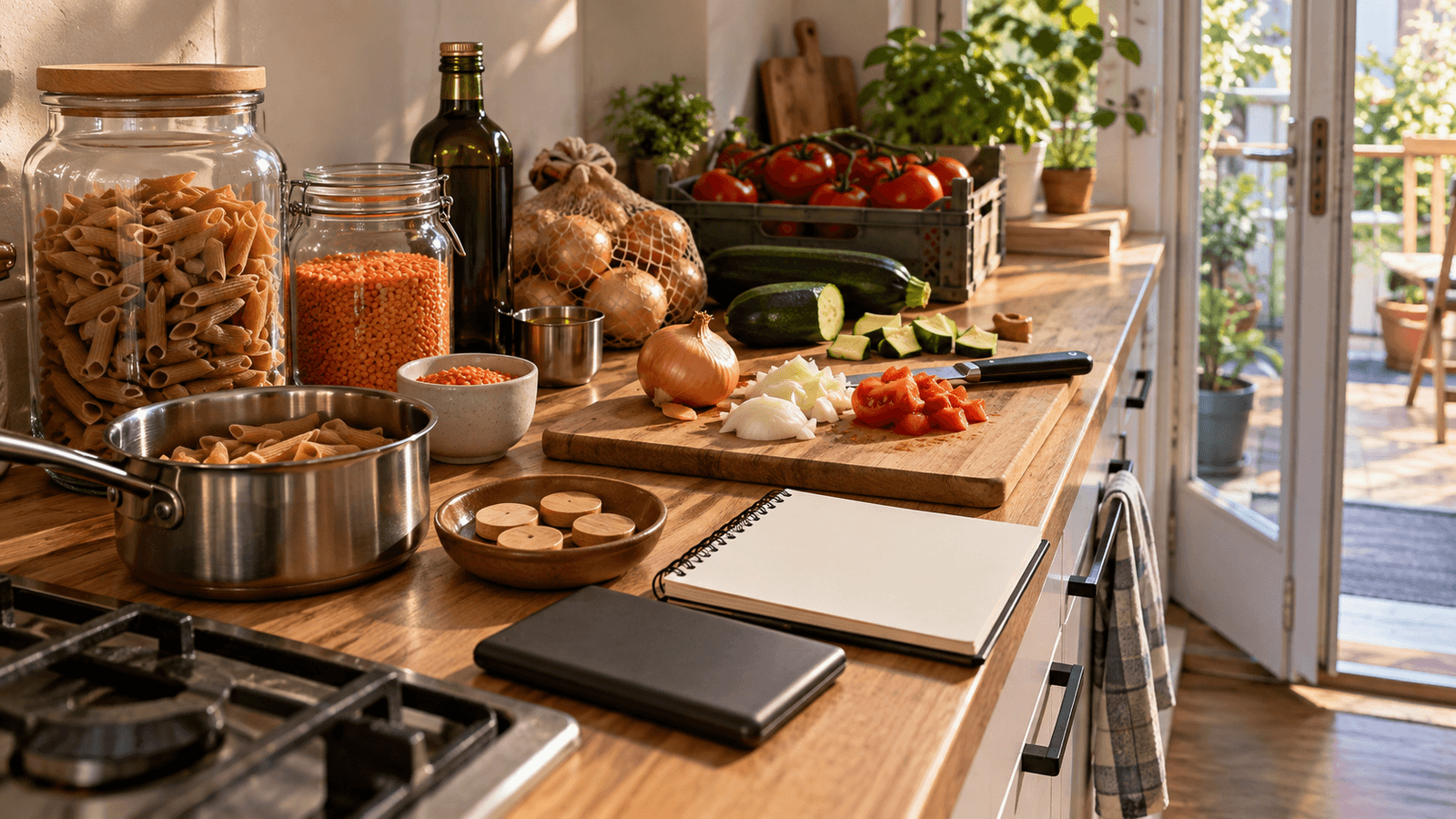
Knowing the cost per meal can make grocery budgeting much more useful.
A grocery receipt tells you how much you spent at the store, but it does not tell you how much tonight's dinner actually cost.
A package of rice may last for several meals. A bottle of oil may last for weeks. A bag of frozen vegetables may be used across multiple recipes.
To estimate the real cost of a meal, you need to calculate the cost of the amount actually used rather than assigning the entire package price to one recipe.
What does cost per meal mean?
Cost per meal is the amount of money spent on the ingredients used to produce one meal or one serving.
For a recipe that produces several servings, you can first calculate the total recipe cost and then divide it by the number of servings.
This gives you a practical estimate of what each portion costs.
Why calculate cost per meal?
Tracking meal costs can help you:
- understand where your grocery budget goes
- compare homemade meals
- evaluate expensive ingredients
- plan affordable meals
- compare different package sizes
- reduce food waste
- estimate weekly food spending
- decide where substitutions make sense
It can also reveal something that grocery totals alone cannot.
An expensive package is not always an expensive meal.
If the package provides many servings, the cost per serving may still be low.
The basic method
For each ingredient, you need three pieces of information:
- the package price
- the amount contained in the package
- the amount used in the recipe
Then calculate the cost of the quantity actually used.
For example, if a package contains 1 kilogram of rice and your recipe uses only part of it, only that fraction of the package cost belongs to the recipe.
Repeat the process for every ingredient and add the results together.
That gives you the approximate total recipe cost.
Then divide the total by the number of portions produced.
Step 1: record the package price
Start with what you actually paid.
This may come from:
- a grocery receipt
- an online grocery order
- a store shelf price
- your own saved product price
- a recent typical price if the exact receipt is unavailable
For accurate personal budgeting, the price you actually paid is usually more useful than a national average.
Step 2: record the package size
Next, identify how much product the package contains.
Examples include:
- 500 g pasta
- 1 kg rice
- 750 g yogurt
- 400 g canned tomatoes
- 1 liter milk
- 10 eggs
For loose produce, the purchase may already be priced by weight.
Step 3: determine how much you used
Record the amount that actually went into the recipe.
For example:
- 250 g pasta
- 300 g chicken
- 200 g tomatoes
- 15 g olive oil
You do not need laboratory precision.
The purpose is to create a useful household estimate.
Step 4: calculate the ingredient cost
Suppose a 500 g package costs €2.00 and you use 200 g.
You used 40% of the package.
The ingredient cost for the recipe is therefore approximately €0.80.
The same principle works for most packaged ingredients.
Step 5: add the ingredient costs
Calculate the used cost of each ingredient and add them together.
Imagine a simple recipe uses:
- pasta
- canned tomatoes
- vegetables
- chicken
- olive oil
Each ingredient contributes part of its package price.
The sum of those amounts is the approximate recipe cost.
Step 6: divide by the number of servings
If the recipe costs €8.00 in total and produces four servings, the approximate cost is €2.00 per serving.
If you eat two servings at once, your meal cost would be approximately €4.00.
The important point is to use portions that reflect how the food is actually divided.
Cost per recipe vs cost per meal
These terms are related but not identical.
Cost per recipe
This is the total ingredient cost for the complete recipe.
Cost per serving
This is the recipe cost divided by the number of servings.
Cost per meal
This may be the same as cost per serving, but not always.
If your meal includes additional foods such as:
- bread
- yogurt
- fruit
- a drink
- sauce
- a side dish
those costs should also be included if you want the total cost of the full meal.
How to calculate cost per gram
A useful intermediate step is calculating the price per gram.
If a 500 g product costs €2.00, divide the price by 500.
Then multiply that unit cost by the number of grams used.
For larger quantities, you can also calculate price per kilogram and convert as needed.
How to calculate cost for liquids
The same principle applies to liquids.
If a bottle contains 1 liter of oil and only a small amount is used in a recipe, calculate the cost of that amount rather than charging the whole bottle to the meal.
For household budgeting, milliliters can often be used when the product is measured by volume.
What about ingredients measured by pieces?
Some foods are easier to calculate per item.
Examples include:
- eggs
- tortillas
- bread rolls
- apples
- individual yogurt cups
If a carton contains 10 eggs, divide the package price by 10 to estimate the cost per egg.
Then multiply by the number used.
What about part of an onion or another vegetable?
For inexpensive produce, extreme precision may not be worth the effort.
You can:
- estimate the fraction used
- weigh the amount used
- use the price per kilogram
- assign a practical approximate cost
Consistency is usually more valuable than perfect precision.
A practical recipe example
Imagine you prepare a simple pasta dish for four servings.
The recipe uses:
- half a package of pasta
- one can of tomatoes
- part of a package of chicken
- one zucchini
- some olive oil
- seasonings
Calculate the used cost of each ingredient.
Add those amounts together.
Then divide by four.
You now have a useful estimate of the cost per serving.
If you also serve bread or another side, add its cost to the meal.
Do spices need to be included?
They can be, but they often contribute very little to the total cost of an individual meal.
For practical household budgeting, you can choose one of two approaches.
Simple method
Ignore very small amounts of inexpensive pantry seasonings.
This makes tracking faster.
Detailed method
Estimate the cost of spices, salt, herbs and condiments as well.
This is more precise but requires more work.
For most home meal planning, consistency matters more than accounting for every grain of salt.
Should electricity and gas be included?
Usually, “cost per meal” in grocery budgeting refers to food ingredients.
You can include cooking energy if your goal is to calculate the full economic cost of preparing the meal, but that is a different level of analysis.
For everyday Mealisa-style grocery planning, ingredient cost is generally the most useful starting point.
What about food waste?
Food waste can make the effective cost of meals higher.
Suppose you buy a large package because the unit price is lower, but part of it spoils before you use it.
The theoretical price per gram was low.
The actual value you received may be worse.
This is why the cheapest package is not automatically the cheapest choice.
Cost per meal and leftovers
Leftovers can reduce the effective cost and effort of future meals.
If a recipe produces six portions and you eat:
- two today
- two tomorrow
- two from the freezer later
the recipe cost should still be divided across all six usable portions.
Do not assign the whole recipe cost to the first meal.
Cost per meal and batch cooking
Batch cooking can make cost calculations easier.
You can calculate:
- the total cost of all ingredients
- the total number of usable portions
- the cost per portion
This makes it easier to compare different recipes.
Compare meals using the same method
If you want to know which meals are more budget-friendly, calculate them consistently.
For example, compare:
- cost per serving
- cost per complete meal
- cost per amount of protein
- cost per usable portion
Do not compare the price of an entire package for one food with the cost of a single serving of another.
Expensive ingredients can still fit a budget
A meal does not need to contain only the cheapest ingredients.
You may decide that certain foods are worth paying more for because of:
- taste
- convenience
- nutrition
- variety
- preparation time
- personal preference
The useful question is not simply “Is this ingredient expensive?”
It is “How much does this ingredient add to the cost of the meal?”
How to reduce cost per meal
Once you know where the money goes, you can make targeted changes.
Use lower-cost protein sources sometimes
Depending on local prices, options may include:
- lentils
- beans
- eggs
- yogurt
- cottage cheese
- tofu
- canned fish
- less expensive cuts of meat
Compare unit prices
A larger package can have a lower unit price, but only if you will actually use it.
Use frozen vegetables
Frozen vegetables can reduce spoilage and make portioning easier.
Plan around foods you already have
Before shopping, check your refrigerator, freezer and pantry.
See How to Plan Meals Around What You Already Have.
Use leftovers deliberately
Plan for extra portions rather than treating leftovers as accidental.
Substitute expensive ingredients
A recipe often works with a less expensive alternative.
The goal is not always to find the cheapest possible substitute, but one that keeps the meal useful and enjoyable.
Cost per meal and nutrition
The cheapest meal is not automatically the best meal.
Cost is one factor among several.
A practical meal plan may need to consider:
- calories
- protein
- fiber
- micronutrients
- preferences
- allergies or intolerances
- cooking time
- convenience
- food waste
- budget
Mealisa is designed around this broader idea: food planning should consider both nutrition and real-life constraints.
Cost per meal for meal planning
Once you know the approximate cost of your regular meals, weekly planning becomes easier.
For example, you can combine:
- several very inexpensive meals
- several moderate-cost meals
- one or two more expensive meals
This can be more realistic than trying to make every meal equally cheap.
Estimating a weekly food budget
Cost-per-meal data can help you estimate weekly spending.
If you know the approximate cost of:
- breakfasts
- lunches
- dinners
- snacks
you can build a more realistic weekly budget.
Remember that grocery spending also includes products that may last longer than one week.
Unit price matters
Package price alone can be misleading.
A €3 package may be better value than a €2 package if it contains substantially more usable food.
Compare:
- price per kilogram
- price per 100 g
- price per liter
- price per item
depending on the product.
Store brands vs branded products
Store-brand products are often less expensive, but price differences vary by category and store.
Compare the unit price and the product itself rather than assuming one option is always cheaper.
Sale prices
Sales can reduce cost per meal when the discounted food is something you will actually use.
Buying discounted food that later goes to waste does not create real savings.
Should you calculate every meal forever?
Probably not.
The biggest benefit often comes from calculating a group of meals you eat regularly.
Once you understand their approximate costs, you can reuse those estimates and update them when prices change substantially.
This gives you useful information without turning every meal into an accounting exercise.
How Mealisa can help
Mealisa can connect food planning with grocery costs.
Depending on the available data, it can help you:
- organize recipes
- estimate meal costs
- compare food prices
- plan meals around a budget
- use ingredients already at home
- reduce unnecessary purchases
- consider nutrition alongside cost
- plan several days at once
The goal is not to calculate every cent perfectly.
The goal is to make the relationship between groceries, meals and budget easier to understand.
Frequently asked questions
What is cost per meal?
It is the approximate cost of the ingredients actually used for one meal or serving.
How do I calculate the cost of a recipe?
Calculate the cost of the amount used for each ingredient, add those costs together and divide by the number of servings if you want cost per portion.
Should I use the full package price?
Only if the entire package is used in the recipe. Otherwise, calculate the cost of the fraction actually used.
Do I include spices?
You can. For simple household budgeting, very small amounts of inexpensive seasonings are often ignored for convenience.
Should I include electricity?
You can if you want a full preparation cost, but grocery-focused cost per meal usually starts with ingredient costs.
How do I calculate the cost of leftovers?
Divide the total recipe cost across all usable portions, including portions eaten later.
Is the cheapest meal always the best?
No. Nutrition, preferences, convenience, cooking time and food waste also matter.
How accurate does the calculation need to be?
For household budgeting, a consistent practical estimate is usually more useful than trying to calculate every fraction of a cent.
The bottom line
To calculate cost per meal:
- record the price and size of each ingredient package
- determine how much of each ingredient you actually used
- calculate the used cost of each ingredient
- add the ingredient costs together
- divide the recipe total by the number of portions
- add any additional foods that are part of the complete meal
This turns grocery prices into information you can actually use for meal planning.
You do not need perfect accounting.
A reasonable, consistent estimate is enough to identify expensive meals, compare alternatives and make your food budget easier to manage.