
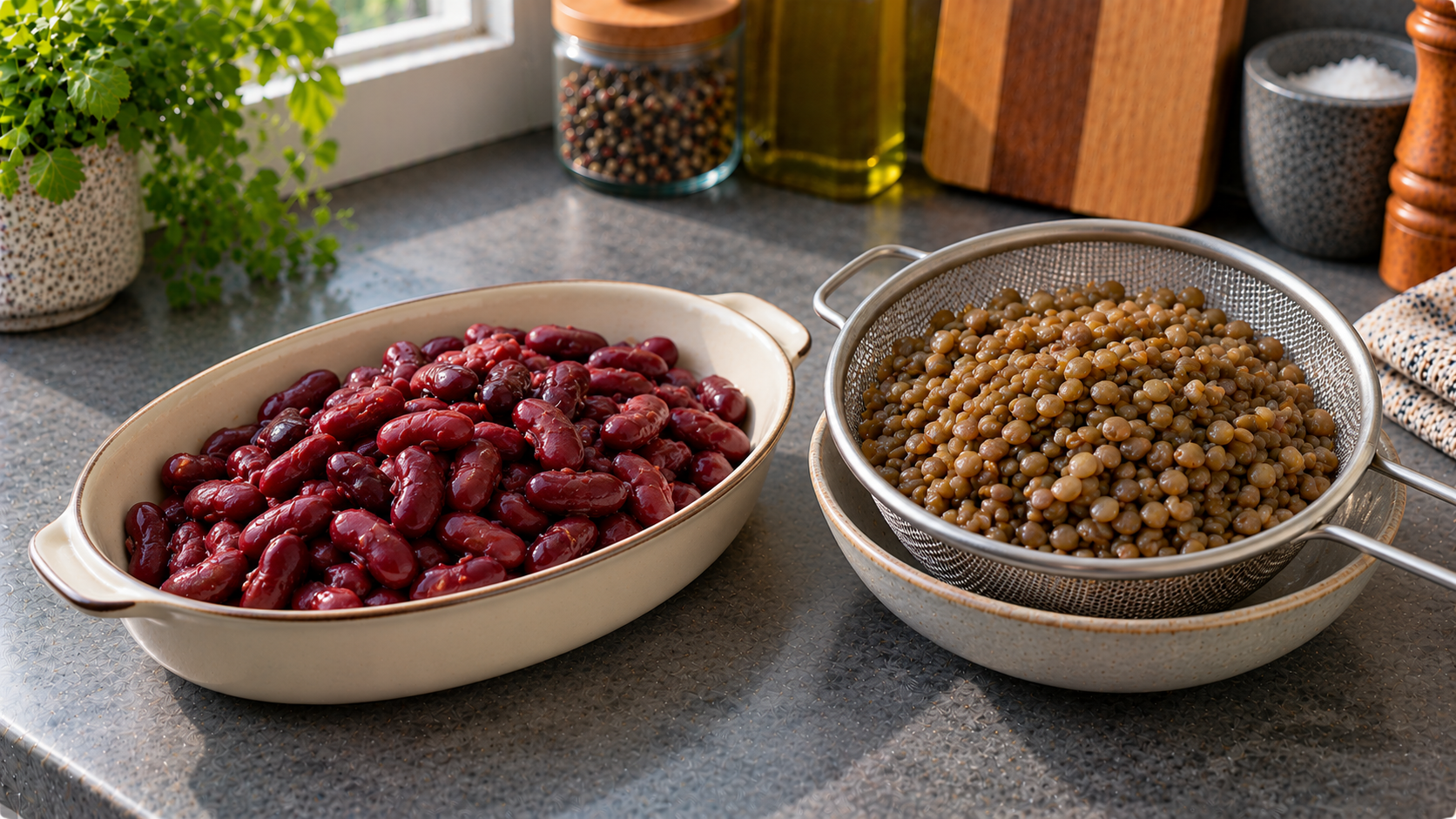
Beans and lentils are both affordable, fibre-rich legumes that can supply plant protein, complex carbohydrates, iron and folate. The better choice depends less on which one is supposedly healthier and more on cooking time, texture, the exact bean variety and how the food fits into your meal.
Lentils generally cook faster, especially red split lentils. Beans often retain their shape better, making them useful for salads, chilli and substantial stews. Nutritionally, many cooked beans and lentils are remarkably similar.
Beans vs lentils: actual nutrition per 100 g
"Beans" covers many different foods. Comparing lentils against an unspecified average bean would conceal meaningful differences.
To check portions beyond this side-by-side table, the individual guides for cooked lentils and black beans give food-specific serving information.
The following USDA FoodData Central SR Legacy entries describe mature legumes boiled without added salt, measured per 100 g of cooked edible food.
| Nutrient | Lentils | Black beans |
|---|---|---|
| Calories | 116 kcal | 132 kcal |
| Protein | 9.02 g | 8.86 g |
| Carbohydrates | 20.13 g | 23.71 g |
| Fibre | 7.9 g | 8.7 g |
| Fat | 0.38 g | 0.54 g |
| Sodium | 2 mg | 1 mg |
Sources: USDA cooked lentils and USDA cooked black beans.
These are actual food-composition records, not invented product examples. Values may vary with variety, moisture, preparation and the specific product.
In this comparison, lentils contain 16 fewer calories and 0.16 g more protein per 100 g. Black beans provide 0.8 g more fibre. Such differences are relatively small compared with those caused by adding oil, cheese, meat or sauces.
Other beans differ: kidney beans, white beans and pinto beans should not automatically inherit the values for black beans.
What does a 150 g or 200 g serving provide?
The following serving calculations use the same USDA entries.
| Cooked serving | Lentil calories | Lentil protein | Black bean calories | Black bean protein |
|---|---|---|---|---|
| 100 g | 116 | 9.0 g | 132 | 8.9 g |
| 150 g | 174 | 13.5 g | 198 | 13.3 g |
| 200 g | 232 | 18.0 g | 264 | 17.7 g |
| 250 g | 290 | 22.6 g | 330 | 22.2 g |
Formula: nutrient per serving = nutrient per 100 g × cooked serving weight ÷ 100.
The figures are mathematically scaled from the reference records and rounded, not individually measured serving samples.
A 200 g portion of either food contributes roughly 18 g protein. Neither is a particularly concentrated source of protein compared with many animal foods or soy-based alternatives, but both contribute protein alongside substantial fibre.
Protein quality and a balanced meal
Beans and lentils contain essential amino acids, although many varieties are relatively limited in certain sulphur-containing amino acids compared with their lysine content.
A varied diet that includes grains, nuts, seeds or other protein sources can provide complementary amino acids across the day. It is usually unnecessary to combine specific proteins at every individual meal.
For example, lentils with whole-grain bread or black beans with rice create practical, affordable meals. Vegetables can contribute additional micronutrients and variety.
A higher protein count does not automatically make an entire dish healthier; total energy, fibre, salt, food variety and portion size also matter.
Fibre, digestion and satiety
Both foods contain substantial dietary fibre. The USDA entries report 7.9 g per 100 g of cooked lentils and 8.7 g per 100 g of cooked black beans.
At 200 g, that becomes approximately 15.8 g and 17.4 g respectively. These are substantial contributions to daily fibre intake.
Fibre-rich meals can support fullness and normal bowel function. Legumes also contain fermentable carbohydrates that may cause gas or bloating, particularly when intake increases suddenly.
If you are not accustomed to legumes, begin with smaller servings, chew thoroughly and increase gradually. Soaking suitable dry beans, discarding soaking water and cooking them fully may improve tolerance.
Red split lentils have a different texture and preparation profile from whole beans, and some people find smaller portions easier to tolerate. Individual digestive responses vary.
Iron and folate: both have value
Lentils and beans can contribute non-haem iron and folate. Exact quantities differ by variety and database entry.
Plant-based iron is absorbed less efficiently than haem iron from animal foods. Including vitamin-C-rich vegetables such as peppers, tomatoes or broccoli can improve non-haem iron absorption within a meal.
Do not assume that all bean varieties provide the same iron or folate amounts. Use the appropriate food description when monitoring a specific nutrient.
For detailed figures, consult USDA FoodData Central.
Cooking time: lentils usually win
The biggest everyday difference is preparation.
| Food | Typical preparation | Best texture |
|---|---|---|
| Red split lentils | Often 10–20 minutes of simmering | Soft, thickening soups and sauces |
| Whole brown or green lentils | Often 20–40 minutes | Soups, salads, grain bowls |
| Dried black beans | Usually soaking optional, followed by longer cooking | Chilli, bowls, bean salads |
| Dried kidney beans | Soaking and thorough boiling required | Stews and chilli |
| Canned beans | Drain or rinse and heat if desired | Fast meals with minimal preparation |
Times are approximate and depend on age, variety, equipment and texture preference.
Important safety point: Raw or insufficiently cooked kidney beans contain phytohaemagglutinin, a natural lectin that can cause illness. Kidney beans require appropriate boiling and thorough cooking. Do not rely on low-temperature slow cooking alone for raw kidney beans. Follow authoritative food-safety guidance and product instructions.
Lentils normally need no overnight soaking and are especially convenient for quick meals.
Dry, cooked and canned weights are different
Comparing 100 g dry lentils with 100 g cooked beans is misleading. Dry legumes absorb water and become heavier during cooking, reducing calories and protein per 100 g of finished food.
For meal tracking, use one consistent approach:
- Weigh dry legumes and apply dry-food values to the entire dry amount used.
- Or weigh cooked, drained legumes and apply a matching cooked-food entry.
- For canned beans, use the manufacturer's values and identify whether they apply to the drained portion.
Never multiply cooked weight by dry-food nutrition values.
What about canned beans and sodium?
Canned beans can save significant time. Their nutritional quality depends partly on added salt and other ingredients.
With canned legumes, the change in sodium depends on the product and how it is drained; our guide to rinsing canned beans explains what to check.
Draining and rinsing may reduce sodium, but the exact reduction varies. If sodium matters, compare product labels and consider no-added-salt varieties.
Cooked lentils with no salt should not be compared directly with salted canned beans as though the sodium difference came solely from the plant species.
The WHO healthy diet guidance supports limiting excessive salt consumption as part of a balanced diet.
Cost: compare the edible yield
Dried beans and lentils can both be economical. Lentils may save cooking time and energy, while canned beans save preparation effort.
Compare prices by the amount of edible cooked food produced, not simply by package weight.
Cost per 100 g cooked = total ingredient cost ÷ cooked edible yield in grams × 100.
For canned beans, use drained weight if the liquid will not be eaten. For dried legumes, measure the actual yield from the batch.
Retail prices and yields vary, so neither food has a permanent cost advantage.
Which works best in a meal?
| Meal | Practical choice |
|---|---|
| Fast weekday soup | Red lentils |
| Thick lentil curry or dal | Red or yellow lentils |
| Salad with ingredients that retain their shape | Whole lentils or beans |
| Chilli | Black or kidney beans, fully cooked |
| Tomato-based pasta sauce | Red lentils |
| Burgers or mashed spreads | Beans or cooked lentils |
| Large batch cooking | Both |
| Quick canned pantry meal | Beans |
Beans and lentils are complementary staples. Choose the variety that fits the desired texture and preparation time.
For protein, fibre and general meal quality, neither has a decisive universal advantage. A varied rotation of lentils and several bean types is often more useful than choosing only one.
Sources and notes
- USDA lentils, cooked without salt — reference entry 172421.
- USDA black beans, cooked without salt — reference entry 173735.
- USDA FoodData Central — additional varieties and micronutrients.
- FDA safe food handling — general food handling practices.
- WHO healthy diet — dietary patterns, fibre and salt.
All nutrition figures are tied to explicitly named cooked entries. Portion tables are derived calculations, not separate laboratory observations.