
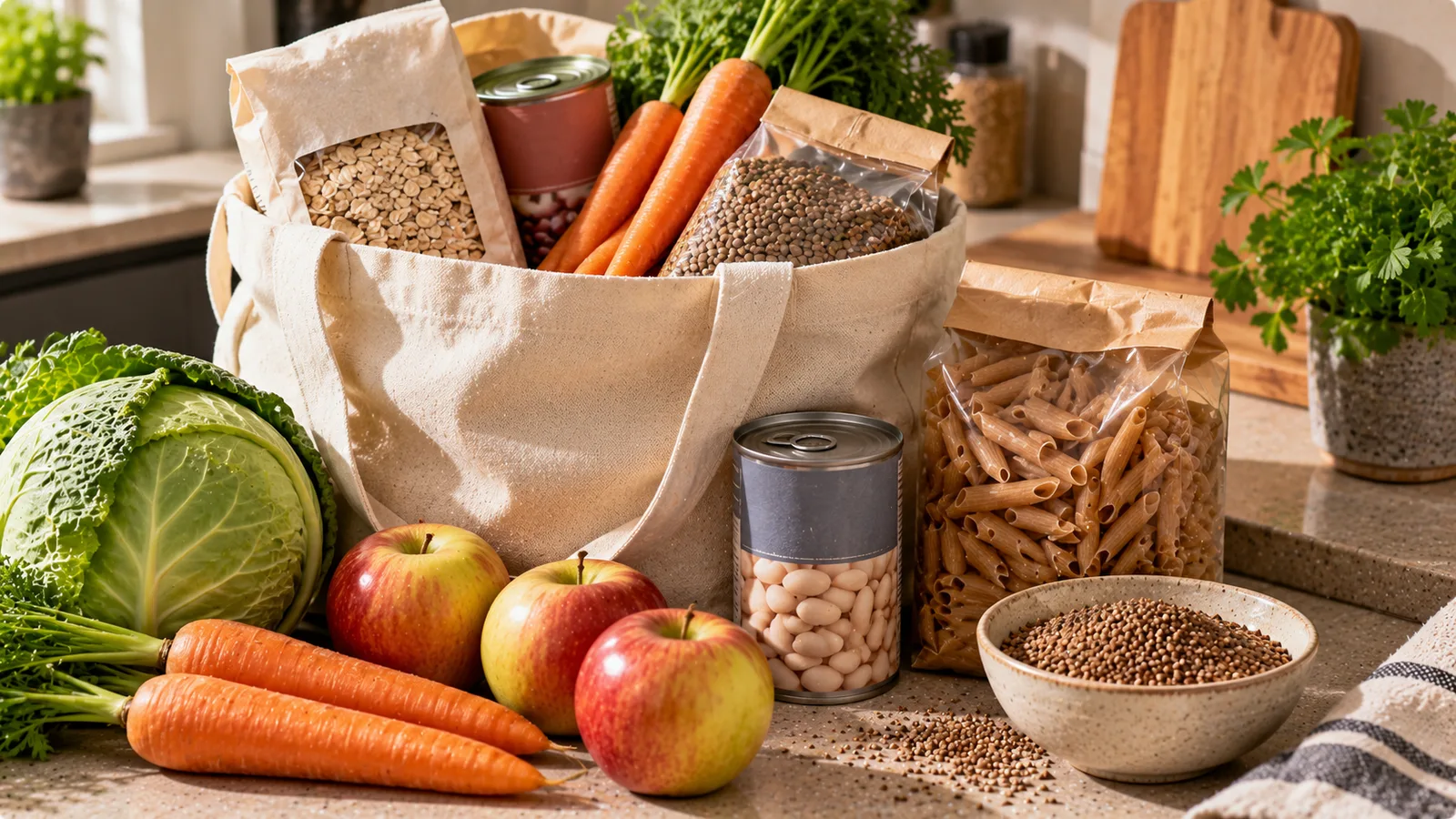
A low-cost high-fiber grocery basket is not simply a list of inexpensive foods. It is a set of ingredients that can be bought in practical package sizes, combined into meals, and used before they spoil.
The difference matters. A product can have an attractive price per kilogram but still be poor value if you use only a small part of the package. Another food can be rich in fiber per 100 g but expensive for the amount you actually eat.
This guide builds a seven-day example basket for one adult, then calculates how much the basket costs, how much fiber its ingredients provide, and how to turn those ingredients into usable meals.
All prices in the worked example are hypothetical teaching figures, not verified supermarket prices or current German market averages. Replace them with prices from your own store, currency and package labels.
Start with a fiber target, not a shopping list
The European Food Safety Authority considers 25 g of dietary fiber per day adequate for normal bowel function in adults. The German Nutrition Society (DGE) recommends at least 30 g per day for adults.
These are population-level reference values, not individualized medical prescriptions.
For a seven-day basket, a useful planning range is therefore:
| Daily planning level | Seven-day total |
|---|---|
| 25 g fiber | 175 g |
| 30 g fiber | 210 g |
A grocery basket does not need to supply every gram through one ingredient. It is more practical to combine whole grains, legumes, vegetables, fruit and, where appropriate, seeds.
People who currently eat little fiber may prefer to increase their intake gradually. Individual tolerance varies, particularly with large portions of legumes or bran.
The example grocery basket
This basket emphasizes ingredients with several uses: oats for breakfast, lentils and beans for substantial meals, wholegrain bread for quick lunches, and vegetables and fruit for variety.
The example assumes one adult and seven days.
| Food | Quantity used during week | Illustrative purchased pack | Example pack price |
|---|---|---|---|
| Rolled oats | 350 g | 500 g | €0.95 |
| Dry lentils | 350 g | 500 g | €1.65 |
| Dry beans | 250 g | 500 g | €1.80 |
| Wholegrain bread | 500 g | 500 g | €1.70 |
| Carrots | 700 g | 1 kg | €1.20 |
| White cabbage | 700 g | 1 kg | €1.50 |
| Apples | 1,000 g | 1 kg | €2.30 |
| Frozen mixed vegetables | 700 g | 1 kg | €2.20 |
| Ground flaxseed | 70 g | 200 g | €1.30 |
Illustrative checkout total: €14.60.
The checkout total includes whole packages, even when some ingredients remain unused at the end of the week.
These figures are deliberately transparent examples. They do not establish what any supermarket currently charges.
The basket covers high-fiber ingredients, not a complete nutritionally balanced weekly diet. Other foods are needed to meet energy, protein, fat and additional nutrient requirements.
How much fiber does the basket provide?
Fiber values depend on the product, variety, processing and food-composition database.
The following are rounded planning estimates informed by generic food-composition information available from USDA FoodData Central. They should be replaced with the values on the actual product labels whenever available.
| Food | Weekly amount used | Assumed fiber per 100 g | Estimated weekly fiber |
|---|---|---|---|
| Rolled oats, dry | 350 g | 10 g | 35 g |
| Lentils, dry | 350 g | 11 g | 38.5 g |
| Beans, dry | 250 g | 15 g | 37.5 g |
| Wholegrain bread | 500 g | 7 g | 35 g |
| Carrots | 700 g | 2.8 g | 19.6 g |
| White cabbage | 700 g | 2.5 g | 17.5 g |
| Apples | 1,000 g | 2.4 g | 24 g |
| Frozen vegetables | 700 g | 3 g | 21 g |
| Ground flaxseed | 70 g | 27 g | 18.9 g |
| Total | 247 g |
On these assumptions, the ingredients used supply approximately:
247 ÷ 7 = 35.3 g fiber per day on average.
That does not mean every individual day automatically contains 35.3 g. Actual intake depends on the meals prepared, portions eaten and leftovers.
Dry legumes must be compared on a consistent basis. The values above refer to their dry purchase weight. Cooking adds water and increases weight, but it does not multiply the total fiber in the original dry ingredients.
Fiber values for wholegrain bread and frozen vegetable mixes can vary substantially. Check the actual products.
What is the real cost of the food consumed?
The checkout cost and the cost of ingredients actually used are different.
For example, a 500 g bag of oats costs €0.95, but only 350 g are used during the example week.
The cost consumed is:
350 ÷ 500 × €0.95 = €0.67.
Apply the same method to every ingredient.
| Food | Example checkout cost | Cost of amount used |
|---|---|---|
| Oats | €0.95 | €0.67 |
| Lentils | €1.65 | €1.16 |
| Beans | €1.80 | €0.90 |
| Wholegrain bread | €1.70 | €1.70 |
| Carrots | €1.20 | €0.84 |
| Cabbage | €1.50 | €1.05 |
| Apples | €2.30 | €2.30 |
| Frozen vegetables | €2.20 | €1.54 |
| Flaxseed | €1.30 | €0.46 |
| Total | €14.60 | Approximately €10.62 |
The difference, approximately €3.98, represents the example value of ingredients remaining after the week, assuming those ingredients are still usable.
It is not an automatic cash saving: the entire €14.60 must be paid at checkout.
This distinction is especially important when planning with a limited weekly cash budget.
Cost per gram of fiber
For comparison, calculate:
Cost per gram of fiber = cost of the quantity used ÷ grams of fiber in that quantity.
For the full example basket:
€10.62 ÷ 247 = approximately €0.043 per gram of fiber.
This is a useful analytical measure, but it should not become the only criterion for choosing food.
Fiber-rich foods also differ in protein, calories, micronutrients, taste, preparation time and suitability for different meals.
A food that is inexpensive per gram of fiber is not necessarily a good meal by itself.
Build actual meals from the basket
A shopping list becomes useful only when the purchased ingredients fit real meals.
Here is one practical way to use the basket.
Breakfast: oats, apple and flaxseed
Use 50 g dry oats, approximately 140 g apple and 10 g ground flaxseed.
Prepare the oats with water or a milk product of your choice.
With the example fiber assumptions, these ingredients contribute approximately:
- Oats: 5 g fiber
- Apple: 3.4 g fiber
- Flaxseed: 2.7 g fiber
Total: approximately 11.1 g fiber, before counting any other ingredients.
Repeat this combination seven times to use the planned quantities of oats, apples and flaxseed.
The breakfast may need additional ingredients depending on energy and protein requirements.
Lunch: lentil and vegetable pot
Use approximately 50 g dry lentils, 100 g carrots and 100 g cabbage per daily portion.
Cook the lentils according to the package instructions. Add the vegetables and seasonings to make a soup or thick stew.
Using the example values:
- Lentils: 5.5 g fiber
- Carrots: 2.8 g fiber
- Cabbage: 2.5 g fiber
Total: approximately 10.8 g fiber per portion.
The exact result depends on the lentil variety and vegetable quantities.
Dinner: beans, vegetables and wholegrain bread
A possible daily combination uses approximately 36 g dry beans, 100 g frozen vegetables and 70 g wholegrain bread.
Using the planning values:
- Dry beans: approximately 5.4 g fiber
- Frozen vegetables: 3 g fiber
- Bread: 4.9 g fiber
Total: approximately 13.3 g fiber.
Together, these three illustrative meals provide around 35 g of fiber per day.
They are examples of how to distribute the basket, not a complete seven-day menu. Add other foods and adjust portions to make the overall diet appropriate for your needs.
A simple seven-day usage schedule
Instead of inventing seven unrelated recipes, use a repeatable ingredient structure with different seasonings and cooking methods.
| Day | Breakfast base | Main legume | Vegetable approach |
|---|---|---|---|
| Monday | Apple oats | Lentils | Carrot and cabbage soup |
| Tuesday | Apple oats | Beans | Warm vegetable bowl |
| Wednesday | Apple oats | Lentils | Thick lentil stew |
| Thursday | Apple oats | Beans | Bean and cabbage skillet |
| Friday | Apple oats | Lentils | Carrot-lentil soup |
| Saturday | Apple oats | Beans | Beans with mixed vegetables |
| Sunday | Apple oats | Lentils and remaining beans | Use remaining vegetables |
This is a flexible allocation plan. It does not require preparing the entire week's cooked food on the first day.
Cook legumes in manageable batches, refrigerate promptly and freeze portions intended for later use.
Dry beans require correct preparation
Dry beans are not always interchangeable with canned beans in preparation time or food safety.
Follow the soaking and cooking instructions appropriate to the specific bean variety.
Do not assume that a short warming period makes raw dried kidney beans safe to eat.
If you want faster meals, canned beans are a convenient alternative. Compare their drained weight and price per usable portion rather than comparing a full can directly with dry beans.
When using canned legumes, the nutrition label may describe either drained or undrained contents. Read the basis carefully.
Compare dry and canned legumes fairly
A dry bag and a canned product have different water contents.
To compare prices:
- Identify the dry weight or drained weight that can actually be eaten.
- Estimate the cooked yield of dry legumes using your own preparation method.
- Divide the package price by the usable amount.
- Compare the cost of a realistic meal portion.
For example, suppose 250 g dry beans cost €0.90 from a larger package and yield 600 g cooked beans.
Their example cost per 100 g cooked is:
€0.90 ÷ 600 × 100 = €0.15.
If a canned product costs €0.85 for 240 g drained beans, its cost is:
€0.85 ÷ 240 × 100 = approximately €0.35 per 100 g drained.
These are hypothetical prices and a hypothetical cooked yield. The comparison changes with local prices, energy costs, brands and actual yields.
Dry beans also require more preparation time.
Prevent waste when buying larger packages
Buying a large package only improves value if the unused portion remains usable.
For oats, lentils and beans, store the dry remainder according to the package instructions in a cool, dry place.
For cabbage, cut only what you need and store the remaining portion appropriately.
Freeze bread portions if you cannot finish the loaf while it remains fresh.
Frozen vegetables allow you to take out smaller quantities without cooking the entire bag.
The basket should be evaluated over several weeks, not only one checkout.
A 200 g flaxseed package, for example, can supply more than one week of the planned 70 g usage.
Adjust the basket to your budget
If the checkout limit is strict
Start with ingredients that fit both your budget and your planned meals.
Compare package prices, not just prices per kilogram.
A larger package may offer a lower unit price but still exceed the amount you can spend today.
If fresh produce is expensive
Compare seasonal fresh produce with frozen vegetables and suitable canned products.
Check the edible portion and added ingredients.
Do not assume that frozen vegetables are always cheaper. Prices differ by store, season and product.
If you already have pantry ingredients
Subtract existing usable stock before shopping.
A basket should represent what you need to buy, not everything you intend to eat.
If legumes cause digestive discomfort
Start with smaller portions, increase gradually as tolerated and consider how the foods are prepared.
Do not force a high-fiber target immediately if it causes persistent discomfort. Seek individualized professional advice when symptoms are significant.
A reusable grocery comparison table
When shopping, record the following information for each candidate product:
| Field | What to record |
|---|---|
| Product | Exact name and variety |
| Package price | Amount paid |
| Package weight | Net weight |
| Edible quantity | Drained or usable amount |
| Fiber per 100 g | Label or reliable database |
| Planned weekly amount | Grams actually used |
| Cost consumed | Price × used share |
| Fiber supplied | Used grams × fiber per 100 g ÷ 100 |
| Leftover quantity | Purchased minus used |
For packaged foods, the product's actual nutrition label is generally the most relevant starting point.
Generic values from USDA FoodData Central are useful for planning but do not replace product-specific information.
How to keep the basket affordable over time
A single week's prices do not establish a long-term trend.
If you want to monitor costs, record the same products, package sizes and dates over multiple shopping trips.
For broader price developments, Eurostat's Harmonised Index of Consumer Prices provides official inflation statistics. Such indices describe price changes across defined product groups; they do not tell you the exact checkout cost of this basket.
For household planning, your own receipts and product labels are more directly useful.
Recalculate the basket when prices, household size or dietary needs change.
The strongest low-cost high-fiber strategy is not buying the maximum amount of fiber for the minimum possible price. It is buying enough usable fiber-rich ingredients to prepare meals you will actually eat, while keeping checkout cost and food waste under control.