
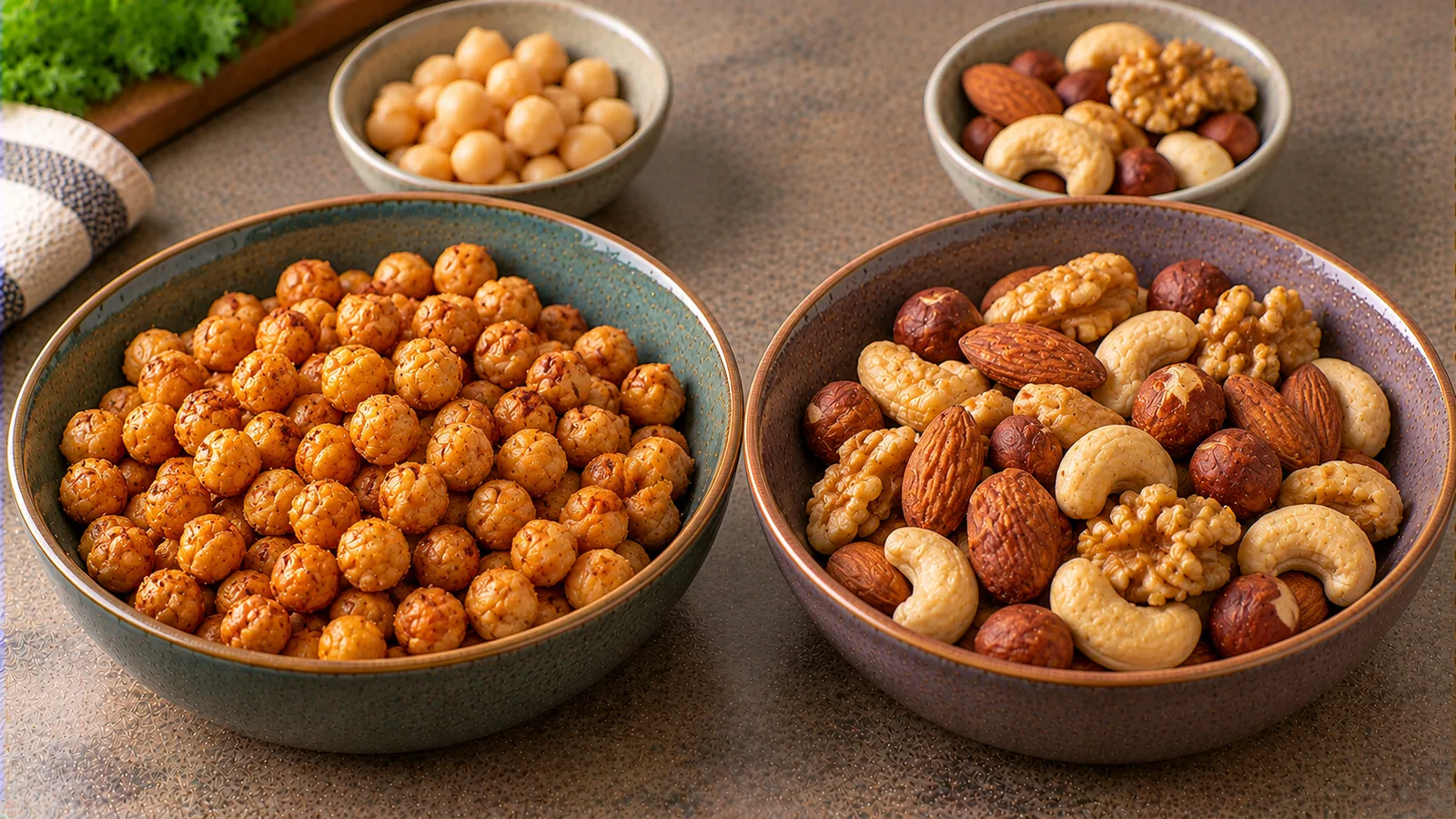
Roasted chickpeas and mixed nuts both work as crunchy snacks that can be eaten directly from the packet. But they are not interchangeable nutritionally: one is a seasoned roasted pulse snack, while the other is a blend of nuts with a much larger share of fat. Comparing 30 g of each ready-to-eat product is more useful than comparing one 90 g packet with one 200 g packet.
This comparison focuses on protein, fiber, price, calories and salt. It uses two identifiable products sold in Germany rather than generic database averages: Hülsenreich Sweet Onion roasted chickpeas and dmBio unsalted mixed nuts. The results describe these specific label snapshots, not every chickpea snack or nut blend.
Roasted chickpeas vs mixed nuts: 30 g at a glance
| For 30 g, ready to eat | Roasted chickpeas | Mixed nuts |
|---|---|---|
| Product | Hülsenreich Sweet Onion | dmBio Nussmischung, unsalted |
| Protein | 6.54 g | 5.70 g |
| Fiber | 6.84 g | 2.46 g |
| Energy | 106 kcal | 191 kcal |
| Fat | 1.77 g | 16.80 g |
| Salt | 0.69 g | 0.006 g |
| Pack size | 90 g | 200 g |
| Published pack price | €2.69 | €3.25 |
| 30 g portion cost | €0.90 | €0.49 |
The chickpea figures use the product information published by Alnatura for Hülsenreich Sweet Onion, barcode 4262413260020. The €2.69 for 90 g price appears in Rossmann's product listing and brand listing. The mixed-nut composition and €3.25 for 200 g price come from the dmBio product page. Checked 22 October 2026. These are publicly listed product prices before delivery fees; availability and shop prices may differ. They are the lowest ordinary public prices for comparable named items that we verified in this check, not a claim about the absolute lowest price at every German store.
Protein: a modest advantage for the chickpeas
The chickpea label gives 21.8 g protein per 100 g, so a 30 g portion supplies 21.8 × 0.30 = 6.54 g. The dmBio nut mix gives 19 g per 100 g, corresponding to 5.70 g per 30 g. The roasted chickpeas have 0.84 g more protein in this particular comparison.
That difference is real for the chosen labels but quite small in an everyday snack. Neither 30 g portion should be treated as a complete high-protein meal. A nut mix can also vary substantially according to its proportions of almonds, cashews, walnuts, Brazil nuts or hazelnuts. The dmBio mix has a specifically declared recipe; it does not represent all nut combinations.
If your goal is to increase protein without powders or bars, snacks are only one part of the plan. Our guide to budget-friendly protein snacks considers snack choices alongside their convenience and meal context. This article answers the narrower question of two finished snacks at identical edible weight.
Fiber: a larger difference, but check product variations
The Alnatura listing for the Hülsenreich Sweet Onion snack reports 22.8 g fiber per 100 g. That becomes 6.84 g per 30 g. The dmBio mixed nuts list 8.2 g per 100 g, or 2.46 g per 30 g. The example chickpea portion therefore provides 4.38 g more fiber.
The important detail is that roasted chickpeas are dry, concentrated snacks. Do not compare these figures directly with 30 g of drained canned chickpeas: the water content is different. Likewise, do not insert a homemade baked-chickpea recipe into this label calculation without measuring its final cooked yield and accounting for any oil used.
A second caution is unusually important for this exact product. REWE lists the same named Sweet Onion chickpea snack with different nutrition data, including 29 g fiber and 332 kcal per 100 g, whereas the Alnatura snapshot shows 22.8 g and 353 kcal. Recipes, packaging revisions or retailer data may differ. The table above consistently uses one declared Alnatura nutritional snapshot and does not mix nutrient values from the different listings. The label of the bag you buy takes precedence.
Price: the nuts cost less in this pair
Price per portion follows a simple calculation: published packet price × 30 ÷ packet grams. Both portions are 30 g of ready-to-eat product; there is no soaking, cooking loss or discarded liquid in this comparison.
- Chickpeas: €2.69 × 30 ÷ 90 = €0.8967, rounded to €0.90 per 30 g. One 90 g packet provides three 30 g portions.
- Mixed nuts: €3.25 × 30 ÷ 200 = €0.4875, rounded to €0.49 per 30 g. A 200 g packet contains about 6⅔ portions, not exactly six.
The difference is approximately €0.41 for a 30 g snack when comparing the two rounded results. For 150 g eaten over time, the calculated costs are approximately €4.48 for the chickpeas and €2.44 for the nuts based on proportional pack prices. In practice, the chickpeas must be bought in 90 g bags, so purchasing 150 g requires buying at least two bags for €5.38; the nuts require one 200 g bag for €3.25. Cost consumed and money paid at checkout are different concepts.
A smaller package can look cheaper at the shelf while being more expensive per gram. Here the more expensive ready-to-eat chickpeas also have less fat and more fiber, so price alone cannot answer which is preferable. We do not include delivery charges, loyalty coupons or temporary discounts in the baseline calculation.
Calories and fat: the trade-off behind the crunch
The 30 g chickpea portion contains approximately 106 kcal and 1.77 g fat on the Alnatura listing. The 30 g dmBio nut portion contains approximately 191 kcal and 16.80 g fat. That is a difference of roughly 85 kcal, even with identical portion weights.
This does not make nuts a food to avoid. Much of their fat is unsaturated, and the nut mix offers a different texture, taste and nutrient profile. Rather, the amount of energy changes substantially with the amount eaten. Thirty grams is a helpful reference if you tend to snack directly from a large packet without noticing the quantity.
An energy comparison also cannot prove that one snack will keep you full longer. Satiety depends on more than a label: chewing, meal timing, individual appetite and the other foods eaten all matter. Avoid treating protein or fiber alone as a guarantee of weight loss.
Salt, seasoning and allergies
The chickpea flavor uses a seasoned coating and the cited label reports 2.3 g salt per 100 g, equivalent to 0.69 g salt per 30 g. The unsalted nut mix lists 0.02 g per 100 g, or 0.006 g per 30 g. The nut mix is markedly lower in declared salt, not necessarily lower in every other nutrient.
Changing to chili, barbecue or heavily salted nuts could reverse this aspect of the comparison. Sweet onion chickpeas are not plain, unsalted chickpeas. If you monitor dietary salt, check both the serving weight and the salt line on the current package; the EU nutrition declaration uses salt, not merely sodium. The EU nutrition declaration guidance describes the label framework.
The dmBio blend contains several tree nuts, including cashews and hazelnuts, and its packaging warns of possible peanut traces. The Hülsenreich product listing indicates possible traces of soy and mustard. Check the exact allergen statement rather than presuming a chickpea product is automatically safe for every allergy. The European food-information rules provide the broader labelling context.
Which snack fits which situation?
Choose these roasted chickpeas when you want more fiber and somewhat more protein at the same 30 g weight and are happy to pay more. Their seasoned flavor may suit a crunchy snack break or a small topping on a bowl. Their declared salt is not negligible.
Choose this unsalted nut mix when a cheaper 30 g portion and much lower declared salt matter, and you prefer a fattier, more energy-dense snack. Its larger packet can be practical for making several portions, provided you store it correctly and can use it before the recommended date.
Both foods are ready to eat; neither needs an air fryer or oven before snacking. If you want to make chickpeas yourself, air-fryer versus oven-roasted chickpeas discusses how cooking methods affect crunch and timing. Homemade chickpeas must be compared by final dry roasted weight, not by the initial wet or drained weight. That is a different question from this store-bought snack comparison.
A repeatable supermarket checklist
- Record the brand, exact variant, package weight and regular public price, with the store and date.
- Compare the same edible quantity—30 g here—and multiply nutrients per 100 g by 0.30.
- Calculate price × 30 ÷ pack grams, keeping unrounded values until the final cents.
- Check fiber, protein, fat, calories and salt on both packets; do not infer one from the category name.
- Check allergens, package reformulations and stock availability. If the real labels differ from the older listing, replace the older numbers rather than averaging conflicting versions.
Sources and methodology
- Alnatura — Hülsenreich Sweet Onion, 90 g, GTIN 4262413260020: 21.8 g protein, 22.8 g fiber, 353 kcal, 5.9 g fat and 2.3 g salt per 100 g; ingredient and allergen statement.
- Rossmann — Hülsenreich Sweet Onion, 90 g and Rossmann brand listing: listed €2.69 for the same named pack on the check date.
- dmBio Nussmischung, 200 g: 19 g protein, 8.2 g fiber, 637 kcal, 56 g fat and 0.02 g salt per 100 g, listed €3.25 per pack.
- REWE — Hülsenreich Sweet Onion: demonstrates a conflicting retailer nutrition snapshot, which is not used in the 30 g calculation.
- EU nutrition declaration and EU food information and allergen rules.
Verification date: 22 October 2026. Calculations are conversions of named product labels, not laboratory nutrient tests or a representative German market-price survey. Check the current package for the final values.