
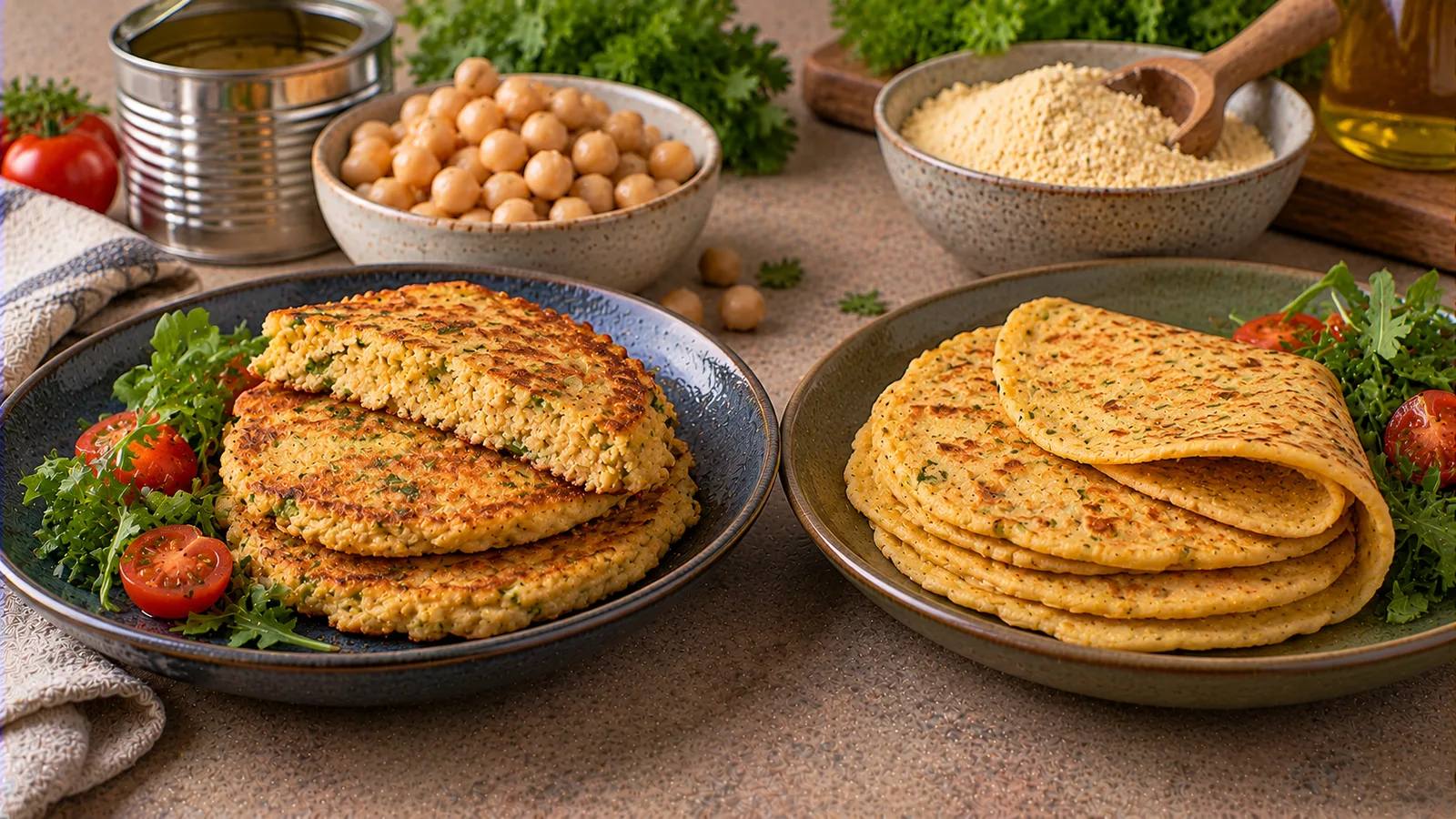
The word chickpea on two packages does not make them interchangeable pancake ingredients. Chickpea flour is dry and finely milled: it absorbs added water and can form a batter on its own. Canned chickpeas have already absorbed water during cooking. They must be drained, mashed and usually given additional structure to stay together in a frying pan. Those differences affect the number of pancakes, finished edible weight, texture and price.
Here is a reproducible comparison for two medium savory pancakes from each method. The prices and cooked yields are hypothetical teaching assumptions, not verified German supermarket offers or measured trial results. The protein figures below use identified product labels, not a claim about the final nutritional content of the complete recipe. We compare cost per pancake and per 100 g after cooking, without pretending that these are equal-protein meals.
What exactly is being compared?
| Feature | Chickpea flour batter | Canned-chickpea batter |
|---|---|---|
| Main ingredient | 120 g dry chickpea flour | 240 g drained, precooked chickpeas |
| Binder | Flour itself hydrates and sets | One 55 g shelled egg + 20 g corn starch |
| Added water | 180 g | 30 g |
| Pan oil | 10 ml | 10 ml |
| Pancakes per batch | Two | Two |
| Assumed cooked yield | 250 g total | 310 g total |
| Assumed weight per pancake | 125 g | 155 g |
These are different recipes designed to give two intact pancakes, not a substitution ratio. The canned method includes egg and is not vegan; the flour method is vegan if the toppings are vegan. The flour route can make a thin, continuous pancake, while the canned route is better suited to thicker, softer patties. Both are savory, but expecting identical texture would be misleading.
A cooked-yield assumption includes moisture lost from the pan and, in practice, oil retained. If you require a reliable local cost figure, weigh your own finished batch rather than treating 250 g or 310 g as guaranteed yields. Use a kitchen scale, not a visual estimate.
Start with labels, not a generic chickpea number
For the flour example, Müller's Mühle chickpea flour 400 g lists 20 g protein and 15 g fiber per 100 g dry flour. The selected canned product, Cirio chickpeas 400 g net/240 g drained, lists 6.7 g protein and 5.8 g fiber per 100 g, with 0.8 g salt per 100 g on its product page. Check the current package for the exact product and whether its nutrition declaration refers to the food as sold or drained; a label alone does not prove that every measured serving after rinsing has the identical salt content.
| Product-label calculation | Dry flour, 120 g | Canned chickpeas, 240 g drained |
|---|---|---|
| Protein from chickpea ingredient | 24.00 g | 16.08 g |
| Fiber from chickpea ingredient | 18.00 g | 13.92 g |
| Labeled salt of chickpea ingredient | 0.012 g | 1.92 g |
The canned method's egg contributes additional protein, but those 16.08 g refer only to the chickpeas. Likewise, vegetables, sauces and toppings change a complete meal's nutrients. Do not market 24.00 g as the measured protein of a cooked flour pancake batch: ingredient-label rounding, cooking loss and other inputs make that a calculation, not a lab test.
The apparent per-100-g advantage of flour partly reflects its dry state. Adding water increases pancake weight without adding protein; draining a can removes packing liquid, not all the water inside the beans. If your objective is a fixed protein target, calculate the entire recipe ingredient by ingredient and adjust the serving, rather than replacing 100 g canned beans with 100 g flour.
Recipe A: thin savory pancakes from chickpea flour
Yield: two medium pancakes; model finished mass: 250 g altogether. The hands-on sequence is a practical recipe, but the finished weight must be measured at home.
Ingredients: 120 g chickpea flour, 180 g cold water, 10 ml neutral pan oil, a pinch of pepper or paprika, and optional finely chopped herbs. Do not add a second binder until you have tested consistency. Use separate vegetables or yogurt as toppings and price them separately.
- Whisk flour and water until no dry pockets remain. Let stand about 10 minutes so hydration becomes more even. Resting does not make raw flour safe to eat.
- Heat a nonstick pan over medium heat. Use roughly half the measured oil, pour in half the batter, and spread into a medium pancake. Avoid excessive thickness, because the centre must cook completely.
- Cook until the surface has set and the underside is browned; flip carefully. Continue until there is no wet or raw centre, allowing roughly 4–6 minutes per side depending on thickness and heat. Timing is an indication, not a safety guarantee.
- Repeat with the second half. Weigh both pancakes on a clean plate after cooking. Record the mass for your cost-per-100-g calculation.
Flour pancakes are naturally suited to a pourable batter. Add water by teaspoons if the mixture is stiff, or a little extra flour if too runny, recording changes if you calculate cost. A topping such as tomatoes or spinach makes a fuller meal but belongs in a separate budget line. If you're deciding between chickpea and wheat flour, that is a different question covered in chickpea flour versus wheat flour for savory pancakes.
Recipe B: thick pancakes from a can of chickpeas
Yield: two substantial patties; model finished mass: 310 g combined. This method intentionally includes a binder so the canned beans can hold together.
Ingredients: one can supplying 240 g chickpeas after draining, one egg with approximately 55 g edible contents, 20 g corn starch, 30 g water, 10 ml neutral oil, and optional smoked paprika. Mash the beans rather than leaving them whole; otherwise the mixture may fracture when turned.
- Drain the can and weigh 240 g of solids. Rinse if you want to, but understand that rinsing and draining change the measured mass and may change the sodium content. Never substitute the 400 g can's total weight for the 240 g drained weight.
- Mash until mostly smooth with some small pieces. Beat in the egg and starch; use the 30 g water only as needed to reach a thick spoonable batter. Keep any raw-egg mixture away from ready-to-eat toppings.
- Heat the pan, add half the oil and form one compact patty. Cook over moderate heat until the centre is fully set. Turn with a wide spatula; cook the second side thoroughly. Repeat for the second patty.
- Transfer to a clean plate and weigh both. If the mixture is loose, reduce water next time; do not add unrecorded starch and still expect the cost calculation to hold.
This batch is softer and more bean-like than a thin flour pancake. An egg allergy, vegan diet or preference for a crisp socca-style result may make the flour version more appropriate. Canned chickpeas are precooked, but the egg and starch binder still require adequate cooking. See how to compare salt in canned beans for a related discussion of salt claims on canned beans; the product and drainage rules matter here too.
A worked cost model: ingredient use versus checkout
These prices are invented illustrative prices in euros, deliberately separated from the verified product-label facts. They are not an advertisement, historical store quote or local price survey. Prices, package sizes and stock vary by outlet, date and brand.
| Assumed purchase | Package price | Used in flour batch | Used in canned batch |
|---|---|---|---|
| Chickpea flour, 400 g | €2.99 | 120 g = €0.897 | — |
| Canned chickpeas, 240 g drained | €1.19 | — | Full can = €1.19 |
| Eggs, hypothetical pack of 6 | €1.80 (i.e. €0.30 each) | — | 1 = €0.30 |
| Corn starch, 400 g | €0.99 | — | 20 g = €0.0495 |
| Oil, 1 litre | €4.00 | 10 ml = €0.04 | 10 ml = €0.04 |
Water, ordinary seasonings and optional fillings are excluded. Calculations keep unrounded values until the result is displayed: €0.94 for flour (0.897 + 0.04 = 0.937), and €1.58 for canned (1.19 + 0.30 + 0.0495 + 0.04 = 1.5795).
| Cost measure | Flour pancakes | Canned pancakes |
|---|---|---|
| Model batch ingredient cost | €0.94 | €1.58 |
| Two pancakes | 2 | 2 |
| Ingredient cost per pancake | €0.47 | €0.79 |
| Model cooked batch weight | 250 g | 310 g |
| Ingredient cost per 100 g cooked | €0.37 | €0.51 |
How the per-100-g numbers work: €0.937 ÷ 250 × 100 = €0.3748, or €0.37 at two decimals. The canned version is €1.5795 ÷ 310 × 100 = €0.5095, or €0.51. Keep the unrounded amounts in calculations and update the final row when the actual cooked yield changes.
The checkout cost is not the sum of these usage costs if you have to buy every complete package. Buying whole hypothetical packages of flour (€2.99), oil (€4.00), canned beans (€1.19), a six-egg box (€1.80) and corn starch (€0.99) from scratch would cost €10.97 across both methods, before any extra seasoning or vegetables. You retain flour, starch, oil and any remaining eggs; the amount in the basket is not the amount consumed in the meal. If you already own staples, the additional cash needed today may be much lower. When comparing only one method, include precisely the packages missing from your kitchen.
Does cooked yield change the winner?
Absolutely. Cost per pancake is fixed under the recipe cost assumptions, but cost per 100 g cooked changes with moisture loss and serving size. Suppose your actual flour batch is only 220 g: €0.937 ÷ 220 × 100 = €0.43/100 g. If the canned batch comes to 280 g, €1.5795 ÷ 280 × 100 = €0.56/100 g. Neither is a measured universal yield. If you weigh a very large flour pancake with lots of added water retained, its cost per 100 g falls even though it contains no additional chickpea nutrients.
For a dinner, the more relevant comparison may instead be cost for one filling plate: a pancake plus vegetables, sauce and a protein-rich accompaniment. If the canned batch includes an egg, comparing just the chickpea ingredient prices conceals that extra cost and extra nutrient contribution. A fair budget spreadsheet therefore has separate columns for chickpea base, required binder, oil, fillings and actually served cooked mass.
Texture, convenience, salt and dietary suitability
Chickpea flour typically makes the smoothest, most cohesive batter. It needs water and adequate cooking, but no blender and no can drainage. Dry flour is also convenient when you want to portion out 60 g today and save the rest in a sealed package. Its price efficiency depends heavily on the package price and your pantry.
Canned chickpeas save the soaking and long cooking required for dry whole chickpeas. Their consistency depends on brand and how thoroughly they are mashed. They can make heartier, coarser pancakes but may require egg or starch to bind. A 400 g can in this example contains only 240 g of chickpeas after draining. Do not compare total wet can weight against dry flour weight or assume the contents of the can equal 400 g of usable legumes.
The selected canned label declares 0.8 g salt per 100 g, versus the flour label's 0.01 g. This is a label-based comparison of these specific products, not a claim that all canned chickpeas are high-salt. Low-salt canned versions exist; rinsing may reduce some sodium, but the reduction is not reliably quantified without testing. When salt is important, compare the actual label and cooking additions rather than declaring one ingredient always healthier.
Chickpea ingredients are naturally without wheat gluten, but gluten-free suitability depends on manufacturing cross-contact and all other ingredients; the selected flour's retailer listing notes possible traces of wheat, barley and other allergens. People with chickpea/legume allergy should avoid the relevant ingredient. The canned recipe here contains egg. Check labels rather than extrapolating from the ingredient name alone.
Cooking and storage: avoid raw batter
Raw flour and raw-egg batter must not be tasted. The FDA's flour safety guidance advises complete cooking and careful cleaning of utensils and surfaces. The EFSA explanation of lectins in legumes also stresses adequate processing and heating; these general warnings are not measured cooking-time specifications for this particular pancake recipe. Use a moderate pan temperature, make pancakes thin enough to heat through, and avoid raw centres. If uncertain, cook longer rather than relying solely on a colour change.
Refrigerate leftovers promptly in shallow sealed containers and follow applicable local food safety guidance. Reheat until thoroughly hot and discard portions that were left out too long. Keep cooked pancakes away from surfaces that handled raw egg batter. Never use a blender jug with raw egg and then serve an uncooked sauce from it without washing.
Which should you choose for your next batch?
Choose flour if you want a smoother, thinner pancake without eggs and with easy-to-weigh dry portions. Choose canned chickpeas if you already have a can open, prefer a bean-textured patty, and do not mind adding a binder. Under this specific illustrative basket, the flour batch costs less per pancake and per modeled 100 g cooked. With another brand, package price, cooking yield or filling, the ranking may reverse. Recalculate rather than treating one set of euro figures as a permanent shopping rule.
Sources
- Müller's Mühle chickpea flour, 400 g — REWE product label: dry-flour protein, fiber, salt and package size.
- Cirio chickpeas — REWE product label: 400 g net, 240 g drained; labeled protein, fiber and salt.
- FDA — Handling Flour Safely: no raw dough or batter and cooking hygiene.
- EFSA — Risks from lectins in foods: adequate legume preparation and heating.
All prices and cooked yields are hypothetical examples; only product-label values are attributable to the listed retailers. The calculations are not nutrition laboratory results or a real-world price survey.