
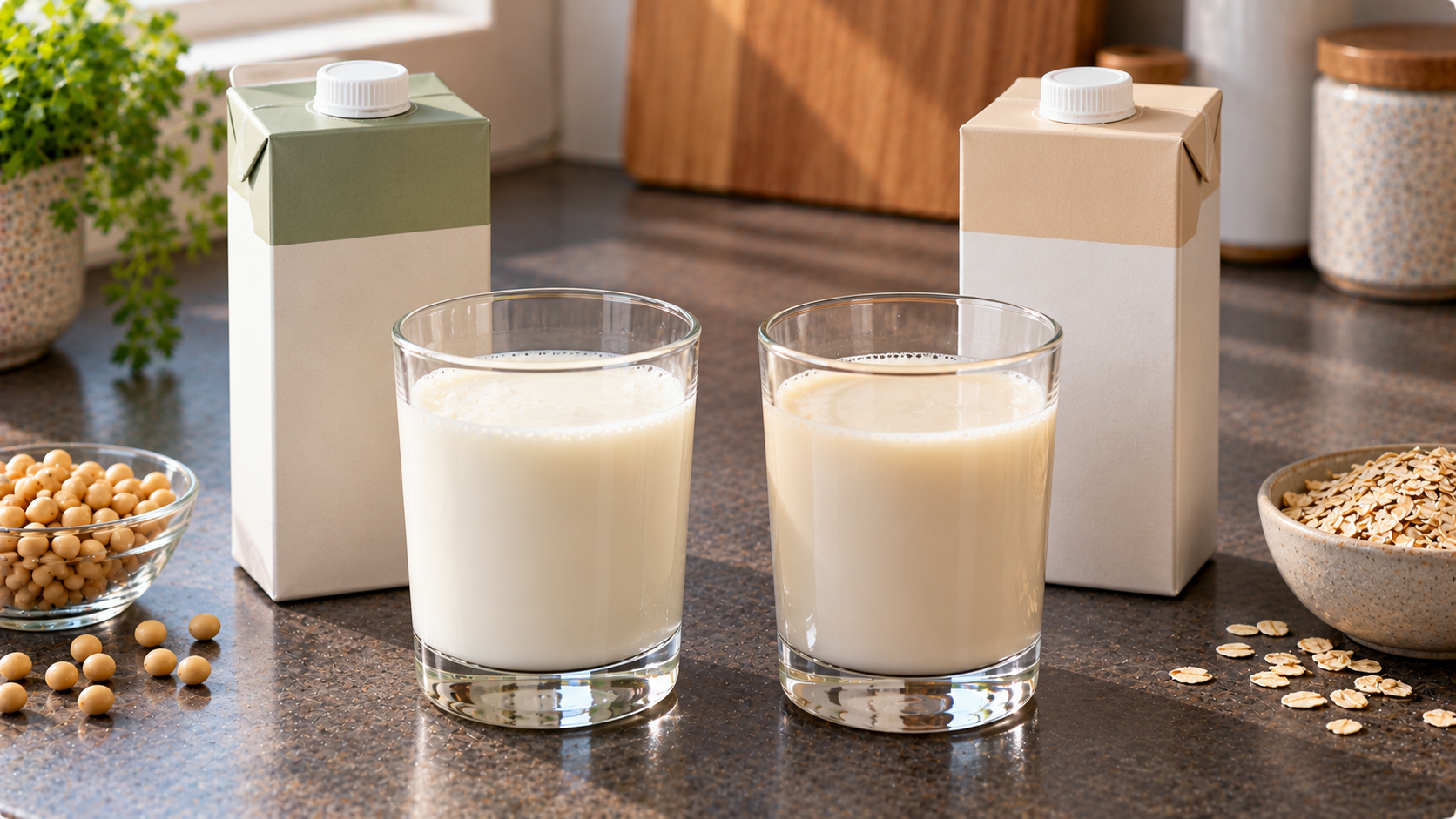
Soy milk and oat milk can both replace dairy milk in coffee, cereal and cooking, but they are not nutritionally interchangeable. Unsweetened soy drink usually offers more protein, while oat drink often contains more carbohydrate and has a naturally creamy texture. Calcium, vitamin B12, vitamin D and iodine depend primarily on fortification, not on whether the carton says “soy” or “oat”. The most useful comparison is between two products sold in the same market, in the same serving size, with their actual nutrition declarations alongside their ingredient lists.
This guide concerns plain unsweetened soy and oat drinks intended for everyday consumption. Barista editions, sweetened vanilla drinks, protein-enriched versions and homemade preparations can be substantially different. Use their own labels rather than substituting the example numbers below.
Soy milk vs oat milk: the decision in one table
| Question | Unsweetened soy drink | Unsweetened oat drink |
|---|---|---|
| Protein | Usually the stronger option among the two | Commonly much lower unless enriched |
| Carbohydrate | Often relatively low | Often higher because the base is oats |
| Naturally occurring sugars | Varies with processing | Can be present even without added sugar |
| Fat | Usually modest; depends on recipe | Often modest, but added oil can change it |
| Calcium and B12 | Check whether fortified | Check whether fortified |
| Iodine | Not guaranteed | Not guaranteed |
| Allergen | Soy must be declared | Oat/gluten cross-contact and cereal specifics require checking |
| Flavor and texture | Bean-like or neutral, often relatively thin | Mild cereal flavor, commonly creamy |
| Best default when protein matters | Often soy | Assess another protein source alongside it |
This table describes broad product patterns, not fixed nutrient values. The British Dietetic Association's review of plant drinks illustrates substantial differences among product categories and brands. A product's front label is a starting point, not the final evidence.
How to compare two cartons fairly
A fair comparison starts with the same quantity. Most European drink labels report nutrients per 100 ml, so that is a practical common baseline. Next, calculate what actually goes in a 200 ml glass, a 250 ml breakfast bowl or a 50 ml coffee. Match plain with plain, and preferably unsweetened with unsweetened. A sweetened oat barista product compared with a no-sugars soy drink answers a different question.
Review energy, protein, carbohydrates, “of which sugars”, fat, saturated fat and salt. Then find the separate vitamin/mineral declaration: calcium, B12, vitamin D, B2 and iodine if listed. Finally examine the ingredient list for water, soybeans or oats, vegetable oil, stabilizers, minerals and added sugars. The amount of the named plant ingredient can differ appreciably between cartons.
Example only — hypothetical labels, not measured products:
| Per 100 ml | Soy A, unsweetened | Oat B, unsweetened |
|---|---|---|
| Energy | 33 kcal | 46 kcal |
| Protein | 3.2 g | 1.0 g |
| Carbohydrates | 0.8 g | 6.7 g |
| Of which sugars | 0.3 g | 3.4 g |
| Fat | 1.7 g | 1.5 g |
| Calcium, if added | 120 mg | 120 mg |
| Vitamin B12, if added | 0.38 µg | 0.38 µg |
| Iodine | Not listed | Not listed |
The example deliberately gives both drinks the same added calcium and B12. That does not mean every brand contains those amounts. If a real carton has no added calcium, replace the hypothetical number with what the manufacturer actually declares; do not silently assume fortification.
What changes in a real glass or bowl?
For a 250 ml portion, multiply every 100 ml label value by 2.5. For the hypothetical products above, the results are:
| Nutrient per 250 ml | Soy A | Oat B |
|---|---|---|
| Energy | 83 kcal | 115 kcal |
| Protein | 8.0 g | 2.5 g |
| Carbohydrates | 2.0 g | 16.8 g |
| Sugars | 0.8 g | 8.5 g |
| Calcium if fortified as shown | 300 mg | 300 mg |
| B12 if fortified as shown | 0.95 µg | 0.95 µg |
These are arithmetic examples, with rounded outcomes. The protein difference is about 5.5 g per glass, which matters more to someone replacing a substantial milk portion every day than to someone adding a splash to espresso. Conversely, neither drink alone needs to supply a whole meal's protein. Breakfast with oats, seeds, yogurt alternatives or eggs changes the final meal composition.
Why soy usually has more protein
Soybeans are protein-rich legumes. Making a drink from soybeans generally leaves more protein in the finished liquid than a conventional drink made predominantly from oats. Processing and dilution matter: a carton with a low percentage of soybeans may be weaker than a higher-soy formulation, and some drinks contain added protein. Hence “soy always contains exactly 3 g” is not a dependable rule.
For adults choosing a plant drink as a regular replacement for dairy milk, protein per 100 ml is often the first meaningful discriminator. Using the example products, a 250 ml glass delivers 8 g from soy versus 2.5 g from oat. If the drink is used three times daily, the difference becomes more material, though the rest of the diet determines overall adequacy. The UK SACN/COT plant-based drinks assessment also identifies protein as an important difference, particularly for younger children. Do not generalize adult purchasing advice to infant feeding. For the smaller quantities actually poured into coffee, plant-based drinks in coffee compares protein, sugar and costs.
For individual serving calculations, use the entries for soy milk and oat milk alongside the carton labels. Added protein, sweeteners and fortification can make a particular product differ from either generic guide.
Carbohydrates, sugars and the “no added sugar” trap
Oat drinks often contain more carbohydrate because oats are starch-rich. During manufacturing, enzymes may break some oat starch into smaller carbohydrates and sugars. As a result, a drink can legitimately contain sugars even when sugar was not added as a separate ingredient. Check both the ingredient list and “of which sugars” per 100 ml; neither alone answers every question.
A no-added-sugar carton is not necessarily sugar-free. Equally, a product with naturally present sugars is not automatically equivalent to a soft drink with the same number printed in the sugars row: overall portion, nutrients and dietary context matter. Compare the exact drink if tracking carbohydrate intake, including when it goes into coffee several times a day. A sweetened soy drink could have more sugar than an unsweetened oat drink; category averages cannot substitute for the two labels.
For people monitoring blood glucose, the beverage's carbohydrate content and portion are more useful than a broad claim that one plant is “better for diabetes”. Individual responses and the wider meal vary. Specific clinical decisions should be made with a qualified professional rather than based on a generic ranking.
Calcium: added nutrients determine the answer
Soybeans and oats are not automatically equivalent to milk as calcium sources when turned into diluted beverages. The NHS guidance on vegan diets lists fortified unsweetened plant drinks as potential calcium sources; the BDA's calcium guidance emphasizes checking the product because some alternatives are unfortified. A common fortified label may provide 120 mg calcium per 100 ml, which would mean 300 mg in 250 ml. But that value must be present on the actual product, not assumed.
Some calcium salts can settle during storage. Follow the manufacturer's shaking instructions so the served portion reflects the intended mixture. The ingredient list may name calcium carbonate, tricalcium phosphate or another calcium compound; the nutrition declaration tells you the quantity. Different compounds and food matrices are not proof that all added calcium is absorbed identically. If calcium is one reason you buy a plant drink, an unfortified artisan version may not meet your aim even if it tastes excellent.
B12, vitamin D and iodine: read three separate lines
A plant-based ingredient by itself is not a reliable source of vitamin B12. A fortified soy or oat carton may supply it, but an unfortified version may contribute little or none. The same caution applies to vitamin D. Vitamin B2 (riboflavin) is also sometimes added. A vegan diet needs reliable B12 intake from fortified foods or appropriate supplements; simply drinking an unspecified plant milk is not a strategy. See the NHS vegan diet guide.
Iodine is often overlooked. Many plant drinks do not provide it unless specifically fortified. The British Dietetic Association advises checking for iodine in alternatives used regularly in place of dairy milk. A calcium- and B12-fortified carton can still contain no declared iodine. This is particularly relevant to households excluding dairy and fish. Do not equate “fortified” with “contains every vitamin and mineral”.
A useful shopping checklist is therefore: calcium amount, B12 amount, vitamin D amount, iodine amount, and whether those values apply per 100 ml. If a nutrient is missing from the declaration, you should not insert a guessed value into a nutrition tracker.
Fat, added oil and the barista label
Fat is not intrinsically a problem in either drink; its amount and type matter within the diet. Some oat drinks contain rapeseed or another vegetable oil to improve mouthfeel and steaming. Soy drinks can also contain oil or stabilizers. Barista products are designed for coffee performance, not necessarily for matching plain drink nutrients. They may have different energy, carbohydrates, fat and protein values.
Look at saturated fat rather than comparing total fat alone. The best choice for someone who wants a creamy cappuccino might differ from the best choice for someone who wants maximum protein in an unflavored breakfast drink. A “light” label should still be checked for calcium and B12: reducing calories is not the same task as replacing nutrients in dairy.
Taste, texture and cooking: where oat and soy behave differently
Oat drink commonly has a cereal-like, gently sweet flavor and can make porridge, coffee or baking feel creamy. Soy drink may taste more bean-like and, depending on processing, can create a firmer structure in some recipes because its proteins behave differently. Neither observation is universal; formulation, heat and acidity change results.
| Everyday use | Often convenient choice | What to check |
|---|---|---|
| Coffee or cappuccino | Oat barista or soy barista | Foam performance and actual sugar/fat |
| Protein-focused breakfast | Unsweetened soy | Protein per 100 ml and entire meal |
| Porridge | Either | Carbohydrates, toppings and portion |
| Smoothie | Either | Fruit, added sweeteners and protein |
| Savory soup | Plain soy or oat | Avoid sweetened or vanilla flavors |
| Baking | Often either, recipe-dependent | Binding, fat and total liquid |
| Daily dairy replacement | Fortified unsweetened version | Calcium, B12, D and iodine |
Heating soy drinks in highly acidic liquids can affect texture; some brands split more easily in hot coffee. A dedicated barista formulation may solve a culinary issue but can change nutrients. For recipes, follow the actual drink's volume in milliliters and avoid assuming all plant drinks produce identical results.
Allergens, gluten and special dietary needs
Soy is an allergen and needs appropriate labeling. People with diagnosed soy allergy should not choose soy drink merely for its protein advantage. Oats do not contain the same soy proteins, but oat drinks can present other ingredient or cross-contact issues. Oats may be contaminated with gluten-containing grains during production, while particular products can be manufactured and certified gluten-free under applicable standards. People with coeliac disease need a suitable labeled option, not the blanket assumption that “oat means gluten-free”.
Plant drinks should not be treated as ordinary substitutes for infant formula. Babies and young children have different nutritional requirements. The UK government's SACN/COT assessment highlights the risk of inadequate protein and micronutrients in some replacement patterns. Parents should follow age-specific clinical and public-health guidance rather than an adult-focused comparison chart.
Comparing price fairly without inventing supermarket prices
Prices vary by country, shop, pack size, brand and date. Compare the same currency and price per liter: pack price divided by pack volume in liters. For a 250 ml glass, divide price per liter by four. A 1 L soy carton costing a hypothetical €1.50 gives €0.375 per 250 ml; a 1 L oat carton costing a hypothetical €2.00 gives €0.50. These are illustrative numbers, not verified current retail prices.
If protein is your target, compare the price for a useful amount of protein. Under the hypothetical labels above, a liter of soy contains 32 g protein and costs €1.50, or approximately €0.94 per 20 g protein. A liter of oat contains 10 g and costs €2.00, or €4.00 per 20 g protein. The latter calculation is a comparison metric, not advice to drink two liters of oat milk to meet a protein target. For calcium, compare price per 300 mg declared calcium only among products that actually list that nutrient.
Which one should you buy?
Choose unsweetened fortified soy drink when protein is a major priority and soy suits your diet. Choose unsweetened fortified oat drink when you prefer its flavor or cooking texture and are meeting protein requirements elsewhere. In either case, calcium, B12, vitamin D and iodine are product-specific checks. The product with more protein is not automatically the one that foams best, costs least, or suits someone with an allergy.
For a quick decision in the supermarket, place two cartons together and compare the same six items: protein, carbohydrates, sugars, calcium, B12 and iodine per 100 ml. Then check ingredients and price per liter. These few steps produce a more meaningful choice than a universal ranking of soy against oat.
Sources and method
- British Dietetic Association — Unpacking the myths around plant-based drinks: product-category examples and variation.
- SACN/COT — Assessment of plant-based drinks: nutrient differences and risks of inappropriate substitution.
- NHS — The vegan diet: calcium, B12 and fortified alternatives.
- British Dietetic Association — Calcium: checking fortified products.
- British Dietetic Association — Iodine and fortification: variability in iodine enrichment.
- European Union — Regulation 1169/2011: food information and labeling framework.
Method note: The numerical carton examples and prices are explicitly hypothetical teaching examples, not current claims about any brand. Product categories vary across markets; for food logging and shopping, the actual label takes precedence. This article is general nutrition information, not individual medical advice.