
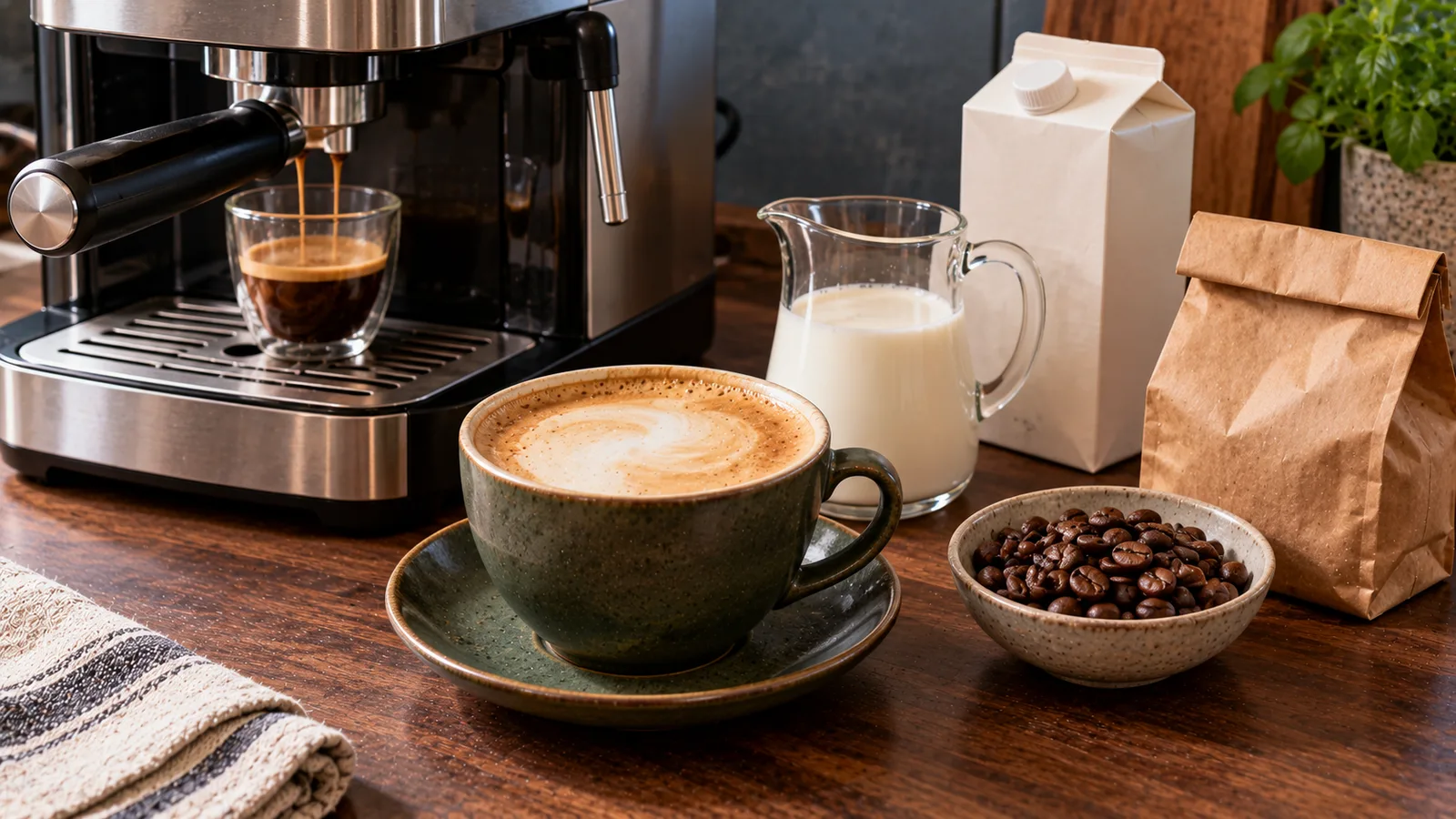
What a homemade cup really costs
Home coffee can be less expensive than a café drink, but that is not a useful conclusion until the portions and prices are specified. A machine-made cup uses a certain mass of coffee beans, a measured volume of milk if you add it, and some electricity. These are three distinct costs. Estimate them for the cup you actually make rather than dividing the price of an entire bag of beans and a carton of milk by one drink. The worked example below uses documented German retail listings and a deliberately hypothetical energy reading; it is not a national average or a promise that other households will pay the same.
Use prices for products you can identify
For a reproducible example, the German dm listing for dmBio Espresso de Peru, whole beans, 250 g shows €4.65, while dmBio long-life whole milk, 3.5%, 1 litre shows €1.25. These are named retail products and online prices checked on 26 October 2026, not general prices for Germany, let alone the other seven language markets. Other shops, promotions, delivery fees and future price changes alter the basket. If you have receipts for the particular beans and milk you buy, those receipts are better inputs than this example. Both retailer listings are linked in Sources so readers can inspect their product and pack size.
Measure the beans, not the number of scoops
A useful starting dose is 18 g of beans per cup in this example. The cost per gram is €4.65 ÷ 250 g = €0.0186/g. Multiplying by the dose gives 18 × €0.0186 = €0.3348, roughly €0.33. Eighteen grams is a chosen recipe amount, not a prescribed dose for every espresso or filter coffee. Weigh the dry beans going into the grinder, or use the actual machine setting after checking its output. A rounded tablespoon measure may vary with the bean, grind and fill; it cannot substitute for grams in an exact cost calculation. Beans left in the hopper still have value and should not all be charged to the first cup.
Count the milk actually poured
For a drink with milk, our example uses 120 ml poured from the carton. At €1.25 per 1,000 ml, milk costs €0.00125/ml. The cup therefore receives 120 × €0.00125 = €0.15 of milk. Frothing introduces air; a larger foamy volume does not mean that more milk was purchased. Record liquid milk before frothing or measure what disappears from the carton. If 20 ml is spilled or discarded, account for it as waste rather than pretending it was served. Whole milk is used only to keep the example concrete; an oat drink, lactose-free milk or cream needs its own price per millilitre and measured amount.
Include electricity without guessing from watts
Electricity is usually a smaller component, but it should not be silently set to zero. Suppose 0.03 kWh per complete drink is measured for brewing and any included milk heating, and your hypothetical variable electricity price is €0.30/kWh. The calculation is 0.03 × €0.30 = €0.009, or 0.9 euro cent. Neither figure is a verified reading from a particular coffee machine or a current tariff: both are explicit exercise assumptions. A machine's 1,500 W rating is not the same as energy consumed during a short cycle; warm-up, idle time and heater switching matter. For a real estimate, use a suitable plug-in meter as directed, or a manufacturer's measured cycle figure, and use the applicable tariff from your bill. Do not open electrical equipment to make measurements.
Worked example: one cup with milk
Add the three unrounded parts: €0.3348 beans + €0.1500 milk + €0.0090 electricity = €0.4938 per cup. That is approximately €0.49, excluding water, cleaning, equipment depreciation and other expenses. Keeping extra digits until the final step matters: rounding every ingredient early can distort the total for ten or a hundred drinks. This is a consumption cost, not a literal till receipt for one cup. To make that drink you may have to purchase full packs. The table separates unit amounts from euro totals; a cappuccino-sized cup and a large milk coffee should not inherit the same milk line by default.
| Item | Quantity per cup | Unit price or input | Cost per cup |
|---|---|---|---|
| Coffee beans | 18 g | €4.65 / 250 g | €0.3348 |
| Whole milk | 120 ml | €1.25 / 1,000 ml | €0.1500 |
| Electricity (illustrative) | 0.03 kWh | €0.30/kWh (illustrative) | €0.0090 |
| Total | €0.4938 |
Compare black coffee with different milk amounts
A black cup made with the same 18 g of beans and the same illustrative 0.03 kWh, but no milk, costs €0.3438, roughly €0.34. If you pour just 60 ml of the same milk, the milk line becomes €0.075, and the new total is €0.4188, about €0.42. These are arithmetical variations, not claims about the energy used by an espresso machine when steaming more or less milk. In practice, changing the drink may change electricity use, too. Adjust the kWh term if a measurement shows a difference; do not move the same assumed figure between methods without stating the limitation.
Ten cups: shopping bill versus ingredients used
Imagine making 10 identical milk coffees with 18 g beans and 120 ml milk each. You use 180 g of beans, costing €3.348, and 1,200 ml milk, costing €1.50. At 0.03 kWh each, electricity is 0.30 kWh, or €0.09 at the assumed tariff. Consumption totals €4.938, approximately €4.94, over ten cups. Buying sufficient sealed packs instead requires one 250 g coffee bag (€4.65) and two 1-litre milk cartons (€2.50): €7.15 at the checkout, or €7.24 including assumed electricity. The remaining 70 g of beans and 800 ml of milk are worth €1.302 + €1.00 = €2.302 at purchase-unit prices. The reconciliation €7.24 − €2.302 = €4.938 works only if the leftovers remain usable; expired or discarded milk becomes a real loss.
Which costs are missing, and which matter?
Per-cup figures omit costs unless you add them explicitly: drinking water, coffee filters or capsules, descaler, cleaning supplies, equipment wear, shipping and wastage. Do not add an entire machine purchase price to a single cup; spread any planned equipment allowance over a realistic lifetime number of cups and label it separately. Similarly, a café menu price includes labour, service and premises costs and is not directly comparable with only beans, milk and electricity at home. For households looking to reduce spending, changing dose, milk volume or the price paid per pack often moves the result more visibly than tiny differences in a short brewing cycle.
Keep a repeatable record
Write down the product, shop and date, paid price, pack size, actual grams of beans, liquid millilitres of milk, estimated or measured kWh, your tariff and the number of cups. Recalculate when you switch beans, use a larger mug or change the machine. The relevant milk and coffee retail pages are linked below; they may change without notice. Readers can also see why standby electricity deserves attention in the German consumer advice cited below. For a broader household picture, treat coffee as one clearly measured component of the meal budget, and distinguish an illustrative model from money already spent. For a separate cooking-energy example, see calculating cooking electricity cost per serving.