
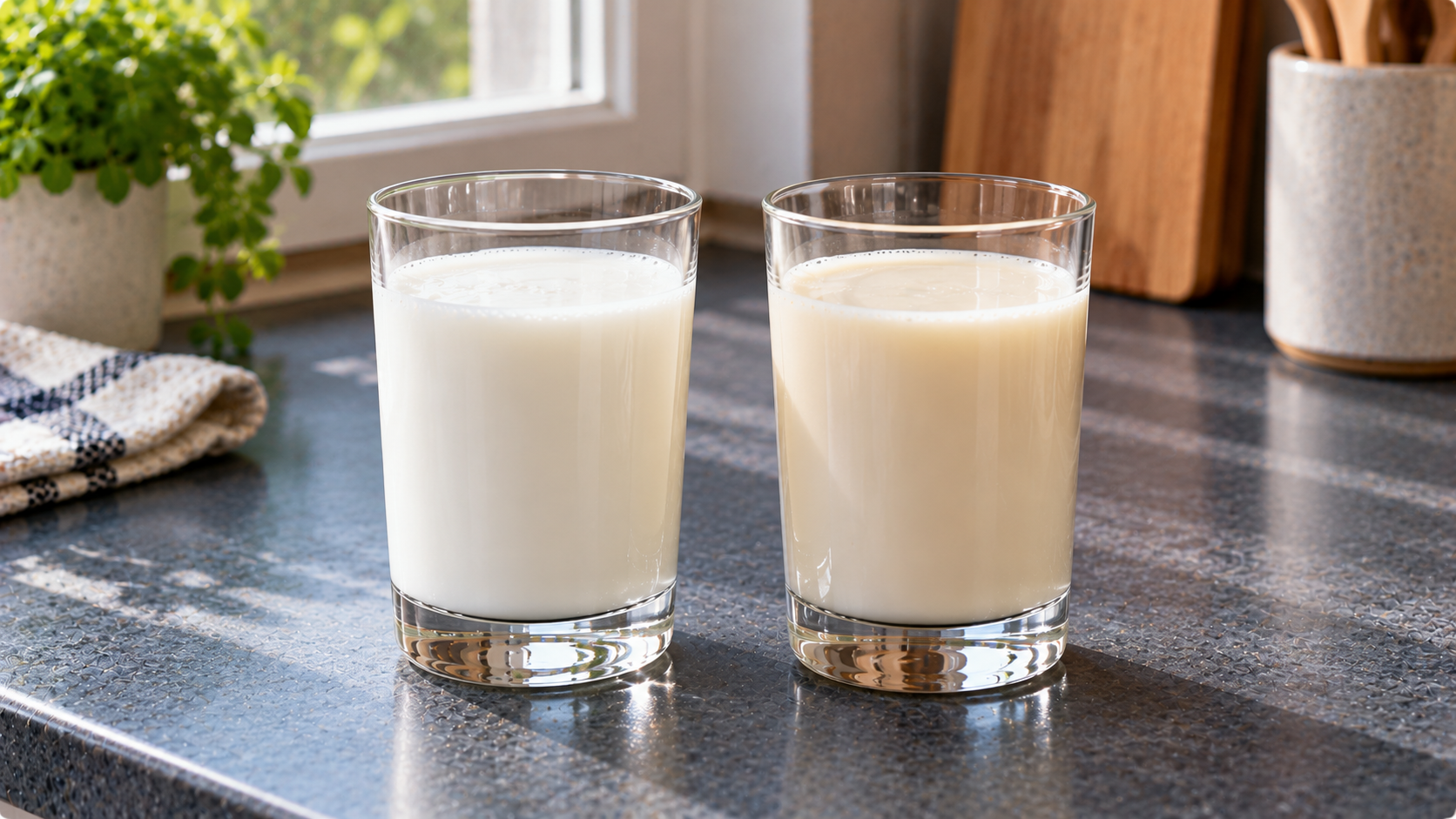
Dairy milk and unsweetened soy drink can look similar in a glass, but their nutrients come from different sources. Cow's milk naturally supplies complete protein, calcium, vitamin B12 and other nutrients; soy drink supplies soy protein and may be fortified with calcium, B12, vitamin D, riboflavin or iodine. A fortified soy drink can be a practical alternative, but not every carton is nutritionally equivalent to milk. The fairest comparison specifies milk fat level, an unsweetened soy product, serving size and the actual labels. This guide focuses on adults and everyday food choices rather than infant feeding.
The quick answer: what changes when you switch?
| Question | Cow's milk | Unsweetened soy drink |
|---|---|---|
| Protein | Generally around 3–3.5 g per 100 ml | Often around 3–3.5 g, but varies |
| Natural milk sugar | Lactose, even without added sugar | Usually little sugar in an unsweetened recipe |
| Fat | Depends strongly on skimmed, semi-skimmed or whole milk | Depends on soy concentration and added oils |
| Calcium | Naturally present, commonly around 120 mg/100 ml | Similar only if fortified to a comparable level |
| Vitamin B12 | Naturally present | Requires fortification or another dietary source |
| Vitamin D | Depends on country and whether milk is fortified | Depends on fortification |
| Iodine | Can be an important source, varying with production and region | Not assured, even in calcium-fortified drinks |
| Lactose | Present unless labelled lactose-free | Absent in a plain soy-and-water formulation |
| Allergy | Milk proteins | Soy proteins |
| Vegan | No | Yes, when ingredients and processing meet the claim |
These are category-level distinctions, not a promise about a particular brand. FDA's nutrient comparison and the German Nutrition Society's assessment both stress checking actual product composition.
Use a matched baseline, not 'milk' versus 'any soy'
A carton of whole milk is a poor comparator for a low-fat soy drink if the question is which beverage has more saturated fat. Equally, a sweetened vanilla soy drink should not be used to represent unsweetened soy. Begin with plain cow's milk at a specified fat level, ideally 1.5% for a common German everyday example, and a plain unsweetened fortified soy beverage. Compare each at 100 ml, then multiply by the amount you actually drink. If you normally choose whole milk, calculate that separately rather than quietly swapping it for 1.5% milk in the table.
Manufacturers may use different soybean concentrations, filtration processes, stabilisers, salt and oils. Some soy drinks are fortified; others are not. Milk may be vitamin-D-fortified in one market and unfortified in another. A valid comparison therefore needs the nutrition declaration, ingredients, fortification list and country of sale. Brand averages never replace the carton in your refrigerator.
Worked comparison: two explicitly hypothetical labels
The following products are illustrative examples, not measured brands, market averages or current shopping prices. They demonstrate the calculation method; replace every value with two real cartons before logging nutrients.
| Per 100 ml | Example cow's milk 1.5% fat | Example unsweetened fortified soy drink |
|---|---|---|
| Calories | 47 kcal | 34 kcal |
| Protein | 3.4 g | 3.3 g |
| Fat | 1.5 g | 1.8 g |
| Saturated fat | 1.0 g | 0.3 g |
| Carbohydrate | 4.9 g | 0.5 g |
| Of which sugars | 4.9 g | 0.0 g |
| Calcium | 120 mg | 120 mg, only in this fortified example |
| Vitamin B12 | Check label or food database | Check fortification declaration |
| Iodine | Check country-specific data | Check whether expressly added |
The near-equal protein in this constructed comparison is deliberate: it shows why soy is often more directly comparable with cow's milk than many oat or almond drinks, without implying every soy brand matches. The calcium entry in the example soy drink is an assumption stated for illustration. A non-fortified soy drink could contain far less calcium. In Germany, BZfE points out this difference.
Calculate what is actually in a 250 ml glass
Multiply every 100 ml declaration by 2.5. In the hypothetical comparison, a 250 ml glass of milk provides about 118 kcal, 8.5 g protein, 3.8 g fat and 300 mg calcium. A 250 ml glass of the illustrated soy drink provides 85 kcal, 8.3 g protein, 4.5 g fat and 300 mg calcium because calcium was added in the imaginary label. Rounding comes from using one decimal place on the source labels; packaged values can differ slightly due to rounding.
| Amount | Example 1.5% cow's milk | Example fortified unsweetened soy |
|---|---|---|
| 50 ml coffee addition | 24 kcal, 1.7 g protein | 17 kcal, 1.7 g protein |
| 200 ml cereal bowl | 94 kcal, 6.8 g protein | 68 kcal, 6.6 g protein |
| 250 ml glass | 118 kcal, 8.5 g protein | 85 kcal, 8.3 g protein |
| 500 ml across the day | 235 kcal, 17 g protein | 170 kcal, 16.5 g protein |
Those differences are modest for one coffee splash but more meaningful when the drink is consumed several times daily. They do not imply that replacing milk guarantees weight loss. Energy balance depends on the complete diet, and more caloric soy products or different dairy fat levels can reverse a simple calorie ranking.
Protein: quantity, quality and use in a meal
Cow's milk contains casein and whey; soy contains proteins from soybeans. Both can contribute high-quality dietary protein, but the amino acid profile and digestion characteristics are not identical. An adequate mixed diet normally matters more than selecting one beverage based on a small difference in grams per glass. For a breakfast with 250 ml beverage, calculate the drink's protein and then include cereal, eggs, seeds or another ingredient actually served. A drink with 8 g protein does not by itself turn every breakfast into a high-protein meal.
For a fair product decision, protein per 100 ml is the first number; protein per 100 kcal can provide a useful second view when calorie targets matter. With the hypothetical labels, 3.4/47×100 gives 7.2 g protein per 100 kcal for dairy milk, and 3.3/34×100 gives 9.7 g for soy. The result changes with fat percentage and product formulation. Never report this arithmetic as a laboratory comparison or a universal soy advantage.
For everyday food logging, the separate references for cow’s milk and soy milk can help with serving sizes. Check the actual carton for fat level, added sugar and fortification before transferring values.
Calcium: fortified does not mean automatically identical
Cow's milk contains calcium intrinsically, whereas many soy drinks depend on added calcium salts. Read the actual calcium content in milligrams per 100 ml or per serving. A fortified soy carton declaring 120 mg per 100 ml gives 300 mg in a 250 ml glass. Without fortification, its calcium content may be much lower. Some added minerals settle, which is one reason manufacturers advise shaking a carton before pouring. DGE's guidance explicitly recommends this.
Calcium absorption may vary with the mineral form, food matrix and wider dietary context. A matching number on the label is therefore a practical comparison, not proof that every nutrient behaves identically in the body. People removing most dairy should review calcium from the whole diet, including fortified foods and other sources, rather than assuming one new beverage automatically replaces everything.
Vitamin B12, B2, iodine and vitamin D
Replacing a frequent milk serving can change micronutrient intake even if calories and protein remain similar. Milk naturally contains vitamin B12 and riboflavin (B2), and dairy can be an important iodine source in some European diets. Vitamin D content is particularly country- and fortification-dependent. Soy beverages do not inherently supply those nutrients at matching levels; the nutrients must be listed as added where applicable. A carton advertising 'calcium fortified' should not be assumed to contain iodine or B12.
Use a short checklist: calcium in mg, vitamin B12 in µg, riboflavin/B2, iodine in µg and vitamin D if present. In Germany the DGE highlights calcium, iodine, B2 and B12 when replacing cow's milk. The FDA similarly emphasises checking calcium, vitamin D and protein. These are guidance priorities, not a claim every package has identical mandatory labeling.
Lactose intolerance and allergies are different decisions
Ordinary dairy milk contains lactose. Someone with lactose intolerance may tolerate smaller amounts, fermented dairy or lactose-free cow's milk, depending on the individual. Lactose-free dairy milk is still dairy: it contains milk proteins and is not appropriate for a diagnosed cow's-milk-protein allergy. A plain soy drink does not contain lactose, but soy itself is a major allergen. A soy allergy means soy drink is not a safe swap simply because it is plant based.
Check the ingredient list and allergen information for the specific product. Flavoured or blended drinks can include other ingredients and cross-contact warnings. For children with allergy or anyone avoiding entire food groups because of medical symptoms, personalised professional advice is more appropriate than relying on a general comparison table. NHS dairy and alternatives guidance distinguishes lactose intolerance from cow's-milk allergy.
Is unsweetened soy lower in sugar?
Milk normally contains lactose, recorded under 'of which sugars' on a European label even when no sugar has been added. That figure should not be interpreted as added table sugar. Unsweetened soy drinks often contain fewer sugars, but products differ: some use ingredients that change the carbohydrate content, and sweetened, vanilla or barista versions can contain more. 'Unsweetened', 'no added sugar' and 'zero sugars' are not interchangeable statements.
To make the right comparison, read the ingredient list for added sugars and then examine total carbohydrate and sugars per 100 ml. Consider the whole meal too: a cereal bowl with sweet granola may contribute much more added sugar than the milk or soy drink. Avoid attributing a clinical benefit to a beverage solely because its sugar row is lower.
Fat, saturated fat and calories
Cow's milk fat depends on the declared fat category. Whole milk generally contains more total and saturated fat than lower-fat milk. Soy drink usually has a different fatty-acid profile and often less saturated fat, but an added-oil barista formulation may change the numbers. A comparison of 3.5%-fat milk against unsweetened soy is therefore not the same experiment as skimmed milk against soy.
Choose the question first. For total energy, compare kcal per 100 ml at the fat levels you actually buy. For saturated fat, use its specific row, not total fat alone. For protein efficiency, calculate grams per 100 kcal. For taste in coffee, test the exact drinks at the same volume. An individual's overall saturated-fat intake comes from many foods; no single swap alone determines cardiovascular outcomes.
Coffee, cereal, smoothies and cooking
Both beverages can be used in coffee, porridge, overnight oats, pancakes and sauces, though their taste and processing behaviour differ. Dairy milk has a familiar dairy flavour and behaves predictably in many recipes. Soy drinks can bring a subtle bean note; some products split in acidic coffee, while barista formulations are designed to foam or resist splitting. The barista carton may not have the same oil or nutrient profile as the plain unsweetened carton used in the nutrition comparison.
In a smoothie, count the milk or soy drink and every other ingredient separately. In pancakes, the protein and fat depend on eggs, flour, oil and toppings as much as the liquid. A recipe specifying 300 ml of dairy milk can often be adapted to soy drink, but a successful texture substitution does not prove nutritional equivalence. For sauces and desserts, sweetness and stabilisers can be more important than a small per-100-ml calorie difference.
How to compare prices without inventing market data
Shelf prices vary by retailer, country, promotions and pack size. The correct calculation starts with the actual shelf price and declared bottle or carton volume. Price per 250 ml = price per litre ÷ 4. If a hypothetical carton costs €1.20 per litre, one 250 ml glass costs €0.30. At €1.80 per litre it costs €0.45. Those figures are mathematical examples, not observed prices or brand recommendations.
For protein value, use price per 10 g protein = (price per litre ÷ protein g per litre) × 10. At 3.4 g per 100 ml the beverage provides 34 g per litre; if it hypothetically costs €1.20, 10 g protein costs about €0.35. A soy drink with 3.3 g per 100 ml gives 33 g per litre; at €1.80 it costs about €0.55 per 10 g. However, cost per calcium serving or suitability for an allergy may matter more than protein efficiency. Never compare the lowest price of an unfortified product with a fortified one without mentioning the nutrient difference.
Environmental considerations without one-dimensional rankings
Plant-based alternatives generally have lower average greenhouse-gas emissions than cow's milk, but comparisons depend on production system, geography and impact measure. Water use, land use, packaging and transport do not always point to the same winner. Soy used in a drink also should not be confused with all global soy production or be blamed for land-use patterns without tracing actual supply chains. The DGE position summarised by BZfE discusses both nutritional trade-offs and generally lower environmental burdens for plant drinks.
Environmental preference does not resolve nutritional suitability automatically. Someone choosing soy for climate reasons can still check calcium, iodine and B12; someone choosing dairy can still assess portion size, waste and overall eating habits. A balanced decision considers the priorities relevant to the person rather than declaring either beverage universally 'healthy' or 'unhealthy'.
A practical buying checklist
| Step | What to check | Why it matters |
|---|---|---|
| 1 | Specify milk fat level and unsweetened/plain soy | Prevents mismatched comparisons |
| 2 | Compare 100 ml energy, protein, sugars and saturated fat | Gives a common baseline |
| 3 | Check calcium mg and fortification list | Soy varies greatly |
| 4 | Check iodine, B12, B2 and vitamin D where listed | Avoids overlooking displaced nutrients |
| 5 | Review allergens and lactose needs | Safety and tolerance come before ranking |
| 6 | Multiply by your real portion | 50 ml coffee is unlike a 250 ml glass |
| 7 | Compare prices for equal volumes and similar fortification | Avoids misleading 'value' comparisons |
For an adult who wants an unsweetened plant-based substitute and values protein, an appropriately fortified unsweetened soy drink is often a sensible first product to inspect. For someone who enjoys and tolerates dairy, cow's milk can also fit a balanced diet. Neither choice excuses ignoring the rest of the diet. If the drink replaces a substantial, regular milk intake, pay particular attention to calcium, iodine and relevant vitamins.
Special caution for infants and young children
Ordinary cartons of soy drink are not infant formula. Infants require age-appropriate feeding advice, and regular plant drinks should not be treated as an interchangeable replacement. For toddlers and young children, replacing dairy can also change the intake of energy, protein, calcium, iodine and vitamins; circumstances need age-specific consideration. The German BZfE guidance for young children emphasises these gaps. Adult examples and tables on this page must not be repurposed as infant-feeding recommendations.
Sources and methodology
- German Nutrition Society (DGE) — Plant-based milk alternatives: nutrient replacement, mineral settlement and gaps in long-term outcome evidence.
- BZfE — Plant drinks versus cow's milk: German dietary context and environmental/nutrient trade-offs.
- US FDA — Milk and plant-based alternatives: why the nutrient label is decisive.
- NHS — Dairy and alternatives: allergy and lactose distinctions, fortified dairy alternatives.
- BZfE — Plant drinks for young children: age-specific caution.
- EU Regulation 1169/2011: consumer food information and nutrient declaration.
Method note: the numerical dairy-versus-soy tables intentionally use hypothetical, labelled examples for an apples-to-apples demonstration. They are not actual brand tests. For accurate food logging or purchasing, replace them with your own cartons' values and check the real fortified nutrients and allergens.