
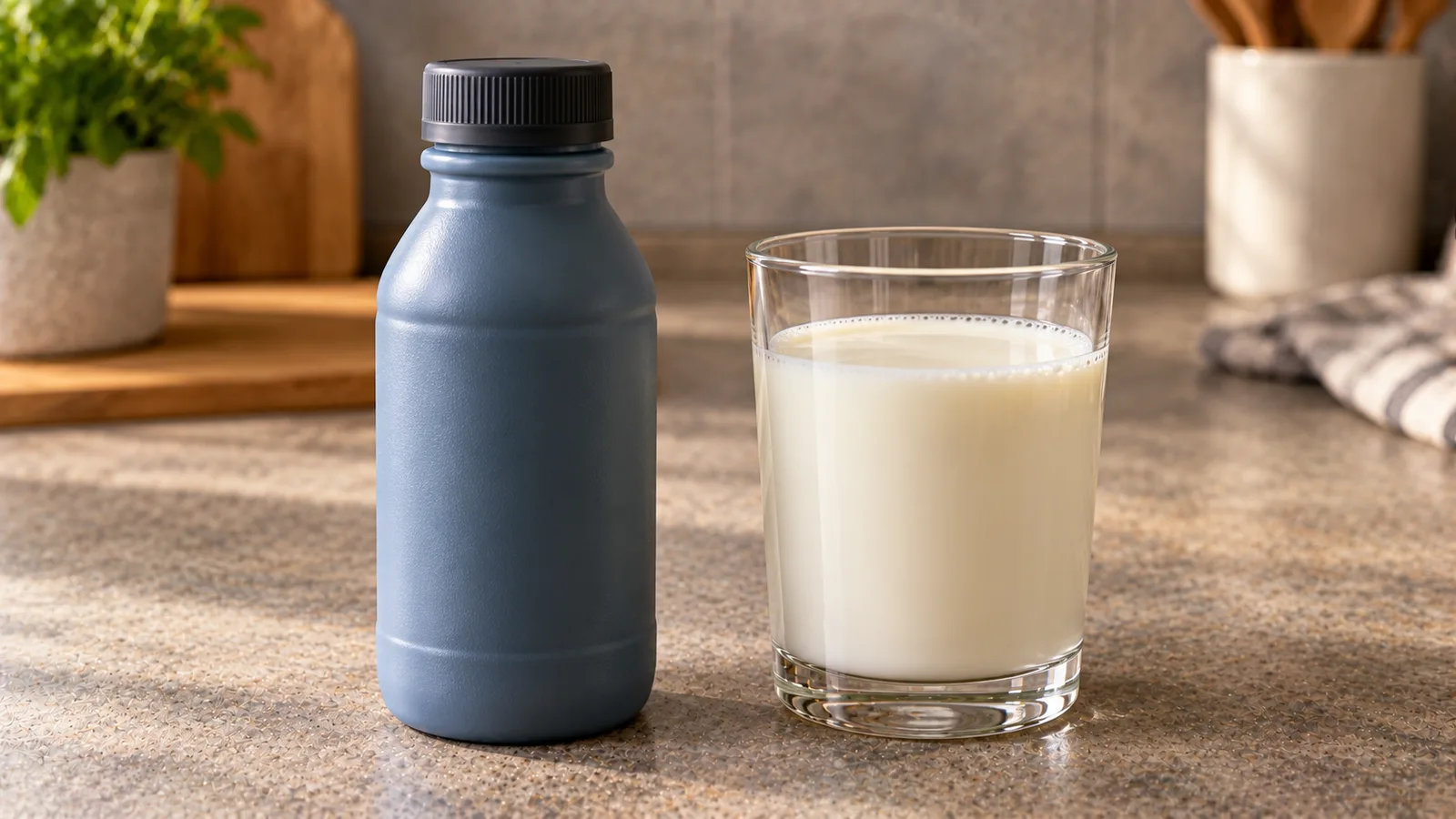
A ready-to-drink protein shake and a glass of ordinary milk can look like similar supermarket purchases, yet the useful comparison changes depending on the question. A single enriched bottle may provide substantially more protein than a small glass, while milk can cost much less per gram of protein. Neither statement tells the whole story about sugar, calories, ingredients or convenience. This guide uses three specific German-market products, their published nutrition labels and a transparent illustrative price model. It compares actual containers, equal volumes and the cost of getting 20 g of protein. Protein powders and homemade shakes are deliberately outside its scope.
The three products—and exactly what is being compared
The examples are ja! long-life milk, 1.5% fat, Ehrmann High Protein Chocolate Drink, 250 ml, and Müllermilch High Protein Vanilla, 400 ml. The last two are formulated milk-based drinks, not plain milk and not dairy-free substitutes. Ehrmann lists 8 g of protein per 100 ml, while the Müller product lists 6.8 g. The milk label gives 3.4 g. These values belong to the named flavors and sizes; a different flavor, seasonal formula or country may show another label.
The comparison uses millilitres because all three example labels are expressed per 100 ml. It does not assume the three packs have equal sizes, or that drinking the whole 400 ml bottle is appropriate for everybody. First compare equal volumes. Then compare the actual pack and the amount required for a protein target. If you normally drink 180 ml of milk with breakfast, calculate that portion rather than pretending everyone drinks 250 ml.
Nutrition per 100 ml: protein is only one row
| Per 100 ml | Milk 1.5% | Ehrmann Chocolate | Müller Vanilla |
|---|---|---|---|
| Energy | 46 kcal | 56 kcal | 64 kcal |
| Protein | 3.4 g | 8.0 g | 6.8 g |
| Sugars | 4.8 g | 5.1 g | 5.7 g |
| Fat | 1.5 g | 0.3 g | 1.6 g |
| Salt | 0.09 g | 0.15 g | 0.21 g |
The numbers are transcribed from the manufacturers' product information published by REWE. They are label values, so rounding applies. The protein drinks provide more protein for a given liquid volume. The Ehrmann example is lower in fat than the selected milk, while Müller has slightly more fat and energy. This is not a ranking of every protein drink. Some bottled products contain coffee, added fiber, different fat levels or very different sweeteners.
Notice that the sugar figures are reasonably close on a per-100-ml basis. That matters because a prominent protein headline can make the rest of the label seem irrelevant. Always compare the sugar line along with total carbohydrate and the ingredient list. A product containing milk may still show several grams of sugars when it has no added sugar.
Real containers: a 250 ml comparison is not a 400 ml comparison
| Typical consumed amount | Milk, 250 ml | Ehrmann, 250 ml | Müller, 400 ml |
|---|---|---|---|
| Energy | 115 kcal | 140 kcal | 256 kcal |
| Protein | 8.5 g | 20.0 g | 27.2 g |
| Sugars | 12.0 g | 12.75 g | 22.8 g |
| Fat | 3.75 g | 0.75 g | 6.4 g |
| Salt | 0.225 g | 0.375 g | 0.84 g |
To calculate a pack, multiply each per-100-ml value by the volume divided by 100: 2.5 for a 250 ml serving and 4 for 400 ml. That is why the Müller bottle delivers more total protein than the Ehrmann bottle even though its concentration is lower. It also provides substantially more energy and sugar because it is a larger drink. Comparisons that report only “grams of protein per bottle” are incomplete unless bottle volumes appear beside them.
If you actually pour 250 ml of Müller instead of drinking all 400 ml, the calculation changes to 160 kcal, 17 g protein and 14.25 g sugars. You would also have 150 ml left to refrigerate according to the package's instructions. Do not treat a bottle's contents as an automatic portion recommendation.
Price per bottle, per 250 ml and per 20 g protein
Retail pages for these products do not establish one dependable nationwide checkout price; milk and drinks may differ by branch, promotion and deposit arrangements. To make the arithmetic inspectable, assume €1.15 per litre of milk, €1.69 per 250 ml Ehrmann bottle and €1.79 per 400 ml Müller bottle. These three prices are hypothetical teaching inputs, not verified current offers.
| Illustrative cost metric | Milk | Ehrmann | Müller |
|---|---|---|---|
| Assumed purchase pack | 1,000 ml / €1.15 | 250 ml / €1.69 | 400 ml / €1.79 |
| Cost of 250 ml consumed | €0.29 | €1.69 | €1.12 |
| Protein in 250 ml | 8.5 g | 20.0 g | 17.0 g |
| Cost per 20 g protein | €0.68 | €1.69 | €1.32 |
The last row uses pack price ÷ total pack protein × 20. Milk provides 34 g protein per litre, so €1.15 ÷ 34 × 20 = about €0.68. Ehrmann provides 20 g per bottle, so one bottle corresponds to €1.69. Müller provides 27.2 g per bottle, so €1.79 ÷ 27.2 × 20 = about €1.32. The last method assumes that the remaining part of a purchased bottle can be consumed later; if you throw it away, your personal cost increases.
For 250 ml, the Müller price is €1.79 × 250/400 = €1.12, even though you may have to pay €1.79 at checkout to buy the entire bottle. Likewise a litre of milk may be inexpensive per serving, but still requires storing the remainder. Distinguish the amount used, the payment at checkout and possible waste. Packaging deposits, if applicable, should be accounted for separately because a refundable deposit is not the same as the drink's consumption cost.
How much liquid provides 20 g of protein?
Protein concentration changes the volume required. At 3.4 g per 100 ml, milk requires about 588 ml to provide 20 g. At 8 g per 100 ml, Ehrmann requires 250 ml. At 6.8 g per 100 ml, Müller requires about 294 ml. These are mathematical comparisons, not recommended serving sizes.
Using the same labels, those 20 g-protein amounts would supply roughly 271 kcal and 28.2 g sugars from milk, 140 kcal and 12.75 g sugars from Ehrmann, and 188 kcal and 16.8 g sugars from Müller. Someone wanting a compact protein addition may value the smaller drink. Someone who likes milk with a meal and already meets their daily protein needs may see no reason to pay more for a specialty bottle.
A meaningful protein target should come from the rest of the day's food, body size, life stage and personal circumstances, not a slogan printed on a bottle. The German Nutrition Society's reference for healthy adults under 65 is generally 0.8 g protein per kilogram of reference body weight per day; adults from 65 have a higher estimated adequate intake. That guidance does not make a 20 g shake compulsory.
Sugar on the label is not automatically added sugar
Both branded examples list sweeteners, and Ehrmann advertises a product without added sugar. Yet its nutrition declaration still shows 5.1 g sugars per 100 ml. This is not necessarily a contradiction: the total-sugars line also includes sugars naturally present in milk or formed during processing. The EU's mandatory nutrition declaration lists total sugars, not a separate standardized “added sugars” line like that seen on many US labels. Read the ingredient list to understand whether sugar or sweetening ingredients were added.
The difference becomes particularly clear in a full bottle. The 400 ml Müller example supplies 22.8 g total sugars. That is a statement about the particular drink in the stated quantity, not a claim that all 22.8 g were added at the factory. A “no added sugar” claim has regulatory conditions and must not be equated with “sugar free.” Readers comparing these labels should avoid turning one number into a medical judgement about either product.
If sweetness is an issue for you, compare plain unsweetened milk, the flavored drink's ingredient list, the sugar total and your actual serving. A ready-to-drink protein product can be useful while still containing sweeteners or flavorings you would rather avoid. Ordinary milk can taste less sweet while contributing similar total sugars per 100 ml.
What does “high protein” actually mean in Europe?
The EU permits the claim “high protein” when at least 20% of a food's energy is provided by protein; the threshold for “source of protein” is 12%. Those are proportions of energy, not a promise that the bottle contains 20 g or 30 g. A tiny serving could legally qualify by energy share while providing only a modest number of grams. Conversely, a glass of plain milk contributes protein without needing to compete with a product designed for front-of-pack claims.
Using the labels as approximate examples, Ehrmann provides 8 × 4 = 32 kcal from protein per 56 kcal, and Müller provides 6.8 × 4 = 27.2 kcal from protein per 64 kcal. Both exceed the 20% threshold. These estimates use the conventional 4 kcal per gram of protein and rounded labels. They do not establish an independent regulatory audit of the packaging. The useful consumer question remains: how much protein will your actual drink provide?
Lactose-free is not dairy-free
Ehrmann describes the specific Chocolate product as lactose-free and lists milk-derived ingredients plus lactase. That does not make it suitable for a person with a cow's-milk protein allergy. Lactose intolerance concerns digestion of milk sugar; milk-protein allergy concerns a reaction to milk proteins. A bottle designed to supply milk protein can be particularly inappropriate for someone avoiding those proteins, even when lactose content is extremely low.
Regular milk contains lactose unless processed to remove or break it down. The Müller example is also a milk product; do not assume it is lactose-free unless the exact label says so. People with a diagnosed allergy should follow their clinical dietary instructions rather than relying on the word “protein,” “low lactose” or “no added sugar.” This is an ingredient and allergy distinction, not a claim about the superiority of any drink.
What about calcium and other nutrients?
Ordinary cow's milk can contribute calcium, riboflavin and vitamin B12 along with protein. The selected ja! milk product lists 118 mg calcium per 100 ml, or 295 mg for 250 ml. It would be misleading to assume the two flavored drinks have exactly the same calcium amount without a verified declaration. Some formulated dairy drinks may include additional vitamins, while others emphasize only protein. Check each bottle for vitamins and minerals rather than borrowing milk's numbers.
A protein drink is not a substitute for every component of a balanced meal. A complete breakfast or lunch may also need fiber-containing foods, produce and sufficient overall energy. If the beverage is a snack, its place in the day matters more than whether its front label looks sporty. For a broader list of ordinary protein sources, use Mealisa's high-protein foods guide.
A practical supermarket decision in five questions
First identify whether your goal is more protein in less liquid, the lowest price per gram, the lowest total calories, or simply a beverage you enjoy. There is no single winning bottle for those four questions. Compare the labels in the same units; then calculate the amount you will actually drink.
Second look at sugar, fat, salt and ingredients, not only protein. Third ask whether the product has to be refrigerated or can sit unopened in a pantry. Fourth consider whether you'll use the entire container before its recommended use-by or post-opening period. Fifth compare actual shelf prices and local offers. This can prevent buying several expensive drinks just because the price of one bottle seems small.
Mealisa's nutrition-label reading guide explains how to check the per-100-ml basis. Its portion versus serving guide helps translate that figure into what you drink, and its milk nutrition guide supplies broader context for ordinary milk types. These links are supporting reading; none replaces the specific printed label in your hand.
Two shopping scenarios with different rational decisions
Scenario A: an easy portable 20 g of protein. A consumer already has lunch organized but wants a small bottled protein contribution during travel. In this comparison the 250 ml Ehrmann bottle meets the target in one pack. The 400 ml Müller bottle can meet it in about 294 ml, leaving some for later. Plain milk would need about 588 ml. The bottled format and storage convenience may justify an extra price for this consumer.
Scenario B: a household using milk daily. Another person regularly buys milk, eats enough protein from normal meals and is watching grocery spending. Under the illustrative assumptions, milk is substantially cheaper per 20 g protein, and a 250 ml glass already contributes 8.5 g toward the day's total. There may be no material nutritional need for an extra branded bottle. The remaining protein can come from other familiar foods rather than chasing a single beverage number.
Neither scenario says the same purchase is always best. Lactose tolerance, allergies, personal preferences and the foods accompanying the drink also affect the answer. Both scenarios assume the given product labels and the hypothetical price inputs, not an unverified supermarket promotion.
Quick calculation you can repeat for any bottle
Write down the drink's millilitres, its protein per 100 ml and its price. Multiply the protein figure by the volume divided by 100 to obtain protein per container. Multiply the sugar, fat and energy figures by the same factor. Then divide the purchase price by the grams of protein and multiply by 20 if you want a cost per 20 g protein benchmark. Finally ask whether you actually consume the whole container.
For example, a new 330 ml drink with 7 g protein per 100 ml would contain 23.1 g protein, whatever marketing phrase it uses. If it cost an assumed €1.98, the price per 20 g protein would be €1.71, calculated as €1.98 ÷ 23.1 × 20. This example is purely hypothetical and is not a description of a currently sold product. You can apply the same method to any correctly labeled drink.
Sources and scope
- ja! H-Milch 1.5% — REWE product nutrition declaration
- Ehrmann High Protein Chocolate Drink 250 ml — REWE label
- Müllermilch High Protein Vanilla 400 ml — REWE label
- European Commission — nutrition labelling
- European Commission — permitted nutrition claims
- German Nutrition Society — protein reference values
- Cambridge University Hospitals NHS — milk allergy and lactose intolerance
The numeric results apply to the named product variants and rounded labels, while every displayed grocery price is an illustrative assumption. This is general nutrition information, not individualized medical advice. Check your local package, allergy information, volume and checkout receipt before deciding.