
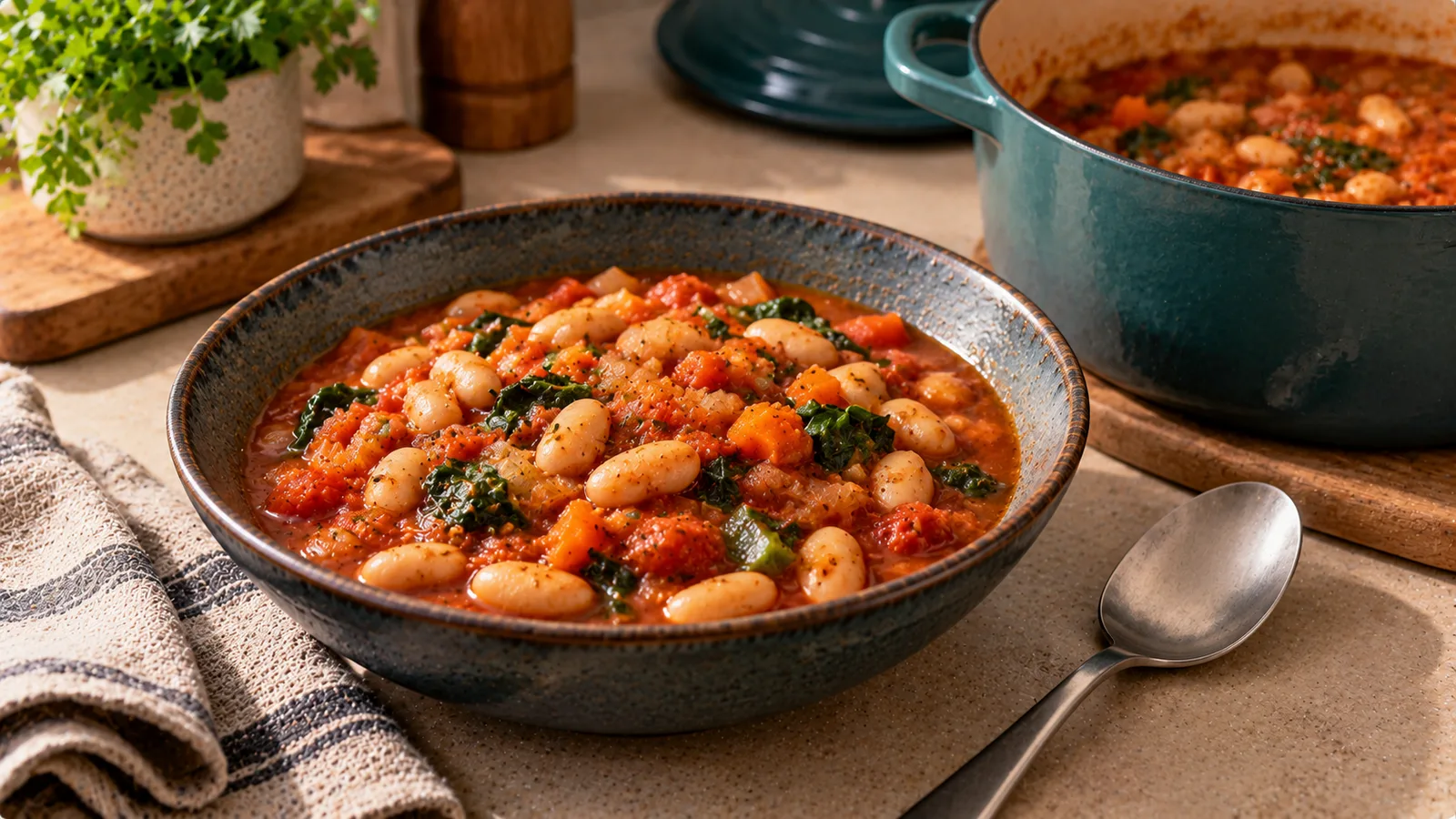
White beans and tomatoes make a simple base for a filling one-pot meal. This version combines beans with carrots, onion, celery, tomatoes and herbs, with enough liquid to create a thick stew rather than a soup.
The recipe makes approximately 4 servings. The final cooked weight will vary with simmering time and evaporation, so weighing the finished pot is the best way to calculate an exact portion size.
Ingredients
For approximately 4 servings:
- 480 g drained and rinsed white beans;
- 800 g canned chopped tomatoes;
- 150 g onion;
- 150 g carrots;
- 100 g celery;
- 10 g garlic;
- 15 g olive oil;
- 300 ml vegetable stock or water;
- 1 teaspoon dried oregano;
- 1 teaspoon dried thyme;
- 1 teaspoon smoked or sweet paprika;
- black pepper to taste;
- salt to taste;
- 10 g fresh parsley, optional.
Cannellini, navy beans, great northern beans or another mild white bean can work well.
If you use canned beans, the 480 g refers to drained weight, not the total weight including the liquid in the cans.
Preparation
1. Prepare the vegetables
Dice the onion, carrots and celery into relatively small pieces.
Finely chop or crush the garlic.
Keeping the vegetables similar in size helps them cook evenly.
2. Soften the vegetables
Heat 15 g olive oil in a large saucepan or Dutch oven over medium heat.
Add the onion, carrots and celery.
Cook for about 7–9 minutes, stirring occasionally, until the onion is soft and the vegetables have started to become tender.
If the vegetables begin sticking, reduce the heat rather than immediately adding more oil.
3. Add garlic and seasonings
Add the garlic, oregano, thyme and paprika.
Cook for approximately 30–60 seconds, stirring continuously.
This briefly heats the spices without giving the garlic enough time to burn.
4. Add tomatoes and liquid
Add:
- 800 g chopped tomatoes;
- 300 ml vegetable stock or water.
Stir well and bring the mixture to a gentle simmer.
Cook uncovered for approximately 10 minutes.
5. Add the white beans
Stir in the drained beans.
Return the stew to a gentle simmer and cook for another 12–15 minutes.
Stir occasionally, especially as the mixture becomes thicker.
6. Adjust the texture
For a thicker stew, lightly mash some of the beans against the side of the pot with a spoon.
This releases some of their starch and thickens the liquid without adding flour or cream.
For a looser stew, add a little more water or stock.
7. Season and serve
Taste before adding the final salt, particularly if the beans and stock already contain sodium.
Add black pepper and parsley if desired.
Serve hot.
How much does the finished stew make?
The ingredients weigh considerably more before cooking than the final dish may weigh because some water evaporates.
A typical batch may finish at approximately 1.8–2.0 kg, depending on:
- how long it simmers;
- how wide the pot is;
- whether the stew is cooked covered or uncovered;
- how much additional water is used.
For accurate portion tracking, weigh the entire finished batch.
For example, if the finished stew weighs 1,920 g:
1,920 ÷ 4 = 480 g per serving
If it weighs 1,840 g:
1,840 ÷ 4 = 460 g per serving
The number of servings can remain four even when the exact gram weight changes.
Estimated nutrition
Using typical nutrition values for the listed ingredients, one quarter of the recipe is approximately:
| Nutrition | Per serving |
|---|---|
| Calories | 350–390 kcal |
| Protein | 17–20 g |
| Carbohydrates | 55–65 g |
| Fat | 6–8 g |
| Fiber | 14–17 g |
These values are estimates.
The actual nutrition depends particularly on the beans, canned tomatoes, stock and exact amount of olive oil used.
For precise tracking, calculate the recipe from the nutrition labels of your ingredients.
Where the calories come from
The largest calorie contribution comes from the white beans.
The olive oil is also calorie-dense even though the amount is relatively small.
Tomatoes and vegetables contribute volume, flavor and nutrients while adding fewer calories than the beans or oil.
This combination is one reason the stew can produce a relatively large serving without requiring a large number of ingredients.
Using dry beans instead of canned beans
You can make the recipe with beans cooked from dry.
The important point is to substitute by cooked bean weight, not dry weight.
The recipe uses:
480 g cooked and drained beans
Do not substitute 480 g of dry beans. Dry beans absorb water and become substantially heavier during soaking and cooking.
Cook the dry beans first, drain them and then weigh 480 g for the stew.
Do you need to rinse canned beans?
Rinsing is useful when you want to remove the canning liquid and have a cleaner tomato-based sauce.
Place the beans in a colander, rinse them briefly under water and allow them to drain.
If the nutrition label is based on drained beans, use the drained amount when calculating the recipe.
Can you use different white beans?
Yes.
Suitable options include:
- cannellini beans;
- navy beans;
- great northern beans;
- butter beans.
The texture will vary.
Cannellini beans usually remain fairly creamy while holding their shape. Butter beans are larger and can produce a chunkier stew.
Nutrition can also differ slightly, so use the specific product label when tracking calories and macros.
How to make the stew thicker
There are several ways to make the stew thicker without changing it into a completely different recipe.
Mash some beans
Mash roughly one-quarter of the beans directly in the pot.
This is the simplest method and does not add another ingredient.
Simmer longer
Cook the stew uncovered for another 5–10 minutes.
More water evaporates and the sauce becomes more concentrated.
Use slightly less stock
If you already know you prefer a very thick stew, start with approximately 200–250 ml rather than 300 ml.
You can always add more liquid later.
How to make it thinner
If the stew becomes too thick, add water or stock in small amounts.
Start with approximately 50 ml, stir and reassess.
Adding water changes the weight and volume of the recipe but does not meaningfully add calories.
That means the calories per 100 g will decrease slightly as more water is added, while the total calories in the pot remain essentially unchanged.
Adding spinach
Spinach works well if you want additional vegetables.
Add approximately 100–150 g fresh spinach during the final few minutes.
Stir until wilted.
Because spinach loses a great deal of volume when heated, this amount can be added without substantially changing the structure of the stew.
Adding other vegetables
You can also use vegetables such as:
- zucchini;
- bell pepper;
- mushrooms;
- kale.
Try to avoid adding many substitutions at once if you want predictable cooking time and nutrition.
If you add a large amount of extra vegetables, you may also need more liquid or seasoning.
Can you add potatoes?
Yes, but potatoes change the recipe more significantly.
If adding diced potatoes, they should go into the pot before the beans because they need longer to cook.
For example, add approximately 300–400 g diced potatoes with the tomatoes and stock and simmer until almost tender before adding the beans.
The potatoes also add calories and carbohydrates, so include them in the recipe calculation.
Adding more protein
The beans already provide plant protein, but the recipe can be modified if desired.
Possible additions include:
- extra white beans;
- lentils;
- chicken;
- turkey;
- tofu.
These additions change the nutrition and cooking method.
If your goal is simply to increase the protein without redesigning the recipe, adding more beans is the most straightforward option.
What to serve with white bean and tomato stew
The stew can be eaten on its own or paired with:
- crusty bread;
- whole-grain bread;
- rice;
- baked potatoes;
- a simple salad.
Remember that side dishes are separate from the nutrition estimate for the stew itself.
For example, if one serving of stew contains approximately 370 kcal and bread adds 180 kcal, the meal contains approximately:
370 + 180 = 550 kcal
before any additional toppings.
Portioning the recipe accurately
If you want four equal portions, weighing the finished batch is more reliable than trying to divide it visually.
Suppose the final cooked weight is 1,900 g.
1,900 ÷ 4 = 475 g per serving
You can then portion four containers at approximately 475 g each.
If you want six smaller servings:
1,900 ÷ 6 = approximately 317 g per serving
The total nutrition of the recipe does not change. Only the amount assigned to each serving changes.
Calculating calories from the full batch
Suppose your exact ingredients add up to 1,480 kcal for the entire recipe.
If divided into four equal servings:
1,480 ÷ 4 = 370 kcal per serving
If divided into five:
1,480 ÷ 5 = 296 kcal per serving
If you divide by finished weight instead, suppose the cooked batch weighs 1,900 g.
1,480 ÷ 1,900 × 100 = approximately 78 kcal per 100 g
A 450 g portion would then contain:
78 × 450 ÷ 100 = approximately 351 kcal
This method is useful when portions are not all the same size.
Meal-prep storage
Allow the stew to cool promptly and transfer it to covered containers before refrigerating.
For meal prep, dividing it into portions before storage can make later meals easier to track and reheat.
Follow appropriate food-storage guidance for your ingredients and refrigerator conditions.
If you will not eat all of the stew within the recommended refrigerated storage period, freeze the extra portions rather than keeping them in the refrigerator for too long.
Freezing
White bean and tomato stew generally freezes well.
Let it cool, divide it into suitable containers and leave enough room for expansion.
When reheating, the stew may be thicker because the beans continue to absorb liquid.
Add a small amount of water or stock if necessary.
Reheating
Reheat until the stew is thoroughly hot.
If it has thickened considerably in storage, stir in a little water before or during reheating.
Adding water will not add calories.
If you add oil, cheese, cream or another calorie-containing ingredient while reheating, include it separately when tracking the meal.
Common tracking mistake: counting the canned weight
A can may list both total weight and drained weight.
For this recipe, the relevant bean quantity is 480 g drained beans.
If two cans each contain 400 g total but only 240 g after draining:
240 + 240 = 480 g drained beans
Entering 800 g of beans in a food log would substantially overestimate the amount actually used.
Common tracking mistake: forgetting the olive oil
The vegetables absorb and carry some of the cooking oil into the finished stew.
If 15 g of olive oil goes into the pan and remains in the dish, include the full amount in the recipe.
At roughly 9 kcal per gram of fat, oil can make a noticeable contribution even when the volume looks small.
Common tracking mistake: changing the serving count without changing portion size
If the recipe is entered as four servings, one serving represents one quarter of the batch.
Changing the app entry to six servings reduces the calculated nutrition per serving, but only because each theoretical serving becomes smaller.
It does not reduce the calories in the pot.
For accurate logging, make sure the serving count reflects how the finished batch is actually divided.
Quick recipe summary
For four servings:
- 480 g drained white beans;
- 800 g chopped tomatoes;
- 150 g onion;
- 150 g carrots;
- 100 g celery;
- 10 g garlic;
- 15 g olive oil;
- 300 ml vegetable stock or water;
- oregano, thyme and paprika.
Cook the vegetables first, add the tomatoes and liquid, then simmer the beans in the sauce until the stew thickens.
A typical serving provides approximately 350–390 kcal and 17–20 g protein, depending on the exact ingredients.
For the most accurate nutrition per portion, calculate the full recipe using your product labels, weigh the finished batch and divide it by the portions you actually serve.