
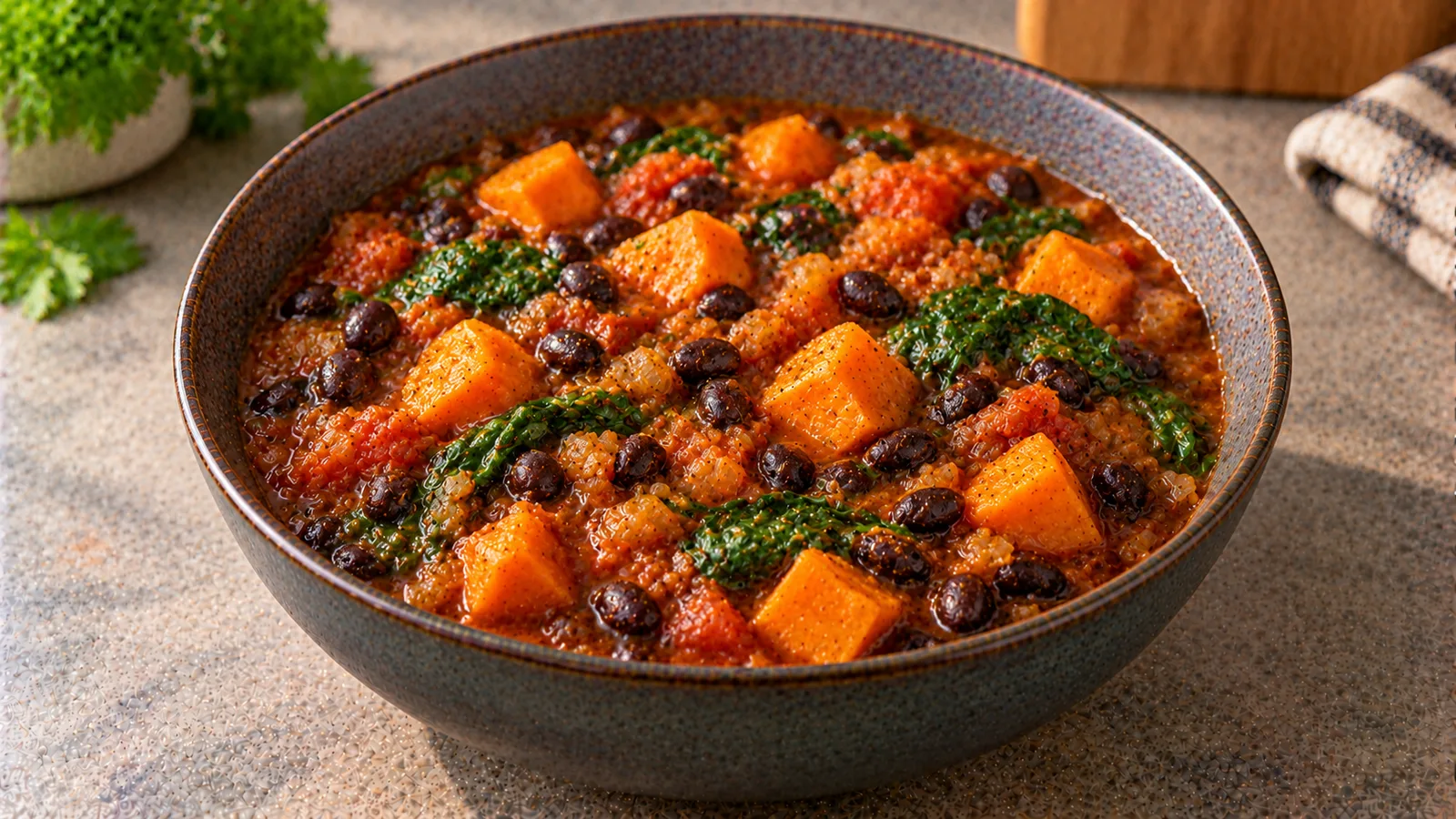
Sweet potato, black beans and spinach turn into a thick, gently smoky vegetarian chili with ordinary supermarket ingredients. This version serves four adults, uses two cans of already-cooked black beans, and keeps the sweet potato in distinct tender chunks instead of mashing it into the sauce. It is designed for a single large saucepan, a straightforward shopping list and leftovers that can be portioned safely. The calorie and cost calculations below refer to this exact ingredient model—not every chili with a similar name.
At a glance: the finished meal
Allow 15–20 minutes of preparation and roughly 30–40 minutes on the hob. The actively simmering period is about 20–25 minutes after the vegetables have been sautéed; particularly large sweet potato cubes can need longer. The recipe is vegan when served without dairy toppings. It contains black beans, vegetables, tomato and olive oil, but no meat, rice or added cheese in the stated nutrition model.
The base batch contains 600 g peeled raw sweet potato, 480 g drained cooked black beans, 200 g raw spinach, 500 g tomato passata, 150 g onion, 180 g red pepper, 12 g garlic and 20 ml olive oil. Water, chili, cumin and smoked paprika are used for consistency and seasoning. The resulting estimate is approximately 367 kcal, 14.8 g protein and 18.5 g fibre per quarter-batch. These are arithmetic estimates with data from named packages and generic raw-food profiles, not a laboratory test of your dinner.
Ingredients for four portions
| Ingredient | Exact amount | Weigh or measure it as | Role in the chili |
|---|---|---|---|
| Sweet potato | 600 g | Peeled, raw edible cubes | Tender sweetness and texture |
| Davert cooked black beans | 480 g | Two cans, 240 g drained each | Beans and fibre |
| Fresh spinach | 200 g | Raw, washed leaves | Greens added at the end |
| dmBio tomato passata | 500 g | One full carton | Thick tomato base |
| Onion | 150 g | Peeled, chopped | Aromatic base |
| Red bell pepper | 180 g | Deseeded, chopped | Soft vegetable pieces |
| Garlic | 12 g | Peeled, finely chopped | Aroma |
| Olive oil | 20 ml | Measured in a jug or spoons | Sautéing |
Also use 150–250 ml water initially, 2 tsp smoked paprika, 1 tsp ground cumin, and chili flakes or powder to taste. Spices and water are not quantified in the nutrition model; a generous commercial seasoning mix, sugar or stock cube can change the numbers, especially salt. Start without added salt because the selected beans and passata are already salted.
There is no need for long soaking: the black beans are already cooked. The Davert product lists 400 g total contents and 240 g drained beans per can. Two cans therefore supply 480 g edible beans after draining, not 800 g of beans. The product label gives 91 kcal, 6.6 g protein, 7.6 g fibre and 0.6 g salt per 100 g; see the Davert black-bean label. Tomato passata is calculated using dmBio's 500 g carton, listed at 34 kcal, 1.6 g protein, 1.7 g fibre and 0.3 g salt per 100 g.
Before heating: which weights matter?
Use the sweet potato's peeled raw edible weight, not the size of an unpeeled specimen at checkout. If you purchase an 800 g root and discard skin, damaged ends or woody parts, weigh 600 g of usable flesh for this model. Cut into approximately 1.5–2 cm cubes: the pieces should soften in the sauce but still hold their shape when stirred.
Drain the two bean cans through a sieve and weigh or use their stated drained weight. The brine counts toward a can's net contents but is not part of this recipe. Rinsing is optional for taste and may change the sodium retained; it does not allow a precise revised salt calculation without new product data. Spinach is weighed raw before it collapses in the pot. Passata is measured as the full 500 g package and oil as 20 ml, not automatically 20 g. For a different dish based on legumes, our black-bean nutrition and portion guide discusses why canned and dry weights are not interchangeable.
Step 1: develop the aromatic base
Choose a sturdy 3–4 litre saucepan or Dutch oven with a lid. Set it over medium heat and add the measured olive oil. Cook the chopped onion and pepper with occasional stirring for about 6–8 minutes, until the onion becomes translucent and the pepper begins to soften. Do not aim for deep browning; a little sweetness and a cooked base are enough.
Add the garlic, smoked paprika and cumin. Stir for about 30 seconds until fragrant. Garlic and powdered spices can scorch quickly against a hot, dry pan. If they start catching, add a spoonful of water rather than extra oil. Smoked paprika creates a chili-like background; it is not a substitute for enough tomato and vegetables. Add chili flakes gradually, especially when feeding people with different heat preferences.
Step 2: simmer sweet potato in the tomato sauce
Stir in 600 g sweet potato cubes, the 500 g passata and 150 ml water. Scrape the bottom to incorporate the seasoned oil and vegetables. Bring the mixture to a gentle simmer, cover partially and cook for 15 minutes, stirring once or twice. The sauce should bubble steadily but not boil aggressively. If it becomes too thick before the potato is nearly cooked, add water in 30–50 ml increments.
The sweet potato is done when a fork enters a cube easily but the cube still keeps a clear outline. Start checking at 18–20 minutes, since the actual time depends on cube size and hob intensity. A pot with different-sized pieces is likely to contain both soft and firm bites. Correct this by cutting evenly, not by simply blending the whole chili. More water changes the weight and thickness of the final dish, but water alone contributes no calories, protein or fibre.
Step 3: warm the beans; wilt the spinach last
Fold in the drained 480 g black beans and simmer for 5–7 minutes, until they are piping hot throughout. These are cooked beans: you are heating them and combining flavours, not making dry beans safe through a short simmer. For advice on cooking and eating legumes, the DGE guidance on pulses distinguishes cooked legumes from raw ones.
Add the 200 g spinach in two handfuls, pushing it down as the leaves wilt. Cook for a further 2–3 minutes, stirring gently. Keep a few intact sweet-potato pieces and visible black beans; a thick chili should not look like a puréed soup. Taste only after the beans and tomato have been mixed through. Adjust smoke, heat and acidity with spices and a little lemon if available; optional lemon is not included in the calorie table. A small squeeze can brighten the flavour without adding a measurable amount of sodium.
How thick should the chili be?
A spoon drawn through the pot should leave a channel that slowly fills in. If the sauce is runny, simmer uncovered for 3–5 minutes. If it is too thick, add warm water a few tablespoons at a time. Avoid crushing all the sweet potato as a shortcut: it will thicken the sauce but remove the defining orange chunks. A handful of lightly mashed beans can thicken the sauce naturally if desired, although the texture becomes different.
Do not use finished cooked weight alone to reconstruct the ingredient calories. If the recipe starts with a fixed amount of food and gains 200 ml water, the same nutrients are spread through a heavier batch. Conversely, evaporation concentrates nutrients per 100 g without creating more of them. Divide the finished chili into four equal portions by weight if precision matters. For the distinction between a manufacturer's portion and the amount on your plate, see portion size versus serving size.
Nutrition: calculate from the ingredient weights
The table below uses the named Davert bean and dmBio passata labels. The remaining whole foods use illustrative generic raw-food values comparable to those searchable in USDA FoodData Central for raw sweet potato and raw spinach. These search links do not certify one unique database ID or cooking yield. Oil is modelled as 824 kcal per 100 ml (an explicit estimate rather than a verified brand label); onion, pepper and garlic use rounded reference values. The spices, water and optional garnishes are excluded. All figures are approximate.
| Calculation | Entire four-portion batch | One of four equal portions |
|---|---|---|
| Energy | 1,467.3 kcal | 366.8 kcal |
| Protein | 59.3 g | 14.8 g |
| Carbohydrate | 241.1 g | 60.3 g |
| Fat | 23.4 g | 5.8 g |
| Fibre | 74.0 g | 18.5 g |
| Salt from bean and passata labels only | 4.38 g | 1.10 g |
Worked example: sweet potatoes contribute 600 × 86 / 100 = 516 kcal; beans contribute 480 × 91 / 100 = 436.8 kcal; passata adds 500 × 34 / 100 = 170 kcal. The 20 ml oil adds approximately 164.8 kcal under the stated oil assumption. The other ingredients account for the balance. The four equal portions each contain one quarter of the entire recipe's estimated energy. This method is more reliable than comparing calories per 100 g of finished chili whose moisture can vary.
The estimated 18.5 g fibre per portion is relatively substantial, largely because the beans, sweet potato, spinach and vegetables all contribute. It is not a health guarantee and can change when using different brands. The DGE fibre reference explains why fibre is relevant in an overall diet. If you need to understand a sweet potato apart from this composite meal, our sweet-potato nutrition guide covers that separate search intent.
Salt: check the cans before adding seasoning
Two cans at 0.6 g salt per 100 g drained beans supply 2.88 g of labelled salt in the recipe. The passata at 0.3 g per 100 g contributes another 1.50 g. That is already 4.38 g for the batch, or 1.10 g per quarter, before counting naturally occurring sodium in the other ingredients or any added salt, stock powder or toppings. It is therefore incorrect to label the recipe “low-salt” merely because you did not sprinkle salt from a shaker.
If you choose different canned beans or an unsalted passata, calculate those contributions again. Rinsing the beans might reduce the salt remaining but the exact decrease is not known from the original label. The right habit is to read the package, measure seasoning and taste after simmering. This keeps the nutrition model transparent rather than overstating precision.
Cost of the used ingredients and the checkout bill
The currently displayed German dm prices are €1.65 for each 240 g drained Davert bean can and €0.70 for one 500 g dmBio passata carton. They total €4.00 for two cans and the carton. The remaining figures below are illustrative budget assumptions, not verified current offers: sweet potato €2.29/kg, spinach €2.50/200 g, onion €1.49/kg, red pepper €3.49/kg, olive oil €7/litre, garlic €9/kg and mixed spices €0.25 for the amount used.
| Ingredient cost illustration | Used amount | Cost charged to recipe |
|---|---|---|
| Davert black beans | Two 240 g drained cans | €3.30 |
| dmBio passata | 500 g carton | €0.70 |
| Sweet potato | 600 g at €2.29/kg | €1.37 |
| Spinach | 200 g | €2.50 |
| Onion + red pepper + garlic | 150 + 180 + 12 g | €0.96 |
| Olive oil + spices | 20 ml + recipe quantity | €0.39 |
| Total used / four portions | €9.22 | |
| Cost per portion | €2.31 |
The small rounding difference between row figures and the underlying unrounded sum is intentional. If you buy an entire bottle of oil, a kilo of onions and all the spices for one dinner, the cash checkout will be higher than €9.22 even though leftovers remain. Conversely, ingredients already in your kitchen do not become free economically: they still have a replacement cost. Do not copy the illustrative prices into a “current REWE bargain” claim. A practical way to keep the full grocery spend in view is our budget meal-prep guide.
Meal prep: cool, refrigerate and freeze safely
To batch cook, divide the hot chili into shallow food-safe containers instead of leaving a large pot on the counter. Refrigerate promptly—within two hours, or one hour in very hot conditions. Keep cooked leftovers at 4 °C or colder where possible and eat refrigerated portions within 3–4 days. Freeze portions for longer storage and reheat thoroughly, stirring until the centre is hot. See the USDA guidance on leftovers.
The sweet potato may become softer after thawing; that is a texture change rather than proof of spoilage. Stir gently when reheating so the beans remain visible. Do not leave an opened bean can at room temperature after draining. If you are cooking for tomorrow's lunch, pack the chili cold and keep it chilled in transit until reheating. Refrigeration is especially important for a moist, cooked bean-and-vegetable dish.
Adjustments that keep the recipe recognisable
For more heat, add fresh chili or extra chili flakes. For a milder version, use only smoked paprika and cumin. For a thinner bowl meal, add more water; for a thicker spoonable chili, simmer uncovered. To make four larger portions, add a separately calculated side of brown rice or wholegrain bread rather than claiming the original nutrition numbers still apply. This is not a “high-protein” guarantee: the illustrated serving has around 14.8 g protein, and the beans supply much of it.
You can replace fresh spinach with frozen leaf spinach, but use the same edible weight, thaw as required and simmer off extra water. You can substitute kidney beans, yet the label protein, fibre and salt will change. A bean burger and this chili serve different cooking purposes; our black-bean burger recipe gives another way to use legumes without recycling this recipe's flavour and texture. An optional avocado topping also changes energy and fat, so weigh it separately.
Sources and calculation notes
- Davert black-bean label, 240 g drained — named packaged bean values and observed price.
- dmBio tomato passata, 500 g — tomato values and observed price.
- USDA FoodData Central: sweet potato, raw search — reference lookup; values vary by entry.
- USDA FoodData Central: spinach, raw search — reference lookup; values vary by entry.
- DGE guidance on legumes — general dietary context.
- DGE reference values for fibre — dietary context, not a recipe-specific test.
- USDA leftovers and food safety — cooling, storage and reheating.
All figures refer to the weighed raw/edible ingredients and drained cooked beans specified above. The spice mix, water and any toppings are excluded. Prices and raw-food profiles should be replaced with the actual products available to you before exact meal logging or budgeting.