
Meal prep can save money, but it can also become surprisingly expensive.
Buying a long list of special ingredients, preparing too much food, using expensive convenience products and throwing away unwanted leftovers can erase much of the financial benefit.
Budget meal prep works differently.
The goal is not to fill a refrigerator with dozens of identical containers.
It is to prepare useful food in advance while controlling how much you buy, how much you cook and how much eventually gets eaten.
What is budget meal prep?
Budget meal prep means planning and preparing food ahead of time with cost as one of the main constraints.
That can include:
- cooking complete meals
- preparing ingredients
- cooking larger batches
- portioning leftovers
- washing and cutting produce
- preparing components that can be used in several meals
You do not need to prepare every meal for the entire week.
Even preparing two or three useful components can reduce cooking time and make it easier to use groceries before they spoil.
Meal prep is only economical if you eat the food
The cheapest meal on paper is not cheap if half of it ends up in the bin.
A useful budget calculation is:
cost of groceries used ÷ portions actually eaten
This is more meaningful than dividing the recipe cost by the number of portions you originally intended to make.
If a €12 batch was supposed to produce six portions but you only eat four, the effective cost per eaten portion is higher.
See How to Calculate Cost per Meal.
Start with food you already have
Before writing a shopping list, check:
- refrigerator
- freezer
- pantry
- bread storage
- produce that needs to be used soon
Build part of your prep around those ingredients.
This can prevent buying duplicates and reduce the chance that older food gets forgotten.
A half bag of rice, frozen vegetables, eggs and a few vegetables may already form the base of several meals.
Choose a small number of flexible ingredients
Budget meal prep becomes expensive when every planned meal requires a completely different ingredient list.
Instead, look for ingredients that can work in more than one meal.
Examples:
Rice
Can be used with:
- vegetables
- beans
- chicken
- tofu
- eggs
- curry
- stir-fries
Potatoes
Can become:
- roasted potatoes
- boiled potatoes
- soup
- a side dish
- part of a tray bake
Eggs
Can work in:
- breakfast
- sandwiches
- rice dishes
- salads
- quick dinners
Vegetables
Carrots, onions, cabbage, peppers, spinach and frozen vegetables can often be used across several dishes.
Ingredient overlap reduces the number of separate products you need to buy.
Do not buy ingredients just because they appear in a meal-prep recipe
A recipe may look inexpensive while requiring:
- several sauces
- specialty spices
- fresh herbs
- toppings
- garnishes
- ingredients you rarely use
The cost of one serving may appear low if the recipe calculation counts only the small amount used.
But you still have to buy the whole package.
Before buying something new, ask:
- Do I already have an alternative?
- Will I use the rest of this ingredient?
- Can I use it in another meal this week?
- Is it important to the recipe?
Skipping a decorative topping or substituting an existing ingredient may make meal prep considerably cheaper.
Plan the number of portions realistically
One of the easiest ways to overspend is to prepare too much.
Consider how many meals you will actually eat at home.
Account for:
- work lunches
- restaurant plans
- social events
- takeout
- travel
- days when you prefer something different
If you realistically need four prepared lunches, making seven does not automatically save money.
It may simply create three unwanted portions.
Prep components instead of seven identical meals
You do not have to prepare a full finished meal for every day.
A more flexible approach is to prepare components such as:
- cooked rice
- roasted potatoes
- cooked lentils
- boiled eggs
- roasted vegetables
- washed salad vegetables
- cooked chicken
- baked tofu
- a simple sauce
Then combine them differently.
For example:
Meal 1: rice + vegetables + chicken
Meal 2: rice + vegetables + egg
Meal 3: potatoes + vegetables + chicken
This keeps ingredient overlap high without requiring identical meals.
Use inexpensive staple foods
Prices vary by country, store and season, but many budget-friendly meal-prep plans are built around basic staples.
Examples can include:
- oats
- rice
- potatoes
- pasta
- lentils
- beans
- eggs
- seasonal vegetables
- frozen vegetables
- canned tomatoes
- plain yogurt
- affordable protein sources available locally
The goal is not to identify one universally cheapest food.
It is to build meals around products that offer good value where you shop.
Compare price per usable amount
A larger package is not automatically cheaper.
Compare:
- price per kilogram
- price per liter
- price per 100 g
- number of usable portions
- how much is likely to be wasted
A large package may have a lower unit price but still cost more overall if part of it spoils.
Use frozen vegetables strategically
Frozen vegetables can work particularly well for budget meal prep because they:
- keep for a long time
- can be portioned as needed
- require little preparation
- reduce spoilage risk
- can fill gaps when fresh produce runs out
Useful options may include:
- peas
- spinach
- broccoli
- cauliflower
- green beans
- mixed vegetables
You do not need to choose between fresh and frozen.
Using both can make planning easier.
Use canned foods where they make sense
Canned foods can provide inexpensive, shelf-stable ingredients.
Examples include:
- beans
- chickpeas
- lentils
- tomatoes
- corn
- some vegetables
Compare drained weight when relevant, not only package size.
Also check product information when sodium, added sugar or other ingredients matter to you.
Build around one or two main protein sources
Buying many different protein sources for one week can increase grocery spending.
Instead, you might choose one or two main options and use them in different ways.
For example:
- eggs + lentils
- chicken + beans
- tofu + eggs
- yogurt + beans
- fish + lentils
The exact combination depends on your diet, preferences and local prices.
Variety can be spread across several weeks rather than forced into every single meal-prep session.
Use leftovers intentionally
Leftovers are not a failure of meal planning.
They can be part of the plan.
If dinner produces two extra portions, decide before cooking what will happen to them.
For example:
- tomorrow's lunch
- another dinner
- freezer portion
This is more reliable than putting leftovers in the refrigerator without a purpose.
See How to Plan Meals With Leftovers.
Freeze portions before you get tired of them
A common meal-prep mistake is keeping every portion in the refrigerator and assuming you will want the same food several days later.
If you prepare a large batch, consider freezing suitable portions early.
That can:
- extend useful storage time
- reduce pressure to eat the same meal repeatedly
- create backup meals for future busy days
- reduce waste
Follow appropriate food-safety guidance for cooling, storing, freezing and reheating foods.
Avoid unnecessary meal-prep equipment
Meal prep does not require buying a new collection of matching containers, specialized organizers or kitchen gadgets.
Use safe containers you already own when possible.
Useful equipment can be simple:
- containers with lids
- freezer-safe containers
- jars
- reusable bags where appropriate
- baking trays
- basic pots and pans
Buying equipment to save money can be counterproductive if the equipment itself becomes another large expense.
Do not confuse bulk buying with saving money
Bulk purchases can reduce unit price, but only when the food is actually used.
Bulk buying works best for foods that:
- you consume regularly
- store well
- fit your available storage
- are genuinely cheaper per usable amount
It works poorly when buying more causes waste or encourages unnecessary spending.
Plan around supermarket offers carefully
A discount is useful only if it replaces something you were likely to buy or provides food you will genuinely use.
Buying three packages instead of one because they are discounted still increases the amount of money spent today.
Ask:
- Was this already on my list?
- Will I use it before it spoils?
- Can I freeze it?
- Is the unit price actually lower?
- Does buying it force me to change several meals?
Meal prep should adapt to useful discounts, not chase every promotion.
Shop after planning, not before
A practical order is:
- check what you already have
- decide how many meals you need
- choose flexible ingredients
- identify ingredient overlap
- write the shopping list
- compare prices at the store
- adjust when a sensible substitute is cheaper
This reduces impulse buying and duplicate purchases.
Keep the shopping list specific
Instead of:
- vegetables
- protein
- snacks
write something closer to:
- 1 kg potatoes
- 500 g carrots
- frozen peas
- eggs
- 2 cans beans
- plain yogurt
The exact quantities should match your household.
A specific list makes it easier to estimate cost and avoid buying vague extras.
Prep the foods most likely to be wasted first
After shopping, identify highly perishable ingredients.
These may include:
- leafy vegetables
- fresh herbs
- certain berries
- mushrooms
- opened dairy products
- fresh meat or fish
Use or prepare these earlier.
More durable foods can wait.
This is one of the simplest ways to connect meal prep with waste reduction.
See How to Avoid Food Waste With Meal Planning.
Keep one low-cost backup meal
Not every meal-prep plan survives the week exactly as expected.
A cheap backup meal can prevent an unplanned takeout order when prepared food runs out.
Examples might include combinations based on:
- eggs
- oats
- pasta
- canned beans
- rice
- frozen vegetables
- soup ingredients
The backup should use foods you normally keep and actually enjoy.
Do not make every meal complicated
A meal does not need ten ingredients to be complete or enjoyable.
Some practical meals may be built from:
- one protein source
- one carbohydrate source
- vegetables
- a small number of flavoring ingredients
Simpler meals can reduce both grocery cost and preparation time.
Use sauces and seasonings you already own
Flavor variety does not require buying a new sauce for every meal.
Before shopping, check what you already have:
- herbs
- spices
- mustard
- vinegar
- soy sauce
- tomato paste
- yogurt
- lemon
- garlic
A small set of familiar seasonings can make the same basic ingredients feel different across several meals.
Track the ingredients that repeatedly go unused
If the same food is regularly discarded, that is useful information.
Possible reasons include:
- buying too much
- unrealistic meal plans
- inconvenient preparation
- not actually liking the food
- forgetting it
- plans changing during the week
Adjust the next shopping trip rather than repeatedly buying the same quantity.
Calculate cost per meal when useful
You do not need to calculate every cent forever.
But occasional cost-per-meal calculations can reveal where money is going.
For example:
- expensive toppings
- large amounts of meat
- convenience products
- sauces
- individually packaged snacks
- ingredients used only once
Once you know the expensive parts, you can decide whether they are worth keeping.
See How to Calculate Cost per Meal.
Budget meal prep for breakfast
Breakfast can often be prepared with inexpensive staples.
Examples include:
- overnight oats
- cooked oats
- boiled eggs
- yogurt with oats or fruit
- homemade breakfast sandwiches
- prepared fruit portions
Choose foods that match your preferences rather than preparing a fashionable breakfast you will not want to eat.
Budget meal prep for lunch
Lunch is often where meal prep can reduce spending most visibly, especially if the alternative is buying lunch away from home.
Possible structures include:
- rice + protein + vegetables
- potatoes + protein + vegetables
- pasta + sauce + vegetables
- soup + bread + another suitable component
- leftovers from dinner
The cheapest useful lunch is one you will actually take with you and eat.
Budget meal prep for dinner
Dinner prep can focus on reducing work rather than completely cooking every meal.
For example, prepare:
- chopped vegetables
- cooked grains
- a sauce
- marinated or cooked protein
- washed greens
Then assemble or finish dinner quickly.
This provides flexibility if your plans change.
Meal prep for two people
For two people, do not automatically double every recipe.
Appetite, schedules and preferences may differ.
Estimate:
- how many shared meals you will eat
- how many individual meals each person needs
- which ingredients both people use
- which meals can share components
See Meal Planning for Two People.
Budget meal prep and nutrition
Saving money does not mean choosing food only by calories per euro.
A practical plan also considers:
- protein
- fiber
- vegetables and fruit
- dietary fats
- variety
- preferences
- satisfaction
An inexpensive plan that leaves you dissatisfied and repeatedly leads to extra purchases may not be economical in practice.
A simple budget meal-prep method
Try this sequence:
Step 1: Check your kitchen
Write down foods that should be used soon.
Step 2: Count your actual meals
Do not prepare for meals you are unlikely to eat at home.
Step 3: Choose two or three flexible bases
For example:
- rice
- potatoes
- pasta
Step 4: Choose one or two protein sources
Use them in multiple meals.
Step 5: Choose a few vegetables
Prefer vegetables that can work in several dishes.
Step 6: Add one backup option
Frozen or shelf-stable foods work well.
Step 7: Shop with a specific list
Compare unit prices and substitute where sensible.
Step 8: Prepare only what helps
Cook complete meals where useful and components where flexibility matters.
Step 9: Freeze suitable extra portions
Do this before you become tired of eating them.
Step 10: Review waste
Before the next shopping trip, check what remained unused.
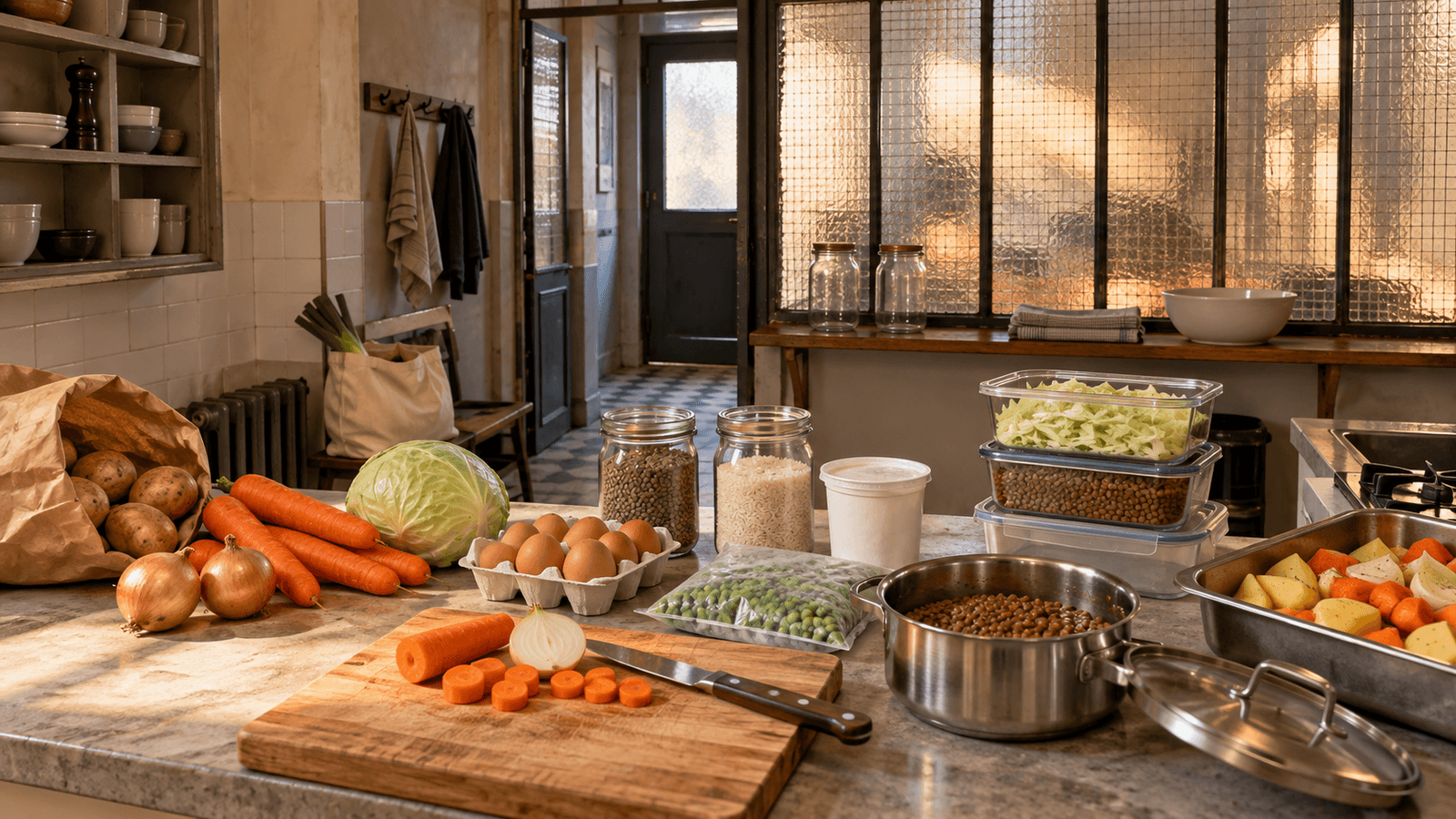
Example of a flexible low-cost prep
Suppose you already have:
- rice
- spices
- a little oil
You buy:
- eggs
- lentils
- carrots
- onions
- cabbage
- frozen peas
- plain yogurt
You might prepare:
- cooked rice
- cooked lentils
- roasted carrots and onions
- sliced cabbage
- boiled eggs
These components could become several different combinations during the week.
The exact meals are less important than the principle:
a short ingredient list can support multiple meals.
Common budget meal-prep mistakes
Preparing too many portions
More portions are not cheaper if they are thrown away.
Buying too many unique ingredients
Ingredient overlap usually makes shopping simpler and cheaper.
Buying meal-prep containers unnecessarily
Use suitable containers you already own first.
Ignoring existing food
New groceries should work with your pantry, refrigerator and freezer.
Making every meal identical
Too much repetition can increase the chance that prepared food is abandoned.
Chasing every discount
A sale is not a saving if you would not otherwise have bought the product.
Forgetting snacks and drinks
Unplanned extras can significantly change weekly food spending.
Ignoring waste
Food that is purchased but never eaten still costs money.
Frequently asked questions
Is meal prep actually cheaper?
It can be. Meal prep may reduce food waste, duplicate purchases and spending on food away from home. But it only saves money when the food prepared is actually used.
How many days should I meal prep for?
There is no universal number. Prepare for the meals you realistically expect to eat, while following appropriate food-storage and food-safety guidance.
Do I need special containers?
No. Use suitable food-safe containers you already have when possible.
Is buying in bulk always cheaper?
No. Compare unit price and consider whether you will actually use the full quantity.
Are frozen vegetables good for budget meal prep?
They can be very useful because they store well, can be portioned as needed and may reduce waste.
Should I cook all meals for the week at once?
Not necessarily. Preparing flexible components can provide many of the same convenience benefits with less repetition.
How can I avoid getting bored with meal prep?
Use shared ingredients in different combinations, vary seasonings and freeze some portions for later rather than eating the same meal every day.
What is the biggest meal-prep money mistake?
Preparing or buying more food than you actually eat is one of the most common ways the expected savings disappear.
The bottom line
Budget meal prep is not about producing the maximum number of containers for the minimum theoretical cost.
It is about using groceries efficiently.
Start with what you already have.
Plan only the meals you are likely to eat.
Choose flexible ingredients that overlap across dishes.
Prepare useful components rather than forcing yourself to eat identical meals.
Use frozen and shelf-stable foods strategically.
Freeze suitable extra portions.
And pay attention to what repeatedly goes uneaten.
The most economical meal prep is not the plan with the cheapest ingredients on paper.
It is the plan that turns the groceries you buy into food you actually eat.
This article provides general educational information and is not individualized medical or dietary advice.