
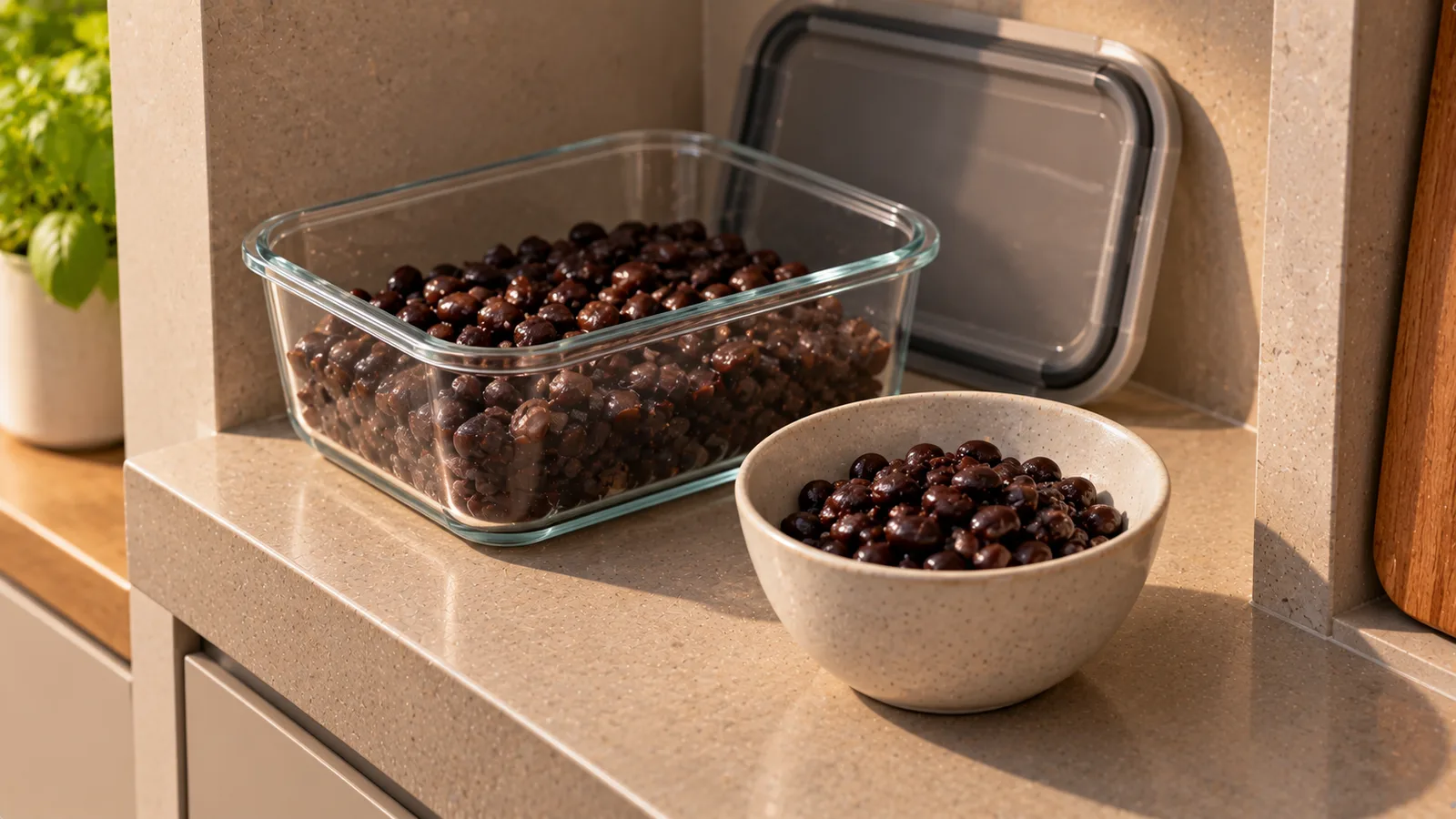
Black beans provide roughly 130–135 calories per 100 g when cooked without added fat.
The exact number varies with the product, cooking method and how much water the beans contain. Canned black beans can also differ between brands, especially depending on whether nutrition information refers to the beans with liquid or after draining.
For calorie tracking, the most reliable approach is to match the food you weighed with the corresponding entry in your nutrition database.
Black bean calories per 100 g
A useful reference for cooked black beans is approximately:
| Nutrient | Per 100 g cooked |
|---|---|
| Calories | ~132 kcal |
| Protein | ~8.9 g |
| Carbohydrates | ~23.7 g |
| Fiber | ~8.7 g |
| Fat | ~0.5 g |
These are approximate reference values rather than a guarantee for every product.
Black beans are relatively low in fat when cooked without oil and provide both protein and fiber.
Calories by portion size
Using approximately 132 kcal per 100 g:
| Cooked black beans | Approx. calories |
|---|---|
| 50 g | 66 kcal |
| 75 g | 99 kcal |
| 100 g | 132 kcal |
| 125 g | 165 kcal |
| 150 g | 198 kcal |
| 200 g | 264 kcal |
| 250 g | 330 kcal |
| 300 g | 396 kcal |
For a portion not shown in the table, use:
portion weight in grams × 132 ÷ 100
For example:
180 g × 132 ÷ 100 = about 238 kcal.
How many calories are in a cup of black beans?
A cup is less precise than weighing because the amount depends on how tightly the beans fill the cup and how much liquid remains.
If a cup of cooked black beans weighs around 170–175 g, it would contain roughly 225–230 kcal using the 132 kcal per 100 g reference.
For more consistent tracking, weigh the beans in grams whenever practical.
Cooked vs dry black beans
Dry and cooked black beans should not be treated as the same food by weight.
Dry beans contain much less water and therefore have far more calories per 100 g.
During soaking and cooking, beans absorb water and become heavier.
The total energy in the batch does not increase simply because water was absorbed, but calories per 100 g fall because the same food energy is distributed across a larger cooked weight.
This is why entering 200 g of cooked beans using a database value for 200 g of dry beans can produce a very large error.
For a detailed explanation, see Raw vs Cooked Weight: Which Should You Use for Calories?.
A batch calculation example
Suppose you start with 300 g of dry black beans.
Imagine the dry beans provide 340 kcal per 100 g according to the package.
The batch therefore contains:
300 × 340 ÷ 100 = 1,020 kcal
After soaking and cooking, suppose the beans weigh 750 g.
The approximate calorie density of the cooked batch is then:
1,020 ÷ 750 × 100 = 136 kcal per 100 g
A 180 g cooked portion would contain:
180 × 136 ÷ 100 = about 245 kcal
This method is particularly useful when your own cooked yield differs from a generic database value.
Calories in canned black beans
Canned black beans can be very convenient, but the label should be read carefully.
Check whether the nutrition information refers to:
- the product as sold;
- drained beans;
- a stated serving size;
- 100 g of product.
If you drain the beans but the label describes the product including liquid, your measured portion may not correspond perfectly to the label value.
When possible, use the manufacturer's stated drained nutrition values or an appropriate database entry for drained canned black beans.
Does rinsing canned black beans remove calories?
Rinsing primarily removes some of the surrounding liquid and can reduce some components present in that liquid.
It does not remove most of the energy stored in the beans themselves.
Do not assume that rinsing turns a labeled portion into a dramatically lower-calorie food.
For calorie tracking, the more important issue is matching the nutrition entry to the state in which the beans are weighed.
Protein in black beans
Using the reference above, cooked black beans provide about 8.9 g of protein per 100 g.
That gives approximately:
| Portion | Approx. protein |
|---|---|
| 100 g | 8.9 g |
| 150 g | 13.4 g |
| 200 g | 17.8 g |
| 250 g | 22.3 g |
Black beans can therefore contribute meaningfully to daily protein intake, especially as part of meals that include other protein-containing foods.
They do not need to be treated solely as a protein food, however. They also contribute substantial carbohydrate and fiber.
Carbohydrates and fiber
Cooked black beans contain roughly 23.7 g of total carbohydrate and 8.7 g of fiber per 100 g using the reference values above.
A 150 g portion would provide approximately:
- 35.6 g carbohydrate;
- 13.1 g fiber;
- 13.4 g protein;
- 198 kcal.
This combination is one reason beans can make meals substantial without requiring very large amounts of added fat.
Black beans in a meal
The calories in black beans are only one part of the total meal.
Consider a simple bowl containing:
- 150 g cooked black beans: ~198 kcal;
- 150 g cooked rice: roughly 190–200 kcal depending on type and preparation;
- vegetables: amount depends on type and quantity;
- 10 g oil: about 90 kcal.
The oil alone can add almost half as many calories as the beans.
That does not make oil a bad ingredient. It illustrates why estimating only the beans can underestimate the total energy of a prepared meal.
Black bean salad
A basic black bean salad may contain:
- black beans;
- tomatoes;
- cucumber;
- corn;
- avocado;
- dressing.
The calorie total can vary considerably depending on the amounts of avocado, corn, oil and other additions.
If you are tracking a homemade salad, calculate each significant ingredient and divide the finished recipe into the portions you actually eat.
Black beans with rice
Black beans and rice are commonly eaten together.
If you track the meal, log both components rather than treating the beans as representing the whole dish.
For example:
200 g cooked black beans at ~132 kcal per 100 g = 264 kcal
200 g cooked rice at 130 kcal per 100 g would add another 260 kcal
Before sauces, oil or other ingredients, the combination would already contain approximately 524 kcal.
Actual values depend on the rice and bean preparation.
Refried black beans can be different
Refried or seasoned black beans may contain added:
- oil;
- animal fat;
- cheese;
- sauces;
- other ingredients.
As a result, their calorie density can differ substantially from plain cooked black beans.
Use the product label or recipe rather than assuming that all black-bean dishes have the same calories as plain boiled beans. For a complete dish using black beans with sweet potatoes and spinach, see sweet potato and black bean chili.
Black bean soup
Black bean soup illustrates the opposite issue.
Water and broth can increase the total weight and volume of the dish without adding many calories.
A 300 g serving of soup is therefore not equivalent to 300 g of plain cooked beans.
The recipe determines how much of that serving is beans, vegetables, liquid, oil and other ingredients.
For homemade soup, recipe-level calculation is more useful than logging the entire serving as plain black beans.
Do black beans fit a weight-loss diet?
Black beans can fit into a diet intended for weight management.
No individual food causes or prevents weight loss by itself.
Black beans provide protein and fiber and can be used in meals with vegetables, grains and other foods.
The portion still matters because calories accumulate as serving size increases and because additions such as oils, cheese, avocado and sauces can significantly change the meal's total energy.
How to track black beans more accurately
A practical method is:
- Determine whether the beans are dry, cooked or canned.
- Weigh them in the same state represented by your nutrition entry.
- Use the package label when tracking a specific packaged product.
- Include meaningful added ingredients.
- For homemade mixed dishes, calculate the complete recipe rather than logging the entire dish as beans.
The most common error is not a small difference between databases.
It is choosing an entry for a different state of the food.
Dry beans for batch cooking
If you regularly cook black beans from dry, you can create your own repeatable value.
For each batch:
- Record the dry weight.
- Use the dry-bean calorie value from the package or chosen database.
- Calculate total batch calories.
- Weigh the finished cooked beans.
- Divide total calories by finished weight.
For example:
- dry beans: 500 g;
- label: 340 kcal per 100 g;
- total: 1,700 kcal;
- finished cooked weight: 1,250 g.
Then:
1,700 ÷ 1,250 × 100 = 136 kcal per 100 g cooked
If your cooking process is consistent, this can be more representative of your own beans than a generic cup measurement.
What changes the calorie count most?
For plain black beans, differences in water content can shift calories per 100 g.
For prepared black-bean dishes, the largest changes often come from other ingredients.
Examples include:
- cooking oil;
- cheese;
- sour cream;
- avocado;
- rice;
- tortillas;
- meat;
- sugary or fatty sauces.
If calorie accuracy matters, focus first on these meaningful additions rather than worrying about whether plain beans contain 130 or 134 kcal per 100 g.
Black beans vs other legumes
Black beans, lentils, chickpeas and kidney beans all have different nutrient profiles, but the preparation state can be just as important as the type.
For example, cooked lentils generally contain fewer calories per 100 g than cooked chickpeas because their composition and water content differ.
When comparing legumes, compare like with like:
cooked with cooked
or
dry with dry.
Avoid comparing a dry value for one food with a cooked value for another.
A practical serving approach
There is no single correct black-bean serving size for everyone.
The useful amount depends on:
- the rest of the meal;
- your energy needs;
- your protein intake;
- your appetite;
- whether beans are the main ingredient or a side;
- your personal tolerance of legumes.
For one meal, 100 g may be a smaller component.
For another, 150–200 g may be the main base.
The nutrition numbers help you understand the portion rather than dictate one universal serving.
Quick reference
For plain cooked black beans, a practical estimate is:
- 100 g: ~132 kcal;
- 150 g: ~198 kcal;
- 200 g: ~264 kcal;
- 250 g: ~330 kcal;
- 300 g: ~396 kcal.
Use the package label for branded canned products and match dry or cooked database entries to the state you actually weigh.
That distinction usually matters more than small differences between generic nutrition references.
Nutrition data sources
Reference values below are per 100 g of the specified food. Product varieties and preparation methods can differ.
- USDA FoodData Central — Beans, black, mature seeds, cooked, boiled, without salt (FDC 173735; 132 kcal/100 g).