
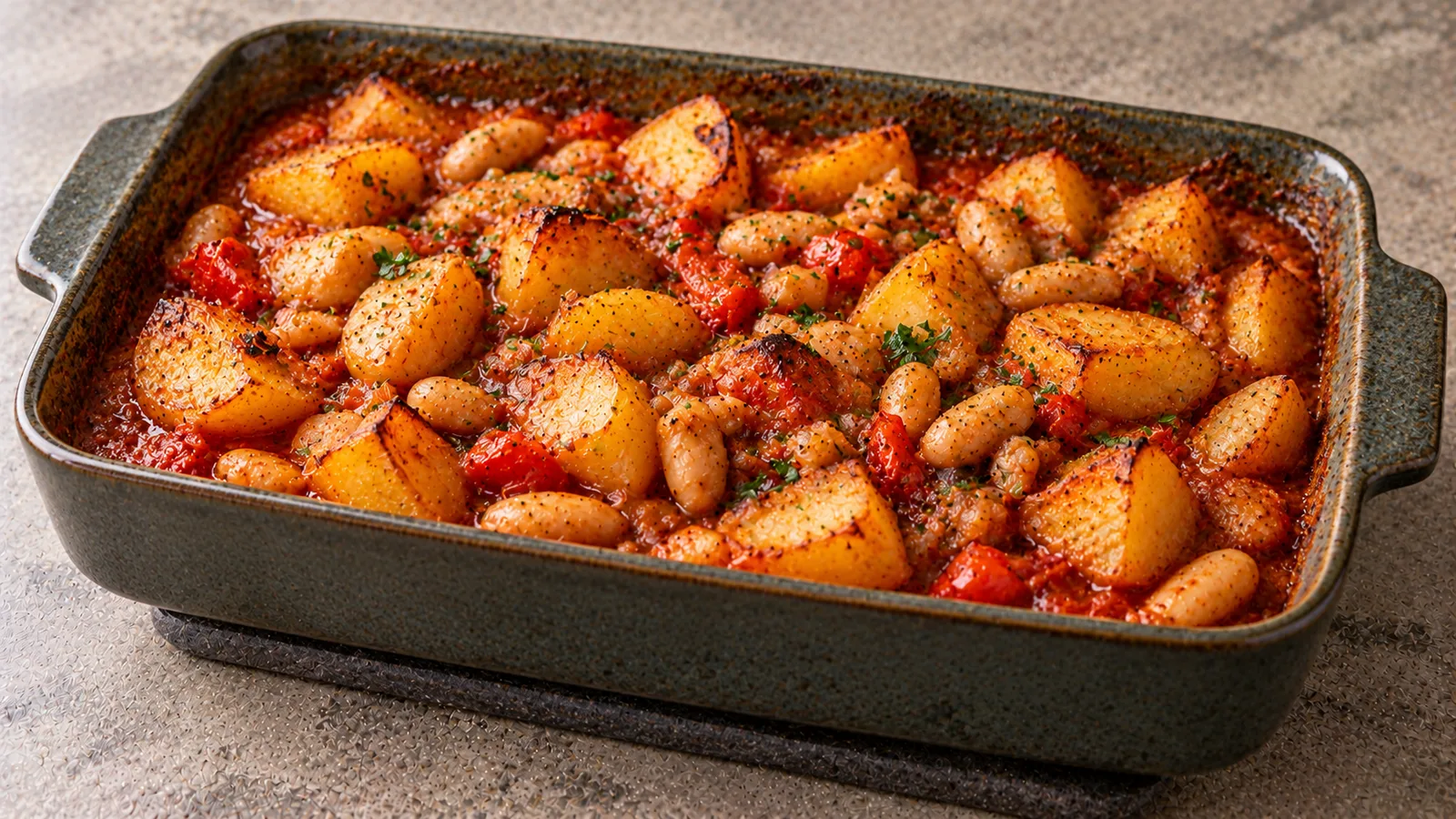
A tray of potatoes and white beans can be an inexpensive, satisfying dinner without cheese, cream or a large amount of oil. The trick is to treat it as a paprika-sauce oven bake, not as potatoes covered in a watery bean soup. Partially cook the potato pieces, thicken the tomato-and-smoked-paprika base, then bake everything until the edges are lightly golden and the white beans remain creamy. The quantities below make four main-course portions. Each estimate describes this fixed recipe, not every potato casserole.
The calculation begins with 800 g raw edible potatoes and 480 g cooked cannellini beans after draining. These are deliberately different weight states. Using the entire 400 g can weight as if it were beans, or logging the browned potatoes as 800 g of a generic cooked product, would distort both nutrition and shopping costs. The recipe uses the product-specific nutrition panels for dmBio cannellini beans and dmBio chopped tomatoes, plus a raw-potato reference from USDA FoodData Central. Prices are illustrative euro assumptions, not observed store prices.
What this smoky bean and potato bake is
Unlike a general sheet-pan vegetable roast, the centre of this dinner is a spoonable tomato-paprika sauce. The potatoes soften inside it; exposed edges become lightly browned. White beans are folded in towards the end so they do not disintegrate during a long roast. The result sits between a casserole and a thick stew, but should be substantial enough to serve directly from the baking dish without draining liquid.
There is no need to call this a high-protein meal merely because it contains beans. In the particular calculation below each quarter provides roughly 14.5 g protein. That can contribute meaningfully to a meal, but the amount is lower than many protein-focused main courses and depends on the brand, drained yield and serving size. For a broader view of the ingredient itself, read Mealisa's white-bean nutrition guide.
Ingredients for four portions
The weights in the table are what go into the recipe, not hypothetical plated weights. Use two 400 g cans of cooked cannellini beans with 240 g drained beans in each. The 400 g can label includes liquid; do not calculate protein or fibre from 800 g of beans.
| Ingredient | Amount used | Preparation or measurement |
|---|---|---|
| Potatoes, raw, edible | 800 g | Washed, cut into 2–3 cm chunks |
| Cooked white beans | 480 g | Two cans, drained and rinsed |
| Chopped tomatoes | 400 g | One can, with tomato juice |
| Red sweet pepper | 200 g | Cored, roughly chopped |
| Onion | 120 g | One medium onion, chopped |
| Garlic | 10 g | Two to three cloves, finely chopped |
| Extra-virgin olive oil | 15 ml | Measured with a spoon or scale-converted volume |
| Smoked paprika powder | 6 g | About two level teaspoons; weigh if tracking |
Also have 120 ml water, black pepper, optional dried oregano and salt to taste. They are not part of the nutrient table below: water has no calories, and the unquantified pepper, oregano and optional salt are excluded. The small measured garlic and paprika amounts are counted. This distinction is important when claiming that a recipe is numerically reproducible.
Choose waxy or all-purpose potatoes, not huge floury pieces that collapse before the sauce reduces. White beans should already be fully cooked; do not put uncooked dried beans directly into the casserole. The recipe is vegetarian and vegan as written, subject to checking your packaged ingredients. No cheese or dairy substitute is needed for creaminess; softened potato surfaces and some gently crushed beans thicken the sauce naturally.
Before the oven: wash, drain and pre-cook
Heat the oven to 200°C conventional / 180°C fan. Place the shelf in the centre and lightly oil an ovenproof dish of about 28 × 22 cm or an equivalent capacity. A cramped deep dish takes longer to evaporate moisture than a broad shallow one; a thin roasting tray may dry the tomato sauce too quickly. Choose an ordinary medium ceramic or metal baking dish with room to stir.
Wash the potatoes, remove any green parts or sprouts, and weigh 800 g edible raw potato after any trimming. Cut into roughly equal 2–3 cm pieces. Simmer them in water for 8–10 minutes until just beginning to soften but not falling apart, then drain thoroughly. They will finish cooking in the oven. This partial boil makes the centre reliably tender without forcing the tomato sauce to bake for an excessively long time. It also avoids trying to achieve deep-brown potato crust in an acidic, wet sauce.
Drain the white beans in a colander; rinse briefly if you prefer less surface brine and let the water run off. Use the 480 g drained weight, rather than estimating what remains after pouring off liquid. Rinsing may change surface sodium and the final drained weight; the nutrition calculation uses the printed label as an approximation and does not pretend to measure sodium removed by rinsing. See Mealisa's portion-size explanation for why a serving and a purchased package are not interchangeable.
Build a concentrated paprika-tomato sauce
Use the 15 ml olive oil for the entire recipe, not an additional unmeasured splash on the dish. Warm most of it in a large frying pan. Cook the diced onion and pepper for 5–7 minutes over medium heat, stirring, until the onion softens and the pepper loses its raw stiffness. Add the garlic for about 30–60 seconds. Avoid burning it; bitter garlic can dominate an otherwise gently smoky sauce.
Turn the heat down before stirring in the 6 g smoked paprika. Paprika powder can taste harsh when scorched in dry hot fat. Coat the vegetables briefly, then add the chopped tomatoes and their juice, plus 120 ml water. Simmer uncovered for 8–12 minutes until the mixture looks thick enough to cling to a spoon. If your canned tomatoes are unusually watery, continue reducing for a few minutes instead of adding flour or more oil. A sauce that looks thin in the frying pan usually becomes thinner again when the beans and potatoes release moisture in the oven.
Season with black pepper, a little dried oregano if you like, and modest salt only after tasting. The selected canned beans already list 0.35 g salt per 100 g, while the chopped tomatoes list 0.10 g per 100 g. These figures help explain why seasoning should be adjusted at the end; they do not give an exact final sodium result after draining, rinsing and optional added salt. Smoked paprika brings flavour but does not replace the need to taste the completed dish.
Bake until tender, not dark brown
Fold the parboiled potatoes into the thick tomato mixture and transfer to the baking dish. Bake uncovered for approximately 20 minutes, stirring once if the edges seem dry. Check a large potato piece with a knife: it should give without a hard core. Gently fold in the drained cooked beans, reserving a spoonful to crush into the sauce if extra body is needed, and return the dish to the oven for 10–15 minutes. The beans should be thoroughly hot and the sauce should bubble at the sides.
Total oven time is usually 30–35 minutes after parboiling, not a promise for every oven or dish size. A broad tray, a refrigerator-cold sauce, oversized potatoes and different oven calibration all change the timing. If the top dries before the potatoes soften, add a few spoonfuls of hot water and cover loosely for the final minutes. If there is excess liquid, continue uncovered briefly rather than increasing the oil.
Aim for tender potato pieces with light golden edges, not a deeply browned crust. The US Food and Drug Administration's acrylamide preparation advice recommends lighter golden colouring for high-heat-cooked potato foods where practicable. The moist sauce makes this recipe different from fries, but there is no nutritional reason to chase dark brown spots. Rest for 5–10 minutes before serving: the sauce thickens as the dish settles.
Nutrition calculation: measure the ingredients, not the finished dish
The reference for raw potatoes gives 77 kcal and 2.05 g protein per 100 g. The chosen canned cannellini beans give 93 kcal and 6.4 g protein per 100 g drained beans; the selected tomatoes give 26 kcal and 1.5 g protein per 100 g. Values for pepper, onion, garlic and paprika are approximate generic food-composition entries, and the oil uses the dmBio olive-oil label, expressed per 100 ml, not per 100 g. Olive oil contributes 123.6 kcal from the measured 15 ml in this label-based model.
| Ingredient | Recipe energy | Recipe protein |
|---|---|---|
| 800 g raw potatoes | 616.0 kcal | 16.40 g |
| 480 g drained white beans | 446.4 kcal | 30.72 g |
| 400 g canned chopped tomatoes | 104.0 kcal | 6.00 g |
| 200 g red pepper | 62.0 kcal | 1.98 g |
| 120 g onion | 48.0 kcal | 1.32 g |
| 10 g garlic | 14.9 kcal | 0.64 g |
| 6 g smoked paprika | 16.9 kcal | 0.85 g |
| 15 ml olive oil | 123.6 kcal | 0.00 g |
| Total, four portions | 1,431.8 kcal | 57.90 g |
Divide the ingredient totals by four for about 358 kcal, 14.48 g protein, 62.03 g carbohydrate, 4.70 g fat and 14.32 g fibre per equal quarter. This is a model, not laboratory analysis. Canned labels are rounded, individual vegetables vary, and some water-soluble compounds may move into cooking liquid discarded during parboiling. For consistent tracking, treat the uncooked ingredient weights as inputs and record any additional fat or toppings separately.
Why cooked weight changes but total calories do not disappear
The recipe begins with roughly 2.0 kg of food and oil by the measurements above, plus 120 ml water. After the potatoes are partly boiled and the dish is baked, some water will evaporate. The completed casserole might weigh, for example, 1,700 g, but that is a hypothetical yield, not a measured outcome. If it does weigh 1,700 g, one quarter weighs 425 g and the model predicts around 84.2 kcal per 100 g (1,431.8 ÷ 1,700 × 100). If it weighs 1,850 g, the corresponding density is about 77.4 kcal per 100 g. The whole recipe remains approximately 1,431.8 kcal under the simplifying assumption that ingredients and energy are retained.
This is why a food tracker can give different results for '100 g baked potatoes' versus a dish logged from raw potatoes and beans. The first entry may represent a different amount of oil and water. The second accounts for what actually went into your pan. If you serve unequal portions, weigh the complete finished bake, weigh each plated amount and multiply its fraction of the final weight by the calculated total. The principle is developed further in Mealisa's potato nutrition guide.
Ingredient cost versus checkout cost
A cost-per-portion estimate is useful only when the assumptions are visible. The following hypothetical German shopping basket uses €3.50 for 2 kg potatoes, €1.15 per can of white beans with 240 g drained, €0.65 for a 400 g can of tomatoes, €2.50 for 500 g pepper, €1.50 for 1 kg onions, €1.00 for 100 g garlic, €7.00 for 500 ml olive oil and €1.40 for 40 g paprika. These are teaching prices, not current or verified offers from the named food-label manufacturers.
| Ingredient | Ingredient cost used | Checkout package cost |
|---|---|---|
| 800 g potatoes | €1.40 | €3.50 |
| 480 g beans (two cans) | €2.30 | €2.30 |
| 400 g tomatoes | €0.65 | €0.65 |
| 200 g pepper | €1.00 | €2.50 |
| 120 g onion | €0.18 | €1.50 |
| 10 g garlic | €0.10 | €1.00 |
| 15 ml oil | €0.21 | €7.00 |
| 6 g paprika | €0.21 | €1.40 |
| Total | €6.05 | €19.85 |
The underlying unrounded ingredient calculation is about €6.05 for the batch, or €1.51 per serving. Buying every package from an empty pantry would cost €19.85, but the remaining potatoes, vegetables, oil and spices are inventory, not automatically wasted food. Changing the assumed pepper price, switching from canned to cooked dried beans, or using oil already in your kitchen will change the budget. Mealisa's budget grocery-list guide explains how to separate money spent at checkout from the ingredients used in one recipe.
Practical substitutions without breaking the recipe
For a thicker bake, mash 60–80 g of the already-counted beans into the tomato sauce rather than adding flour or cheese. This changes texture but not the calculated bean weight. For more heat, use a pinch of chilli; for a milder taste, replace some smoked paprika with ordinary sweet paprika. If you change the total paprika quantity, update the small spice contribution in your food tracker. Paprika varieties vary in intensity, so start conservatively.
You can swap cannellini beans for another cooked white bean, but the product's nutrition label and drained yield may differ. A 400 g tin with only 220 g drained beans does not provide the same edible amount as the 240 g drained can used here. Frozen red pepper works if you reduce additional water or cook off its moisture before combining. Passata can replace chopped tomatoes, but a thinner sauce may need longer reduction. To make a larger meal, serve a crisp side salad or add a second course; avoid advertising the original four-portion numbers after increasing oil, cheese or bread.
Cooling, storing and reheating safely
Serve the casserole hot. Divide leftovers into shallow containers and refrigerate promptly, preferably within two hours; do not leave a large warm ceramic dish on the countertop all evening. The USDA FSIS leftovers guide recommends using refrigerated cooked leftovers within 3–4 days and reheating them thoroughly to 74°C / 165°F. Store refrigerated food around 4°C or colder. Always follow any shorter instructions on opened packaged ingredients; the tomato product linked above asks for prompt refrigerated use after opening.
For best texture, reheat an individual portion in a covered ovenproof dish until hot through, then uncover briefly so the potatoes do not remain soggy. In a microwave, stir and check for cool centres, especially around large potato chunks. Freeze cooled portions if you cannot eat them within the recommended refrigerated window, though potatoes may become softer after thawing. A sour or odd smell is not a substitute for safe storage practices; harmful microbes are not always detectable by smell.
Serving it as a balanced meal
Potatoes supply starch, beans add protein and fibre, and tomato, pepper and onion add vegetables. The German Nutrition Society's dietary guidance supports eating legumes regularly and varying vegetables and staple foods. That does not make one recipe a complete definition of a balanced diet, nor does it establish a therapeutic benefit. The approximate 14.3 g fibre per quarter is meaningful within an ordinary daily diet, but individual digestive tolerance to beans varies. Start with a smaller helping if you are not used to legumes.
Choose four servings for the stated estimates or divide into three heartier servings and multiply all per-portion numbers by 4 ÷ 3: roughly 477 kcal and 19.30 g protein each. If your primary goal is to track intake, that explicit portion decision matters more than whether the bake is advertised as 'healthy' or 'smoky'. Use actual ingredient labels when shopping in a different country, and weigh the drained beans rather than relying on the can's front number.
Sources
- USDA FoodData Central — raw potatoes, SR Legacy search — reference for 77 kcal and 2.05 g protein per 100 g edible raw potato.
- dmBio cannellini beans — ingredients, drained weight and nutrients — 240 g drained per can, 93 kcal and 6.4 g protein per 100 g.
- dmBio chopped tomatoes — ingredients and nutrients — 26 kcal and 1.5 g protein per 100 g.
- dmBio olive oil — nutrition per 100 ml — source for the measured-oil calculation.
- DGE — food-based dietary guidance — general dietary context for legumes and vegetables.
- FDA — acrylamide and food preparation — guidance on avoiding unnecessary dark browning of potato foods.
- USDA FSIS — leftovers and food safety — cooling, refrigerated storage and reheating.