
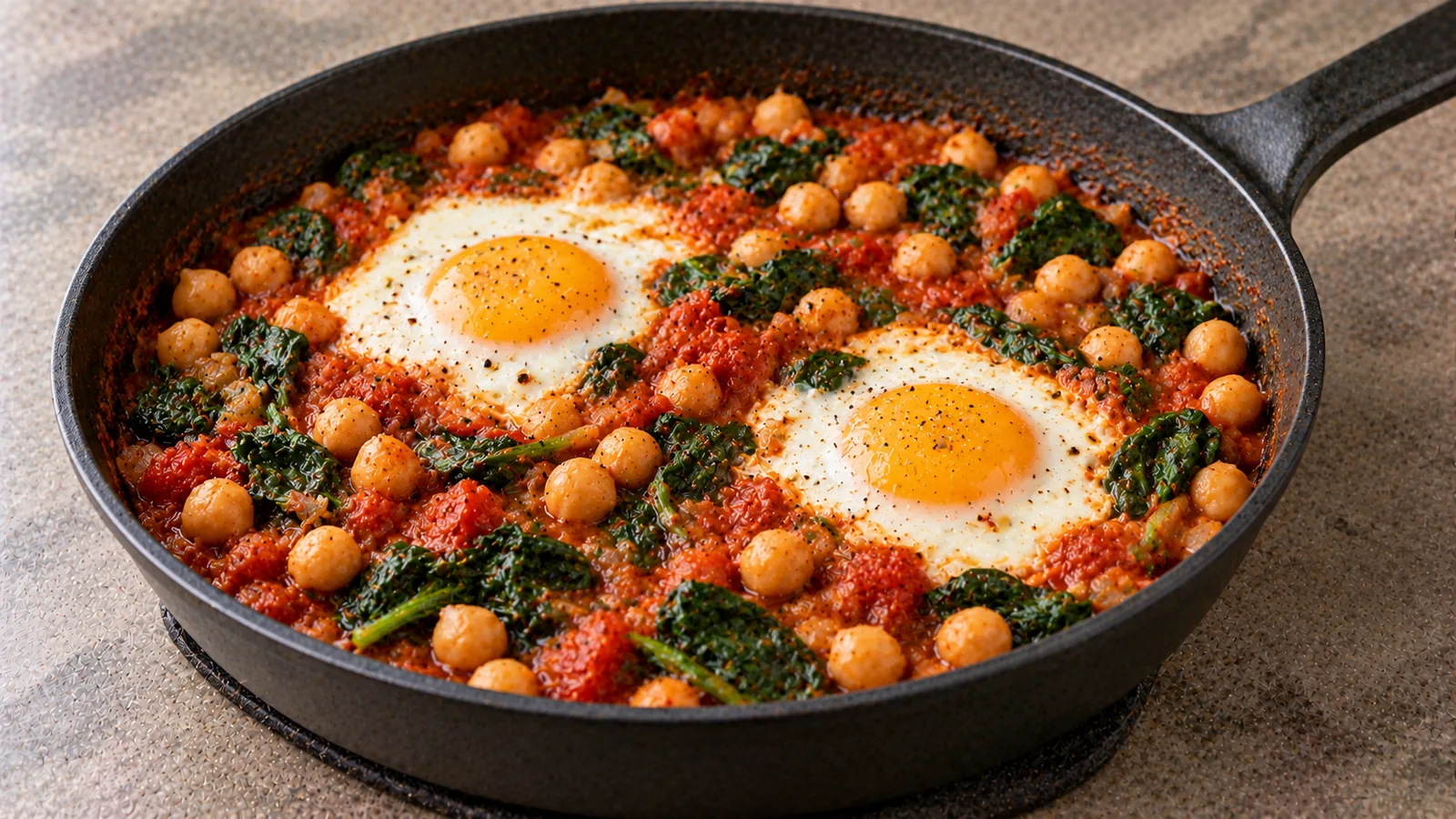
This spinach, chickpea and tomato skillet is an everyday vegetarian dinner built around one pan, four eggs and readily available ingredients. It is not simply a tomato shakshuka with a token handful of greens: spinach and chickpeas are the main body of the dish, and the tomatoes make a light coating rather than a deep pool of sauce. Each person gets one egg and a measured share of the vegetables and legumes. The result is easy to cook, easy to portion and straightforward to enter into a food diary.
The amounts below serve four people. A portion is one quarter of the cooked chickpea-and-vegetable base plus one fully cooked egg. You can serve bread or potatoes alongside, but neither is included in the stated nutrition or cost calculation. Values are calculated from specified product labels and food-composition references, not measured in a laboratory. Different cans, egg sizes and the amount of oil left behind can change the actual result.
Why this is a spinach-and-chickpea skillet, not another shakshuka
Shakshuka usually begins with a substantial tomato-and-pepper sauce into which eggs are set. This recipe puts 200 g of fresh spinach alongside 480 g of drained cooked chickpeas, cooks down the leaves and uses a smaller 400 g tomato layer to bind the vegetables. There is no bell pepper, feta, yogurt or crusty bread in the base recipe. Garlic, sweet or smoked paprika and a little black pepper supply the seasoning; cumin and chili are optional rather than defining ingredients.
That distinction matters for cooking as well as search intent. Spinach needs very little time in the pan, whereas canned chickpeas only need heating through. Eggs go in last. If you simmer the spinach for twenty minutes while waiting for the eggs, it loses its texture and can make the sauce watery. This guide therefore provides a separate, repeatable skillet sequence and real quantities rather than recycling a generic egg-in-tomato recipe.
Ingredients for four portions
Use one wide lidded frying pan, ideally about 28–30 cm across, so there is room for four eggs. An instant-read food thermometer is useful for checking the eggs. The ingredient weights are before cooking except for chickpeas, which are measured after draining. The four eggs represent approximately 200 g edible raw egg in total, excluding shells; use the actual weight for a particularly accurate calculation.
| Ingredient | Weight for the whole pan | Practical shopping note |
|---|---|---|
| Cooked chickpeas, drained | 480 g | Two cans at 240 g drained weight each |
| Chopped canned tomatoes | 400 g | One standard tin, including tomato juice |
| Fresh spinach | 200 g | Wash and drain thoroughly |
| Onion, peeled | 150 g | One medium-to-large onion |
| Eggs, edible part | 200 g | About four medium-to-large eggs |
| Olive oil | 20 g | Weigh the oil; it is not 20 ml |
| Garlic, peeled | 10 g | About two to three cloves |
Add 1–2 teaspoons paprika, black pepper and dried herbs to taste. If your chickpea can is salted, taste the finished base before adding salt. A squeeze of lemon after cooking is optional. The spices, lemon and any optional salt are not included in the numerical model: their typical small energy contribution is ignored, but added salt affects sodium. Do not treat that approximation as a measured analysis.
Prepare the ingredients before heating the pan
First empty both chickpea cans into a sieve. Let liquid drain; rinse if you want to reduce some surface brine, then drain again. Weigh 480 g of edible chickpeas, not the 800 g total weight of two cans with liquid. If your brand yields only 220 g per can, the finished dish contains less chickpea unless you top it up. It is better to correct the recipe quantity than to assume that the tin's printed gross mass is edible weight. The specific example uses the Davert canned chickpea label, which states 240 g drained and provides nutrition per 100 g; see the Davert product information.
Next wash the spinach, remove spoiled leaves and spin or shake off as much water as possible. Wet spinach will release additional water into the pan. Chop the onion into small pieces, mince the garlic and open the tomatoes. Crack each egg into a separate small bowl just before using it, one at a time, checking shell fragments and avoiding cross-contamination. Keep the eggs chilled until needed. This short mise en place matters more than a complicated spice blend: the vegetables cook quickly and the eggs should not sit on the counter unnecessarily.
Step-by-step: a skillet that stays substantial rather than soupy
1. Soften the onion. Put the 20 g weighed olive oil in the wide pan over medium heat. Add 150 g onion and cook for approximately 5–7 minutes, stirring until softened. Do not brown the garlic at this stage. A few tablespoons of water may be added later if the onion catches, without meaningfully changing calories.
2. Add garlic and seasoning. Stir in the minced 10 g garlic and paprika for around 30 seconds. Keep the heat moderate so the paprika does not scorch. If you prefer a smoky flavor, replace part of the sweet paprika with smoked paprika rather than adding a large quantity of oil.
3. Reduce the tomatoes. Add the entire 400 g tin of chopped tomatoes. Simmer uncovered for about 6–8 minutes until the sauce looks thicker and leaves a brief trail when stirred. The exact time depends on the water content of the brand and pan diameter. You are concentrating the sauce, not trying to evaporate every drop.
4. Warm the chickpeas. Fold the 480 g drained chickpeas through the reduced tomatoes. Heat for 3–4 minutes, stirring until evenly hot. They are already cooked; prolonged boiling is unnecessary and can break them down into paste.
5. Wilt the spinach in batches. Add the washed 200 g spinach in two or three handfuls. Allow each to collapse before adding more. Cook about 2–3 minutes after the last batch, turning the mixture gently. A little released moisture is normal. If the pan looks wet, briefly increase the heat before adding the eggs.
6. Make four wells and add eggs. Use a spoon to create shallow spaces in the thick base. Slide one egg into each. Cover and cook over low-to-medium heat until the whites and yolks are fully set. The necessary time varies with the egg size, pan and lid. For maximum food safety, follow the USDA egg guidance: cook until both whites and yolks are firm; egg-containing dishes should reach 71 °C / 160 °F. A visibly set white alone does not prove that a runny yolk is safe.
7. Portion deliberately. Divide the chickpea, spinach and tomato mixture into four equal amounts and serve one egg over each. If eggs differ in size or a diner receives far more chickpeas, the portions no longer have identical nutrients. Finish with black pepper or lemon, if desired, and serve immediately.
The ingredient-level nutrition calculation
The following table states the exact numbers used in this worked example. Chickpeas come from the Davert label, tomatoes from dmBio chopped tomatoes and the other foods from standard USDA SR Legacy profiles. They refer to edible quantities in their stated starting condition, not to the final cooked weight. The numbers for oil are based on grams, using 884 kcal per 100 g, rather than treating one tablespoon as a fixed mass. Values displayed to two decimal places are calculation results, not laboratory precision.
| Ingredient and starting state | kcal / 100 g | Protein / 100 g | Fiber / 100 g |
|---|---|---|---|
| Davert cooked chickpeas, label example | 112 | 6.70 g | 5.70 g |
| dmBio chopped tomatoes, as packed | 26 | 1.50 g | 0.90 g |
| Spinach, raw (USDA) | 23 | 2.86 g | 2.20 g |
| Onion, raw (USDA) | 40 | 1.10 g | 1.70 g |
| Whole egg, raw edible part (USDA) | 143 | 12.56 g | 0 g |
| Olive oil, by weight (USDA) | 884 | 0 g | 0 g |
| Garlic, raw (USDA) | 149 | 6.36 g | 2.10 g |
For example, the chickpeas contribute 480 ÷ 100 × 112 = 537.6 kcal and 480 ÷ 100 × 6.7 = 32.16 g protein to the whole skillet. Four eggs containing 200 g edible egg provide approximately 286 kcal and 25.12 g protein. The 20 g olive oil contributes 176.8 kcal. All three quantities are included even though the oil may be visually hidden among the vegetables.
Using the weights in the ingredients table, the entire skillet contains approximately 1,225.30 kcal, 71.29 g protein, 109.22 g carbohydrate, 50.40 g fat and 38.12 g fiber. Dividing by four gives the serving estimate below. These totals are arithmetic based on the chosen labels and reference entries. They do not incorporate cooking losses, discarded pan oil, a dressing, bread or extra toppings. Fiber is not added to European labeled carbohydrate figures as if it were identical to available carbohydrate.
What one serving actually provides
| Nutrient | Whole skillet (4 portions) | One quarter, including 1 egg |
|---|---|---|
| Energy | 1,225.30 kcal | 306.33 kcal |
| Protein | 71.29 g | 17.82 g |
| Carbohydrate | 109.22 g | 27.30 g |
| Fat | 50.40 g | 12.60 g |
| Fiber | 38.12 g | 9.53 g |
The chickpeas provide much of the fiber and a substantial share of the protein. The eggs add another concentrated protein source, while spinach contributes volume and a smaller amount of protein. This is not an automatic claim that the recipe qualifies as a regulated “high-protein” product or that a single bowl meets every nutritional need. The DGE's guidance on legumes supports including legumes regularly, but meal suitability still depends on personal needs and the rest of the diet.
The numbers are especially useful for portion logging. If you eat half the entire pan instead of a quarter, you take about twice the base recipe's nutrients and, if the half-pan includes two eggs, twice the eggs. If you omit an egg, check the egg calorie and serving guide and remove that egg's approximate contribution, rather than dividing the entire pan by four and pretending the same composition remains. You can review the difference between a package's suggested serving and the food you actually eat in Mealisa's portion-size guide.
Why the cooked weight is not the correct calorie shortcut
Spinach shrinks dramatically when heated, and tomatoes release steam. Suppose the cooked contents, without the pan itself, weigh 1,250 g after evaporation. That is a hypothetical final yield, not a guaranteed result. Using the full recipe model, the energy density would be 1,225.30 ÷ 1,250 × 100 = 98.02 kcal per 100 g of finished food. If evaporation leaves 1,100 g, it becomes about 111.39 kcal per 100 g, while total recipe energy remains approximately the same.
There is a crucial exception: the egg shells, chickpea brine and any discarded cooking liquid or oil were not included in the edible starting amounts. If you scoop sauce out of the skillet and leave a significant amount behind, the exact consumed total changes. Weighing the final edible batch makes per-100-g logging possible, but it does not replace a recipe calculation based on all edible ingredients. For background on how ready-to-eat legumes differ from dry legumes, see Mealisa's chickpea nutrition guide.
How much does this dinner cost?
Prices below are an illustrative shopping basket in euros, not verified current checkout prices or a claim about one particular supermarket. The purpose is to show the arithmetic. Substitute your own receipt amounts if you want an actual cost per serving. This example assumes two chickpea cans at €0.95 each, one can of tomatoes at €0.85, a 200 g bag of spinach at €1.65, one kilogram of onion at €1.60, ten eggs at €3.00, 500 g of olive oil at €3.00 and 100 g of garlic at €1.00.
| Grocery item | Cost of amount used | Full-package checkout assumption |
|---|---|---|
| Chickpeas: 2 entire cans | €1.90 | €1.90 |
| Tomatoes: 400 g | €0.85 | €0.85 |
| Spinach: 200 g | €1.65 | €1.65 |
| Onion: 150 g out of 1 kg | €0.24 | €1.60 |
| Eggs: 4 out of 10 | €1.20 | €3.00 |
| Olive oil: 20 g out of 500 g equivalent | €0.12 | €3.00 |
| Garlic: 10 g out of 100 g | €0.10 | €1.00 |
| Total | €6.06 | €13.00 |
At these assumed prices, the amount used costs €6.06 ÷ 4 = €1.52 per serving, rounded to cents. The €13.00 checkout basket includes six unused eggs, most of the onion, oil and garlic; those leftovers are inventory, not waste or free ingredients. A bottle of olive oil is usually sold by volume, so if you work from a 500 ml price rather than this mass-equivalent illustration, convert the amount with the appropriate density and unit price. The estimate excludes spices, electricity and optional bread. A real supermarket receipt can change the result substantially.
Serving options and controlled substitutions
For a more substantial dinner, add a measured slice of rye bread, cooked potatoes or brown rice. These add their own calories and cost: they cannot be silently folded into the base figure. To raise protein without adding another egg, a spoonful of plain Greek yogurt might fit the flavors, but record its weight and account for dairy allergens. For an egg-free meal, skip the eggs and serve extra chickpeas or tofu; the result is a variation with a different nutritional model, not the same recipe.
Frozen spinach is convenient, but weigh it after checking the label's frozen versus drained-weight convention and remove excess water before combining. The resulting texture can be softer than with fresh leaves. Dried chickpeas require soaking and fully cooking first; 480 g of cooked chickpeas is not equivalent to 480 g dry. Chickpeas from different manufacturers also vary substantially in sodium. Salt in packaged tomatoes and chickpeas is the reason seasoning should be adjusted at the end, not estimated from a fixed teaspoon.
If you are building a plate for a particular energy target, look at the whole meal rather than assuming that a vegetable-rich skillet always has the same calories. Mealisa's balanced-meal overview explains how vegetables, a protein source and other foods can fit together. The dish offers legumes, greens and eggs but is not a substitute for a varied diet over the week.
Food safety: eggs, canned food and leftovers
Wash hands and equipment after handling raw eggs; keep uncracked eggs refrigerated until cooking. The USDA advises cooking the whites and yolks until firm and heating egg-containing dishes to 71 °C (160 °F) when measured as a dish. A soft or runny yolk is not the version recommended here. If a runny texture is specifically desired, choose pasteurized eggs or egg products intended for that use and follow their directions; do not present a short covered simmer as a safety guarantee. See the USDA egg handling guidance and FDA egg-safety advice.
Transfer leftovers promptly into shallow covered containers and refrigerate within two hours, or sooner in warm conditions. USDA guidance generally allows properly chilled cooked leftovers for 3–4 days and recommends reheating to 74 °C (165 °F), but follow a shorter applicable manufacturer's instruction for any opened ingredient and discard food handled unsafely. For the best egg texture, cook the vegetable-and-chickpea base ahead and prepare fresh eggs when serving, instead of repeatedly reheating rubbery eggs. See the USDA leftovers guidance.
Check the food label if managing allergies or sodium intake. Eggs are an allergen; canned legumes may contain salt. Fresh spinach must be washed according to food-handling guidance, and bulging or damaged cans should not be used. The recipe's calculations do not establish sodium content for the final dish because the amount of brine removed by draining or rinsing cannot be deduced precisely from the ingredient labels.
Make the skillet reliably on a weeknight
If you have fifteen minutes to prepare, drain the chickpeas, wash the spinach and chop the onion before heating the pan. Keep the cooking sequence fixed: onion first, garlic briefly, tomatoes to reduce, chickpeas to heat, spinach to wilt and eggs last. This order is the main technique. Turning up the heat after the eggs go in can burn the tomato base before the yolks cook; reducing the sauce earlier is easier than trying to fix it under a lid.
For a smaller household, halve everything: 240 g drained chickpeas, 200 g tomatoes, 100 g spinach, 75 g onion, 2 eggs, 10 g oil and 5 g garlic make two equivalent portions. For a six-person meal, scale the ingredients by 1.5 but use a larger pan or cook in two pans, since overcrowding changes moisture evaporation. The egg count should follow the number of portions if you want one per diner.
You can also cook only the vegetable base and freeze it without eggs, subject to safe cooling and storage. Add a freshly cooked egg when reheating the base. This avoids some of the texture problems of freezing an egg-topped skillet and keeps the reheated food easier to portion.
Sources
- Davert — cooked canned chickpeas, label and drained weight
- dmBio — chopped tomatoes, nutrition label
- USDA FoodData Central — spinach, raw, SR Legacy 168462
- USDA FoodData Central — egg, whole, raw, SR Legacy 171287
- USDA FoodData Central — onion, raw, SR Legacy 170000
- USDA FoodData Central — olive oil, SR Legacy 171413
- USDA FoodData Central — garlic, raw, SR Legacy 169230
- DGE — legumes and nuts regularly
- USDA FSIS — eggs from farm to table
- FDA — egg safety
- USDA FSIS — leftovers and food safety