
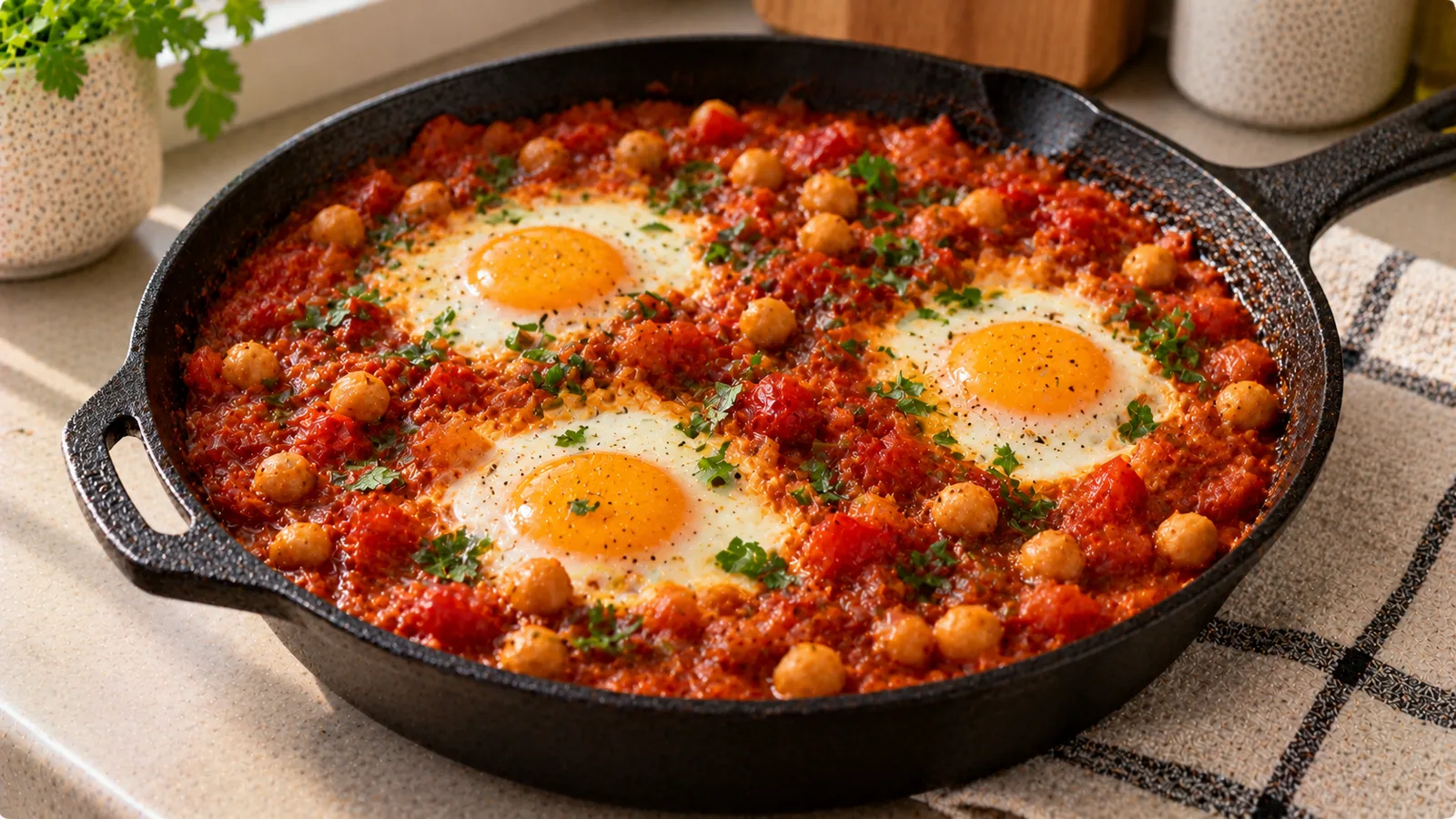
Chickpea shakshuka is a one-pan dish made with eggs gently cooked in a seasoned tomato sauce with chickpeas, peppers and onions.
The chickpeas make the sauce more substantial, while the eggs add protein and a soft, rich texture. It works for breakfast, lunch or dinner and can be prepared using ordinary pantry ingredients.
This version makes four servings with one egg per person and a generous amount of chickpeas and vegetables. Bread is optional and is not included in the nutrition estimate.
Recipe overview
| Detail | Amount |
|---|---|
| Servings | 4 |
| Preparation | 10–15 minutes |
| Cooking | 25–30 minutes |
| Total time | Approximately 35–45 minutes |
| Equipment | Large skillet with a lid |
| Main ingredients | Chickpeas, eggs, tomatoes |
| Estimated energy | Approximately 370 kcal per serving, without bread |
Cooking time depends on the pan, tomato moisture and how firmly you cook the eggs.
Ingredients for four servings
| Ingredient | Quantity |
|---|---|
| Chickpeas, canned, drained | 400 g |
| Eggs | 4 large |
| Chopped canned tomatoes | 800 g |
| Red bell pepper | 150 g |
| Onion | 150 g |
| Garlic | 12 g, about 3 cloves |
| Olive oil | 20 g |
| Tomato paste | 30 g |
| Ground cumin | 2 teaspoons |
| Sweet or smoked paprika | 2 teaspoons |
| Ground coriander | 1 teaspoon |
| Chili flakes | ¼ teaspoon, optional |
| Salt | To taste |
| Black pepper | To taste |
| Fresh parsley or cilantro | A small handful, optional |
Use plain, fully cooked chickpeas. If using canned chickpeas, check their drained weight rather than the total weight printed on the front of the can.
For the tomatoes, choose plain chopped tomatoes without a heavily seasoned sauce. Their sodium content varies by brand.
A 28–30 cm skillet is convenient because it gives the sauce room to simmer and provides space for four eggs.
Step-by-step instructions
1. Prepare the vegetables
Dice the onion and bell pepper into small, fairly even pieces.
Finely chop or crush the garlic.
Drain and rinse the canned chickpeas. Set them aside.
Crack the eggs only when the sauce is ready, or crack each one into a separate small bowl to make it easier to add them without breaking the yolks.
2. Soften the onion and pepper
Heat 20 g olive oil in a large skillet over medium heat.
Add the onion and pepper.
Cook for approximately 6–8 minutes, stirring occasionally, until the onion softens and the pepper begins to become tender.
Avoid using very high heat, which may burn the vegetables before they soften.
3. Add garlic and spices
Stir in the garlic, cumin, paprika, coriander and optional chili flakes.
Cook for approximately 30–60 seconds while stirring.
The spices should become fragrant but should not burn.
If the pan looks dry, add a tablespoon or two of water rather than increasing the oil automatically.
4. Build the tomato sauce
Add the tomato paste and stir it through the vegetables.
Pour in the chopped tomatoes.
Season lightly with salt and black pepper.
Bring the mixture to a gentle simmer.
Cook uncovered for approximately 10–12 minutes, stirring occasionally, until the sauce thickens slightly.
The sauce should be thick enough to hold shallow wells for the eggs, but it should still contain enough liquid to simmer without sticking.
If it becomes too thick, add a little water.
5. Add the chickpeas
Stir the 400 g drained chickpeas into the tomato mixture.
Simmer for another 3–5 minutes, until the chickpeas are heated through.
Taste the sauce and adjust the seasoning.
Remember that the flavor will become slightly milder once the eggs are added.
6. Cook the eggs
Use the back of a spoon to create four shallow wells in the sauce.
Carefully add one egg to each well.
Cover the skillet with a lid and cook over low to medium-low heat until the eggs reach your preferred doneness.
The cooking time will depend on the thickness of the sauce and the heat of the pan.
For food safety, cook eggs until both the whites and yolks are firm, or until an appropriate safe temperature is reached. The FDA recommends cooking egg dishes to 160°F (71°C).
Source: FDA — Egg Safety.
If you prefer softer yolks, be aware that undercooked eggs carry additional food-safety risk. Fully cooked eggs are the safer option, particularly for pregnant people, older adults, young children and people with weakened immune systems.
7. Finish and serve
Remove the skillet from the heat.
Sprinkle with chopped parsley or cilantro if desired.
Divide the dish into four servings, giving each person one egg and approximately one-quarter of the chickpea-tomato mixture.
Serve immediately.
Estimated nutrition per serving
The following estimates use representative values for cooked chickpeas, eggs, canned tomatoes, vegetables and olive oil.
They are intended for meal planning rather than laboratory-accurate labeling.
| Nutrient | Approximate amount per serving |
|---|---|
| Calories | 370 kcal |
| Protein | 19 g |
| Fat | 13 g |
| Carbohydrates | 44 g |
| Fiber | 12 g |
The complete recipe is estimated to provide approximately 1,480 kcal.
These values assume four equal servings, four large eggs and the ingredient quantities listed above.
Nutrition varies with egg size, the brand of chickpeas, tomato composition, oil measurement and the amount of sauce lost during cooking.
The nutrition estimate excludes bread, cheese, yogurt and other optional accompaniments.
Reference database: USDA FoodData Central.
How to calculate your own version
If your chickpea can provides 240 g drained weight rather than the 400 g required for this recipe, you must either use additional chickpeas or calculate nutrition using the smaller quantity.
Similarly, 30 g olive oil instead of 20 g adds approximately 90 kcal to the complete dish, or around 23 kcal per serving.
For the most accurate result, weigh ingredients before cooking and use their actual package values.
What makes this version different from classic shakshuka?
Shakshuka is commonly prepared with eggs cooked in a spiced tomato and pepper sauce.
This version adds a substantial amount of chickpeas.
The chickpeas change both the texture and nutritional composition.
They contribute carbohydrates, dietary fiber and plant protein, while making the sauce thicker and more filling as a meal.
The recipe is inspired by shakshuka rather than presented as the only authentic preparation.
Regional and household variations use different spices, vegetables and serving methods.
How to get the sauce texture right
The most common challenge is a sauce that is either too watery or too dry.
If the sauce is watery
Simmer it uncovered for a few additional minutes before adding the eggs.
Stir occasionally to prevent sticking.
A thicker sauce helps the eggs remain in their wells.
If the sauce is too thick
Add water a tablespoon at a time.
The sauce should still be able to simmer gently while the eggs cook.
If the tomatoes taste too acidic
Allow the sauce to simmer a little longer and check the seasoning.
The sweetness of the cooked onion and pepper can help balance the flavor.
There is no need to add sugar automatically.
If the spices taste harsh
Spices may become bitter if they burn.
Cook them briefly over moderate heat and add the tomatoes promptly.
Can you use dried chickpeas?
Yes, but they must be fully cooked before being added to the shakshuka.
The 400 g quantity refers to cooked, drained chickpeas.
It does not refer to 400 g dried chickpeas.
Dried chickpeas absorb water during soaking and cooking, so their cooked weight is substantially higher than their dry weight.
Follow the package instructions for soaking and cooking.
For a quick weekday recipe, canned chickpeas are the simplest option.
Can you use fresh tomatoes?
Yes.
You can replace the canned tomatoes with ripe fresh tomatoes, but the sauce may require a different cooking time.
Fresh tomatoes vary in moisture and acidity.
Chop them finely and cook until they form a sufficiently thick sauce.
For a consistent result, canned chopped tomatoes are usually easier.
If you use a prepared tomato sauce, check for added oil, sugar and salt.
Those ingredients affect both flavor and nutrition.
Easy recipe variations
Spinach and chickpea shakshuka
Add 100–150 g fresh spinach shortly before adding the eggs.
Stir until wilted.
The spinach adds vegetables without changing the basic cooking method.
Spicy chickpea shakshuka
Increase the chili flakes or add a small amount of harissa.
Harissa products vary in salt, oil and heat, so start with a modest quantity.
Chickpea and feta shakshuka
Crumble 40–60 g feta over the sauce shortly before serving.
This adds flavor, protein, fat and sodium.
Count the feta separately in your nutrition estimate.
Shakshuka with extra eggs
Use six eggs instead of four.
The total energy and protein increase, and the serving distribution changes.
If divided into four portions, some servings will contain more than one egg.
Shakshuka without eggs
Omit the eggs and serve the chickpea-tomato mixture as a vegetable and legume stew.
This is a different nutritional composition and should be tracked separately.
What to serve with chickpea shakshuka
The recipe can be eaten on its own.
Common accompaniments include:
- Whole-grain bread.
- Pita bread.
- Plain yogurt.
- Cucumber salad.
- Fresh herbs.
- A small amount of feta.
Bread is especially useful for scooping up the tomato sauce.
However, it adds calories and carbohydrates.
Example: adding bread
Suppose one serving of shakshuka contains approximately 370 kcal.
If you add 60 g bread, the additional calories depend on the bread's nutrition label.
At an illustrative 250 kcal per 100 g, 60 g bread adds 150 kcal.
The meal would then contain approximately 520 kcal.
This example does not include other sides or toppings.
How to adjust the recipe for two people
For two servings, use approximately half of each ingredient:
| Ingredient | Two servings |
|---|---|
| Cooked, drained chickpeas | 200 g |
| Eggs | 2 |
| Chopped tomatoes | 400 g |
| Bell pepper | 75 g |
| Onion | 75 g |
| Garlic | 6 g |
| Olive oil | 10 g |
| Tomato paste | 15 g |
Reduce the spices proportionally, then adjust to taste.
Use a smaller skillet if possible.
A very large pan may cause a small amount of sauce to evaporate too quickly.
Preparing the sauce ahead of time
The chickpea-tomato sauce can be prepared in advance without the eggs.
Cook the vegetables, spices, tomatoes and chickpeas as instructed.
Cool the sauce promptly and refrigerate it in a covered container.
When ready to eat, reheat the sauce thoroughly in a skillet, create wells and add fresh eggs.
Cook the eggs to a safe doneness.
This approach works better than repeatedly reheating eggs already cooked in the sauce.
For food safety, refrigerate perishable cooked food promptly and use it within the recommended storage period.
The USDA generally recommends using refrigerated cooked leftovers within 3–4 days.
Source: USDA Food Safety and Inspection Service.
Can you freeze chickpea shakshuka?
The tomato-chickpea sauce can be frozen without the eggs.
Allow it to cool promptly, portion it into suitable containers and freeze.
Thaw safely in the refrigerator or use another approved thawing method.
Reheat thoroughly before adding freshly cracked eggs.
Freezing the completed dish with cooked eggs is possible, but the egg texture may deteriorate considerably.
For the best eating quality, freeze only the sauce.
Common mistakes to avoid
Adding eggs before reducing the sauce
A watery sauce makes it difficult for the eggs to remain in place.
Reduce the tomato mixture first.
Using dry chickpeas directly
Dried chickpeas cannot be cooked properly during the short simmer used for this recipe.
Use canned chickpeas or fully cooked dried chickpeas.
Overheating the skillet
High heat can burn the sauce at the bottom while leaving the eggs unevenly cooked.
Reduce the heat once the eggs are added.
Forgetting the oil in calorie calculations
Olive oil contributes substantial energy even in small quantities.
Measure it rather than estimating an unrestricted pour.
Counting bread as part of the base recipe
The nutrition values here cover the shakshuka only.
Bread, feta and other sides must be added separately.
Recording chickpea shakshuka in a food diary
For a homemade dish, the most reliable method is to create a recipe from its ingredients.
Record:
- Chickpeas: 400 g cooked and drained.
- Eggs: four large.
- Chopped tomatoes: 800 g.
- Pepper: 150 g.
- Onion: 150 g.
- Garlic: 12 g.
- Olive oil: 20 g.
- Tomato paste: 30 g.
- Spices and any additional toppings.
Set the recipe to four servings.
If you eat one-quarter of the finished dish, record one serving.
If the portions are uneven, weigh the finished edible dish and record the amount you actually eat.
Be aware that evaporation changes the cooked weight but does not remove the calories of the ingredients.
Sources
- USDA FoodData Central — representative nutritional data for chickpeas, eggs, vegetables and oil.
- FDA — Egg Safety — safe preparation of eggs.
- USDA Food Safety and Inspection Service — handling and storing cooked leftovers.
Nutrition values are approximate and depend on the ingredients used. The base recipe makes four servings and excludes bread and optional toppings.