
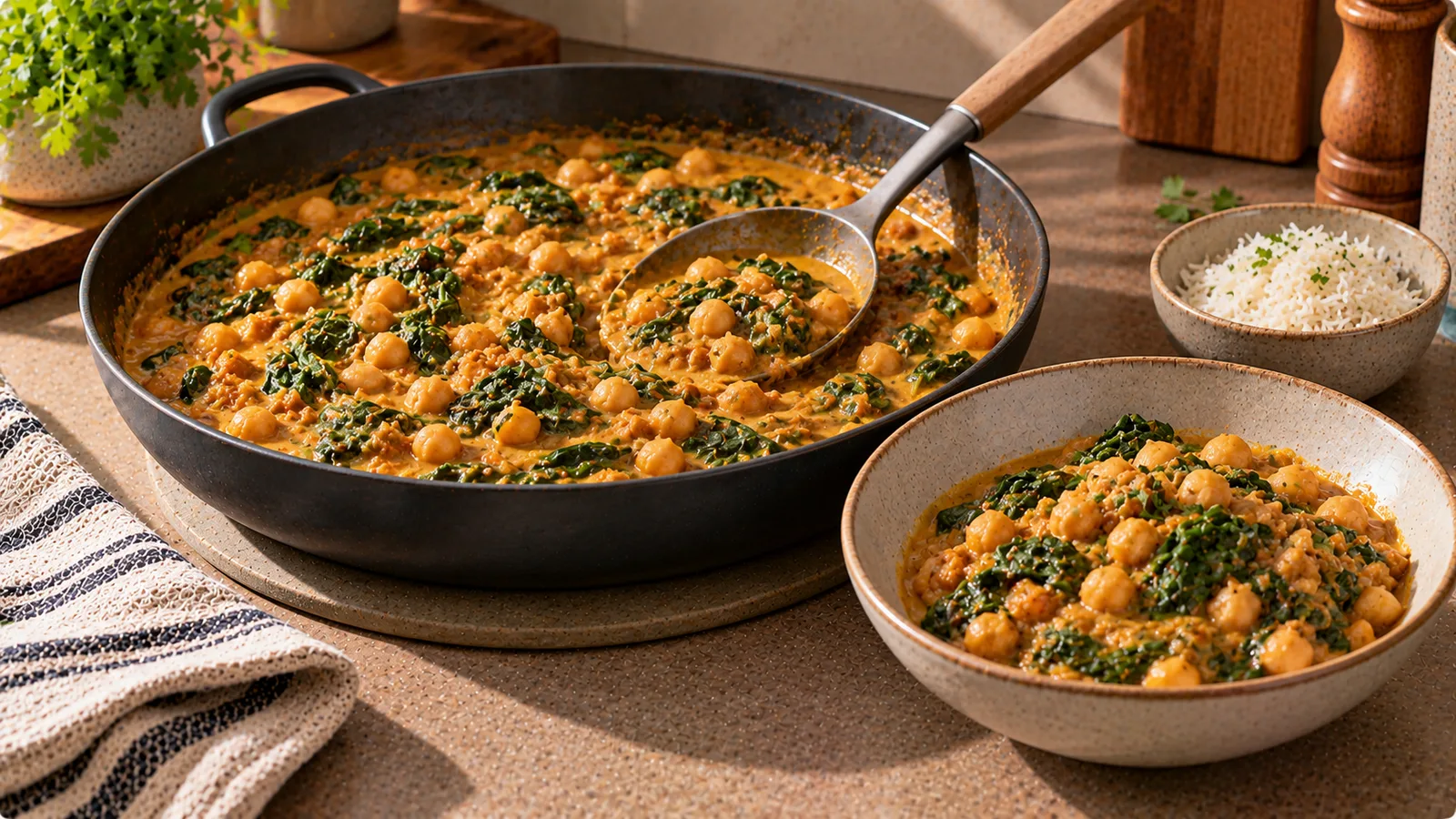
This chickpea and spinach curry is built around canned chickpeas, tomatoes, spinach and coconut milk.
It is designed as a practical four-serving meal with enough sauce for rice, flatbread or another grain on the side.
The recipe uses a defined amount of coconut milk rather than treating it as an optional splash. That matters because coconut milk can contribute a substantial share of the calories and fat in a curry.
Chickpea and spinach curry at a glance
Servings: 4
Preparation time: about 10 minutes
Cooking time: about 25 minutes
Total time: about 35 minutes
Main ingredients: chickpeas, spinach, tomatoes, coconut milk
Estimated nutrition per serving, without rice: approximately 430–480 kcal, depending mainly on the coconut milk used
Ingredients
For four servings:
- 480 g chickpeas, drained and rinsed;
- 300 g fresh spinach;
- 400 g canned chopped tomatoes;
- 400 ml coconut milk;
- 180 g onion;
- 15 g fresh ginger;
- 3 garlic cloves;
- 15 g cooking oil;
- 15 g tomato paste;
- 2 teaspoons ground cumin;
- 2 teaspoons ground coriander;
- 1 teaspoon turmeric;
- 1 teaspoon garam masala;
- 1/2 teaspoon chili powder or chili flakes, optional;
- 100 ml water;
- salt to taste;
- 15 ml lemon or lime juice.
Fresh coriander can be added at the end if desired.
A note about coconut milk
This recipe uses:
400 ml canned coconut milk
Canned coconut milk varies considerably in fat and calorie content.
A full-fat product may contain around:
170–200 kcal per 100 ml
while lighter versions can contain substantially less.
For the most accurate nutrition calculation, use the value from the can you actually use.
Do not substitute the nutrition value of a carton coconut drink. Coconut drinks intended for drinking are usually much more diluted than canned coconut milk used for cooking.
Step 1: Prepare the chickpeas
Drain the canned chickpeas thoroughly and rinse them under cold water.
The recipe uses:
480 g drained chickpeas
This is the edible drained weight, not the total weight of the cans including liquid.
Depending on the can size and brand, you may need roughly two standard cans to obtain this amount.
If your cans provide a different drained weight, use the actual amount.
Step 2: Prepare the aromatics
Finely dice the onion.
Grate or finely chop the ginger.
Mince the garlic.
Heat:
15 g cooking oil
in a large pan or wide saucepan over medium heat.
Add the onion and cook for approximately:
5–7 minutes
until softened.
Add the garlic and ginger and cook for another:
30–60 seconds
while stirring.
Avoid allowing the garlic to burn.
Step 3: Bloom the spices
Add:
- cumin;
- coriander;
- turmeric;
- garam masala;
- optional chili.
Stir for approximately:
30 seconds
so the spices mix with the oil and aromatics.
Then add:
15 g tomato paste
and cook for another minute.
This creates a more developed base before the liquid ingredients are added.
Step 4: Add tomatoes and coconut milk
Pour in:
400 g chopped tomatoes
and:
400 ml coconut milk
Add approximately:
100 ml water
and stir thoroughly.
Bring the mixture to a gentle simmer.
The sauce should be fluid enough to coat the chickpeas without becoming watery.
Step 5: Add the chickpeas
Add:
480 g drained chickpeas
to the sauce.
Stir and simmer uncovered or partially covered for approximately:
12–15 minutes
Stir occasionally.
During this time the sauce should thicken slightly and the chickpeas should heat completely through.
If the curry becomes too thick, add a small amount of water.
If it remains thinner than you prefer, simmer uncovered for a few extra minutes.
Step 6: Add the spinach
Add the spinach gradually.
Three hundred grams can look like a very large volume before cooking, so add it in several handfuls.
Allow each addition to wilt before adding more.
Once all the spinach has wilted, simmer for another:
2–3 minutes
The spinach should be tender but does not need prolonged cooking.
Step 7: Finish the curry
Turn off the heat and add:
15 ml lemon or lime juice
Taste and adjust salt, chili or acidity.
Fresh coriander can be added at this stage.
The final curry should be creamy, tomato-rich and thick enough to serve with rice or bread.
Approximate nutrition
Nutrition depends particularly on the coconut milk and chickpea products used.
Using full-fat coconut milk, a four-serving batch may provide approximately per serving:
- 430–480 kcal;
- 14–17 g protein;
- 45–52 g carbohydrate;
- 22–27 g fat;
- 11–14 g fiber.
These values do not include rice, bread, yogurt or other sides.
They are estimates rather than laboratory values.
Why the coconut milk changes the calories so much
Suppose one coconut milk contains:
180 kcal per 100 ml
Using 400 ml contributes:
180 × 4 = 720 kcal
to the complete recipe.
A lighter coconut milk at:
90 kcal per 100 ml
would contribute:
360 kcal
The difference is:
360 kcal for the batch
or:
90 kcal per serving
when divided into four portions.
That is why using the actual coconut milk label matters more than relying on one universal calorie estimate.
Chickpea weight: drained or undrained?
Use the drained weight.
The liquid in a chickpea can is not equivalent to chickpeas nutritionally.
If the package says:
400 g total weight
and:
240 g drained weight
then one can contributes approximately:
240 g chickpeas
to this recipe.
Two cans would provide approximately:
480 g drained chickpeas
which matches the recipe quantity.
Fresh vs frozen spinach
Fresh spinach is convenient because it wilts directly into the sauce.
Frozen spinach can also work.
If using frozen spinach, approximately:
250–300 g
is a practical replacement.
Thaw it first if possible and remove excessive free water before adding it.
Otherwise the curry may become thinner and require additional simmering.
Can you use light coconut milk?
Yes.
Light coconut milk produces a less rich curry and usually reduces calories and fat.
The texture may be thinner.
If using a lighter product, you can simmer the sauce a little longer before adding the spinach.
Do not assume that every product labeled "light" has the same nutrition. Compare the actual values per 100 ml.
Can you make it without coconut milk?
Yes, but it becomes a different version of the recipe.
Possible replacements include combinations of:
- vegetable stock;
- plain yogurt added carefully after cooking;
- a lower-fat cooking cream;
- blended tomato and cashew sauce.
Each option changes the calories, fat, flavor and texture.
If tracking the recipe, recalculate it using the ingredients actually used rather than keeping the nutrition estimate for the coconut-milk version.
How much curry is one serving?
The recipe is designed as:
4 servings
The simplest approach is to divide the finished curry into four similar portions.
However, cooking changes the final weight because:
- water evaporates;
- spinach loses volume;
- additional water may be added;
- different pans produce different evaporation rates.
If you want portions based on weight, weigh the complete finished curry.
For example, suppose the cooked curry weighs:
1,760 g
Four equal servings would be:
1,760 ÷ 4 = 440 g
per serving.
If the final batch weighs 1,920 g:
1,920 ÷ 4 = 480 g
per serving.
The exact serving weight therefore depends on your finished batch.
How to calculate calories per gram
Suppose your ingredients total:
1,840 kcal
and the finished curry weighs:
1,800 g
Calories per gram:
1,840 ÷ 1,800 = 1.02 kcal per gram
A 400 g portion would contain approximately:
1.02 × 400 = 408 kcal
A 500 g portion:
1.02 × 500 = 510 kcal
This method is useful when portions are not equal.
Serving with rice
Rice can substantially increase the energy and carbohydrate content of the meal.
For example, if you serve each portion with:
150 g cooked rice
and your cooked rice contains approximately:
130 kcal per 100 g
then the rice contributes:
195 kcal
The complete meal might therefore contain roughly:
625–675 kcal
if the curry itself provides 430–480 kcal.
Use the nutrition value for the rice you actually prepare.
Serving with naan or flatbread
A naan or other flatbread can also add a substantial amount of energy.
Depending on size and recipe, one piece can contain several hundred calories.
For accurate tracking, log:
curry + bread
rather than treating the curry nutrition estimate as the complete meal.
Higher-protein variation
Chickpeas already provide protein, but you can increase the protein content further.
Possible additions include:
- firm tofu;
- extra chickpeas;
- seitan;
- a high-protein yogurt topping.
For example, adding 300 g firm tofu to the complete recipe changes both calories and protein.
It should therefore be included in the recipe calculation rather than treated as nutritionally neutral.
Adding more vegetables
The curry can accommodate additional vegetables such as:
- cauliflower;
- bell pepper;
- zucchini;
- peas;
- carrots;
- green beans.
Dense vegetables such as carrots and cauliflower should be added earlier so they have time to soften.
Quick-cooking vegetables can be added later.
Large additions may require more liquid or seasoning.
How spicy is this curry?
The base recipe is mild to moderately spiced.
The chili is optional.
For a mild version, omit it entirely.
For more heat, increase chili gradually or add fresh chili with the garlic and ginger.
Spice level does not materially affect calories unless a calorie-containing chili sauce or oil is added.
Meal-prep instructions
This curry works well for meal prep because the chickpeas and sauce reheat effectively.
After cooking:
- allow the curry to stop steaming heavily;
- divide it into containers;
- refrigerate promptly;
- keep rice separate if you prefer better texture;
- reheat thoroughly before eating.
Avoid leaving a large pot of warm curry at room temperature for an extended period.
Refrigeration
Stored in a clean, sealed container and refrigerated promptly, the curry is generally suitable for approximately:
3–4 days
in the refrigerator.
Cool leftovers efficiently rather than leaving them out for several hours.
If you know you will not eat a portion within that period, freezing is usually the better option.
Freezing
The curry can be frozen.
Divide it into meal-sized portions before freezing.
The spinach may become slightly softer after thawing, but the dish generally freezes well.
For best quality, thaw in the refrigerator when practical and reheat until thoroughly hot.
Can you freeze the rice with it?
Yes.
Cooked rice can be frozen with the curry, but food safety and cooling matter.
Cool cooked rice promptly and freeze or refrigerate without leaving it warm at room temperature for long periods.
When reheating, heat the meal thoroughly.
Using dried chickpeas
You can replace canned chickpeas with chickpeas cooked from dry.
The recipe requires approximately:
480 g cooked chickpeas
not 480 g dry chickpeas.
Dry chickpeas absorb water and increase substantially in weight during soaking and cooking.
If you track the recipe, make sure the database entry matches whether your recorded weight is dry or cooked.
Avoid mixing dry and cooked nutrition entries
This is especially important for legumes and grains.
If you weigh:
480 g cooked chickpeas
but select a database entry intended for:
480 g dry chickpeas
the calorie estimate will be dramatically too high.
Use:
cooked weight with cooked nutrition data
or:
dry weight with dry nutrition data
consistently.
Adjusting the recipe to six servings
To make approximately six similar servings, multiply the main ingredients by:
1.5
For example:
- chickpeas: 720 g drained;
- spinach: 450 g;
- tomatoes: 600 g;
- coconut milk: 600 ml;
- onion: 270 g;
- oil: about 22–23 g.
Seasonings can also be increased, although spices are often best adjusted to taste rather than scaled with perfect mathematical precision.
A practical shopping list
For the four-serving recipe, buy approximately:
- 2 cans chickpeas providing about 480 g drained;
- 1 can coconut milk, around 400 ml;
- 1 can chopped tomatoes, around 400 g;
- 300 g spinach;
- 1 large onion;
- 1 piece fresh ginger;
- 1 bulb garlic;
- 1 lemon or lime;
- cumin;
- coriander;
- turmeric;
- garam masala;
- optional chili.
Rice or flatbread can be added separately depending on how you plan to serve the curry.
Common calorie-tracking mistakes with this curry
Using the weight of chickpeas including can liquid
Use the drained chickpea weight.
Selecting coconut drink instead of canned coconut milk
These can have dramatically different calorie values.
Forgetting the cooking oil
The 15 g of oil contributes approximately:
135 kcal
to the complete recipe.
Logging dry rice as cooked rice
Rice changes weight substantially during cooking.
Keep the weight basis consistent.
Treating the estimated nutrition as exact
Different coconut milk and chickpea products can shift the total considerably.
The most accurate version uses the labels of your actual ingredients.
Recipe summary
For four servings, combine:
480 g drained chickpeas + 300 g spinach + 400 g tomatoes + 400 ml coconut milk
with onion, garlic, ginger, spices and 15 g cooking oil.
Simmer the tomato-coconut sauce, add the chickpeas, then wilt in the spinach near the end.
The result is a filling plant-based curry that works as a standalone dish or as the main component of a meal with rice or flatbread.
For nutrition tracking, the two details that matter most are using the drained chickpea weight and the actual calorie value of the coconut milk.