
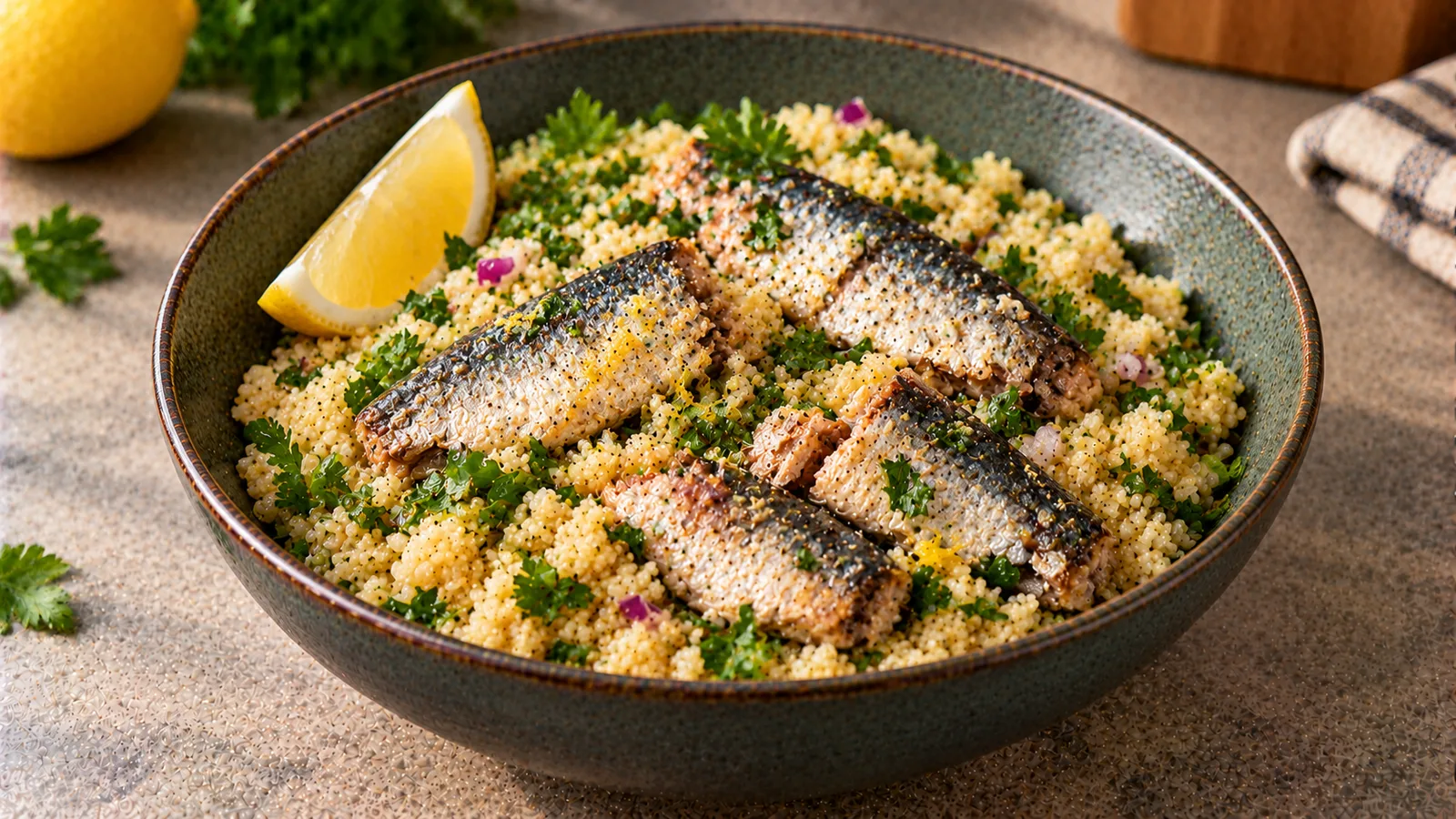
A sardine couscous salad is a practical lunch when you want a real meal without cooking fish from scratch. Fluffy couscous, canned sardines, fresh lemon and flat-leaf parsley give this version its character. Cucumber and tomato provide a little crunch and moisture; neither needs a complicated dressing. The recipe is intended for two substantial lunch portions and takes roughly 20 minutes, including the time needed to cool the couscous before adding fish.
The biggest practical detail is the weighing method. The 150 g of couscous below is dry weight, while 152 g of sardines means drained edible fish from two cans, not the weight printed on the front of the unopened tins. This distinction affects both calories and price per portion.
Quick recipe overview
| Detail | This recipe | Why it matters |
|---|---|---|
| Servings | 2 main-dish portions | Split the finished salad equally |
| Preparation | About 10 minutes | Chop herbs and vegetables while couscous hydrates |
| Couscous | 150 g dry | Weigh before adding water |
| Sardines | 152 g drained | Two 100 g tins, nominally 76 g drained each |
| Serving temperature | Cool or room temperature, promptly served | Do not leave the fish salad on the counter |
This is a cold-grain salad, not sardine pasta and not a warm fish casserole. The fish stays in recognisable pieces; the citrus and parsley are present throughout the grains rather than acting as decorative garnishes.
Ingredients for two people
- 150 g dry wholewheat couscous, such as dmBio Couscous.
- Two 100 g tins of sardine fillets in olive oil, with approximately 76 g drained fish per tin (152 g total), such as REWE Beste Wahl.
- 180 g cucumber, finely diced.
- 180 g fresh tomatoes, seeded if especially juicy and cut into small pieces.
- 40 g fresh lemon juice, approximately the juice of one medium lemon; reserve a little zest if the peel is suitable for eating.
- 20 g flat-leaf parsley, washed, dried and chopped, including tender stems.
- 225 ml freshly boiled water, following the selected couscous packet's approximate 1.5:1 water-to-dry-grain ratio.
- Black pepper to taste. Add salt only after tasting: canned sardines already contain salt.
A nonreactive mixing bowl, fork, knife, sieve and a small container for draining the sardines are enough. You do not need a pan for the canned fish. Check the tin's instructions if your particular brand is packed with skin, bones, water or tomato sauce: those are not numerically interchangeable with the chosen fillets in olive oil.
Method: fluffy couscous, intact sardines
- Weigh the grains dry. Put 150 g couscous into a heatproof bowl. Pour over about 225 ml freshly boiled water, stir briefly, cover and let stand for approximately ten minutes, or follow the exact packet directions. Do not boil it in a large volume of water unless the package specifically instructs you to.
- Fluff rather than mash. Uncover and gently work a fork through the hydrated grains. Spread them in a shallow food-safe dish to release heat. Avoid leaving cooked grains at room temperature for an extended period; move to the refrigerator if not assembling promptly.
- Prepare the bright ingredients. Dice cucumber and tomatoes into similarly sized pieces. Chop parsley. Squeeze and measure the lemon juice, keeping seeds out. Too much tomato liquid makes the salad soggy, so drain very watery chopped tomatoes briefly.
- Drain the sardines. Open both tins carefully. Let loose packing oil drain without squeezing or disintegrating the fish. Gently lift the fillets out and weigh them if accuracy matters. The nominal 76 g on the selected label is a purchasing guide, not a promise that every tin will yield exactly that amount.
- Dress the grains. Toss the cooled couscous with the cucumber, tomatoes, parsley, lemon juice and pepper. The salad should taste fresh and lightly acidic, not swimming in juice.
- Fold in the fish last. Divide sardines into a few natural pieces and turn them into the salad with only two or three gentle movements. Keep several recognisable pieces visible on top. Taste before adding salt.
- Serve or refrigerate immediately. Divide into two bowls. A small lemon wedge can accompany each portion, but it is not needed for the measured recipe.
The central technique is modest: hydrate the couscous correctly, allow it to cool, and preserve the texture of the canned sardines. Neither a shiny oil dressing nor additional cooking improves the fundamental result.
Dry couscous versus finished couscous
The dmBio package lists 351 kcal, 13 g protein and 8.3 g fibre per 100 g dry couscous. For 150 g, that equals 526.5 kcal, 19.5 g protein and 12.45 g fibre before adding anything else. The manufacturer suggests 150 g couscous with roughly one-and-a-half times as much boiling water for two people. The preparation guidance and label are published on the dmBio couscous product page.
With a 225 ml water addition, the bowl may contain roughly 375 g hydrated couscous if the water is retained. Actual final yield changes with evaporation, draining and handling. The entire couscous still supplies approximately 526.5 kcal. If you log 375 g cooked couscous as if it were 375 g dry, the result would be wildly inflated. If you log only 150 g cooked without checking the conversion, you may undercount.
For a repeatable calculation, write down the dry amount, the label values and the total cooked yield. You can also compare this approach with Mealisa's couscous calorie guide, which explores why dry and prepared amounts are different measurement bases.
What does “drained sardines” mean?
The selected REWE Beste Wahl sardine fillets are described as 100 g net weight with 76 g drained weight. The published nutrition table shows 222 kcal, 24 g protein, 14 g fat and 0.6 g salt per 100 g. Those figures are the declared values for the retail item. The manufacturer does not establish on that listing that precisely the same nutritional composition holds after every possible degree of draining. We therefore apply them to the 152 g edible-fish assumption as an illustrative model, not a laboratory measurement of this finished salad.
A rough model gives 337 kcal, 36.5 g protein and 0.91 g salt from 152 g of the labelled sardine product. If significant packing oil remains on the fish, calories can rise; if you drain more thoroughly, the actual value may differ. Never add a full tin's drained oil to the salad and then calculate as if only fish were eaten.
For other brands check all three lines: net weight, drained weight, and the basis of nutrition facts. A 120 g tin is not necessarily 120 g of edible fish. The sardine nutrition guide is a useful complement for comparing canned preparations with other sardine products.
Nutrition estimate for the complete salad
The table combines the two named product labels with approximate general food-composition values for fresh vegetables, lemon and parsley. All values are estimates, not tested meal-laboratory results. No added olive oil, bread, cheese or mayonnaise is included.
| Ingredient | Recipe amount | Energy, kcal | Protein, g |
|---|---|---|---|
| dmBio couscous, dry | 150 g | 526.5 | 19.50 |
| REWE sardine product, assumed drained | 152 g | 337.4 | 36.48 |
| Cucumber | 180 g | 27.0 | 1.26 |
| Tomatoes | 180 g | 32.4 | 1.62 |
| Lemon juice | 40 g | 8.8 | 0.14 |
| Fresh parsley | 20 g | 7.2 | 0.60 |
| Total | Two servings | 939.3 | 59.60 |
| Per serving | Half the salad | 469.7 | 29.80 |
Estimated fibre is roughly 8.1 g per person, mostly from the wholewheat couscous and vegetables; estimated fat is roughly 12.6 g, largely from the sardine product. Carbohydrate is around 58 g per person, mostly from the dry couscous. The figures are rounded and inherit uncertainty from drained oil, produce variation and whether the nutrition label applies to the drained portion.
For a more precise individual serving, weigh the entire mixed salad and then weigh the amount you actually eat; do not assume equal-looking bowls always weigh the same. The difference between a labelled serving and an actual portion is covered in portion size versus serving size.
What the salad costs in a German supermarket
The dmBio couscous page displays €1.25 for 500 g, so 150 g costs €0.375 at that listed price. REWE does not show a universal location-independent price for the sardines. To avoid inventing a live shelf price, the calculation below explicitly assumes €2.29 per tin, and assumes €1.70 in total for the cucumber, tomatoes, lemon and parsley actually used. The assumptions can be replaced with your own receipt.
| Cost item | Amount used | Calculation | Illustrative cost |
|---|---|---|---|
| Couscous | 150 g from 500 g | €1.25 × 150/500 | €0.38 |
| Sardines | Two tins | 2 × assumed €2.29 | €4.58 |
| Cucumber, tomatoes, lemon, parsley | Measured portions | Combined assumed price | €1.70 |
| Whole recipe | Two meals | €0.375 + €4.58 + €1.70 | €6.66 |
| One portion | Half | €6.655 ÷ 2 | €3.33 |
The difference between ingredient-use cost and checkout cost matters. You buy a full 500 g couscous bag and may buy whole herb bunches and vegetables. The €3.33 figure represents the edible amount allocated to one meal; it is not the amount charged for purchasing every package afresh. If sardines cost €1.79 instead of €2.29 per tin, the meal becomes €0.50 cheaper per person. If they cost €2.79, the meal becomes €0.50 more expensive per person. For a more general way to distinguish full-pack spending and usable portions, see the budget grocery list guide.
How much protein do the sardines contribute?
The couscous supplies about 9.75 g protein per person. The fish contributes approximately 18.24 g per person in the illustrative model. Vegetables and parsley supply the remainder, producing about 29.8 g total. Fish is therefore the main protein source, but not the only one. Removing one tin while still serving two people would reduce the estimated recipe protein by 18.24 g in total, or 9.12 g per person, rather than leaving the original value unchanged.
Do not treat protein in this salad as a precise nutrition claim for every tin, variety or drained state. Labels differ. Canned sardines in tomato sauce, water or olive oil can have different fat and salt declarations. For a lunch that needs more energy without more fish, serve a larger couscous portion and recalculate from dry weight. For a lighter bowl, reduce dry couscous but recognise that protein and fibre from grains fall as well.
Lemon, parsley and texture adjustments
The lemon is doing more than making the dish look Mediterranean. Its acidity offsets the richness and salinity of the canned fish. Start with about 30 g juice, fold it through, then add the remaining measured 10 g if the sardines taste particularly oily. If you use preserved lemons or a bottled lemon dressing, the sodium, sugar and fat model may change, so inspect the label instead of automatically substituting equal calories.
Flat-leaf parsley gives an identifiable fresh-herb taste. Wash and dry it before chopping so the couscous stays fluffy. Add half while tossing the grain and fold the rest in near the end. Parsley is an ingredient here, not a token garnish. Mint or dill can substitute in small quantities, but the resulting salad tastes different; keep the sour-and-herbal balance rather than adding a second heavy sauce.
Cucumber should be diced small enough to mix evenly. Ripe tomatoes can release considerable water. Remove some seeds from very wet tomatoes if making a packed lunch. This changes the final salad weight slightly; it does not alter the dry couscous amount you started with.
Safe handling and storage for a packed lunch
Canned fish is shelf-stable before opening, not indefinitely shelf-stable once mixed with hydrated couscous and cut vegetables. Follow FoodSafety.gov's food-safety guidance: promptly chill perishable food to 4 °C or colder and do not leave it at room temperature for longer than two hours (one hour when the surrounding temperature is above 32 °C). Use clean utensils and shallow containers for rapid cooling.
For this salad, a next-day lunch is the simplest quality-oriented plan: chill it promptly after preparing, carry it in an insulated bag with a cold pack, and eat while cold. General FoodSafety.gov storage tables give three to four refrigerated days for certain prepared tuna and pasta salads, but a more conservative one- to two-day target suits the best texture of cucumber, parsley and fish, especially where the chosen sardine packet advises using opened contents within two days. Never let a long general guideline override the shorter instruction printed on your actual product.
If you need several lunches, store the cooked couscous, vegetables and unopened sardine tins separately and assemble a portion shortly before eating. Discard food with an unsafe time-and-temperature history even if it still smells normal.
Fish benefits without exaggerated promises
Sardines are among the fish listed as lower-mercury “Best Choices” in the FDA/EPA advice. The German Nutrition Society (DGE) recommends eating fish once or twice a week and notes the contribution of oily fish to long-chain omega-3 intake. That context supports including fish as part of a varied diet; it does not justify inventing an EPA or DHA milligram number for these particular cans.
Calcium also depends on whether bones are present and eaten. Boneless fillets are not nutritionally identical to bone-in canned sardines. The exact species, liquid and salt content may vary among products. Read the label instead of relying on the idea that all sardine tins deliver one fixed nutrient package.
Common changes and their accounting consequences
With water-packed sardines: drain and weigh again, then use that brand's nutrition label. Do not reuse the olive-oil product's 222 kcal per 100 g if the replacement lists another value. With leftover cooked couscous: record how much dry grain went into the original batch and which fraction of the cooked yield you use. With extra olive oil: every 10 ml adds approximately 80–85 kcal depending on the product; count the dressing rather than treating it as a free flavouring. With chickpeas or olives: add their weight and label values, and expect salt to change.
If you need to avoid wheat or gluten, normal couscous is unsuitable: the selected dmBio product is made from durum wheat and explicitly lists wheat as an allergen. A certified gluten-free grain can work as a different recipe, but it requires its own cooking directions and nutrient calculations. The fish itself is also a declared allergen; people with a fish allergy should not regard this salad as suitable.
A practical method to reproduce this salad
Keep a small note of three numbers on your next shopping trip: 150 g dry couscous, actual drained fish weight, and the price of the tins. Those variables explain most of the difference between the illustrative model and your kitchen. Measure the lemon juice once, then adjust the next batch for taste. This makes the meal easy to repeat without forcing every ingredient into artificial precision.
The finished dish should be an ordinary bowl of fluffy couscous with visible silvery sardine pieces, fresh parsley and a little lemon. It is meant to taste like a satisfying lunch, not a laboratory calculation. The arithmetic is there to make portions and prices transparent, not to obscure the cooking.
Sources
- dmBio Couscous: ingredients, preparation, nutrition and listed 500 g price.
- REWE Beste Wahl Sardinenfilets: nutrition, 100 g net weight and 76 g drained weight.
- FDA/EPA: Advice about eating fish.
- DGE: Eat fish every week.
- FoodSafety.gov: Four steps to food safety.
- FoodSafety.gov: Cold storage chart.