
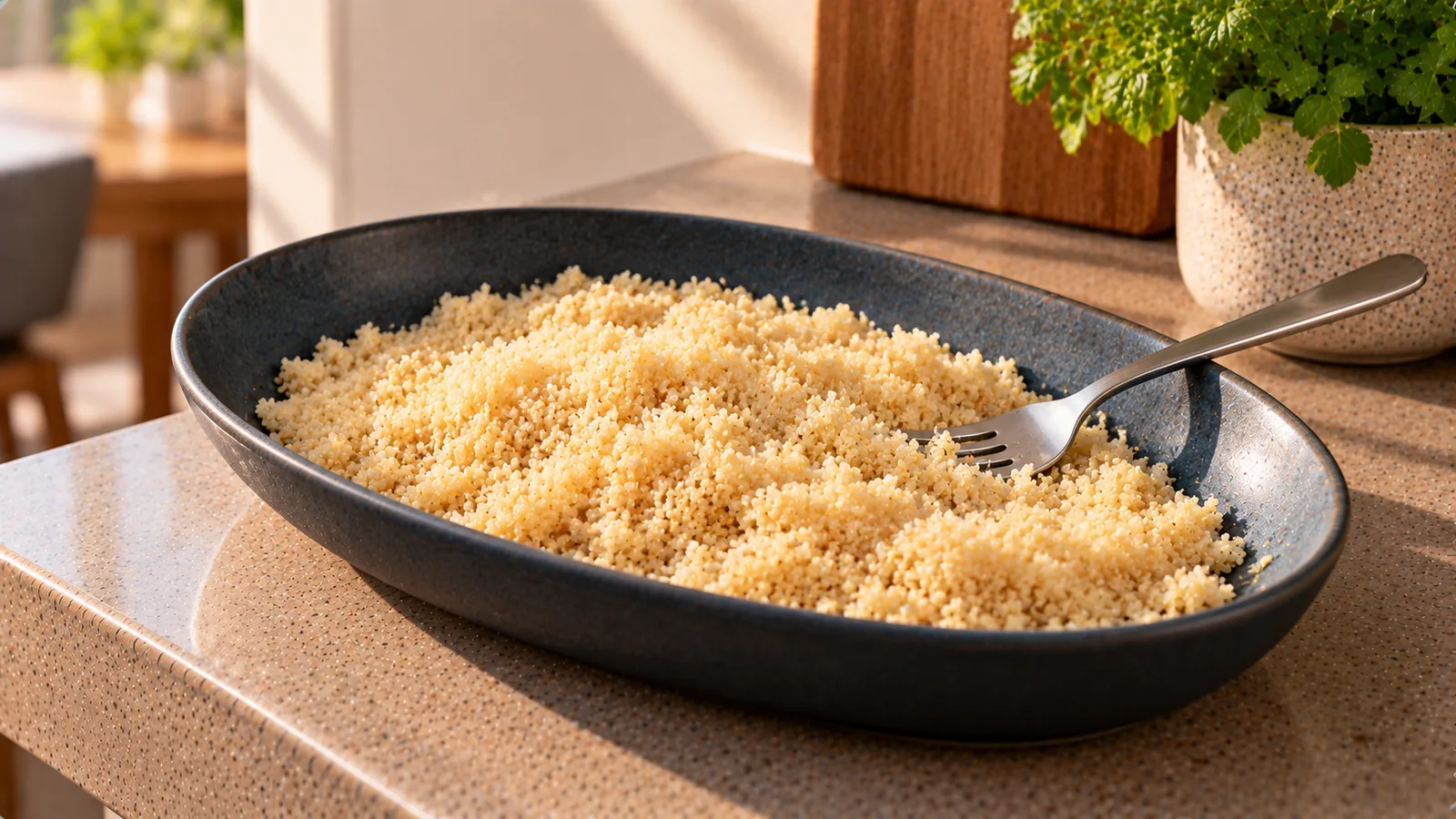
Couscous can look confusing in a calorie tracker because the value changes dramatically depending on whether it is listed dry or cooked.
As a useful reference, cooked couscous contains about 112 kcal per 100 g, while dry couscous commonly provides around 360–380 kcal per 100 g.
Cooking does not remove most of the calories. The grains absorb water and become heavier, so the same energy is distributed across a larger final weight.
Couscous nutrition per 100 g
A typical serving of plain cooked couscous provides approximately:
| Nutrient | Per 100 g cooked |
|---|---|
| Calories | ~112 kcal |
| Protein | ~3.8 g |
| Carbohydrates | ~23 g |
| Fat | ~0.2 g |
| Fiber | ~1.4 g |
Dry couscous is much more concentrated.
A typical dry product may provide roughly:
| Nutrient | Per 100 g dry |
|---|---|
| Calories | ~370 kcal |
| Protein | ~12–13 g |
| Carbohydrates | ~75–78 g |
| Fat | ~1–2 g |
Exact values vary by product, grain type and formulation. When you have the package, use its nutrition information.
Calories in cooked couscous portions
Using approximately 112 kcal per 100 g:
| Cooked couscous | Approx. calories |
|---|---|
| 50 g | 56 kcal |
| 75 g | 84 kcal |
| 100 g | 112 kcal |
| 125 g | 140 kcal |
| 150 g | 168 kcal |
| 175 g | 196 kcal |
| 200 g | 224 kcal |
| 250 g | 280 kcal |
For any portion:
grams eaten × calories per 100 g ÷ 100
For example:
180 g × 112 ÷ 100 ≈ 202 kcal
Calories in dry couscous portions
Using 370 kcal per 100 g as an example:
| Dry couscous | Approx. calories |
|---|---|
| 25 g | 93 kcal |
| 30 g | 111 kcal |
| 40 g | 148 kcal |
| 50 g | 185 kcal |
| 60 g | 222 kcal |
| 75 g | 278 kcal |
| 100 g | 370 kcal |
A dry portion can therefore appear much more calorie-dense than the same couscous after hydration.
Dry versus cooked couscous
The difference is mainly water.
Suppose you prepare 60 g dry couscous from a package containing 370 kcal per 100 g.
The dry couscous contributes:
60 × 370 ÷ 100 = 222 kcal
After hydration, it might weigh around 150–180 g depending on the preparation.
If the finished amount weighs 170 g, the entire 170 g still contains approximately 222 kcal before any added ingredients.
That works out to:
222 ÷ 170 × 100 ≈ 131 kcal per 100 g
Your own result may differ from a generic cooked-couscous database value because water absorption varies.
Why cooked couscous may not match a database exactly
Two people can start with the same amount of dry couscous and end up with different cooked weights.
The result depends on:
- how much water is added;
- whether excess liquid is drained;
- resting time;
- grain size;
- preparation method;
- how much moisture remains when weighed.
This changes calories per 100 g of the finished couscous without changing the total calories originally present in the dry grain.
The easiest method when cooking one portion
If you prepare couscous only for yourself, weighing it dry is often simplest.
For example, your package says:
376 kcal per 100 g dry
You use:
65 g dry
Calories:
65 × 376 ÷ 100 = 244.4 kcal
You can log approximately 244 kcal from the couscous.
Once you add water, you do not need to recalculate it just because the food becomes heavier.
Any oil, butter, sauce or other ingredients are tracked separately.
The best method for a batch
For several servings, calculate the full dry batch and then weigh the finished couscous.
Example:
Dry couscous: 250 g
Package value: 370 kcal per 100 g
Total calories:
250 × 370 ÷ 100 = 925 kcal
After preparation, the finished couscous weighs:
675 g
Calories per cooked gram:
925 ÷ 675 ≈ 1.37 kcal
A 180 g serving contains:
180 × 1.37 ≈ 247 kcal
A 220 g serving contains:
220 × 1.37 ≈ 301 kcal
This is especially useful when portions are not equal.
How much protein is in couscous?
Plain cooked couscous provides roughly 3–4 g of protein per 100 g.
Using 3.8 g per 100 g:
| Cooked portion | Approx. protein |
|---|---|
| 100 g | 3.8 g |
| 150 g | 5.7 g |
| 200 g | 7.6 g |
| 250 g | 9.5 g |
Couscous contributes some protein, but it is primarily a carbohydrate-rich grain product.
A meal can contain additional protein from foods such as beans, lentils, fish, meat, eggs, dairy or tofu.
Carbohydrates in couscous
Cooked couscous commonly contains around 23 g of carbohydrate per 100 g.
That gives approximately:
- 100 g cooked → ~23 g carbohydrate
- 150 g → ~35 g
- 200 g → ~46 g
- 250 g → ~58 g
Exact values depend on the product and preparation.
One cup of cooked couscous
Cup measurements are less precise than weighing because the amount depends on how loosely the couscous fills the cup.
A cup of cooked couscous is often around 150–160 g.
At 112 kcal per 100 g:
157 g × 112 ÷ 100 ≈ 176 kcal
So a cup may be around 175–180 kcal using this reference.
Treat this as an estimate rather than a universal value.
Half a cup of cooked couscous
If half a cup weighs about 75–80 g:
80 × 112 ÷ 100 ≈ 90 kcal
Again, weighing the actual serving is more reliable than assuming every half-cup contains exactly the same amount.
Instant couscous
Many supermarket couscous products are designed to hydrate quickly with boiling water.
The dry nutrition information may look high because it applies before water is added.
If the package gives values both “as sold” and “as prepared,” check which one matches the state in which you measure your food.
Do not apply a dry value to a cooked weight.
Whole-wheat couscous
Whole-wheat couscous may contain more fiber than a refined couscous product.
Its calorie value, however, is not necessarily dramatically lower.
If you are choosing between regular and whole-wheat couscous, compare the actual labels for:
- calories;
- fiber;
- protein;
- carbohydrate;
- serving size.
Do not assume “whole wheat” automatically means substantially fewer calories.
Pearl couscous is not the same serving reference
Pearl couscous, sometimes called Israeli couscous, has larger pieces and different preparation characteristics from fine North African-style couscous.
Its cooked weight and water absorption can differ.
For accurate tracking, use a database entry or package label specifically for the product you have rather than assuming all types of couscous have identical cooked values.
Does adding hot water add calories?
Plain water adds no calories.
If you hydrate dry couscous using only water, the total calories from the couscous itself remain approximately those of the dry amount you started with.
The final weight increases because water becomes part of the prepared food.
Couscous prepared with butter or oil
Added fat can make a significant difference.
Suppose you prepare:
- 200 g dry couscous at 370 kcal/100 g;
- 20 g olive oil at approximately 884 kcal/100 g.
Couscous:
200 × 370 ÷ 100 = 740 kcal
Oil:
20 × 884 ÷ 100 ≈ 177 kcal
Total:
740 + 177 = 917 kcal
If the finished dish is divided into four equal servings:
917 ÷ 4 ≈ 229 kcal per serving
This is before any other ingredients are included.
Couscous prepared with broth
Broth can range from almost negligible in calories to more substantial depending on the product and concentration.
If the broth has nutrition information, include it in the recipe calculation when relevant.
Do not automatically assume every broth is calorie-free.
Couscous salad
A couscous salad can contain ingredients such as:
- olive oil;
- chickpeas;
- feta;
- dried fruit;
- nuts;
- vegetables;
- herbs;
- dressing.
Plain cooked couscous data represent only the couscous portion.
For a homemade salad, calculate the couscous and additions separately or save the full recipe.
Couscous with vegetables
Vegetables usually add volume as well as their own nutrients and calories.
If a dish contains 150 g cooked couscous plus vegetables, do not weigh the complete mixture and apply the plain couscous value to all of it.
Either:
- track the ingredients before mixing; or
- create a recipe containing all ingredients and divide it by final weight or portions.
Couscous with meat or fish
The same principle applies to complete meals.
A plate containing couscous, chicken and vegetables is not accurately represented by a generic couscous entry.
If you know the approximate quantities, log:
- couscous;
- chicken or other protein;
- vegetables;
- cooking fat;
- sauce.
This gives a much more useful estimate.
Tracking restaurant couscous
Restaurant couscous is more difficult because the dry weight and added fats are usually unknown.
A practical approach is to estimate the cooked couscous portion separately from meat, vegetables and sauce when possible.
Remember that restaurant couscous may have been prepared with oil, butter, broth or sauce, so plain cooked couscous can underestimate the complete dish.
When exact information is unavailable, consistency matters more than false precision.
Does reheating couscous change its calories?
Reheating does not create or remove a meaningful amount of energy by itself.
It can change water content.
If couscous dries out during reheating, the same portion may weigh slightly less afterward, making calories per 100 g appear higher.
For meal prep, tracking the original batch and dividing its calories among actual portions is generally more reliable.
Package-first example
Suppose your dry couscous package states:
- 372 kcal per 100 g;
- 12.5 g protein;
- 76 g carbohydrate;
- 1.5 g fat.
You use 80 g dry.
Calories:
80 × 372 ÷ 100 = 297.6 kcal
Protein:
80 × 12.5 ÷ 100 = 10 g
Carbohydrate:
80 × 76 ÷ 100 = 60.8 g
Fat:
80 × 1.5 ÷ 100 = 1.2 g
After adding water, the total calories and macros from the couscous itself remain based on those 80 g dry.
Common tracking mistakes
Couscous is often logged inaccurately when people:
- weigh cooked couscous and select a dry entry;
- weigh dry couscous and select a cooked entry;
- assume a universal dry-to-cooked conversion;
- forget butter or oil added during preparation;
- treat pearl couscous and fine couscous as identical;
- log a mixed couscous salad as plain couscous;
- estimate cups without checking their weight;
- use a generic value when the package provides more relevant data.
Checking the food state and the label solves most of these problems.
Quick reference
Plain cooked couscous at approximately 112 kcal per 100 g:
- 50 g: ~56 kcal
- 100 g: ~112 kcal
- 150 g: ~168 kcal
- 200 g: ~224 kcal
- 250 g: ~280 kcal
Dry couscous at an example 370 kcal per 100 g:
- 25 g: ~93 kcal
- 50 g: ~185 kcal
- 60 g: ~222 kcal
- 75 g: ~278 kcal
- 100 g: ~370 kcal
For the most accurate tracking, use the nutrition label on your couscous and make sure the dry or cooked state of the entry matches the state in which you weighed the food.