
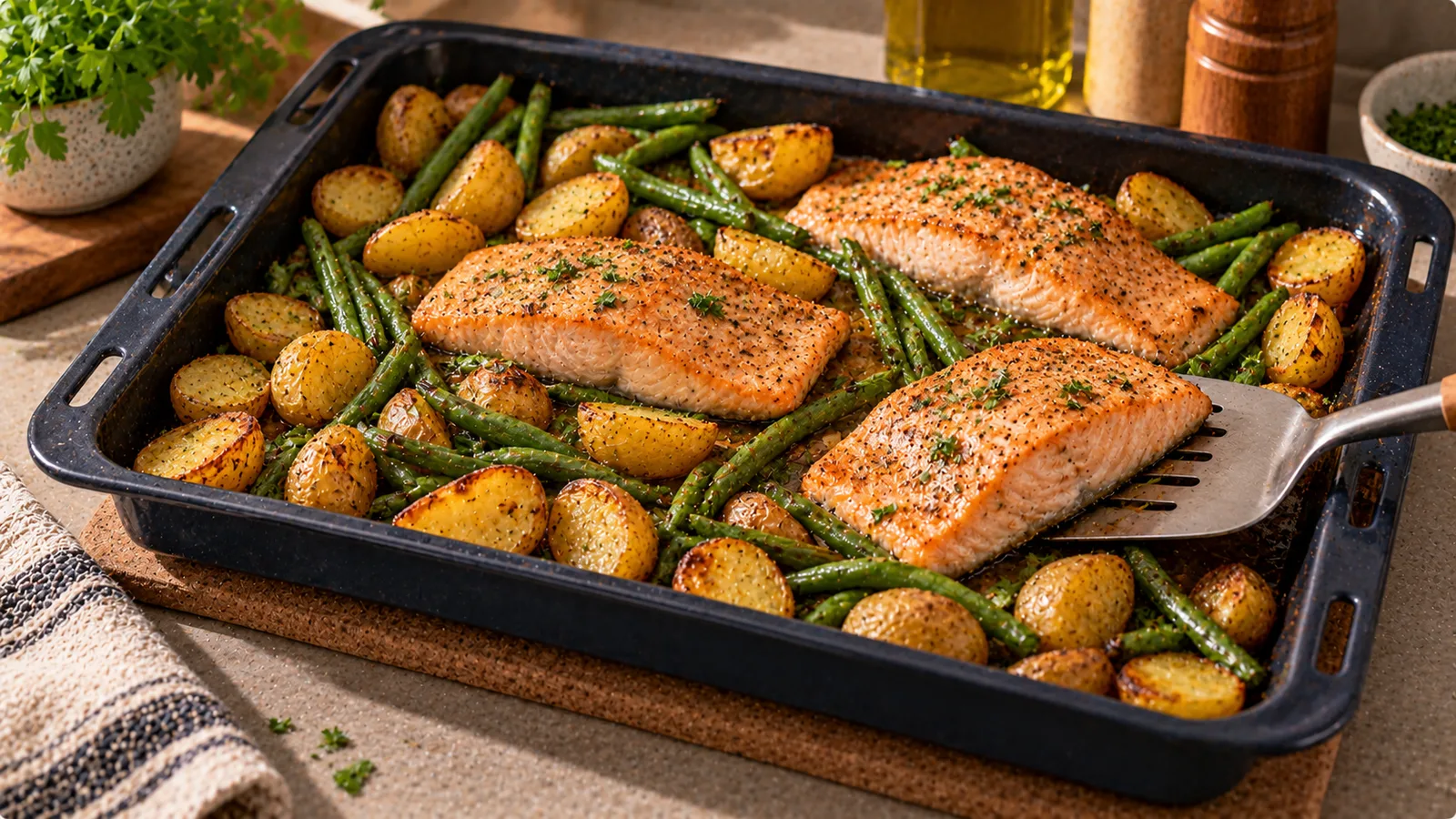
This salmon and potato tray bake is built around one important timing difference: potatoes need considerably longer in the oven than salmon. For another sheet-pan meal using salmon and a different vegetable, see a salmon and broccoli tray bake.
Instead of adding everything to the tray at once, the potatoes roast first. The salmon and faster-cooking vegetables are added later, allowing the potatoes to become tender without drying out the fish.
The recipe makes 4 servings and works well as a straightforward dinner with minimal washing up.
Ingredients
For 4 servings:
- 600 g salmon fillets, about 4 × 150 g, skin on or skinless
- 800 g potatoes
- 300 g green beans
- 250 g cherry tomatoes
- 1 medium red onion, about 150 g
- 25 g olive oil
- 1 lemon
- 2 garlic cloves
- 1 teaspoon dried oregano
- 1 teaspoon smoked paprika
- 1/2 teaspoon black pepper
- salt to taste
- fresh parsley or dill, optional
The ingredient weights are raw weights unless stated otherwise.
Equipment
You need:
- one large baking tray;
- baking paper or a lightly oiled tray;
- a knife and chopping board;
- a large bowl;
- ideally, a food thermometer for checking the salmon.
A large tray is preferable to a small crowded one. If the ingredients are packed tightly together, they steam more and brown less.
Step 1: heat the oven
Heat the oven to:
220°C conventional / 200°C fan / 425°F
Line a large baking tray with baking paper if desired.
Step 2: prepare the potatoes
Wash the potatoes and cut them into pieces roughly 2–3 cm across.
Keeping the pieces reasonably similar in size helps them cook evenly.
Place the potatoes in a bowl with:
- 15 g olive oil;
- oregano;
- smoked paprika;
- black pepper;
- a little salt.
Mix until evenly coated.
Spread them over the tray in a single layer.
Step 3: give the potatoes a head start
Roast the potatoes for:
20 minutes
This head start is important.
A 150 g salmon fillet may need only around 12–18 minutes depending on thickness, while raw potato pieces commonly need around 35–45 minutes in a hot oven.
Adding both at the beginning would make it difficult to cook them properly at the same time.
Step 4: prepare the vegetables
While the potatoes roast:
- trim the green beans;
- halve the cherry tomatoes if large;
- cut the red onion into wedges;
- finely chop or crush the garlic.
Mix the vegetables with the remaining 10 g olive oil and garlic.
Season lightly.
Step 5: prepare the salmon
Pat the salmon dry.
Season it with a little salt and pepper.
Cut the lemon in half.
Use some of the juice over the salmon and reserve the rest for serving.
You can also place a few thin lemon slices on or beside the salmon.
Step 6: add the vegetables
After the potatoes have roasted for 20 minutes, remove the tray from the oven.
Turn the potatoes.
Add:
- green beans;
- red onion;
- cherry tomatoes.
Return the tray to the oven for:
8 minutes
This gives the firmer vegetables a short head start before the salmon is added.
Step 7: add the salmon
Remove the tray again and make space for the four salmon fillets.
Place the salmon on the tray without stacking it over the vegetables.
Return everything to the oven.
Bake for approximately:
12–16 minutes
The exact cooking time depends on the thickness of the salmon.
A thick fillet will take longer than a thin tail piece.
How to know when the salmon is cooked
The safest way to check fish is with a food thermometer.
For a conservative food-safety target, cook the thickest part of the salmon to approximately:
63°C / 145°F
The flesh should be opaque and separate easily into flakes.
Avoid relying only on oven time because salmon fillets can differ substantially in thickness.
Total cooking time
A typical schedule is:
- potatoes alone: 20 minutes;
- potatoes and vegetables: 8 minutes;
- everything with salmon: 12–16 minutes.
Total oven time:
about 40–44 minutes
Preparation usually takes another 10–15 minutes.
Serving
Divide the tray into four portions.
Each serving contains approximately:
- 150 g raw-weight salmon before cooking;
- 200 g raw-weight potatoes;
- about 175 g mixed vegetables;
- roughly one quarter of the oil and seasonings.
Finish with fresh lemon juice and optional parsley or dill.
Approximate nutrition per serving
Nutrition varies with the salmon, potato variety and exact amount of oil retained on the food.
Using the recipe above, one serving is approximately:
| Nutrient | Approximate amount |
|---|---|
| Calories | 590–630 kcal |
| Protein | 36–40 g |
| Carbohydrate | 43–49 g |
| Fat | 27–31 g |
| Fiber | 7–9 g |
These values are estimates rather than laboratory measurements.
For more accurate tracking, use the nutrition values from the ingredients you actually buy.
Where the calories come from
The main energy sources are salmon, potatoes and olive oil.
A rough breakdown for the entire recipe may look like:
Salmon, 600 g:
about 1,200–1,250 kcal
Potatoes, 800 g:
about 600–620 kcal
Olive oil, 25 g:
about 220 kcal
Green beans, tomatoes and onion together:
about 220–260 kcal
Total:
roughly 2,250–2,350 kcal
Divided into four portions:
roughly 560–590 kcal before allowing for ingredient variation
Higher-fat salmon can move the total upward, which is why a practical serving estimate can reasonably fall around 590–630 kcal.
Why salmon calories vary
Salmon is naturally a relatively fatty fish, but its fat content is not identical across all products.
Values can differ according to:
- species;
- farmed versus wild salmon;
- cut;
- season;
- product preparation.
If the package provides nutrition information, use that value for your calculation.
For example, if your salmon contains 208 kcal per 100 g:
208 × 600 ÷ 100 = 1,248 kcal
The salmon contributes 1,248 kcal to the whole recipe.
Divided across four equal portions:
1,248 ÷ 4 = 312 kcal from salmon per serving
Raw versus cooked salmon weight
This recipe uses:
600 g raw salmon
The fish loses water during cooking, so its cooked weight will usually be lower.
That does not mean calories disappeared.
If 600 g raw salmon becomes 500 g after baking, the nutrition from the original 600 g is now concentrated into approximately 500 g of cooked fish.
For recipe tracking, avoid mixing a raw nutrition entry with an unexplained cooked weight.
Use a consistent basis.
Raw versus cooked potato weight
The same principle applies to potatoes.
The recipe begins with:
800 g raw potatoes
Roasting removes some water.
The finished potatoes may therefore weigh less than 800 g.
If you calculate the recipe using the raw ingredient values, keep the ingredient quantity at 800 g rather than replacing it with the final roasted weight.
Can you use baby potatoes?
Yes.
Small baby potatoes work particularly well.
Halve larger ones so that most pieces are similar in size.
Very small potatoes can be left whole, although whole potatoes may need a longer head start.
The goal is to have them almost tender before the salmon finishes cooking.
Can you use sweet potatoes?
Yes, but the result will be different.
Cut sweet potatoes into roughly 2–3 cm pieces and monitor them because their texture changes differently during roasting.
You can use the same staggered cooking method:
- start the sweet potatoes first;
- add vegetables;
- add salmon near the end.
For nutrition tracking, use the sweet potato values instead of the potato values.
Vegetables that work well
Green beans and tomatoes are used here because they cook relatively quickly and pair well with salmon.
Other options include:
- broccoli florets;
- asparagus;
- bell peppers;
- zucchini;
- Brussels sprouts.
Timing matters.
Zucchini cooks quickly and can become very soft if added with the potatoes.
Brussels sprouts generally need more time.
Adjust when each vegetable goes onto the tray rather than assuming all vegetables require identical cooking times.
Avoid overcrowding the tray
A crowded tray traps moisture.
Instead of roasting, the potatoes and vegetables can begin to steam.
If your tray is small, use two trays.
Keep the potatoes in a reasonably open layer.
The salmon also benefits from having some space around each fillet.
Can you reduce the oil?
Yes.
The recipe uses 25 g olive oil for four servings.
That equals approximately:
6.25 g oil per serving
Because oil provides about 9 kcal per gram, the oil contributes roughly:
56 kcal per serving
If you reduce the oil to 15 g for the entire recipe, you remove approximately:
10 g × 9 = 90 kcal
from the full tray, or roughly:
22–23 kcal per serving
Use enough oil to coat the potatoes and vegetables lightly rather than pouring it freely over the tray.
Can you use more salmon?
Yes.
If you use four 200 g fillets instead of four 150 g fillets, the recipe contains:
800 g salmon instead of 600 g
This increases both protein and calories.
It can also affect cooking time if the larger fillets are thicker.
Use internal temperature rather than assuming the original 12–16 minute range will always be sufficient.
Making six servings
To scale the recipe to six portions, a practical starting point is:
- 900 g salmon;
- 1.2 kg potatoes;
- 450 g green beans;
- 375 g cherry tomatoes;
- about 225 g red onion;
- 35–40 g olive oil.
Do not crowd all of this onto a tray designed for four servings.
Use two trays if necessary.
Crowding can significantly change roasting time and texture.
Meal-prep portions
For meal prep, divide the finished tray into four containers after cooking.
If you want the portions to be especially even, weigh the cooked components.
For example, divide the salmon into four fillets and then distribute the cooked potatoes and vegetables as evenly as practical.
You do not need every container to be identical to the gram unless precise portioning is important for your goal.
Refrigerating leftovers
Cool leftovers promptly and refrigerate them in covered containers.
As a practical food-safety rule, use refrigerated cooked salmon within approximately:
3–4 days
Keep the refrigerator at about:
4°C / 40°F or colder
If the food has been left at room temperature for an extended period, refrigeration does not undo that exposure.
Reheating
Reheat leftovers until thoroughly hot.
An oven or air fryer can help restore some texture to the potatoes.
A microwave is faster but tends to make roasted potatoes softer.
Salmon can dry out when reheated aggressively, so use only as much heating as necessary.
Can you freeze the tray bake?
The cooked salmon can be frozen.
Roasted potatoes can also be frozen, although their texture may become softer or slightly grainier after thawing.
Green beans generally tolerate freezing reasonably well.
Tomatoes will become much softer.
For the best texture, you may prefer to freeze salmon and potatoes while adding fresh vegetables when serving.
If freezing complete portions is more convenient, they are still usable; just expect a softer vegetable texture.
Freezing individual portions
Allow the cooked food to cool promptly.
Pack portions in freezer-safe containers.
Freeze them while fresh rather than waiting until the end of their refrigerated storage period.
Thaw in the refrigerator before reheating when possible.
A useful variation with mustard
For a sharper flavor, mix:
- 15 g Dijon mustard;
- juice from half a lemon;
- one crushed garlic clove.
Brush the mixture lightly over the salmon before baking.
If the mustard contains meaningful calories or sugar, include it when calculating the recipe, although a small amount usually changes the total only modestly.
A Mediterranean variation
Replace the green beans with bell peppers and zucchini.
Add:
- oregano;
- garlic;
- lemon;
- a small amount of fresh parsley after cooking.
Add zucchini later than the potatoes so it does not become excessively soft.
A simple portion-tracking example
Suppose your exact ingredients contain:
- salmon: 1,248 kcal;
- potatoes: 616 kcal;
- olive oil: 221 kcal;
- vegetables and onion: 235 kcal.
Total:
1,248 + 616 + 221 + 235 = 2,320 kcal
Four servings:
2,320 ÷ 4 = 580 kcal per serving
If the four portions are reasonably equal, you can log approximately:
580 kcal per serving
If you eat a substantially larger or smaller portion, calculate it from the fraction of the recipe you actually ate.
If you weigh the finished recipe
You can also calculate calories by cooked weight.
Suppose the edible cooked food weighs:
2,000 g
and the full recipe contains:
2,320 kcal
Calories per gram:
2,320 ÷ 2,000 = 1.16 kcal/g
A 500 g portion would contain:
500 × 1.16 = 580 kcal
This method is useful when portions are not divided equally.
Common timing problem: potatoes are still hard
If the salmon is cooked but the potatoes remain firm, the potatoes were probably:
- cut too large;
- crowded on the tray;
- started for too little time;
- cooked at a lower effective oven temperature.
Do not keep fully cooked salmon in the oven for another 20 minutes just to finish the potatoes.
Remove the salmon and continue roasting the potatoes separately.
Next time, cut them smaller or extend their initial roasting time.
Common timing problem: dry salmon
Salmon can dry out if it is added too early.
The potatoes should already have had most of their cooking time before the fish reaches the tray.
Also remember that thinner salmon pieces cook faster.
Check the thickest part rather than automatically using the maximum cooking time.
Recipe summary
For four servings:
- Heat the oven to 220°C conventional or 200°C fan.
- Roast 800 g seasoned potatoes with 15 g oil for 20 minutes.
- Add green beans, tomatoes and onion with the remaining 10 g oil.
- Roast for another 8 minutes.
- Add four 150 g salmon fillets.
- Bake for about 12–16 minutes, checking the thickest fillet for doneness.
- Finish with lemon and divide into four portions.
The staggered timing is what makes this tray bake work: the potatoes get enough roasting time while the salmon is added late enough to stay tender.