
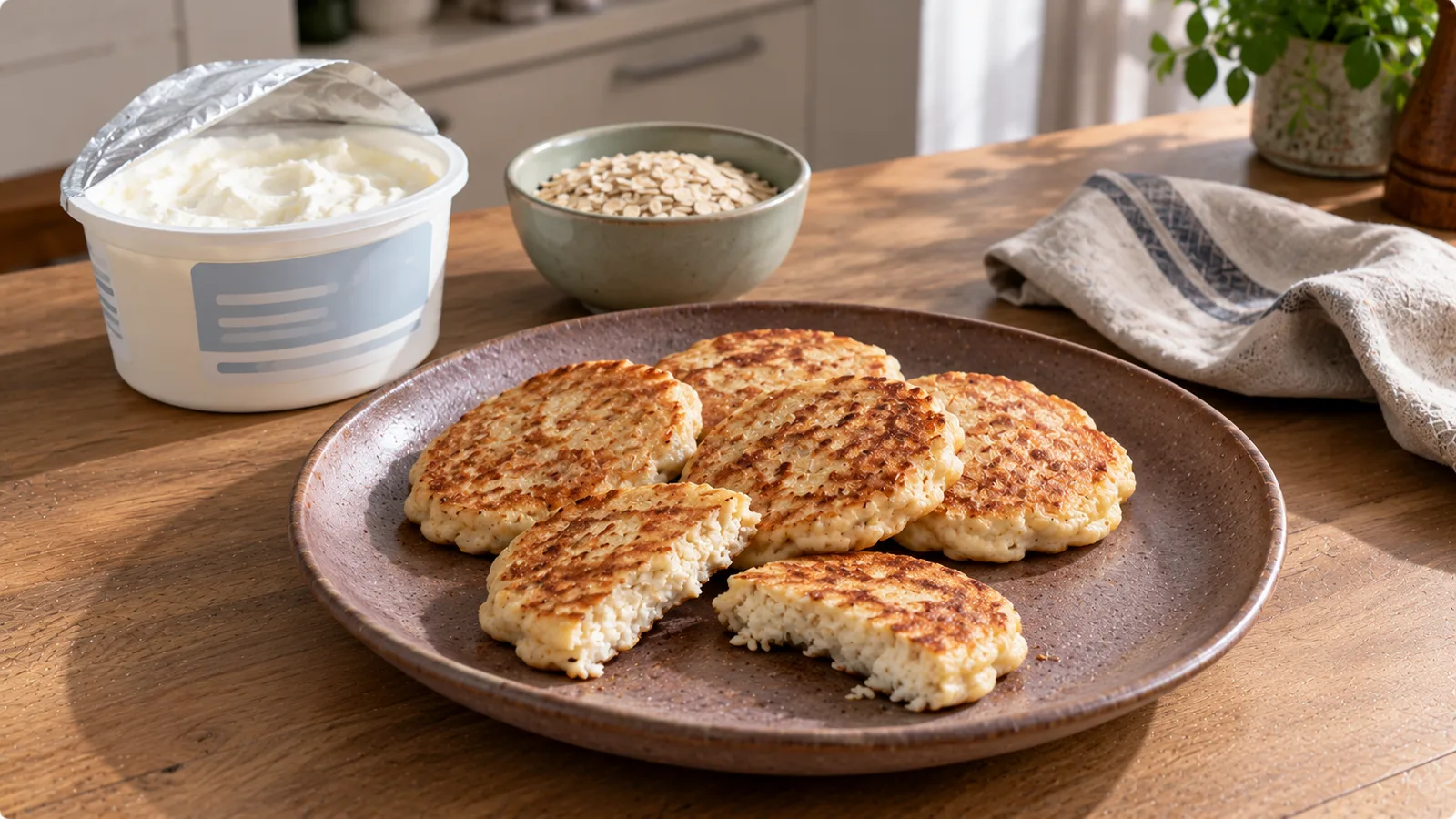
Quark pancakes are soft, lightly tangy pancakes made with fresh quark, eggs and oats. They work well for breakfast because the batter requires only a few ingredients and provides more protein than many traditional pancake recipes.
This version uses Magerquark (low-fat German quark), finely ground oats and a small amount of oil for cooking. There is no protein powder and no added sugar in the batter.
Recipe at a glance
| Preparation | 10 minutes |
| Resting | 5 minutes |
| Cooking | 12–15 minutes |
| Total | About 30 minutes |
| Yield | 8 small pancakes |
| Servings | 2 |
| Difficulty | Easy |
The recipe makes two servings of four small pancakes each.
Ingredients
For 8 small pancakes:
| Ingredient | Amount |
|---|---|
| Low-fat quark (Magerquark) | 250 g |
| Rolled oats | 80 g |
| Eggs | 2 medium, about 100 g without shells |
| Milk, 1.5% fat | 40 ml |
| Baking powder | 5 g |
| Vanilla extract | 1 teaspoon |
| Ground cinnamon | 1/2 teaspoon |
| Salt | Small pinch |
| Neutral cooking oil | 8 g |
Optional toppings, not included in the base nutrition estimate:
- 100 g fresh berries.
- 50 g plain yogurt or skyr.
- A little lemon zest.
- Maple syrup or honey, if desired.
Quark choice: German Magerquark usually has a thick consistency and a low fat content. Full-fat quark changes the calories and fat content. If using a thinner dairy product, reduce the milk.
Oats: Rolled oats can be blended into flour. Oat flour also works, but its absorption can vary slightly.
How to make quark pancakes
1. Prepare the oats
Blend the 80 g of rolled oats until they resemble coarse flour.
A perfectly fine powder is not necessary. Slightly coarse oats give the pancakes a pleasant texture.
If you prefer a more rustic pancake, leave some oats partially intact.
2. Mix the wet ingredients
In a medium bowl, combine:
- 250 g low-fat quark.
- 2 eggs.
- 40 ml milk.
- Vanilla extract.
Whisk until the mixture is reasonably smooth.
Small lumps of quark are fine.
3. Add the dry ingredients
Stir in:
- Ground oats.
- Baking powder.
- Cinnamon.
- Salt.
Mix until no large dry patches remain.
The batter should be thick enough to hold its shape briefly when spooned into a pan, but still spreadable.
4. Let the batter rest
Leave the batter for approximately 5 minutes.
Oats absorb liquid during this time, making the mixture thicker.
If the batter becomes too stiff, add milk in small amounts, about 5–10 ml at a time.
If it is very runny, stir in a little more ground oats.
Any extra ingredients will change the final nutrition estimate.
5. Heat the pan
Place a non-stick frying pan over medium-low heat.
Add a small portion of the measured 8 g oil and spread it across the surface.
Do not use very high heat: quark pancakes contain substantial moisture and need time to cook through before the outside becomes too dark.
6. Cook the pancakes
Spoon the batter into the pan to make pancakes approximately 8–10 cm wide.
Cook for about 2–3 minutes on the first side, until the edges look set and the underside is golden.
Flip carefully with a thin spatula.
Cook for another 2–3 minutes, until the centre is set.
Cooking times depend on pancake thickness and pan temperature. Check a thicker pancake before serving; the centre should not contain raw batter.
Repeat with the remaining batter and oil.
7. Serve
Divide the eight pancakes into two servings.
Serve warm with berries, yogurt or another topping of your choice.
For a balanced breakfast, fresh fruit adds flavour and fibre without needing much sweetener.
Estimated nutrition
The following calculation uses illustrative values for common ingredients:
| Ingredient | Calories | Protein |
|---|---|---|
| 250 g low-fat quark | 168 kcal | 30 g |
| 80 g rolled oats | 296 kcal | 10.4 g |
| 2 eggs, 100 g edible weight | 143 kcal | 12.6 g |
| 40 ml milk, 1.5% fat | 19 kcal | 1.4 g |
| 8 g cooking oil | 72 kcal | 0 g |
| Baking powder, vanilla, cinnamon | Approximately 7 kcal | Negligible |
| Whole recipe | Approximately 705 kcal | 54 g |
These are estimates, not laboratory measurements. Quark and oat nutrition varies by brand. The calculation assumes all measured cooking oil is consumed.
Per serving
| Nutrient | Approximate amount |
|---|---|
| Calories | 353 kcal |
| Protein | 27 g |
| Carbohydrates | 33 g |
| Fat | 12 g |
| Fibre | 4–5 g |
Each serving contains four small pancakes.
The carbohydrate, fat and fibre estimates are rounded and depend on the specific products used.
Toppings are not included. For example, adding berries, yogurt, syrup or nut butter increases the total according to the quantities used.
For the most accurate result, use the nutrition labels on your own ingredients and divide the full recipe by the number of servings.
Why quark works in pancakes
Quark has a thick texture and mild acidity.
In pancake batter, it:
- Adds moisture without requiring much oil.
- Contributes protein.
- Creates a tender, slightly dense interior.
- Pairs well with vanilla, cinnamon and fruit.
Unlike a very thin pancake batter, quark batter needs a gentler cooking temperature.
The goal is a golden exterior and a cooked, soft centre.
How to keep the pancakes from falling apart
Quark pancakes can be more delicate than pancakes made with a large amount of wheat flour.
Three adjustments help.
Keep them small. Pancakes around 8–10 cm wide are easier to flip.
Allow the first side to set. Flipping too early can tear the pancake.
Use moderate heat. High heat browns the outside before the centre firms up.
If the batter is unusually loose, let it rest a little longer or add a small amount of ground oats.
If the pancakes are dry, reduce the cooking time and check whether the batter needs a little more milk.
Can you use skyr instead of quark?
Yes, but the result may differ.
Plain skyr is generally less dense than Magerquark, depending on the product.
If substituting 250 g skyr:
- Start without the 40 ml milk.
- Mix the other ingredients.
- Rest the batter for 5 minutes.
- Add a little milk only if needed.
Protein and calorie values will depend on the skyr brand.
Greek yogurt can also work, but fat content and thickness vary substantially.
Can you make the pancakes without a blender?
Yes.
Use ready-made oat flour instead of rolled oats.
Alternatively, use fine oats and let the batter rest longer, approximately 10–15 minutes.
The texture will be slightly more rustic.
Do not assume that 80 ml of oat flour weighs 80 g: measure by weight for consistent results.
Serving ideas
These combinations change the nutrition of the final meal.
Berries and skyr
Add a spoonful of plain skyr and fresh raspberries or blueberries.
This keeps the topping simple and adds extra protein.
Warm apple and cinnamon
Gently heat diced apple with a little water and cinnamon until soft.
Spoon over the pancakes.
Banana and peanut butter
Add sliced banana and a measured amount of peanut butter.
This is a more energy-dense option, so record the nut butter separately if tracking calories.
Savoury variation
Omit vanilla and cinnamon.
Add chopped chives and serve with a little plain yogurt.
Avoid adding sugar or sweet toppings to this version.
Storage and reheating
Allow cooked pancakes to cool promptly.
Store in a covered container in the refrigerator and use within 2 days as a conservative home-storage guideline.
Reheat thoroughly in a pan or microwave.
For longer storage, freeze the cooled pancakes in separate layers, then transfer them to a freezer-safe container.
Defrost in the refrigerator or reheat directly from frozen until hot throughout.
Do not leave cooked pancakes at room temperature for extended periods.
Common ingredient adjustments
| Change | Effect |
|---|---|
| Full-fat quark | Higher fat and calories |
| Skyr instead of quark | Different thickness and protein content |
| More oats | Thicker batter and more carbohydrates |
| More milk | Thinner batter |
| Additional oil | Higher calories |
| Banana in batter | Sweeter flavour and more carbohydrates |
| Protein powder | Changes moisture balance and nutrition |
Make one adjustment at a time so the batter remains easy to cook.
How to log the recipe in a food diary
For accurate tracking:
- Enter the exact weight of the quark, oats, eggs, milk and oil.
- Add any toppings separately.
- Save the complete recipe as eight pancakes or two servings.
- Record how many pancakes you actually eat.
If the pancakes vary in size, weighing the finished batch and your portion is more accurate than counting pieces.
Avoid entering the pancakes as generic restaurant pancakes: recipes made with butter, sugar or wheat flour may have very different nutrition.