
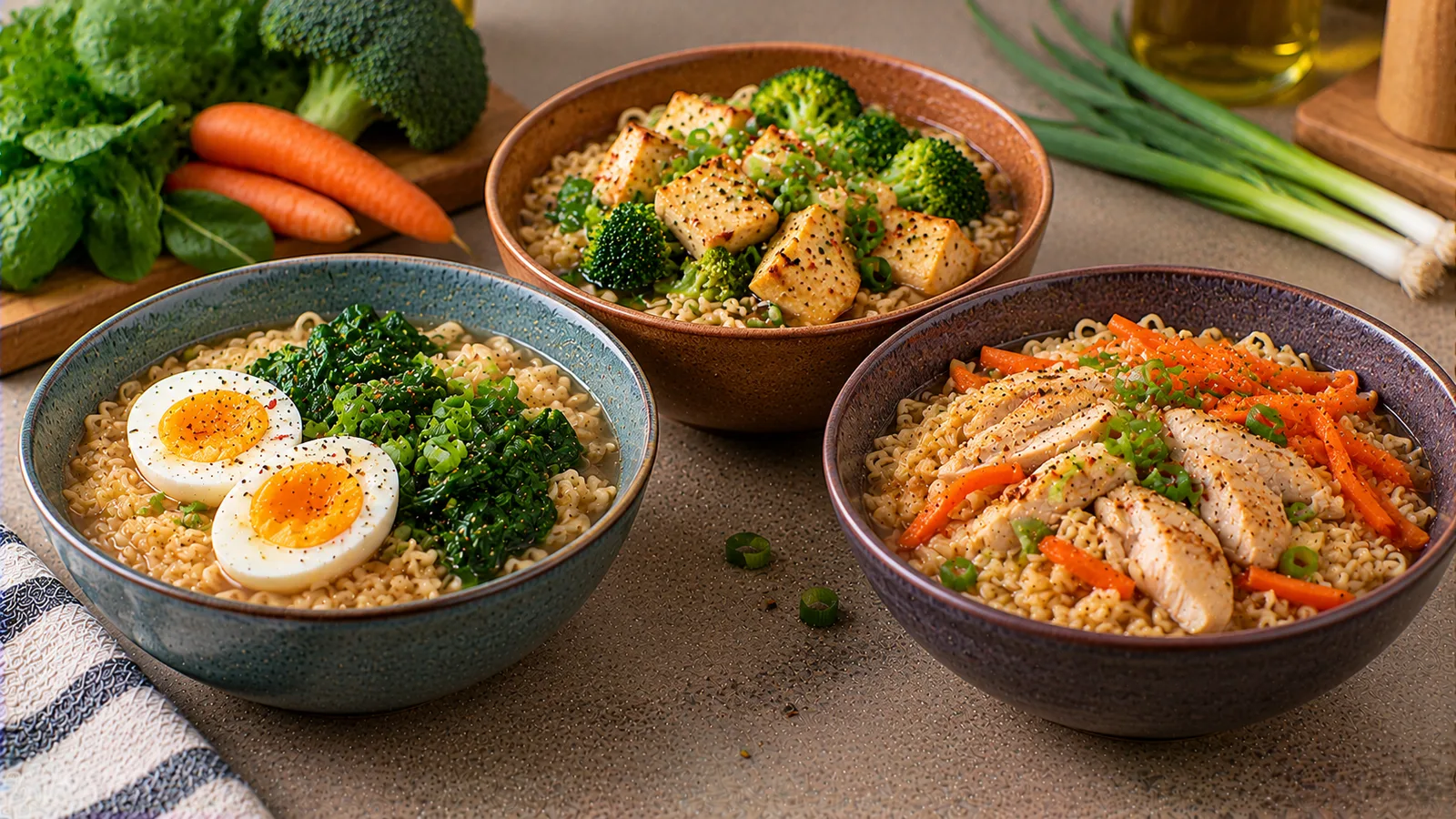
Can instant noodles become a more balanced meal?
Yes. Use one 70 g dry instant-noodle block for one adult, add a substantial protein-containing food and a measured serving of vegetables, and treat the seasoning separately rather than assuming that more toppings cancel out its salt. Three different, usable bowls are below: two eggs with peas and carrots, 180 g firm tofu with spinach and mushrooms, or 160 g drained canned chickpeas with broccoli and tomatoes. The quantities are for three alternative single-serving meals, not ingredients combined in one bowl or a three-day nutrition prescription. Our budget-balanced-plate guide explains how to assess the final plate beyond marketing claims.
Instant noodles are a convenient starchy base. They are not automatically nutritionally equivalent across brands: fried and air-dried blocks, sachets, declared serving sizes and nutrition information vary. These dishes add variety and protein-containing foods; without real product labels we cannot truthfully promise a particular protein total, calorie level or reduction in salt. The measurements help you cook and recalculate from your own packet.
Choose the correct noodle packet before adding anything
For each bowl use 70 g of noodles weighed dry, without the seasoning sachet. If your packet contains 65 g or 85 g, either weigh out 70 g and retain the rest safely or use the whole packet and recalculate; do not silently treat a packet of any size as 70 g. Check the instructions for whether the nutrition declaration includes a separate seasoning sachet, is for the product as sold, or describes it as prepared. Those denominators cannot be interchanged. In the EU, nutrition information is generally declared per 100 g or 100 ml, with optional per-portion figures; the European Commission explains that basis.
A simple, hypothetical arithmetic example: if the noodle product label explicitly states 8 g protein and 3.0 g salt per 100 g of the product as sold, then a 70 g serving of the same product would supply 5.6 g protein and 2.10 g salt, before additions. This is an illustration of multiplication (0.70 × the label value), not a measurement of the recipes here, not a claim about a particular manufacturer and not a value to reuse if the seasoning is excluded from the declared basis. If an actual label reports salt for a prepared bowl including liquid, follow its own serving definition instead. In Europe the label usually declares salt, whereas some international labels give sodium; 1 g salt corresponds to roughly 400 mg sodium. Our guide to reading nutrition labels explains why label basis and serving size matter.
Ingredients for three alternative bowls
The table gives ingredients per finished bowl for one adult. Vegetables are weighed before cooking; peas and spinach are weighed frozen, chickpeas after draining, tofu after draining, and eggs by count. Choose only one column to prepare a meal. Water does not add protein; seasoning and sauce are optional and must be considered in the total salt calculation.
| Measured ingredient | Egg + peas | Tofu + spinach | Chickpeas + broccoli |
|---|---|---|---|
| Instant noodles, dry | 70 g | 70 g | 70 g |
| Whole eggs | 2 pcs | — | — |
| Frozen peas | 120 g | — | — |
| Carrot | 100 g | — | — |
| Firm tofu, drained | — | 180 g | — |
| Frozen spinach | — | 150 g | — |
| Mushrooms | — | 100 g | — |
| Canned chickpeas, drained | — | — | 160 g |
| Broccoli florets | — | — | 180 g |
| Chopped tomato | — | — | 120 g |
| Spring onion | 40 g | 40 g | 40 g |
| Water (approx.) | 350 ml | 350 ml | 350 ml |
These are approximate home-kitchen quantities, not a laboratory nutrient analysis. A package described as 'two servings' cannot be assumed to deliver the quantities in this table. The ingredient types differ by bowl, so their final protein values must be checked separately. The next sections provide enough steps to actually cook each dish.
Bowl 1 — Egg, pea and carrot noodles
Use: 70 g dry instant noodles, 2 eggs, 120 g frozen green peas, 100 g carrot, 40 g spring onion and approximately 350 ml water. Optional: a little black pepper, lemon or part of the noodle seasoning sachet. This bowl contains egg and wheat if wheat noodles are used; check the package for any other allergens. The vegetables are not a decorative scattering: 220 g peas and carrot are weighed before cooking, plus the onion.
Method: (1) Wash and slice carrot thinly, trim the spring onion and reserve the green part. (2) Bring water to a boil in a saucepan and simmer the carrot for about 3–5 minutes, depending on thickness. (3) Add the frozen peas and cook according to their pack; add the noodles when the remaining cooking time matches the noodle packet, commonly around 3–5 minutes but never guaranteed. Add extra water if needed and stir so no frozen centre remains. (4) Beat the two eggs in a cup. Stir the simmering broth, pour in the egg and keep cooking until the egg is fully set throughout, not merely warmed by the soup. (5) Add spring onion and a measured amount of seasoning after tasting. Serve immediately.
Cooking the egg directly in the broth makes a substantial egg-and-vegetable bowl without requiring a separate frying pan. A half-sachet may taste less salty, but it does not prove a 50% reduction in the full bowl's salt: the noodles and other ingredients already contain sodium, and the sachet's distribution is unknown. For people who must strictly restrict sodium, use the actual product declaration and clinical advice rather than guessing.
Bowl 2 — Tofu, spinach and mushroom noodles
Use: 70 g dry instant noodles, 180 g firm tofu (drained weight), 150 g plain frozen spinach, 100 g fresh mushrooms, 40 g spring onion and about 350 ml water. Optional flavour: ginger, lemon or garlic if on hand; no extra salty sauce is assumed. Confirm that the tofu is suitable for cooking as directed, and follow any package instructions for frozen spinach.
Method: (1) Drain the tofu and cut it into small cubes. Wipe the mushrooms and slice them; wash and cut the spring onion. (2) In a saucepan, heat the mushrooms with a splash of water for 4–5 minutes, stirring until their moisture starts to evaporate. (3) Add tofu, frozen spinach and water. Bring to a steady simmer; separate any frozen spinach clumps and cook according to its packaging until hot throughout. (4) Add the dry noodle block and simmer for the time stated on its packet, usually 3–5 minutes for many products. Check both the noodle and spinach instructions rather than using an invented fixed time. (5) Finish with spring onion and only as much seasoning as you want after reading the label.
Tofu supplies a different protein-containing food from eggs and canned pulses, and mushrooms add texture. But 180 g tofu does not mean 180 g protein. To estimate actual protein, multiply the label's grams of protein per 100 g by 1.8, then add the noodle and other ingredient values on their matching raw/drained bases. If the tofu is sold in 200 g packs and loses liquid when drained, weigh the edible portion; do not use gross pack weight as the edible weight.
Bowl 3 — Chickpea, broccoli and tomato noodles
Use: 70 g dry instant noodles, 160 g drained canned chickpeas, 180 g broccoli florets, 120 g chopped tomatoes and 40 g spring onion, with about 350 ml water. The chickpeas are already cooked; if using dried raw chickpeas instead, they require an entirely different soaking and cooking process and cannot simply be tipped into a 5-minute noodle pot.
Method: (1) Drain and rinse the canned chickpeas if desired; measure 160 g after draining. Cut broccoli into small florets and chop tomatoes; wash the spring onion. (2) Bring the water to a simmer and cook broccoli until nearly tender, typically 4–6 minutes for small florets. (3) Add tomatoes and chickpeas and heat thoroughly. (4) Stir in noodles and simmer to their packet's specified point of doneness, commonly about 3–5 minutes. If water becomes scarce, add small amounts without assuming that this changes the nutrition of the dry noodles. (5) Finish with spring onion, pepper or a small amount of seasoning. Serve hot, rather than leaving the cooked noodles at room temperature for a later meal.
This is the pulse-based version. Canned chickpeas can contribute protein and fibre; the actual amounts depend on their label and drained edible mass. The optional rinse can remove some liquid on the surface but is not an accurately quantifiable reduction in sodium without product-specific information. Tomato and broccoli change both vegetable quantity and the bowl's texture compared with a plain noodle cup.
Protein, salt and energy: calculate the complete bowl, not just the packet
To estimate protein for one bowl, add the noodle contribution, measured protein food and all vegetables using the correct label basis. If tofu lists 12 g protein per 100 g as sold and your 180 g edible drained portion has the same composition, that part contributes 21.6 g protein (12 × 1.8). If the dry noodle label gives 8 g per 100 g on a directly comparable basis, its 70 g adds 5.6 g. Together that is 27.2 g before mushrooms, spinach or other ingredients; it is a conditional calculation based on two illustrative labels, not a verified protein claim for Bowl 2. A different tofu brand, draining method or noodle label changes the result.
For calories, fat, carbohydrate and fibre, apply the same method. Do not multiply values for cooked noodle weight by a dry-food declaration; water absorption changes mass, not the amount of nutrients in the original dry portion. Conversely, if the manufacturer reports the nutrition for a prepared soup including added water, use that prepared basis and volume. Some noodle sachets contain oil as well as powdered seasoning; leaving out an oil sachet can change energy content as well as flavour. Do not call the dish 'low calorie', 'low sodium' or 'high protein' under EU claim rules without confirming applicable thresholds on the actual complete food. EU nutrition-claim conditions have specific legal meanings.
The World Health Organization's adult reference is less than 2,000 mg sodium per day, approximately 5 g salt. That is for the whole day, not a magic allowance for a noodle bowl. One meal can contribute a substantial share. If your packet's salt declaration is for the complete dry product with all sachets, using only part of the sachet makes the original full-pack number an imperfect estimate, not proof that the sodium halved. For accurate tracking, look for separate sachet nutrition or choose noodles with an unambiguous label and season them yourself.
Quick decision guide
Choose the egg bowl when eggs are convenient and you want a savoury broth with peas. Choose the tofu bowl when you prefer a soy-based option and leafy greens. Choose the chickpea bowl when you have a ready-to-eat can, want a pulse-and-broccoli combination and do not want to cook raw legumes. Each is a single serving based on 70 g dry noodles, not three servings from one block. Vegetables supply volume and diversity, but none of these choices automatically meets a day's overall nutrient targets. A snack or other meal may still be necessary depending on individual needs.
For meal planning, buy vegetables you will actually use. Frozen spinach and peas make measured additions convenient; leftover broccoli, carrots or tofu should be stored according to their packaging. Our high-protein ready meals versus homemade comparison provides a different comparison of ready meals with home-prepared alternatives; this article is solely a practical noodle upgrade, not a claim that a particular instant product is worse or better than all home cooking.
Safe preparation and storage
Follow all package instructions, including special directions for frozen vegetables and noodles. Keep raw eggs away from ready-to-eat toppings; cook them fully and clean utensils that touched raw egg. If using a microwave, use microwave-safe cookware, stir appropriately and follow the manufacturer’s directions. Serve these bowls immediately for the best noodle texture.
If a portion remains, refrigerate it promptly in a shallow covered container at 4 °C or below, within 2 hours of cooking (1 hour if ambient temperature exceeds 32 °C). General US guidance says to use refrigerated cooked leftovers within 3–4 days and reheat to 74 °C (165 °F); quality may deteriorate sooner and product-specific instructions can be stricter. Do not rely on reheating to rescue noodles that were left out too long. The FoodSafety.gov four-step guidance explains these limits.
Sources and calculation method
- European Commission — Nutrition labelling: label basis and required declarations.
- European Commission — Nutrition claims: rules for nutrient claims.
- WHO — Sodium reduction: adult sodium and salt reference.
- FoodSafety.gov — Four steps to food safety: cooling, refrigeration and safe reheating.
All nutrient examples in this article are explicitly hypothetical label arithmetic, not measured compositions of unnamed products. Ingredient quantities and methods are recipe instructions; nutritional totals must be recalculated from purchased packs. The 70 g noodle portion is a recipe choice, not a standard package weight.