
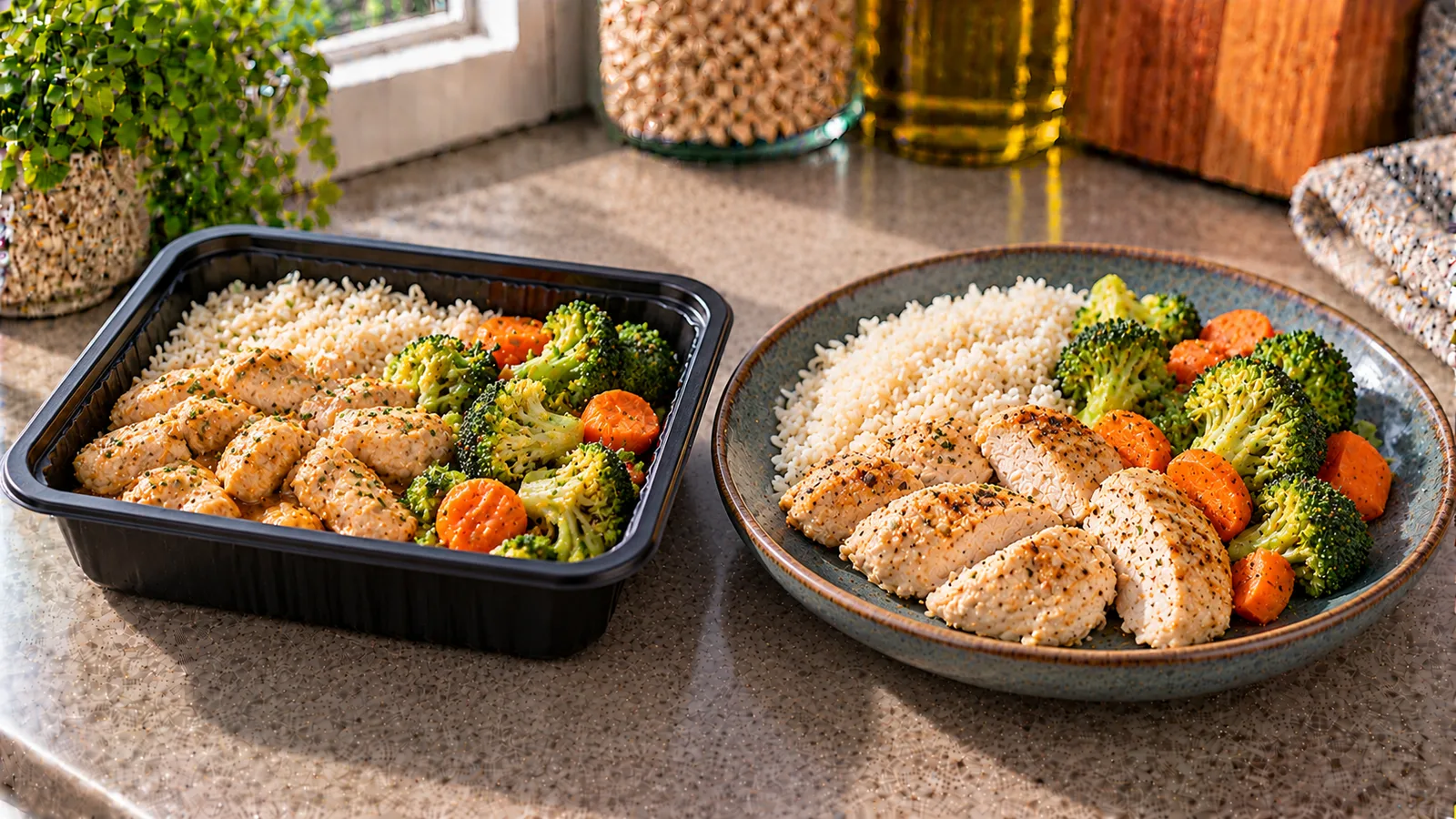
Choosing a high-protein ready meal or making a comparable dinner at home is not simply a contest between “processed” and “healthy.” The fair question is: what nutrition, cost and effort do you get for the entire portion you will actually eat? A packaged meal saves preparation time and offers a fixed nutrition label; a homemade bowl lets you choose ingredients and often costs less per serving when you can use the rest of your groceries.
Here is a transparent worked comparison: one 400 g commercial chicken-and-vegetable meal versus a 400 g homemade chicken, cauliflower and soybean bowl. The ready-meal nutrition comes from a real published German retail label. All prices are hypothetical euros for calculation, not a current REWE quotation or a German/French market average. Home nutrition is a recipe estimate, not laboratory-tested product data.
A real ready-meal label, measured as one complete meal
The REWE Beste Wahl High Protein cauliflower rice with chicken and vegetables, 400 g contains chicken, cauliflower, soybeans, pepper and teriyaki-style sauce. Its retailer page supplies values per 100 g and per 400 g. We use the complete 400 g tray, because comparing a 100 g label with a whole homemade plate would seriously distort the result.
| Nutrient on the published REWE label | Per 100 g | Entire 400 g tray |
|---|---|---|
| Energy | 88 kcal | 352 kcal |
| Protein | 6.8 g | 27.2 g |
| Fat | 4.1 g | 16.4 g |
| Carbohydrate | 5.4 g | 21.6 g |
| Fibre | 1.2 g | 4.6 g (published tray value) |
| Salt | 0.85 g | 3.4 g |
The retailer displays 4.6 g fibre for the tray, even though multiplying its displayed rounded 1.2 g/100 g by four gives 4.8 g. This small discrepancy is attributable to independently rounded label figures; keep the explicitly printed tray value rather than silently “correcting” it. Product formulations and declarations can change, so verify the physical package when buying.
The dish has 27.2 g protein for 352 kcal, not 27.2 g for each 100 g. Its protein contributes roughly 109 kcal, or about 31% of labelled energy (using 4 kcal per gram). This exceeds the 20% of energy from protein threshold for a “high protein” claim in the EU nutrition-claims regulation. It does not automatically mean the meal is rich in fibre, low in salt or nutritionally better than every homemade option.
A comparable 400 g home-cooked chicken bowl
To reproduce the same kind of dinner rather than compare unrelated meals, assemble one cooked plate with chicken, cauliflower, soybeans, pepper and sauce. Use the following illustrative eaten weights, measured after preparation: 90 g cooked chicken breast, 150 g cauliflower, 40 g shelled edamame, 50 g red pepper, 10 g olive oil retained in the serving and 60 g sauce or seasoned cooking liquid. These quantities add up to 400 g. The sauce can be mostly water with measured seasoning; it is not 60 g of pure soy sauce.
The recipe plausibly supplies around 350–390 kcal and approximately 34–38 g protein. This is a deliberately labelled estimate based on ordinary ingredient composition; exact figures depend on the cooked chicken, soybean product, moisture and sauce. Fibre may be roughly 5–7 g if the vegetables and soybeans remain in the portion. There is no defensible single salt number without weighing the seasoning. A salty bottled sauce may erase the home's salt advantage.
The USDA FoodData Central food search can help identify the individual ingredient entries, but it should not be presented as a tested 400 g finished-recipe record. For a precise household estimate, use the actual product labels, calculate from raw ingredient amounts and divide by your measured cooked portions. Consult our chicken breast calorie guide if your chicken is weighed raw but logged using a cooked entry.
| Dimension for a 400 g eaten meal | Commercial example | Homemade illustration |
|---|---|---|
| Energy | 352 kcal, retailer label | Approximately 350–390 kcal |
| Protein | 27.2 g, retailer label | Approximately 34–38 g |
| Fibre | 4.6 g, retailer tray value | Roughly 5–7 g, ingredient-dependent |
| Salt | 3.4 g, retailer label | Depends on weighed sauce and salt |
| Food cost | €3.99, hypothetical shelf price | €2.51, illustrative ingredient cost |
| Active preparation | Follow packet; microwave at least 9 minutes for this item | Cutting, cooking and washing up; time varies |
This is not an exact nutritional twin. Both are chicken-and-vegetable meals of the same edible weight, but the homemade proportions were selected to be practical, not to reverse-engineer the brand's recipe. The homemade version has a different sauce, potentially more chicken protein and different sodium. A rigorously identical-product study would require the precise manufacturer's recipe and independent analysis.
Ingredient-by-ingredient homemade cost, without hidden shopping assumptions
A purchased raw chicken portion is heavier than the cooked 90 g eaten. For this example, assume 120 g raw chicken produces 90 g cooked chicken, purely as a recipe yield assumption. Real cooking losses differ. Other ingredient quantities are the edible quantities assigned to this one finished plate. Prices below are example purchase rates for teaching cost calculation; they have not been collected from a particular store on today's date.
| Ingredient allocated to one plate | Pricing assumption | Portion cost |
|---|---|---|
| Raw chicken breast, 120 g purchased | €11.00 per kg | €1.32 |
| Cauliflower, 150 g used | €3.60 per kg | €0.54 |
| Shelled edamame, 40 g | €5.00 per kg | €0.20 |
| Red pepper, 50 g | €4.00 per kg | €0.20 |
| Olive oil, 10 g consumed | €10.00 per kg | €0.10 |
| Prepared sauce or cooking liquid, 60 g | €2.50 per kg equivalent | €0.15 |
| Total food ingredients | One 400 g meal | €2.51 |
For instance, chicken cost is 0.120 kg × €11.00/kg = €1.32, and cauliflower is 0.150 kg × €3.60/kg = €0.54. Adding all six item costs gives €2.51. The 60 g sauce rate is particularly simplified because water, spices and bottled sauces have different prices. Use your actual recipe's sauce cost rather than treating €0.15 as universal.
This is allocated cost, not the till receipt for purchasing entire packs. If you need to buy a full bag of edamame and a bottle of oil today, you will pay more upfront, even though only part of each package is assigned to the meal. Conversely, if the remaining products are used in other meals, they should not be charged in full to one dinner. Throwing unused ingredients away changes the real economic result.
What if the ready meal is on sale? Price sensitivity and protein value
Because the retailer's page says the price depends on location, no specific current price is established here. Treat €3.99 as a hypothetical sticker price and test other possible prices. Hold the homemade example at €2.51 and assume its midpoint of 36 g protein solely for this calculation.
| Hypothetical ready-meal price | Extra food cost vs €2.51 home meal | Ready-meal cost per 20 g protein |
|---|---|---|
| €3.49 | €0.98 | €2.57 |
| €3.99 | €1.48 | €2.93 |
| €4.99 | €2.48 | €3.67 |
At €3.99, buying the tray costs €1.48 more than our ingredients for one plate. As a rough protein-cost comparison, €3.99 ÷ 27.2 g × 20 = €2.93 per 20 g protein. The illustrative homemade dish yields €2.51 ÷ 36 g × 20 ≈ €1.39 per 20 g protein. Cost per 20 g of protein is a price-efficiency ratio, not the nutritional quality, amino-acid availability or health benefit of a meal.
A cheaper ready meal can reverse the food-cost comparison. A homemade version with expensive premium chicken, a large amount of cooking oil, or wasted vegetables can be more expensive. Use the Mealisa guide to protein-enriched product premiums for the wider question of when paying extra for protein is worthwhile; this page concerns whole meals, not only packaged products with added protein.
Salt, fibre and total calories can change the choice
The commercially labelled tray contains 3.4 g salt, which is substantial compared with the WHO advice of less than 5 g salt per adult per day; it is not 3.4 g sodium. A homemade meal is not automatically lower in salt: soy sauce, stock cubes and a seasoned chicken product can contribute a lot. Compare the full label, and weigh what you actually add. The European Commission nutrition-labelling guide explains which nutrients must appear and why fibre is not one of the mandatory EU declarations.
Fibre also deserves a check beyond the word “vegetables.” A small amount of vegetable garnish is not the same as a generous serving of legumes and plants. The branded example includes cauliflower, soybeans and pepper; its declared tray fibre is 4.6 g. The home estimate depends on actual ingredient weights. Don't claim a higher fibre result if the homemade dish consists mostly of chicken, oil and a thin sauce.
Likewise, protein should be evaluated together with the meal's role in the day. A 350 kcal tray may fit someone wanting a light lunch but be insufficient as their complete dinner without bread, rice or fruit. If they add 200 kcal of sides to the ready meal but compare it with the bare 400 g homemade bowl, their comparison no longer has the same scope. Account for drinks, sauces and side dishes on both sides.
Convenience has value, but calculate it separately
The product instructions specify a microwave method requiring at least nine minutes at 600 W, followed by standing time. Home cooking may need shopping, chopping, heating, portioning and cleaning; batch preparation spreads some of these steps across several meals. The extra €1.48 in the hypothetical scenario can therefore be interpreted as a convenience premium, not proof that one choice is categorically better.
Suppose you cook two portions in 25 minutes of active time and the hypothetical ingredients scale perfectly: €5.02 homemade versus €7.98 for two bought trays, a €2.96 food-cost difference. That is equivalent to approximately €7.10 per hour of active cooking time (€2.96 ÷ 25 × 60), not a wage, a complete household cost or an objective monetary value for free time. Electricity, gas, water, equipment, travel and cleanup time have not been priced consistently. Individual shoppers may rationally value convenience more or less.
One bought ready meal may also reduce spoilage for a person who cooks only once every few days. For a household eating four matching portions, a batch recipe may distribute preparation time and pantry purchases more efficiently. What matters is whether those extra ingredients get used before spoiling.
Batch cooking and food safety without misleading savings
Home cooking for the week works only when the food is stored safely. According to the USDA FSIS leftovers guidance, refrigerate cooked food promptly in shallow containers; properly refrigerated leftovers are generally used within three to four days, while freezing offers a longer option. Reheat ordinary leftovers thoroughly to 74 °C (165 °F). Follow manufacturer storage and reheating instructions for the retail tray. Not all frozen convenience meals have the same handling requirements.
Cooking a large batch and discarding half cannot be called cheaper merely because the ingredient price per planned portion was low. Include the cost of the share actually discarded: if €10.04 of ingredients is allocated to four portions but only three are eaten, the cost per eaten portion becomes roughly €3.35, not €2.51. This can narrow the apparent gap with a single frozen tray, even before time and energy costs.
A reproducible decision you can use in the supermarket
First, select a packaged meal and record the complete pack weight, calories, protein, fibre if declared, salt and real shelf price. Second, define a homemade dish of similar type and weigh its edible portions. Third, add up the grocery cost of the ingredients actually consumed, taking raw-to-cooked yield into account. Fourth, note what gets wasted and whether cooking takes 15 minutes or an hour. Finally, compare per eaten meal, not a 100 g nutrition declaration against a larger plate.
For help comparing two ready-made products against each other, use our ready-meal nutrition-label comparison. For the difference between a standard label serving and what is actually on the plate, see portion size versus serving size. Those questions are complementary to this ready-made-versus-homemade meal decision.
Result: With the stated assumptions, the illustrative homemade 400 g bowl costs €2.51, versus a hypothetical €3.99 ready-meal price, and is likely to provide somewhat more protein with a customizable salt level. The named commercial product's nutrition numbers are genuine published retailer-label data; the homemade nutrition and both example prices are estimates. Change any input and the conclusion can change. A ready meal is a reasonable choice when it meets your nutrition needs, your budget and your available time.