
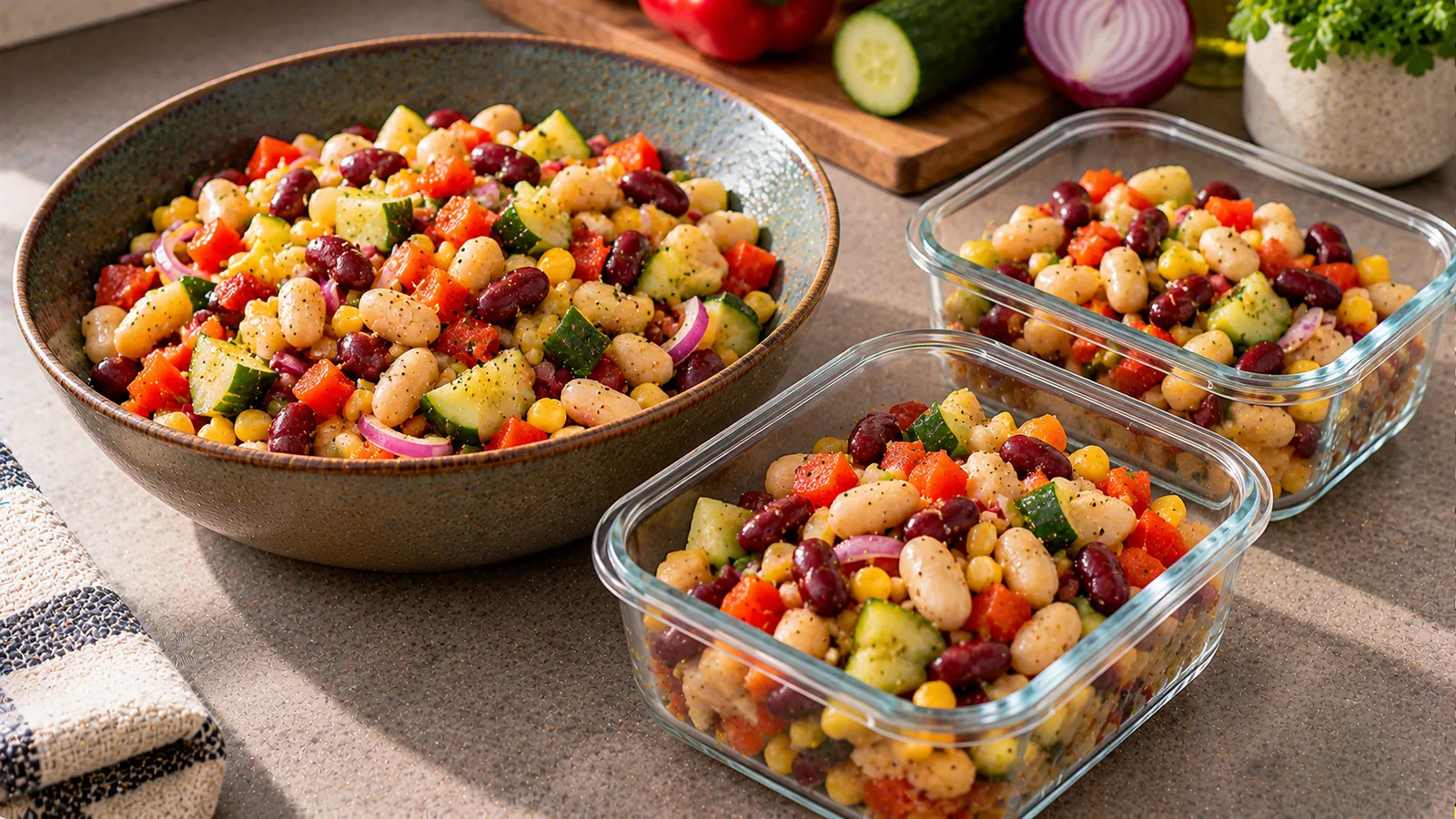
Preparing three lunches from one inexpensive bean-salad batch is less about repeating an identical bowl and more about separating what can be prepared ahead from what is better added fresh. Two 240 g drained cans of beans provide 480 g ready-to-eat legumes. Divide them into three portions of 160 g, make a lemon-and-herb dressing once, and change the accompaniment each day: a pita pocket, a yogurt-topped wrap, and a potato-and-feta bowl.
This guide serves one adult for three lunches, not three people sharing one meal. It includes exact amounts, a checkout-versus-used-ingredients budget, and a three-day refrigeration schedule. The prices for the non-bean groceries are illustrative German shopping assumptions, not live offers or a promise of the cheapest local shop.
The three-lunch plan at a glance
| Lunch | Bean-salad base | Fresh vegetables | Add at serving | Illustrative used-ingredient cost |
|---|---|---|---|---|
| Day 1: stuffed wholegrain pita | One-third of batch, about 200 g | 80 g cucumber + 100 g tomato | 70 g pita + 20 g salad greens | €2.29 |
| Day 2: creamy bean wrap | One-third, about 200 g | 80 g cucumber + 100 g tomato | 60 g tortilla + 50 g yogurt + 60 g carrot | €2.06 |
| Day 3: potato, bean and feta bowl | One-third, about 200 g | 80 g cucumber + 100 g tomato | 220 g potato + 40 g feta + 10 g salad greens | €2.46 |
| Total | Entire batch | 240 g cucumber + 300 g tomato | Three different finishes | €6.81 |
All three lunches use the same refrigerated bean-and-dressing base. That is an efficiency choice, not an instruction to let dressed tomatoes sit for three days. Keep the cucumber and tomato whole or cut in a separate covered container, and combine each day's vegetables only when eating. The potato should be cooked fresh on day three, or prepared and chilled safely in advance; the directions below use freshly cooked potato.
The portions are examples for an adult with ordinary appetite. Increase the pita, potato or vegetable portion if lunch needs to be more substantial. For a wider framework on what makes a satisfying lunch, see this guide to a balanced meal.
Shopping list: what to buy and what you actually use
For transparency, the two named bean products are dmBio kidney beans, 240 g drained, and dmBio cannellini beans, 240 g drained. Their manufacturer/retailer pages show €0.85 and €1.15 per can when checked, but retail prices can change: kidney beans and cannellini beans. The other prices below are a deliberately simple scenario. The word used means the fractional ingredient cost, not the amount paid at the till.
| Purchase | Illustrative full-pack cost | Quantity used across three lunches | Cost allocated to used amount |
|---|---|---|---|
| Kidney beans, 240 g drained | €0.85 | 240 g | €0.85 |
| Cannellini beans, 240 g drained | €1.15 | 240 g | €1.15 |
| Cucumber, 350 g | €0.89 | 240 g | €0.61 |
| Tomatoes, 500 g | €1.79 | 300 g | €1.07 |
| Red onion, 500 g | €0.99 | 60 g | €0.12 |
| Lemon, one | €0.49 | One, yielding about 45 g juice | €0.49 |
| Olive oil, 500 ml | €4.49 | 15 ml | €0.13 |
| Flat-leaf parsley, 30 g | €0.79 | 15 g | €0.40 |
| Wholegrain pita, 4 × 70 g | €1.69 | 70 g | €0.42 |
| Salad greens, 100 g | €1.29 | 30 g | €0.39 |
| Tortillas, 6 × 60 g | €1.79 | 60 g | €0.30 |
| Plain yogurt, 500 g | €0.99 | 50 g | €0.10 |
| Carrots, 1 kg | €0.99 | 60 g | €0.06 |
| Potatoes, 1 kg | €1.49 | 220 g | €0.33 |
| Feta, 200 g | €1.99 | 40 g | €0.40 |
| Total | €21.67 | Three lunches | €6.81 |
The checkout amount is high relative to three meals because it includes a bottle of oil, a bag of onions, surplus potatoes, unused wraps and other food for later meals. Those leftovers are inventory, not food waste, provided you store and use them appropriately. A first-time purchase including oil is not fairly compared with a recipe that assumes a stocked cupboard. If you already have oil and herbs, do not buy duplicate packs. If you need a broader list for the week, see the budget grocery list.
The cost model multiplies each package price by the fraction used; the lemon is counted as one complete purchase. The sum uses unrounded calculations before rounding to cents. Taxes and cooking electricity, travel, and any condiments not listed are not separately modelled. This is a repeatable way to compare recipes, not an actual supermarket receipt.
Make the one bean-salad base: ten minutes of active prep
Ingredients for the complete three-portion base: 240 g drained kidney beans; 240 g drained cannellini beans; 60 g finely diced red onion; about 45 g fresh lemon juice; 15 ml olive oil; 15 g chopped parsley. Optional freshly ground pepper costs are excluded from the model. Do not include feta, yogurt, pita, potato, cucumber or tomato in the stored base.
- Wash your hands and clean your counter and utensils. Open both cans and drain the packing liquid. Rinse the beans under cool running water if you prefer less brine; let them drain well. Use the drained weights rather than mistakenly weighing the full 400 g contents of each can.
- Mix the beans, onion, lemon juice, olive oil and parsley with a clean spoon. Break up only a few white beans if you want the dressing to cling; leave most intact so the mixture still has texture.
- Divide the mixture into three similar portions of approximately 200 g. Actual weight will vary slightly because 15 ml oil is a volume, not 15 g, and because drained beans may retain surface water. Equal division is more reliable than promising a gram-perfect finished yield.
- Seal in three shallow, clean containers, label with preparation time and Day 1, Day 2 and Day 3, and refrigerate immediately. Keep the containers out of the door where the temperature changes most.
- Wash the cucumber and tomatoes. For better texture, leave them whole until the day you eat, then cut 80 g cucumber and 100 g tomatoes per lunch. If you do chop ahead, refrigerate them in a separate sealed container; never leave cut vegetables on the counter overnight.
Do not prepare this base with uncooked dried kidney beans. Raw or inadequately cooked kidney beans contain harmful lectins. Use commercially cooked canned beans, or follow reliable dried-bean cooking guidance before preparing a cold salad. The German Nutrition Society also advises that legumes must not be eaten raw. DGE guidance.
Day 1: a crunchy stuffed pita
Take one container of bean base from the fridge. Cut 80 g cucumber and 100 g tomato and fold them into that portion with a clean spoon. Warm a 70 g wholegrain pita if you like, then let it cool slightly before stuffing so the vegetables do not wilt. Fill with 20 g salad greens and the bean mixture. If the pita is too small for all the salad, serve the remainder at the side rather than pressing wet filling into the bread.
This is a lunch designed to eat soon after assembly; a stuffed pita held for hours becomes soggy. For a commute, pack the bread and salad separately and fill it shortly before eating. With the worked prices, the base accounts for roughly €1.61, the pita €0.42 and the greens €0.26: about €2.29 for ingredients used. That does not mean these three items can all be purchased at the shop for €2.29.
The bread is not just a holder. It provides an additional grain component alongside the beans and vegetables. A wholegrain option often makes the meal more substantial; the amount of fibre varies by brand, so read the package rather than assuming every dark-coloured pita is wholegrain.
Day 2: a creamy wrap with grated carrot
Stir 50 g plain yogurt with pepper, or a small squeeze of lemon if you kept extra juice aside; do not add unpriced ingredients to the budget unnoticed. Spread yogurt on one 60 g tortilla, avoiding the final centimetres of each edge. Add 60 g grated carrot and the second 200 g bean base portion mixed with its 80 g cucumber and 100 g tomato. Roll firmly and cut at serving time.
A soft wrap needs a different texture from a pita. The yogurt provides moisture and tang without another large amount of olive oil; the carrot adds crunch. However, the beans already carry dressing, so use only enough yogurt to make the wrap pleasant rather than pouring in sauce until it leaks. Carry chilled components separately on warm days. If you add yogurt to the stored batch on preparation day, the entire batch then has to follow the yogurt's shorter applicable storage condition and becomes harder to repurpose.
In the cost model the tortilla accounts for €0.30, yogurt €0.10 and carrot €0.06, in addition to its share of the bean base. Total: about €2.06. Changing from branded tortillas to a less expensive bread may reduce the cost, but compare grams per pack and edible portions rather than sticker price alone.
Day 3: a potato and feta bean bowl
Cook 220 g potatoes until tender, using clean utensils and water. Drain and serve warm alongside the cold, freshly opened Day 3 bean-base container. Add today's 80 g cucumber, 100 g tomato, 40 g feta, and 10 g salad greens. Crumble the feta just before eating. You get warm potatoes beside a bright cold bean salad, not a reheated cucumber-and-lemon mixture.
Why potatoes on the third day? They transform the texture and meal format without opening a third can or preparing a completely new sauce. Feta is salty, so taste before adding any salt. If the feta pack was already open, respect its own label's storage and use-by instructions; the three-day bean-salad schedule does not automatically extend the safety of another opened food.
The model allocates €0.33 to potatoes, €0.40 to feta and €0.13 to greens, plus the base: about €2.46. The potatoes are measured as raw, edible purchase weight, not the cooked weight on the plate. The meal can also be made with a separately cooked grain; that substitution changes cost and, sometimes, food-storage decisions.
Protein, fibre and salt: what the bean portion provides
The bean contribution can be calculated from the named product labels, without pretending to know the precise nutrients in your pita, wraps or vegetables. dmBio kidney beans state 7.7 g protein, 6.4 g fibre and 0.35 g salt per 100 g. The cannellini label states 6.4 g protein, 5.9 g fibre and 0.35 g salt per 100 g. These are ready-to-eat canned product figures and may differ between brands.
| From beans alone | 80 g kidney beans | 80 g cannellini beans | Per lunch combined |
|---|---|---|---|
| Protein | 6.16 g | 5.12 g | 11.28 g |
| Fibre | 5.12 g | 4.72 g | 9.84 g |
| Salt listed before rinsing | 0.28 g | 0.28 g | 0.56 g |
The 11.3 g protein and 9.8 g fibre often quoted for this lunch are from beans only. The final meals will contain more nutrients from bread, vegetables, yogurt, potato and feta, but accurate totals require those specific product labels. Rinsing may lower the sodium content, yet the result cannot be calculated reliably by applying a fixed universal percentage to the label. See the practical guide to rinsing canned legumes for how to interpret the trade-off.
For perspective, DGE describes around 125 g of cooked ready-to-eat legumes as one reference serving in its food-based recommendations. The 160 g bean amount here is a larger recipe serving, not a daily requirement. If beans are new to your diet, begin with a smaller amount and scale the recipe; use the portion-size versus serving-size explanation to distinguish a reference quantity from the serving you choose.
Store the batch safely, not just neatly
Prepare on the evening before Day 1 and eat on three consecutive lunch days. This timing keeps the last portion within roughly three days of preparation, not three lunches scattered over a week. The product pages for both beans say to transfer opened contents into non-metallic containers, refrigerate, and use within 3–4 days. That is a limit for the opened bean product under suitable refrigeration, not a guarantee about any homemade salad that has been handled poorly.
FoodSafety.gov's cold-storage guidance uses 4 °C / 40 °F or below for refrigerated storage, while USDA food-safety guidance stresses prompt chilling in shallow containers and not leaving perishable leftovers at room temperature for more than two hours (one hour in hot conditions above 32 °C / 90 °F). Cold storage chart. These are safety principles, not an invitation to use the final minute of every time limit. Use clean utensils each time, bring only the intended portion to the table, and return the unopened portions to the refrigerator promptly.
Check for off odours, slime or mould, but do not rely on smell or appearance to decide food is safe: pathogens can be present without obvious spoilage. If the fridge is warmer than 4 °C, storage was interrupted, or a container spent too long unrefrigerated, discard rather than stretching the schedule. A shorter, one- or two-day batch is preferable if you cannot keep ingredients reliably cold. Pack lunch with an ice pack and insulated bag when refrigeration is unavailable at work.
Ways to adapt this budget without losing the plan
The most important substitution is one that preserves the batch arithmetic. If your chosen can contains only 200 g after draining, two cans no longer supply 480 g, so either use smaller bean portions or buy enough beans for your intended serving. A product with 400 g total content often has just 240 g after draining; calculate cost on the drained weight. When selecting lower-salt beans, compare label values per 100 g and keep the vegetables and lemon that make the salad taste fresh.
You can replace the wholegrain pita with bread you already have, the tortilla with a second pita, or feta with an appropriate plant-based topping. Then update the ingredient list and portion price; don't carry over the €6.81 total. If your cucumber is soft before day three, cut and eat it earlier and save sturdier vegetables for the last portion. Keeping the acidic dressing separate from lettuce is useful for texture but does not reset the food-safety clock on the bean base.
A pack cost is not a serving cost. Here €21.67 is a hypothetical first checkout for 15 packages, €6.81 is the estimated value of ingredients consumed, and €2.27 is the three-lunch average after rounding. Both are useful: the first for cash needed today, the second for repeatable recipe economics. If a small household cannot use the surplus before it spoils, choosing smaller packs may be smarter even at a higher price per kilogram.
Sources
- dmBio kidney beans: 240 g drained, nutrition, price and storage.
- dmBio cannellini beans: 240 g drained, nutrition, price and storage.
- German Nutrition Society: legumes and nuts.
- FoodSafety.gov: cold food storage chart.
Editorial note: prices other than the two cited bean listings are illustrative. All nutrient figures for beans refer to the specified canned products before any changes due to rinsing; total-meal calories and macronutrients are deliberately not fabricated.