
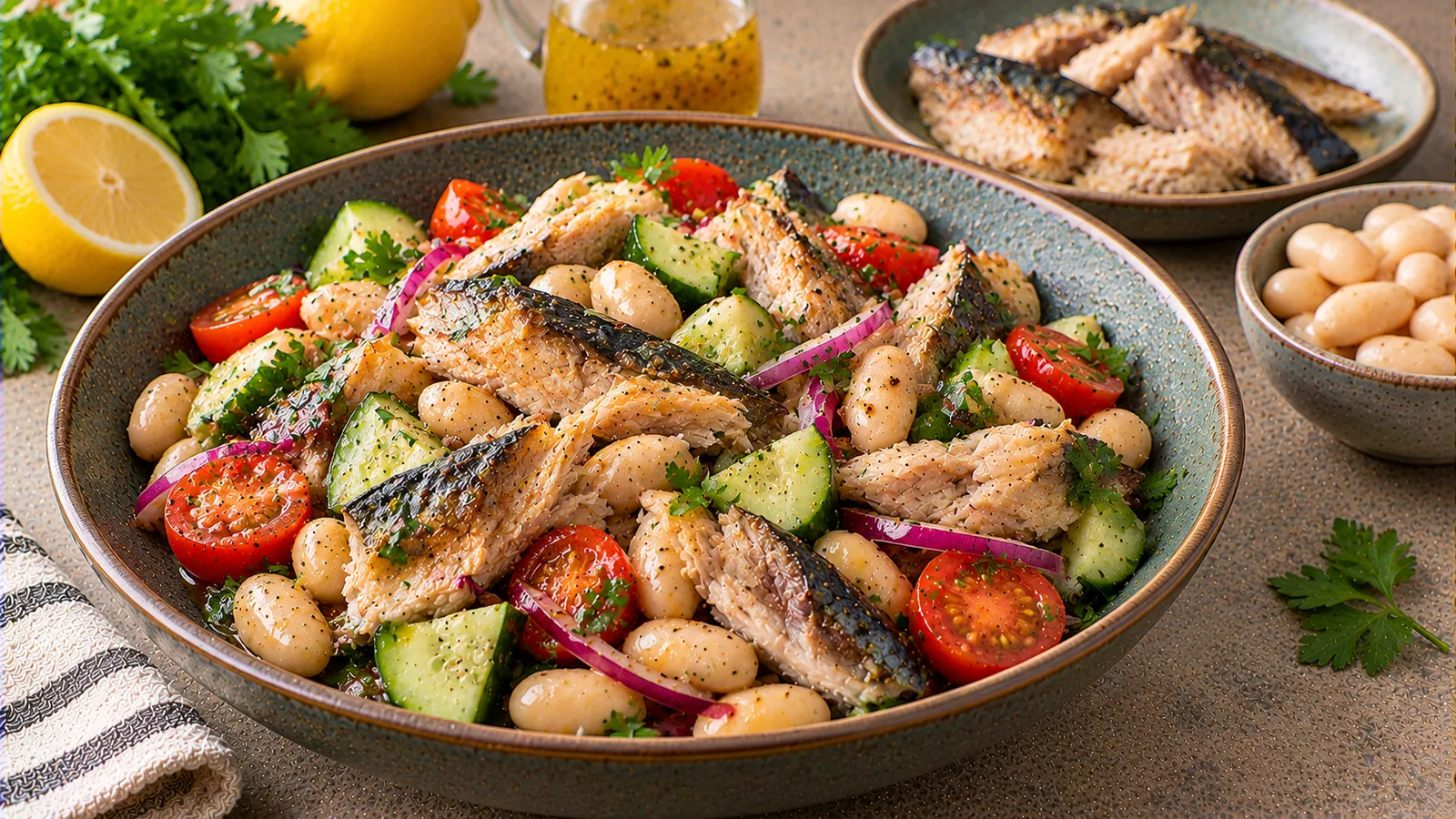
Mackerel and white bean salad is a cold, fork-friendly meal built around oily fish, creamy beans, crisp cucumber, ripe tomatoes and a sharp lemon–mustard dressing. This measured version makes two substantial bowls. It is deliberately different from a tuna-and-bean salad: mackerel has a stronger flavour and often comes packed in oil, so the recipe uses enough acidity and crunchy vegetables to balance it, without hiding the fish beneath mayonnaise.
Recipe at a glance
| Detail | Quantity or method |
|---|---|
| Yield | 2 main-course salad bowls |
| Preparation time | About 20 minutes, no cooking if using ready-to-eat canned fish and beans |
| Mackerel | 180 g drained edible fish, measured after opening |
| White beans | 240 g drained cooked beans, not dry bean weight |
| Vegetables | 160 g cucumber, 180 g tomatoes, 60 g red onion |
| Herbs | 12 g flat-leaf parsley |
| Dressing | 20 ml olive oil, 30 ml lemon juice, 10 g prepared mustard |
| Seasoning | About 1 g black pepper; optional salt only after tasting |
| Serving | Divide all mixed ingredients into 2 equal bowls |
The recipe is designed for mackerel already cooked and labelled ready to eat, in a can or jar. Raw fresh mackerel is not an interchangeable no-cook ingredient. If using cooked chilled fish instead, follow its storage and safety instructions and weigh only the edible flesh.
Ingredients and measured portions
| Ingredient | Total for 2 bowls | Approximate amount per bowl |
|---|---|---|
| Ready-to-eat mackerel, drained | 180 g | 90 g |
| Canned white beans, rinsed and drained | 240 g | 120 g |
| Cucumber, usable weight | 160 g | 80 g |
| Tomatoes, usable weight | 180 g | 90 g |
| Red onion, trimmed | 60 g | 30 g |
| Parsley leaves and tender stems | 12 g | 6 g |
| Olive oil | 20 ml | 10 ml |
| Lemon juice | 30 ml | 15 ml |
| Prepared Dijon-style mustard | 10 g | 5 g |
| Ground black pepper | 1 g | 0.5 g |
Weights are intentional. The 180 g is the amount of fish actually eaten, not the net weight including oil, brine or sauce. Likewise, 240 g of beans means drained cooked beans; neither an unopened can's total weight nor 240 g of dry beans. Check the pack's drained weight or use a kitchen scale. Two cans may be needed to obtain 180 g of fish; the exact number depends on the brand.
Start with no added salt. Canned fish, beans and mustard can already contain enough. Taste the completed dressing with a small piece of bean and fish, and add salt only if necessary. If your mackerel is packed in a flavoured tomato sauce, the quantities above will no longer produce the same flavour or dressing concentration; choose plain mackerel for this method.
Before you mix: choose the right mackerel
Look for fish that is explicitly ready to eat, with an intact container and a valid date. You can use mackerel in water, brine or oil. Drain it well and weigh the fish; don't pour packing oil into the bowl automatically. For mackerel in oil, the nutritional numbers on the label might refer to the drained product or to the product as sold. Read the exact basis before doing a calorie calculation.
Mackerel is not one uniform species for mercury advice. The FDA/EPA fish-choice chart lists Atlantic mackerel and Pacific chub mackerel among its Best Choices, but lists king mackerel among fish to avoid for people who are pregnant or may become pregnant, people who are breastfeeding and young children. Check the species when the packaging identifies it; do not assume all fish labelled “mackerel” share one advisory category. This recipe does not override individual medical or dietary guidance.
For the beans, choose cannellini or another large cooked white bean with a mild flavour. Rinse briefly if canned in salty liquid and let the water drain away. Rinsing affects surface brine but does not make a product “salt-free”; use the manufacturer's label if sodium matters. Avoid substituting dry beans straight from the packet: they must be fully cooked first and would change the recipe schedule.
How to make the salad
- Prepare the workspace. Wash your hands, utensils and chopping board. Check that the canned fish is safe to eat directly from its package, then open it. Drain the mackerel and weigh 180 g of edible pieces. Check carefully for unexpected hard bones if the product is not sold as boneless; some small soft canned bones may be edible, but never assume everyone wants to eat them. Keep the fish cold while you prepare the vegetables.
- Rinse the beans. Empty the beans into a sieve, rinse with cool drinking water and leave to drain for a minute or two. Weigh 240 g after draining. Spread them on a clean towel if especially wet; excess liquid dilutes the dressing.
- Cut the vegetables. Wash 160 g cucumber and 180 g tomatoes under running water, then dry them. Dice the cucumber into bite-size pieces and cut the tomatoes into wedges or chunks. Remove the outer layer from 60 g red onion and slice finely. For a milder flavour, soak the onion briefly in cold water, drain thoroughly and dry. Finely chop 12 g parsley.
- Emulsify the dressing. Whisk 30 ml lemon juice, 10 g mustard and 1 g ground black pepper in a small bowl. Drizzle in 20 ml olive oil while whisking. The mixture should be tangy and lightly thickened, not a large pool of oil. Taste with a bean before deciding whether any additional salt is needed.
- Dress the beans first. Toss the drained beans with onion and roughly two-thirds of the dressing. Leave for about 5 minutes while you arrange the rest. This gives the beans some flavour without exposing delicate fish to heavy mixing.
- Finish gently. Fold in cucumber, tomatoes and parsley. Break the 180 g mackerel into large flakes and place it on top. Spoon over the remaining dressing. Fold once or twice; vigorous tossing makes the fish paste-like and crushes the beans.
- Serve. Divide into 2 bowls. A bowl contains about 90 g drained mackerel and 120 g drained beans plus half the vegetables and dressing. Serve immediately, or cover and refrigerate promptly.
The method uses no stove because the mackerel and beans are already cooked. If the ingredients are unusually wet, dry the vegetables rather than adding bread crumbs or extra oil. For a firmer lunchbox version, pack the dressing separately and mix at the table.
Texture, acidity and practical substitutions
Three things make this salad work: the beans should remain intact, the cucumber should provide crunch, and the mackerel should retain visible flakes. If the bowl is too sharp, add a little more tomato rather than sugar. If it tastes flat, add a few drops of lemon first; salt is not always the missing ingredient. If it is watery, drain the tomatoes briefly or spoon out loose juice and stir the dressing again.
You may use cooked butter beans instead of cannellini beans gram for gram at 240 g drained weight. Cherry tomatoes are suitable if measured after trimming. Chives can replace parsley, although the flavour becomes more onion-forward. If mustard is unsuitable, whisk the lemon and olive oil with a little mashed bean to help the dressing cling; mustard is a declared allergen in the EU and should not be concealed in a recipe name.
A true substitute for mackerel changes the search intent and flavour. If you want the milder tuna version, compare this preparation with the tuna and white bean salad; if you have sardines instead, the sardines with bones versus boneless explains why the presence of soft bones changes calcium estimates. Neither linked article should be treated as proof that different canned fish are nutritionally interchangeable.
How much protein or energy is in a bowl?
Use the label of the specific fish and beans in your kitchen rather than presenting an invented “universal mackerel salad” value. A 100 g declaration and the quantity actually eaten are the two numbers required. This illustration uses hypothetical label values solely to explain the method; they are not claims about the recipe's measured nutrition.
| Worked protein example | Formula | Protein |
|---|---|---|
| Fish, assumed 22 g protein/100 g | 180 × 22 ÷ 100 | 39.6 g |
| Beans, assumed 7 g protein/100 g | 240 × 7 ÷ 100 | 16.8 g |
| Fish + beans for both bowls | 39.6 + 16.8 | 56.4 g |
| Fish + beans per bowl | 56.4 ÷ 2 | 28.2 g |
This example excludes the smaller contribution from vegetables, mustard and any other ingredients. Your actual result depends on the labels and drained weights. For calories, also count 20 ml olive oil added separately. If the mackerel label already includes oil in the product as eaten, do not count the same packing oil a second time. Likewise, the nutritional value of beans in brine may be declared as sold or drained; verify the pack wording instead of blindly applying the figures to the liquid.
The protein example does not imply that a full lunch is “high-protein” under any particular legal labelling definition. A healthy meal is more than a single macro number: include vegetables, consider total salt, and adapt the portion to appetite. Bread or boiled potatoes may make this into a larger energy-containing meal, but their quantities and nutrition are not included in the two-bowl recipe.
Food safety and make-ahead storage
A cold fish salad is perishable even though the fish was shelf-stable before opening. Follow the package's after-opening instructions first, and keep the fish and finished salad refrigerated at 4 °C or colder when not serving. USDA guidance says perishable foods should not remain at room temperature for more than 2 hours, reduced to 1 hour above 32 °C. Bring an insulated bag and ice pack when carrying the salad to work.
For best cucumber texture, prepare and eat it on the same day. If you need to prepare ahead, keep the dressing separate, cool the ingredients promptly and eat within 24 hours as a conservative practical target. The UK Food Standards Agency advises eating refrigerated cooked leftovers within 48 hours or freezing them; this does not extend any shorter instruction printed on the fish container. See its food safety guidance. Never use smell or appearance alone to declare a salad safe after prolonged warm storage.
Do not freeze the finished dressed salad if you want crisp vegetables: thawed cucumber becomes watery. If a can of beans yields more than 240 g drained, save the extra beans separately in a clean covered container and follow its label's storage guidance. If you assemble the salad at a buffet, set out small portions and replenish from the refrigerator rather than keeping the complete batch unrefrigerated.
Common questions while cooking
Can I use smoked mackerel? Only if it is fully cooked and labelled ready to eat. Smoked versions can be saltier than plain canned fish, so check the label and use no added salt at first. Hot-smoked and cold-smoked products have different handling requirements; do not assume all smoked fish is ready to eat without further preparation.
Can I use mackerel in tomato sauce? It changes the balance. The measured lemon–mustard dressing assumes plain drained fish; a tomato sauce already contributes liquid, acid, salt and potentially sugar. For reproducible results, stick to plain fish here.
Do I need to peel cucumber? Not normally. Wash under running water, remove any damaged parts and use the measured 160 g usable weight. Peeling is a texture preference; if you peel, weigh after peeling to preserve the recipe ratio. Follow the FDA's produce handling advice.
Will rinsing reduce all salt in the beans? No. It can remove some salty packing liquid, but not reliably all the salt in the food. Compare drained serving labels if controlling sodium, and consider low-salt canned beans.
Can I replace lunch with this bowl every day? Variety is sensible. Fish species differ in mercury guidance and canned foods vary in salt. Rotate proteins and vegetables, and use the FDA/EPA chart when fish-choice advice is relevant to your household.
Sources
- FDA/EPA — Advice about Eating Fish — mackerel species and mercury advisory categories.
- USDA FSIS — Steps to Keep Food Safe — cold holding and the 2-hour/1-hour rule.
- Food Standards Agency — Cooking Your Food — leftovers, refrigeration and cold consumption.
- FDA — Selecting and Serving Produce Safely — handling vegetables eaten raw.
The ingredient weights, preparation sequence and serving split above are an original home recipe. The illustrative protein arithmetic should be recalculated from the labels of the products actually used.