
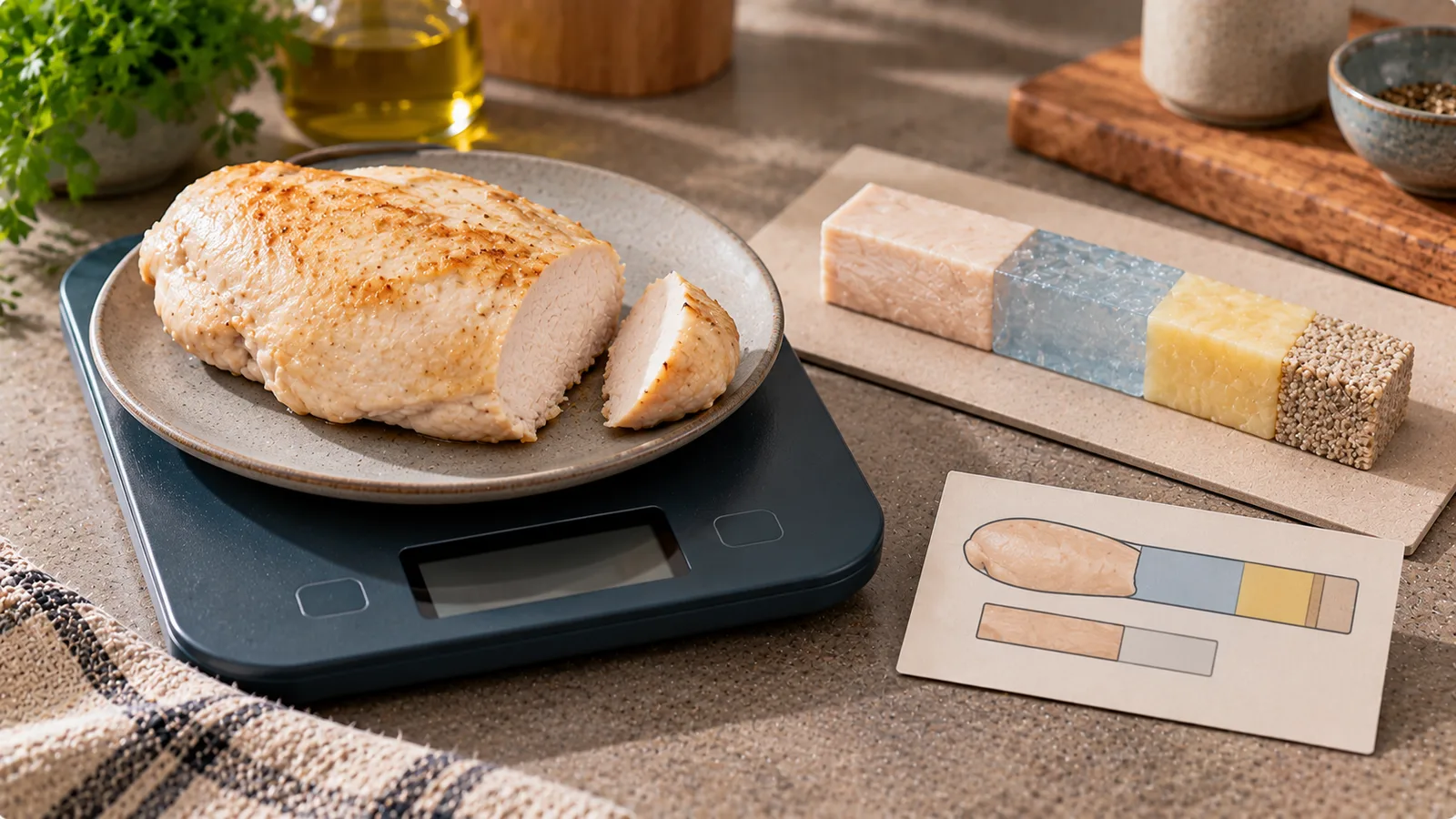
If a portion of chicken weighs 100 g, that does not mean it contains 100 g of protein.
The 100 g describes the total weight of the food. Protein is only one component of that weight.
The rest can include water, fat, carbohydrate, minerals and other substances.
This distinction matters when calculating protein from nutrition labels, comparing foods or logging meals.
Food weight and protein weight are different measurements
Consider 100 g of raw chicken breast.
Depending on the product, it might contain approximately:
- 22–24 g protein;
- 1–3 g fat;
- a large amount of water;
- small amounts of minerals and other components.
The entire piece still weighs 100 g.
Protein represents only part of that total.
So:
100 g chicken ≠ 100 g protein
A more realistic example might be:
100 g chicken → about 23 g protein
The exact value should come from the nutrition information for the product you are using. (USDA — FoodData Central)
Think of protein as one part of the food
A food can be imagined as a combination of components.
For example, a hypothetical 100 g food might contain:
- 23 g protein;
- 2 g fat;
- 0 g carbohydrate;
- approximately 75 g water and other components.
Those components together make up the food's total mass.
The protein value is therefore not another way of stating the food's weight.
It describes how much of the food consists of protein.
How to calculate protein from a nutrition label
If a label gives protein per 100 g, use:
protein per 100 g × portion weight ÷ 100
Suppose chicken contains 23 g protein per 100 g.
For a 150 g portion:
23 × 150 ÷ 100 = 34.5 g protein
The 150 g chicken portion therefore provides approximately 34.5 g protein, not 150 g.
Example: 200 g of chicken
Using the same chicken at 23 g protein per 100 g:
23 × 200 ÷ 100 = 46 g protein
So:
- food weight = 200 g;
- protein = 46 g.
These numbers describe different things.
Protein concentration
It can be useful to think in terms of protein concentration.
If a food contains 23 g protein per 100 g, then approximately:
23% of its weight is protein
If another food contains 10 g protein per 100 g, approximately:
10% of its weight is protein
This does not necessarily mean the first food is healthier or better overall. It only describes protein relative to food weight.
Different foods contain different amounts of protein per 100 g
Food weight alone does not tell you how much protein is present.
Illustrative values might look like this:
| Food | Approximate protein per 100 g |
|---|---|
| Chicken breast | 22–24 g |
| Salmon | 19–22 g |
| Whole egg | 12–13 g |
| Cooked lentils | 8–10 g |
| Cooked chickpeas | 8–9 g |
| Greek-style high-protein yogurt | 8–11 g |
| Regular milk | 3–4 g |
Actual values vary by product, preparation and water content.
The table is useful for understanding the principle, not as a replacement for the label or reliable food database.
Why meat is not mostly protein
Raw meat contains a substantial amount of water.
That is why 100 g of chicken can contain roughly 23 g protein rather than anything close to 100 g.
The same applies to fish and many other protein-rich foods.
A food can be considered “high in protein” while most of its physical weight still comes from water and other components.
Raw and cooked weights can cause confusion
Cooking changes food weight.
Meat commonly loses water during heating.
Suppose:
- 200 g raw chicken contains 46 g protein;
- after cooking, the same chicken weighs 150 g because water was lost.
The cooked chicken has not suddenly gained a large amount of protein.
The same original protein is now concentrated into a smaller total weight.
If the cooked portion contains approximately the same 46 g protein:
46 ÷ 150 × 100 = 30.7 g protein per 100 g cooked
This is why cooked chicken can show more protein per 100 g than raw chicken.
The difference is largely caused by water loss.
Do not mix raw weight with cooked nutrition data
This is one of the easiest mistakes to make.
Suppose you weigh:
200 g raw chicken
but use a database entry showing nutrition for:
100 g cooked chicken
The calculation can become inaccurate because the food weight and nutrition reference are on different bases.
Use:
- raw weight with raw nutrition data; or
- cooked weight with cooked nutrition data.
Keeping the basis consistent is more important than choosing one method over the other.
Example: raw versus cooked chicken
Imagine a package says raw chicken contains:
23 g protein per 100 g
You cook 200 g.
Protein before cooking:
23 × 200 ÷ 100 = 46 g
After cooking, the chicken weighs 150 g.
If you eat all of it, you still consumed approximately the protein that was present in the original 200 g raw portion.
You should not calculate 150 g using the original raw per-100-g value unless the database entry is designed for that cooked state.
What about 100 g of cooked chicken?
If a cooked chicken database entry says:
31 g protein per 100 g cooked
then 100 g of that cooked food provides approximately 31 g protein.
Again:
100 g cooked chicken ≠ 100 g protein
The remaining weight includes water, fat and other components.
Eggs show the same principle
A large egg may weigh roughly 50–60 g without the shell, depending on size.
It does not contain 50–60 g protein.
Whole egg contains roughly 12–13 g protein per 100 g.
If an edible egg portion weighs 55 g and contains 12.5 g protein per 100 g:
12.5 × 55 ÷ 100 = 6.9 g protein
So the egg weighs 55 g but provides approximately 7 g protein.
Beans are another useful example
Cooked beans contain water, carbohydrate, fiber and protein.
Suppose cooked beans contain 8.5 g protein per 100 g.
A 200 g portion provides:
8.5 × 200 ÷ 100 = 17 g protein
The 200 g portion does not contain 200 g protein.
Most of its mass comes from other components, especially water and carbohydrate.
Dairy products can vary widely
Two dairy products with the same food weight can contain very different amounts of protein.
For example:
- 200 g regular yogurt might provide a moderate amount of protein;
- 200 g high-protein yogurt may provide substantially more;
- 200 g sour cream may provide relatively little protein.
This is why the weight of the container alone is not enough.
Look at protein per 100 g or protein per serving.
Protein powders are more concentrated
Protein powder can contain a much higher percentage of protein by weight than ordinary foods.
Suppose a powder contains:
75 g protein per 100 g
A 30 g serving provides:
75 × 30 ÷ 100 = 22.5 g protein
Even here, 30 g powder does not equal 30 g protein.
The remaining weight may include carbohydrate, fat, flavorings, minerals and other ingredients.
How much food gives 30 g of protein?
If you know the protein concentration, you can reverse the calculation.
Use:
desired protein ÷ protein per 100 g × 100
Suppose chicken contains 23 g protein per 100 g and you want approximately 30 g protein.
30 ÷ 23 × 100 = 130.4 g
You would need approximately 130 g of that chicken to obtain 30 g protein.
This is a food-weight calculation, not a recommendation for how much protein you personally need.
Example with lentils
Suppose cooked lentils contain 9 g protein per 100 g.
To obtain 30 g protein from those lentils alone:
30 ÷ 9 × 100 = 333 g
Approximately 333 g cooked lentils would provide 30 g protein.
The portion is larger than the chicken example because the lentils contain less protein per 100 g.
That does not make lentils a poor food. They also provide carbohydrate, fiber and other nutrients.
It simply illustrates protein concentration.
Example with yogurt
Suppose a high-protein yogurt contains 10 g protein per 100 g.
A 250 g container provides:
10 × 250 ÷ 100 = 25 g protein
The container weighs 250 g.
Only 25 g of that weight is protein.
Food labels may show values per serving instead
Some labels provide protein per serving.
For example:
Serving size: 150 g
Protein: 18 g
That means:
150 g of the food provides 18 g protein
If you eat 300 g, or two servings:
18 × 2 = 36 g protein
You do not need to convert to 100 g unless that makes comparison easier.
Serving size is not protein amount
A label might say:
Serving size: 170 g
and:
Protein: 17 g
These numbers are not contradictory.
The serving weighs 170 g in total, and 17 g of that amount is protein.
The rest of the serving consists of water, carbohydrate, fat and other components.
Protein percentage can help with comparisons
To calculate the approximate percentage of food weight represented by protein:
protein grams ÷ food grams × 100
Example:
A 200 g food portion contains 30 g protein.
30 ÷ 200 × 100 = 15%
Approximately 15% of the portion's weight is protein.
This can be useful when comparing foods, but it does not provide a complete nutritional assessment.
Why calories cannot be calculated from protein alone
Protein provides approximately 4 kcal per gram.
If a food contains 25 g protein, those 25 g contribute approximately:
25 × 4 = 100 kcal
But the food may also contain fat and carbohydrate.
Suppose a meal contains:
- 25 g protein;
- 20 g carbohydrate;
- 10 g fat.
Approximate energy from these macronutrients:
Protein:
25 × 4 = 100 kcal
Carbohydrate:
20 × 4 = 80 kcal
Fat:
10 × 9 = 90 kcal
Total:
100 + 80 + 90 = 270 kcal
Food weight and calorie content therefore cannot be inferred from protein grams alone.
Protein per 100 g versus protein per 100 kcal
These are also different comparisons.
Protein per 100 g tells you how concentrated protein is relative to the food's physical weight.
Protein per 100 kcal tells you how much protein is provided for a given amount of energy.
A food can perform differently under these two measures.
For example, added water can lower protein per 100 g without changing the underlying relationship between protein and calories in the same way.
Use the comparison that matches the question you are trying to answer.
Foods containing bones, shells or other inedible parts
Be careful when the weighed amount includes material you do not eat.
Examples include:
- bone-in chicken;
- fish with bones;
- shell-on seafood;
- foods with thick peels that are discarded.
If 300 g of bone-in chicken is weighed, you cannot automatically treat all 300 g as edible chicken meat.
Use nutrition data appropriate for the purchased form or determine the edible portion.
Drained foods
The same issue appears with foods packed in liquid.
For example, canned beans or tuna may list:
- total package weight;
- drained weight.
If the liquid is discarded, the drained weight is usually the more relevant basis for the food actually eaten.
Check whether the nutrition label refers to the product as sold, drained or prepared.
A simple label-reading workflow
When calculating protein from a food, use four steps.
1. Identify the reference
Does the label give protein:
- per 100 g;
- per serving;
- per package?
2. Identify the food state
Is the value for:
- raw food;
- cooked food;
- drained food;
- prepared food?
3. Measure the amount you actually eat
Use grams when possible.
4. Apply the matching nutrition value
Do not combine a raw weight with a cooked entry or a drained weight with data intended for the entire undrained product.
Worked example: chicken dinner
Suppose your meal contains:
- 180 g raw chicken breast;
- chicken label: 23 g protein per 100 g;
- 250 g potatoes;
- vegetables.
Protein from the chicken:
23 × 180 ÷ 100 = 41.4 g
The chicken portion weighs 180 g but contributes approximately 41 g protein.
Any protein from the potatoes and vegetables can then be added separately if you are calculating the meal total.
Worked example: beans and yogurt
Suppose you eat:
- 180 g cooked beans at 8.5 g protein per 100 g;
- 200 g yogurt at 10 g protein per 100 g.
Beans:
8.5 × 180 ÷ 100 = 15.3 g protein
Yogurt:
10 × 200 ÷ 100 = 20 g protein
Total:
15.3 + 20 = 35.3 g protein
The foods weigh 380 g together, but they provide approximately 35 g protein.
Common calculation error
A frequent mistake is to see:
Chicken: 200 g
and record:
Protein: 200 g
That would imply the entire chicken portion consisted of pure protein, which is not how whole foods are composed.
Instead, find the protein concentration.
If the chicken contains 23 g protein per 100 g:
200 g chicken → 46 g protein
Another common error: using the package protein value as the food weight
Suppose a yogurt label says:
- package weight: 200 g;
- protein: 20 g.
The 20 g number does not describe how much yogurt is in the container.
It describes the protein contained within the 200 g of yogurt.
Both numbers can therefore appear on the same package without conflict.
What to enter in a food diary
When logging food, enter the amount of food you actually consumed.
For example:
Chicken breast: 150 g
The nutrition database or product entry should then calculate the corresponding protein, fat, carbohydrate and calories.
You normally should not enter “35 g protein” as though it were 35 g of chicken.
Protein is a nutrient total, not the physical portion size.
The practical rule
Whenever you see a food weight and a protein value, keep the two concepts separate:
Food weight = how much the entire food weighs.
Protein grams = how much protein is contained within that food.
For a food that provides 23 g protein per 100 g:
- 100 g food → 23 g protein;
- 150 g food → 34.5 g protein;
- 200 g food → 46 g protein;
- 250 g food → 57.5 g protein.
Once the distinction is clear, protein calculations become straightforward: use the protein value that matches the food's state and multiply it by the amount actually eaten.