
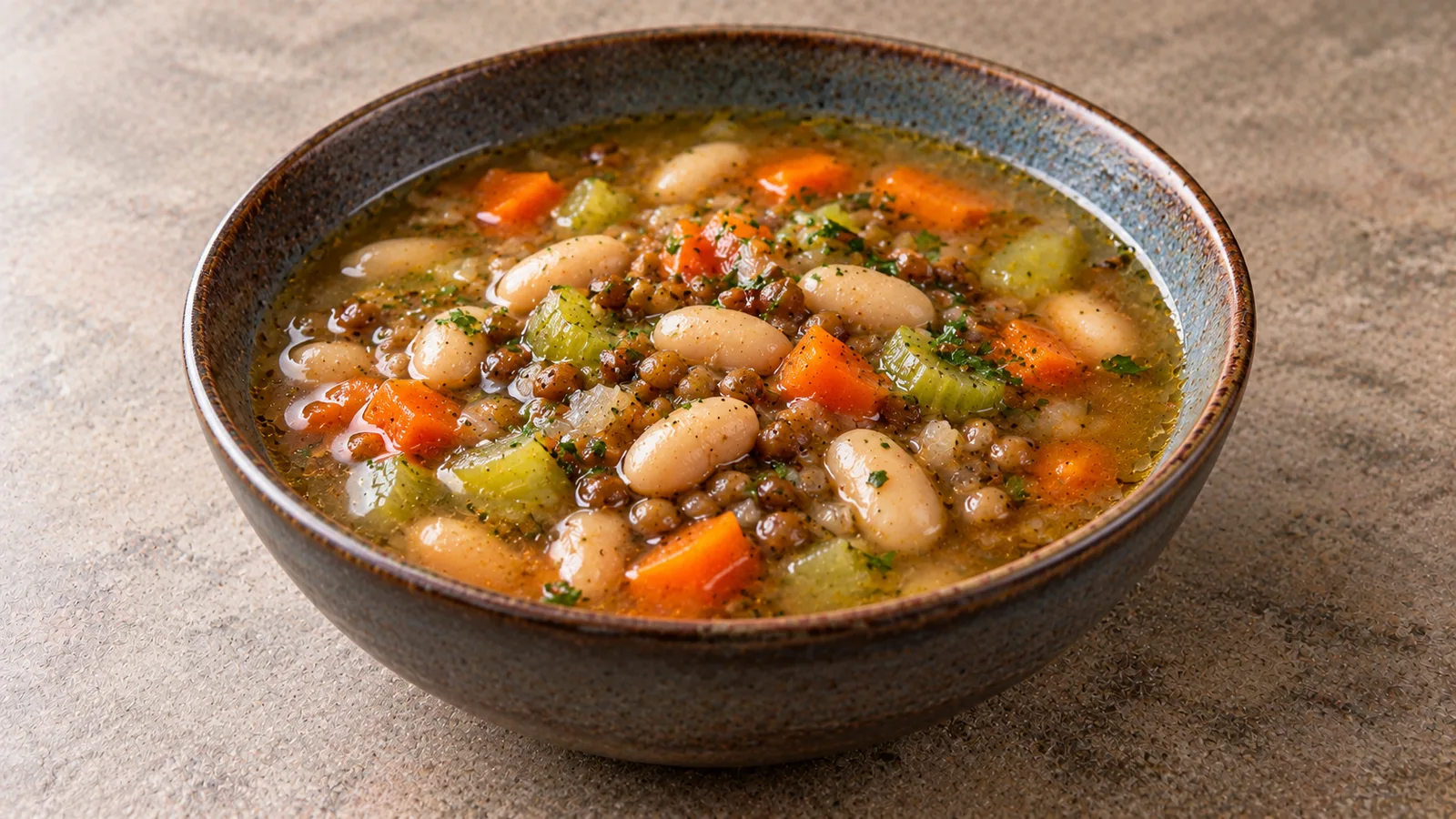
A soup can look watery and show only 3.19 g protein per 100 g, yet an ordinary 375 g bowl can supply about 11.98 g. Another bowl of the same size may provide less protein after water is added—even though the recipe's entire pot still contains the same protein. These are not contradictory results. They measure different quantities: concentration, edible portion, and the share of the batch that reaches your plate.
This practical guide teaches you to convert soup labels and homemade-recipe totals into protein per bowl without confusing broth with beans, weight with volume, or the dry weight of an ingredient with its cooked weight. The numerical soup below is an explicitly illustrative calculation, not a laboratory-tested commercial product. It uses one named USDA lentil reference value; its mixed-vegetable line is a declared modelling assumption. Use your own labels and a kitchen scale for actual meals.
Three numbers that answer three different questions
Protein per 100 g describes concentration: how much protein is present in a fixed mass of finished soup. Protein per bowl describes the amount you consume: concentration multiplied by the real bowl weight. Protein per pot describes the total protein in the entire prepared recipe before you decide how many portions to serve. These measures should be connected, not substituted for one another.
A soup containing lots of water can rank low when foods are sorted by protein per 100 g. That does not make its protein disappear. Conversely, a thick soup may have a higher concentration but be served in a smaller bowl. A restaurant's generous serving, a measured home portion and the manufacturer's suggested serving are not necessarily the same weight. For the difference between a stated serving and the amount actually eaten, consult Mealisa's portion-size versus serving-size guide.
For quick decisions, read the per-100-g figure first, weigh the soup you actually serve, and calculate the amount in that bowl. For recipe planning, estimate the protein from individual ingredients and divide by the number of portions only after deciding what a portion means. If you have neither the final batch weight nor reliable ingredient figures, record a reasonable estimate rather than presenting a precise-looking answer as confirmed.
A worked lentil-soup recipe with declared assumptions
Imagine a cooked soup assembled from 500 g cooked, drained lentils, 200 g vegetables and 800 g added water retained in the pot. Seasonings are ignored for the protein calculation because this example is designed to show dilution, not to report a fully analysed recipe. The final soup weighs 1,500 g. No evaporation or discarded cooking liquid is assumed in this first scenario.
The USDA Lentils, mature seeds, cooked, boiled, without salt reference reports approximately 9.02 g protein per 100 g cooked lentils. See the FoodData Central SR Legacy search and check the exact cooked entry rather than borrowing a value for dry lentils. To keep the second ingredient transparent, the mixed vegetables are assigned an illustrative 1.40 g protein per 100 g. That is an assumed composite value, not a certified USDA mixed-vegetable food or a universal vegetable average. Plain added water contributes zero protein.
| Model ingredient | Weight used | Protein per 100 g | Protein in batch |
|---|---|---|---|
| Cooked lentils (USDA reference) | 500 g | 9.02 g | 45.10 g |
| Mixed vegetables (assumed model) | 200 g | 1.40 g | 2.80 g |
| Added water retained | 800 g | 0 g | 0 g |
| Total finished soup | 1,500 g | 3.19 g | 47.90 g |
The calculation is 500 × 9.02 ÷ 100 + 200 × 1.40 ÷ 100 = 47.90 g protein. Divide 47.90 by 1,500 and multiply by 100 to obtain 3.19 g per 100 g after rounding. The exact intermediate concentration is 3.1933… g per 100 g. Keep unrounded intermediate values in a spreadsheet or food tracker; rounding after each ingredient can produce small but unnecessary discrepancies.
Convert 100 g into a real bowl
The general equation is protein in bowl (g) = protein per 100 g × bowl weight (g) ÷ 100. Applied to the unrounded soup model, a 250 g small bowl supplies 7.98 g, a 375 g regular bowl supplies 11.98 g, and a 500 g large bowl supplies 15.97 g. These weights are examples, not compulsory portion recommendations. Your soup bowl may hold a different mass, especially when the soup is chunky.
| Finished soup served | Share of 1,500 g pot | Protein per bowl | Interpretation |
|---|---|---|---|
| 250 g | 1/6 | 7.98 g | Small measured serving |
| 375 g | 1/4 | 11.98 g | Four equal bowls |
| 500 g | 1/3 | 15.97 g | Three equal bowls |
| Entire 1,500 g | Whole batch | 47.90 g | Recipe total, not one meal |
If you split the pot evenly into four 375 g servings, each receives 47.90 ÷ 4 = 11.975 g, shown as 11.98 g. If instead you use five containers, weigh the filled contents or calculate the new portion size. Merely writing “serves four” on a recipe cannot prove that every bowl is one-quarter of the nutrients when solids settle or ladles pick up different proportions of lentils.
What changes when you add 500 g more water?
Now add 500 g plain water to the same finished pot. Assume all the water stays in the soup and nothing spills out. The total mass becomes 2,000 g, while total protein stays 47.90 g. Protein concentration drops from 3.19 to 2.40 g per 100 g (unrounded value 2.395). The reason is a larger denominator, not protein destruction.
| Quantity compared | Original soup | Soup plus 500 g water |
|---|---|---|
| Finished batch weight | 1,500 g | 2,000 g |
| Protein in the full pot | 47.90 g | 47.90 g |
| Protein per 100 g | 3.19 g | 2.40 g |
| Protein in a fixed 375 g bowl | 11.98 g | 8.98 g |
| Protein in one-quarter of the pot | 11.98 g | 11.98 g |
| Weight of one-quarter of the pot | 375 g | 500 g |
This comparison is the central distinction. A fixed 375 g bowl becomes less protein-rich after dilution because it contains a smaller share of the entire mixture. A quarter of the pot does not lose protein; that quarter is simply larger and heavier after adding water. Describing both outcomes merely as “protein per serving” hides which serving definition was used. Keep the bowl weight alongside every logged value.
Adding water can also change sodium concentration and energy density per 100 g, but it does not necessarily reduce the total sodium or calories consumed when you finish the same amount of soup ingredients. Additions such as milk, stock, yoghurt, beans or meat are not plain water; their nutrients must enter the numerator as well as their mass entering the denominator.
Evaporation moves the numbers the other way
Simmer a soup uncovered and water escapes as steam. Suppose the original 1,500 g pot loses 200 g of water with no ingredient discarded and no substantive protein losses. It now weighs 1,300 g but still has approximately 47.90 g protein. Its calculated concentration rises to 3.68 g per 100 g. A fixed 375 g bowl would then contain about 13.82 g protein, because that bowl occupies a larger proportion of the smaller finished pot.
That does not mean cooking created extra protein. Only the denominator changed. Real cooking introduces further uncertainties: foam may be skimmed off, liquid may spill, vegetables can be strained, beans can remain at the bottom and some components may adhere to the pan. For routine logging, measure the actual final edible mass and account for any discarded protein-containing material where it is meaningful.
If you reheat leftover soup with a splash of water, log the actual new amount when accuracy matters. If you cook off the water again, return to the revised final mass. Do not “correct” the protein total merely because the soup tastes thinner or looks thicker; appearance is not a quantitative protein assay.
Track chunky soup without assuming every ladle is equal
The arithmetic above assumes that lentils and vegetables are evenly distributed throughout the pot. Real soup is often heterogeneous. The first ladle from the surface may be mostly broth; a later ladle from the bottom may contain many more lentils. Two bowls weighing 375 g can therefore have different protein totals even when they come from the same batch. Pureeing makes the mixture more uniform, but it cannot guarantee perfect homogeneity.
For meal prep, stir the pot well immediately before portioning. Weigh the empty container, add soup, subtract the container weight and repeat for every portion. When the recipe includes visible beans or meat, deliberately distribute solids across portions rather than letting the last container collect them all. If the soup is strained, separate broth and edible solids in your recipe record.
A more careful method for a chunky batch is to weigh the cooked lentils and vegetables before adding broth, record the final weight, and distribute the solids deliberately. This still gives estimates, not laboratory precision, but it avoids treating broth-heavy and lentil-heavy servings as identical. The approach is especially helpful for soups cooked for several people whose preferred broth-to-solid ratio differs.
Read a shop-bought soup label in the right state
For EU-packaged soups, the mandatory nutrition declaration generally uses values per 100 g or 100 ml; portions may be presented additionally under specified conditions. Check the EU Food Information Regulation, especially Articles 31–33. A soup labelled at 2.8 g protein per 100 g supplies about 9.8 g protein in 350 g, assuming that the declaration describes the soup in the form you consume. This is a worked conversion, not a claim about an identified brand.
Powdered and concentrated soups need another check: does the printed nutrition table refer to the dry mix, the product prepared according to instructions, or both? When you add the stated amount of water, you change the prepared mass. Using dry-mix concentration for a bowl of prepared soup can greatly inflate the calculation. For tinned soup, check whether the values describe the contents as sold or a specific diluted preparation.
In the US, the FDA explains that Nutrition Facts values normally refer to the serving size indicated on the label, and a container can contain multiple servings. Read its serving-size guidance and compare the labelled serving mass with your own bowl. Do not take a US “per serving” number and treat it as a European “per 100 g” number. And where an EU label uses per 100 ml, do not quietly equate millilitres with grams in a thick soup: use measured density or a labelled serving conversion.
Dry lentils are not the same as cooked lentils
A major error happens before water is ever poured into soup. 100 g dry lentils and 100 g cooked lentils have very different water contents. The cooked reference used in our example already includes water absorbed during cooking. Multiplying a dry-legume nutrition label by 500 g cooked lentils would overstate protein substantially. Choose one consistent state for every ingredient.
If starting from dry lentils, record the original dry weight and use the dry product's label to calculate the batch contribution. Do not then count the extra weight from absorbed water as more lentil protein. If starting with cooked lentils or a tin, use values matching the ready-to-use edible state and, where necessary, drained weight. That is a different issue from adding extra liquid to the finished soup. For background on food sources of protein, see Mealisa's high-protein foods guide.
The German Nutrition Society's pulses guidance identifies lentils, beans and peas as valuable sources of plant protein and fibre. This supports choosing pulses as ingredients, but not any particular protein figure for a homemade soup, because the recipe, dilution and portion size still control the result. Read a branded lentil product's current label when it is available rather than treating one database average as a universal guarantee.
How to record a homemade soup in a food diary
Start a single recipe entry. Record each ingredient in the correct raw, cooked, drained or packaged state; use one source for each and include oil, milk, stock and toppings where applicable. Add the ingredient protein amounts to obtain a batch protein total. Next, weigh the completed edible soup after cooking and after any added water. Enter that finished yield as the recipe's final weight. Finally, weigh the quantity put in your actual bowl.
The logging formula is batch protein × (bowl weight ÷ final batch weight). In our initial example this is 47.90 × (375 ÷ 1,500) = 11.975 g, displayed as 11.98 g. This formula is reliable only when the sampled bowl represents the batch mixture reasonably well. If pieces are deliberately apportioned unequally, log their individual quantities separately when practical. Mealisa's guide to tracking calories explains the broader workflow for meals made from multiple ingredients.
Write down the final weight rather than relying on “three ladles” or “one large bowl.” A soup may be served with bread, sour cream or seeds, none of which should be treated as part of the soup unless included in the recipe entry. If you later thin the whole pot, update the final mass. If you add one spoonful of yoghurt to just one bowl, add that yoghurt to the bowl, not to the entire four-serving recipe.
When protein density is useful—and when it misleads
Protein per 100 g remains useful when comparing foods at a standard weight. It can help identify whether a soup recipe is primarily broth or contains substantial lentils, beans, tofu, chicken or dairy. However, protein per 100 kcal answers a different question about nutrient density relative to energy, and protein per euro answers a budgeting question. Do not collapse these rankings into a single “best soup.”
A 500 g low-density vegetable soup may provide more total protein than a 150 g portion of a thicker soup. The thicker option may still have more protein per 100 g. A bowl served with a side of bread or cheese may become an adequate meal even when the soup alone contributes modest protein. Think about the whole meal rather than classifying a thin soup as worthless.
Protein is only one dietary consideration. Vegetables, pulses, whole grains and the balance of the entire day also matter. For meal composition beyond a single nutrient, see Mealisa's balanced-meal guide. Resist claims that more protein per 100 g automatically proves better health, greater satiety or more appropriate nutrition for every person.
Storage, leftovers and measurement quality
Divide a large hot pot into smaller shallow containers and refrigerate promptly rather than leaving it to cool for many hours. The USDA leftovers guidance specifically notes that a large pot of soup cools slowly and recommends shallow containers. FoodSafety.gov's cold-storage chart lists vegetable or meat soups and stews at 3–4 days in a refrigerator at 4 °C or below. Follow more restrictive local instructions or product dates when applicable.
Water added during reheating affects the concentration reported for that reheated portion, not the protein that was already in the edible solids. Record any new ingredients and quantities. For frozen portions, label containers with the original recipe and portion weight rather than hoping to remember whether they were filled before or after dilution. When reporting a calculation, round protein to a sensible precision; database values and kitchen scales are not exact enough to justify many decimal places.
A reusable five-step check
- Identify the nutrition basis: dry mix, cooked ingredient, food as sold or soup as prepared.
- Calculate the total protein: add grams of protein contributed by every meaningful ingredient; water contributes zero.
- Weigh the finished edible batch: include retained water, but exclude anything drained, discarded or evaporated.
- Define the portion: actual bowl weight, equal fraction of the pot, or labelled serving; do not switch definitions halfway through.
- Calculate and qualify: divide batch protein by final mass, multiply by your portion mass, round once and note uncertainty if solids were unevenly distributed.
For the illustrated recipe, 47.90 g remains the pot's protein total whether it weighs 1,500 g or 2,000 g solely because of added water. Concentration changes from 3.19 to 2.40 g per 100 g, and a fixed 375 g bowl changes from 11.98 to 8.98 g. But a quarter of either batch supplies about 11.98 g. That distinction—not simply calling one soup “high protein”—is what makes soup nutrition comparisons meaningful.
Sources
- USDA FoodData Central: SR Legacy search for cooked lentils — source for the cooked-lentil reference used in the illustration; verify food state and entry.
- DGE: pulses and nuts — background on pulses as sources of plant protein and fibre.
- Regulation (EU) No 1169/2011 — rules on nutrition values per 100 g/100 ml and optional portions.
- US FDA: How to understand and use Nutrition Facts — serving size and nutrients per labelled serving.
- USDA FSIS: Leftovers and food safety — rapid cooling of large amounts of soup.
- FoodSafety.gov: Cold food storage chart — refrigerated storage window for soups and stews.
Method note: The mixed-vegetable protein assumption and all hypothetical soup yields are instructional inputs, not published composition data for a specific branded soup. Ingredient protein can change with product, cooking method and losses; kitchen estimates are not laboratory measurements.