
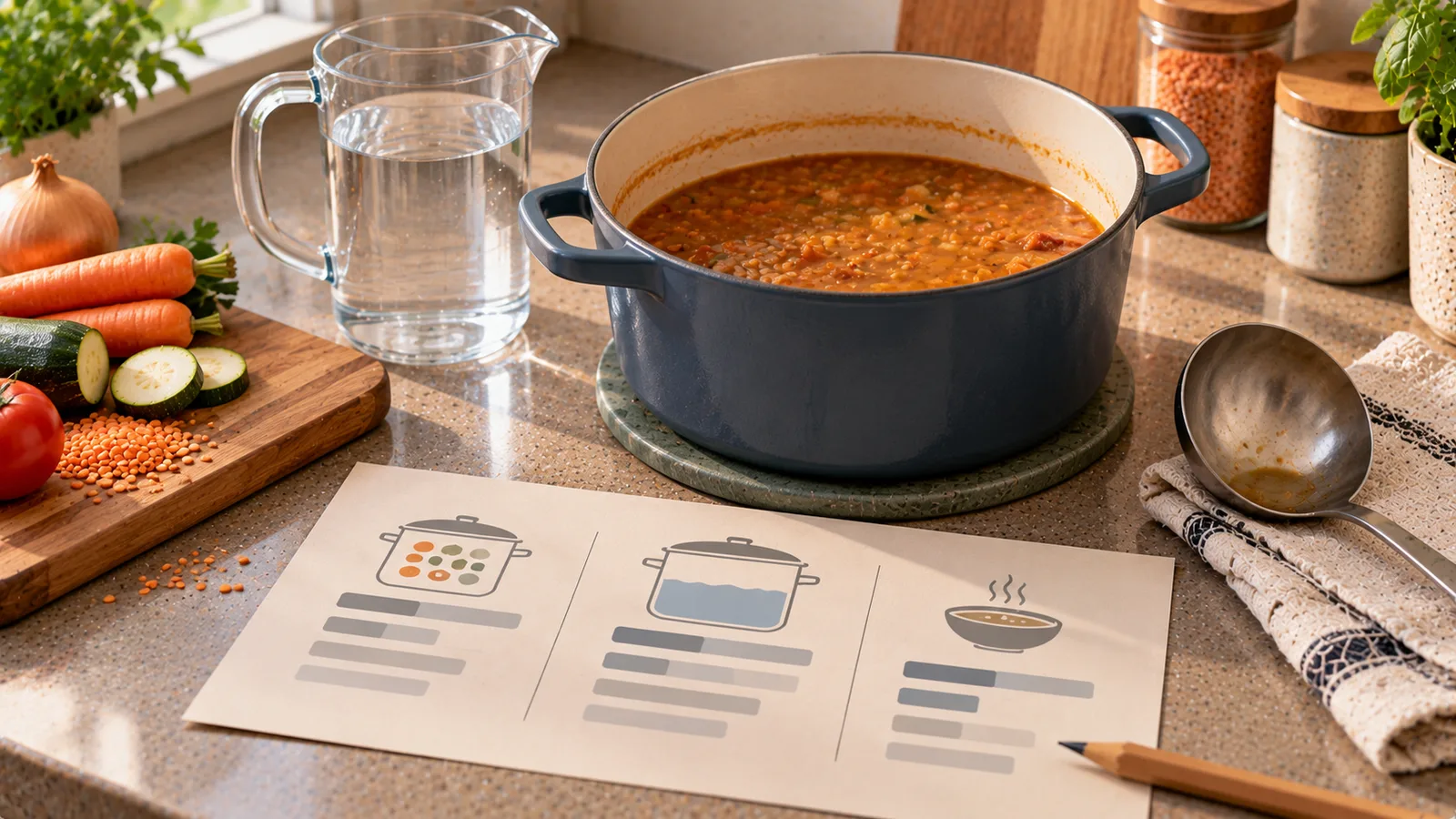
Adding water to homemade soup changes its weight and volume, but it does not add calories.
That distinction is important when you calculate calories per bowl, per 100 g or per gram.
If a pot of soup contains 1,500 kcal before you add water, adding 500 g of water does not turn it into a 2,000 kcal recipe. The whole pot still contains approximately 1,500 kcal. Those calories are simply distributed across a larger final weight.
The reverse happens when water evaporates during cooking: the soup becomes lighter and more concentrated, while most of the recipe's energy remains.
The most practical solution is to calculate the total calories of the calorie-containing ingredients and then use the final cooked weight of the soup.
The core formula
For calories per 100 g:
Calories per 100 g = total recipe calories ÷ final soup weight × 100
For a specific serving:
Serving calories = total recipe calories × serving weight ÷ final soup weight
This method automatically accounts for added water and ordinary evaporation.
Simple dilution example
Suppose your soup ingredients contain a total of:
1,600 kcal
Before adding extra water, the cooked soup weighs:
2,000 g
Its calorie density at that point is:
1,600 ÷ 2,000 × 100 = 80 kcal per 100 g
You then add:
1,000 g water
The final soup weighs approximately:
3,000 g
The total energy is still about:
1,600 kcal
The new calorie density is:
1,600 ÷ 3,000 × 100 ≈ 53 kcal per 100 g
The soup did not lose calories. It became less calorie-dense because the same energy is now distributed through more water.
What happens when soup reduces?
Now consider the opposite situation.
A soup contains:
1,800 kcal
At one point it weighs:
3,600 g
That would equal:
1,800 ÷ 3,600 × 100 = 50 kcal per 100 g
You simmer it uncovered and 600 g of water evaporates.
The final weight becomes:
3,000 g
Assuming the lost mass is primarily water, the total recipe energy remains approximately 1,800 kcal.
The new calorie density is:
1,800 ÷ 3,000 × 100 = 60 kcal per 100 g
The soup is now more calorie-dense even though you did not add any calorie-containing ingredient.
Why final weight works
Soup can change substantially during cooking because of:
- water added from the tap;
- stock or broth;
- evaporation;
- ingredients absorbing water;
- ingredients releasing water;
- blending;
- simmering with or without a lid.
Trying to track every gram of water movement can become unnecessarily complicated.
The final-weight method avoids much of this problem.
You calculate the total nutrition contributed by the ingredients and then distribute it across the actual final edible weight.
Step 1: calculate the calorie-containing ingredients
Record the ingredients used in the entire pot.
For example:
- 300 g chicken;
- 250 g potatoes;
- 150 g carrots;
- 100 g onions;
- 15 g oil;
- 100 g lentils;
- broth or other ingredients as applicable.
Use the nutritional values for the actual amounts used.
Suppose the entire recipe contains:
1,750 kcal
That number represents the energy in the whole pot before considering portion size.
Step 2: include caloric liquids
Water has essentially no calories, but not every liquid is calorie-free.
Depending on the recipe, you may need to include:
- milk;
- cream;
- coconut milk;
- oil;
- wine;
- sweetened sauces;
- calorie-containing stock or broth.
Do not treat all liquid as water.
If 200 ml of cream contributes 400 kcal, those calories belong in the recipe total.
If you add 800 g of plain water, the water changes the final weight but contributes essentially no energy.
Step 3: weigh the final soup
After cooking is complete, determine the final edible weight.
One practical method is:
- weigh the empty pot;
- weigh the pot containing the finished soup;
- subtract the empty pot weight.
For example:
Pot with soup: 5,420 g
Empty pot: 1,820 g
Soup weight:
5,420 − 1,820 = 3,600 g
If the recipe contains 1,750 kcal:
1,750 ÷ 3,600 × 100 ≈ 49 kcal per 100 g
You can save the finished soup using approximately 49 kcal per 100 g.
Step 4: weigh the portion you eat
Suppose your bowl contains:
450 g
If the soup contains 49 kcal per 100 g:
49 × 4.5 ≈ 221 kcal
Or calculate directly from the recipe:
1,750 × 450 ÷ 3,600 ≈ 219 kcal
Small differences can occur because of rounding.
Using the unrounded values internally gives the most consistent result.
Worked example: lentil soup
Suppose a pot contains:
- lentils: 600 kcal;
- vegetables: 250 kcal;
- oil: 180 kcal;
- tomato ingredients: 120 kcal;
- broth and other calorie-containing ingredients: 50 kcal.
Total:
1,200 kcal
After cooking, the soup weighs:
2,400 g
Calories per 100 g:
1,200 ÷ 2,400 × 100 = 50 kcal
You decide the soup is too thick and add:
600 g water
The final weight becomes approximately:
3,000 g
Total calories remain approximately:
1,200 kcal
New value:
1,200 ÷ 3,000 × 100 = 40 kcal per 100 g
A 500 g bowl contains approximately:
40 × 5 = 200 kcal
Worked example: soup that evaporates
You make a tomato and bean soup containing:
1,500 kcal
After combining the ingredients, the pot contains 3,500 g of soup.
You simmer it for a long time.
The finished soup weighs only:
2,900 g
Calories per 100 g:
1,500 ÷ 2,900 × 100 ≈ 52 kcal
If you had calculated using 3,500 g instead:
1,500 ÷ 3,500 × 100 ≈ 43 kcal
That would underestimate the calories per 100 g of the finished soup.
This is why final cooked weight is more useful than an earlier weight.
Adding water after you already calculated the recipe
Suppose you saved a soup as:
70 kcal per 100 g
and the current batch weighs:
2,000 g
Estimated total calories:
70 × 20 = 1,400 kcal
You add:
500 g water
New total weight:
2,000 + 500 = 2,500 g
New calorie density:
1,400 ÷ 2,500 × 100 = 56 kcal per 100 g
You do not add another food entry for plain water simply to create calories. Instead, you update the recipe yield or final weight.
If you add broth instead of water
Check whether the broth contributes calories.
Suppose the soup currently contains:
1,400 kcal
You add 500 g of broth containing:
75 kcal
The new total is:
1,400 + 75 = 1,475 kcal
If the final soup weighs 2,500 g:
1,475 ÷ 2,500 × 100 = 59 kcal per 100 g
The calculation differs from adding 500 g of plain water because the broth itself contributed energy.
If you add cream
The same principle applies.
Original soup:
1,200 kcal
Final weight before cream:
2,400 g
Add 200 g cream containing:
400 kcal
New recipe calories:
1,200 + 400 = 1,600 kcal
Approximate new weight:
2,400 + 200 = 2,600 g
Calories per 100 g:
1,600 ÷ 2,600 × 100 ≈ 62 kcal
Adding cream increases both weight and calories.
Adding plain water increases weight without meaningfully increasing calories.
What if you do not know how much water evaporated?
You usually do not need to know.
If you have:
- total recipe calories;
- final soup weight;
the final weight already reflects the net result of water added and water lost.
That is one of the main advantages of this method.
Do you need to weigh every water addition?
Not necessarily.
If your goal is the final calories per 100 g, you can often skip recording every addition of plain water.
Calculate the calorie-containing ingredients and weigh the soup at the end.
However, recording water can still be useful for reproducing the recipe or understanding why one batch has a different final yield.
What if you cannot weigh the pot?
You can use volume as an approximation, but it introduces more uncertainty.
For a thin, water-like soup, 1 ml may be reasonably close to 1 g.
For thick soups, stews and blended soups, this assumption can be less accurate.
If precise portion tracking matters, weighing the finished soup is preferable.
Using serving count instead of weight
If you divide the entire pot into equal portions, you can simply divide the total calories.
For example:
Whole soup:
1,800 kcal
Six equal portions:
1,800 ÷ 6 = 300 kcal per portion
This works if the portions are genuinely similar.
If one bowl contains 350 g and another 600 g, using the same calorie value for both is less accurate.
Solids can settle
Soup is not always perfectly uniform.
Beans, meat, pasta or vegetables may settle toward the bottom while broth remains near the top.
A bowl with more solids may therefore contain more calories than an equal-weight bowl containing mostly broth.
To improve consistency:
- stir the soup before portioning;
- distribute solids and liquid reasonably evenly;
- use an average recipe value rather than assuming mathematical perfection.
For normal home tracking, this is usually sufficient.
Blended soups are easier to portion consistently
When soup is blended thoroughly, ingredients are generally distributed more evenly.
That makes a per-100-g recipe value particularly practical.
You can weigh each bowl and scale the recipe value directly.
What about pasta or rice cooked inside the soup?
If dry pasta or rice is added directly to the soup, include its dry amount in the recipe nutrition.
During cooking it absorbs water and becomes heavier.
The absorbed water does not add calories.
For example, 100 g of dry pasta may become much heavier after cooking, but the pasta's original energy has not multiplied.
The final soup weight automatically captures the added water held by the pasta.
What if rice is cooked separately?
If you serve rice separately from the soup, it is usually easier to log the two foods separately.
For example:
- 400 g soup;
- 150 g cooked rice.
This avoids changing the soup recipe every time someone chooses a different amount of rice.
What about noodles added to individual bowls?
Treat them separately if they are not evenly incorporated into the entire pot.
The same applies to:
- cheese;
- sour cream;
- croutons;
- bread;
- extra oil;
- seeds;
- toppings.
If a topping is added to only one serving, add it to that serving rather than to the entire soup recipe.
Removing liquid changes the calculation too
Suppose you remove some broth from a soup.
If the removed liquid contains very little energy compared with the solids, the remaining soup may become more calorie-dense.
But if the broth contains meaningful fat, starch or other nutrients, assuming it was pure water can be inaccurate.
For ordinary cooking, the final-weight method is still useful, but remember that discarded material can contain calories.
Skimming fat from soup
If you visibly remove a substantial amount of fat, the total recipe calories may decrease.
The simple assumption that only water leaves the pot would no longer be fully correct.
If you can measure the removed fat reasonably, you can subtract its estimated nutrition.
For small or uncertain amounts, avoid pretending the result is exact.
What if some soup is already eaten before the final weighing?
You can reconstruct the approximate original final yield.
Suppose:
Remaining soup: 2,200 g
Previously eaten bowl: 450 g
Estimated original finished weight:
2,200 + 450 = 2,650 g
If the whole recipe contained 1,500 kcal:
1,500 ÷ 2,650 × 100 ≈ 57 kcal per 100 g
This is less precise if the first serving had an unusual ratio of solids to liquid, but it can still provide a useful estimate.
Reheating can change weight again
Repeated reheating can evaporate additional water.
Suppose a soup originally weighed 3,000 g and contained 1,500 kcal.
Initially:
1,500 ÷ 3,000 × 100 = 50 kcal per 100 g
After several reheatings, the remaining soup may become more concentrated.
If accurate per-100-g tracking matters, you can add water back to the original consistency or update the weight of the remaining batch.
For most everyday tracking, small changes do not require constant recalculation.
Freezing soup
Freezing does not inherently add or remove calories.
If you freeze a 500 g portion of a well-mixed soup calculated at 60 kcal per 100 g:
60 × 5 = 300 kcal
That portion remains approximately 300 kcal after freezing and thawing, assuming nothing significant is added, removed or discarded.
Why measuring only the bowl volume can mislead
Two bowls that look equally full may not contain the same mass.
A thick bean soup and a thin broth can have very different compositions.
Even within one recipe, solids may be distributed unevenly.
If you want to use a saved per-100-g value, weighing the bowl is usually more useful than estimating its volume visually.
Calculate macros the same way
The same final-weight method works for:
- protein;
- carbohydrates;
- fat;
- fiber;
- other nutrients available in your ingredient data.
Suppose the whole soup contains:
- 1,600 kcal;
- 100 g protein;
- 180 g carbohydrates;
- 50 g fat.
Final weight:
3,200 g
Per 100 g:
Calories:
1,600 ÷ 3,200 × 100 = 50 kcal
Protein:
100 ÷ 3,200 × 100 ≈ 3.1 g
Carbohydrates:
180 ÷ 3,200 × 100 ≈ 5.6 g
Fat:
50 ÷ 3,200 × 100 ≈ 1.6 g
Adding plain water changes all of these values per 100 g because it changes the denominator.
Do not change the total calories just because the soup became thinner
This is one of the most important distinctions.
If you add water:
- total calories stay approximately the same;
- total weight increases;
- calories per 100 g decrease.
If water evaporates:
- total calories stay approximately the same;
- total weight decreases;
- calories per 100 g increase.
The total energy changes only when calorie-containing material is added, removed or discarded.
A reusable workflow
For most homemade soups:
- enter all calorie-containing ingredients;
- calculate the total recipe nutrition;
- finish cooking;
- weigh the final edible soup;
- subtract the pot weight;
- calculate nutrition per 100 g;
- weigh each serving;
- scale the saved recipe value to the serving weight.
This method is usually easier than trying to model every change in water during cooking.
Quick example
Recipe calories:
2,100 kcal
Final soup weight:
4,200 g
Calories per 100 g:
2,100 ÷ 4,200 × 100 = 50 kcal
Serving:
550 g
Serving calories:
50 × 5.5 = 275 kcal
If you later dilute the remaining soup with plain water, recalculate using the new total weight.
Common mistakes
Avoid these errors:
- treating added water as if it added calories;
- continuing to use the old per-100-g value after major dilution;
- calculating with the pre-cooking weight after substantial evaporation;
- forgetting calories from oil, cream or other liquids;
- including the pot in the finished weight;
- assuming every bowl is identical when solids are unevenly distributed;
- adding separately served toppings to the whole recipe;
- confusing total recipe calories with calories per 100 g.
The practical rule
For homemade soup, separate two questions:
How many calories are in the whole recipe?
and:
Across how much finished food are those calories distributed?
Plain water mainly changes the second answer.
Once the soup is finished, weigh it and calculate:
total recipe calories ÷ final soup weight × 100
That gives you calories per 100 g.
Then weigh the portion you eat.
Whether the soup was diluted with extra water or concentrated through evaporation, the final cooked weight captures the change and gives you a practical basis for tracking each bowl.