
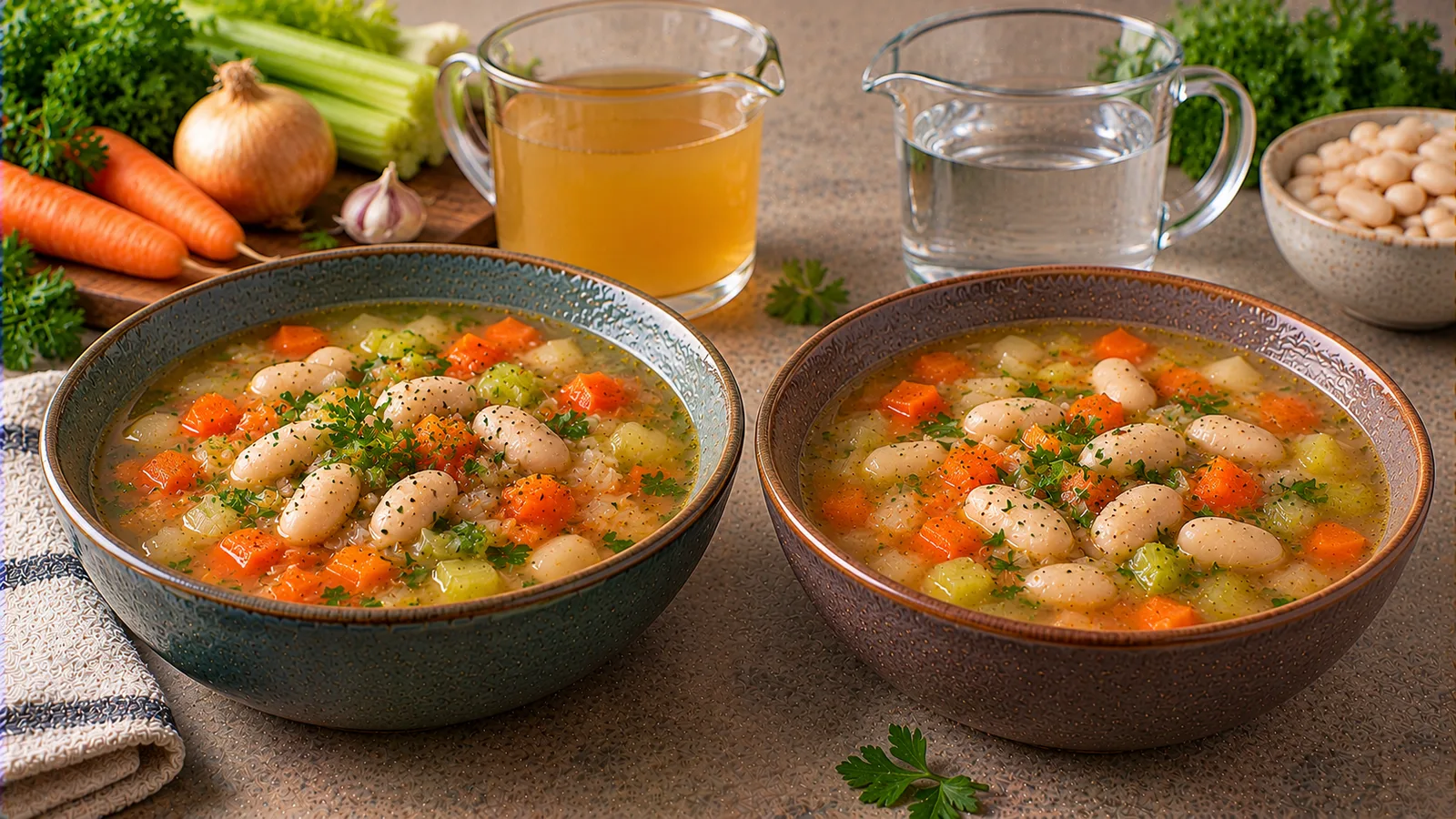
A vegetable stock can make a bean soup taste fuller, but even a stock marketed as milder or reduced in salt can contribute more sodium than the beans and vegetables. The useful comparison is not simply a label on a jar versus a glass of water. It is the same bean soup, in the same four bowls, with the cooking liquid changed and nothing else altered.
In the worked example below, 600 ml of prepared Swema Gemüsebrühe Mild contributes 3.42 g salt to the pot, or 0.855 g salt per bowl, before the other ingredients are counted. Water contributes no added salt. These are calculations from one product's prepared-broth declaration, not a claim about every low-salt stock or about the exact sodium content of your tap water.
First check the prepared stock label
The Alnatura listing for Swema Gemüsebrühe Mild gives 0.57 g salt per 100 ml prepared broth and instructs cooks to mix 13 g of the fresh concentrate with 500 ml boiling water. The retailer describes this product as reduced in salt. That description does not mean the finished liquid is salt-free, nor have we independently established a qualifying percentage reduction against a directly comparable standard product. The only number used here is the stated salt content of the prepared product.
| What the label or model describes | Quantity | Meaning for soup |
|---|---|---|
| Prepared Swema mild vegetable stock | 0.57 g salt / 100 ml | Product declaration; check your own package |
| Prepared stock used in one pot | 600 ml | Delivers 3.42 g salt from stock |
| Water used instead | 600 ml | No stock-derived salt added |
| Shared salt in beans and vegetables | 0.40 g / pot | Explicit illustrative assumption, not a measured nutrient total |
| Number of servings | 4 bowls | Identical ingredient amounts and portion count |
Do not confuse salt per 100 g of concentrate with salt per 100 ml after preparation. If the product is a cube or paste and its label only reports the concentrate, the instructions and dilution must be checked first. Conversely, if a carton declares salt per 100 ml as sold, use that value directly. The denominator is what keeps the comparison honest.
One matched four-bowl bean soup
Use the same soup ingredients in both tests: 480 g drained cooked beans (for example two tins that each contain 240 g after draining), 400 g chopped tomatoes, 150 g onion, 150 g carrot, 10 ml olive oil, parsley, pepper, and 600 ml cooking liquid. Avoid adding table salt, salted cheese, bacon, sausage, bouillon powder or soy sauce during the comparison. If the beans or tomatoes are seasoned, the shared-background assumption must be replaced with the combined figures on their actual labels.
For a reproducible kitchen comparison, weigh the strained beans, chop the vegetables, heat the oil, soften the onion and carrot, add tomatoes, beans and either liquid, simmer until the vegetables are tender, then divide the finished soup into four equal portions by weight. Stir before portioning. Evaporation can change the bowl's final mass, but if the four portions together contain the full pot, they still share its salt equally. If you leave a quarter of the soup uneaten, do not count that quarter as consumed.
The example assumes 0.40 g salt for the whole pot from everything except the stock, simply to make the arithmetic visible. Actual beans, tomatoes and vegetables contain varying naturally occurring sodium and sometimes added salt. The figure is not taken from a product label and should not be used as a nutrition declaration. The stock contribution, in contrast, uses the published prepared-product value.
Calculate salt and sodium for each bowl
Multiply the prepared-stock label by the volume used: 0.57 g × (600 ml ÷ 100 ml) = 3.42 g salt. Divide by four to get 0.855 g salt from stock per bowl. The European food-information regulation defines label salt as sodium multiplied by 2.5. Therefore, the extra stock supplies 342 mg sodium per bowl (0.855 ÷ 2.5 × 1,000).
If we include the shared 0.40 g salt per pot assumption, the complete comparison becomes:
| Cooking liquid for one four-bowl pot | Salt from liquid, pot | Total model salt, pot | Total model salt, bowl | Total model sodium, bowl |
|---|---|---|---|---|
| 600 ml water | 0 g | 0.40 g | 0.10 g | 40 mg |
| 300 ml prepared mild stock + 300 ml water | 1.71 g | 2.11 g | 0.5275 g ≈ 0.53 g | 211 mg |
| 600 ml prepared mild stock | 3.42 g | 3.82 g | 0.955 g ≈ 0.96 g | 382 mg |
These are model totals, not laboratory results for a finished soup. The 600 ml full-stock recipe adds 342 mg sodium per bowl compared with the water recipe; the half-stock recipe adds 171 mg. Choosing plain water changes the stock-derived portion, not necessarily the sodium inherently present in beans and vegetables. Local drinking water can also contain sodium, which is not included in the simplified model.
Why “reduced salt” and “low salt” are different
The European Commission's nutrition-claims guidance lists rules for comparative reduced sodium/salt claims and separate limits for low sodium/salt claims. Reduction is relative to comparable products; low is an absolute content threshold. The terms are not interchangeable. Some stocks legitimately contain less salt than conventional versions yet still add an appreciable amount when you use half a litre or more.
The EU rule generally requires an appropriate comparison for a reduced-sodium or reduced-salt claim; the permitted reduction threshold for sodium or equivalent salt is 25%, subject to the wider legal conditions. We have not verified any comparator for this particular stock. That is why the table uses the retailer's 0.57 g per 100 ml figure, and does not assume the product is 25% below a generic industry average.
A label on a cube may say “mild”, “less salty” or “reduced salt” but the relevant question is how much prepared broth goes into your recipe. Multiplying a per-100-ml value by six may be more informative than looking at a front-of-pack phrase. A label can also change with reformulation, so photograph or check the exact item you buy.
How to recalculate with your own beans and stock
Record the prepared stock's salt in g/100 ml and the total volume used. Multiply these, then add salt from every other ingredient, measured for the quantity actually used. Finally, divide by the number of portions eaten. If your label lists sodium in mg rather than salt, do not add it directly to figures stated in grams of salt: first convert everything to the same unit using the 2.5 relationship in Regulation (EU) No 1169/2011.
For example, if an alternative stock contains 0.30 g salt per 100 ml, then 600 ml supply 1.80 g salt per pot, or 0.45 g per bowl in a four-serving batch. That hypothetical alternative is not a named product or a verified shelf label. It shows how easily the method adapts to your own pack. If the recipe uses 900 ml instead, substitute 900 in the numerator. If the number of servings changes from four to six, adjust the denominator rather than silently changing the ingredients.
Watch out for concentrate directions. Six hundred millilitres of prepared stock do not mean adding 600 ml concentrate. For this Swema listing, the preparation example gives 13 g of concentrate for 500 ml of water; scaled proportionally for roughly 600 ml, that is 15.6 g concentrate, with actual final volume subject to the preparation instructions. Use the declared nutrition of the prepared broth as the base, not two incompatible definitions of dilution.
Taste without turning water into an empty-tasting soup
Water-based bean soup need not be bland. Brown onion and carrot lightly before adding water; cook tomatoes long enough to lose their raw edge; mash a spoonful of beans back into the pot for body. Garlic, black pepper, thyme, paprika, bay leaf, lemon juice and fresh parsley can increase aroma or brightness without automatically adding sodium. Acidity changes how food tastes; it does not remove salt already present. A squeeze of lemon after cooking is a seasoning choice, not a sodium-lowering chemical reaction.
A useful compromise is 300 ml mild stock plus 300 ml water. In this example that cuts the stock's added salt from 3.42 g to 1.71 g per pot, while preserving some of its prepared flavour. If you start with water and add concentrate little by little, write down the grams used. Simply guessing “half a cube” is less reliable when cubes differ in mass and salt content.
You could also reserve the liquid from unsalted cooked beans for body, although canned bean liquid can contain salt. Read its label if sodium matters, especially for soups combining beans with tomato paste, pickled vegetables or salty toppings. For the broader issue of packaged versus homemade soups, see packaged versus homemade bean soup and label costs: this article isolates the cooking liquid while keeping the pot itself matched.
What this comparison cannot tell you
It does not estimate the sodium in every brand of broth, prove that one product legally qualifies as “low salt”, or compare the nutritional value of a water soup with a store-bought ready meal. It is not clinical advice for someone with a medically prescribed sodium limit. The portion totals can change if liquid is discarded, ingredients are substituted, more salt is added at the table, or the batch is not divided evenly.
There is also no automatic “healthy” verdict from the lowest number in the table. Beans provide food substance independently of stock choice; the decision about sodium should fit the whole day's diet and any individual medical advice. WHO recommends less than 2 g sodium daily for adults, equivalent to less than 5 g salt. The model's 0.955 g salt per full-stock bowl would represent about 19% of that salt amount before bread, cheese, drinks or other meals. The water version is much lower in the calculation, but again actual ingredient labels are needed for an actual food log.
A practical choice for tonight
If you want the simplest way to lower sodium from the cooking liquid, use water and flavour the soup with sautéed vegetables, herbs and acid. If you prefer some stock character, try a half-stock mix and measure the concentrate. If you use a full 600 ml of the example mild stock, count its 3.42 g salt in the entire pot rather than assuming “reduced salt” makes it negligible. Serve equal bowls and record what was actually consumed.