
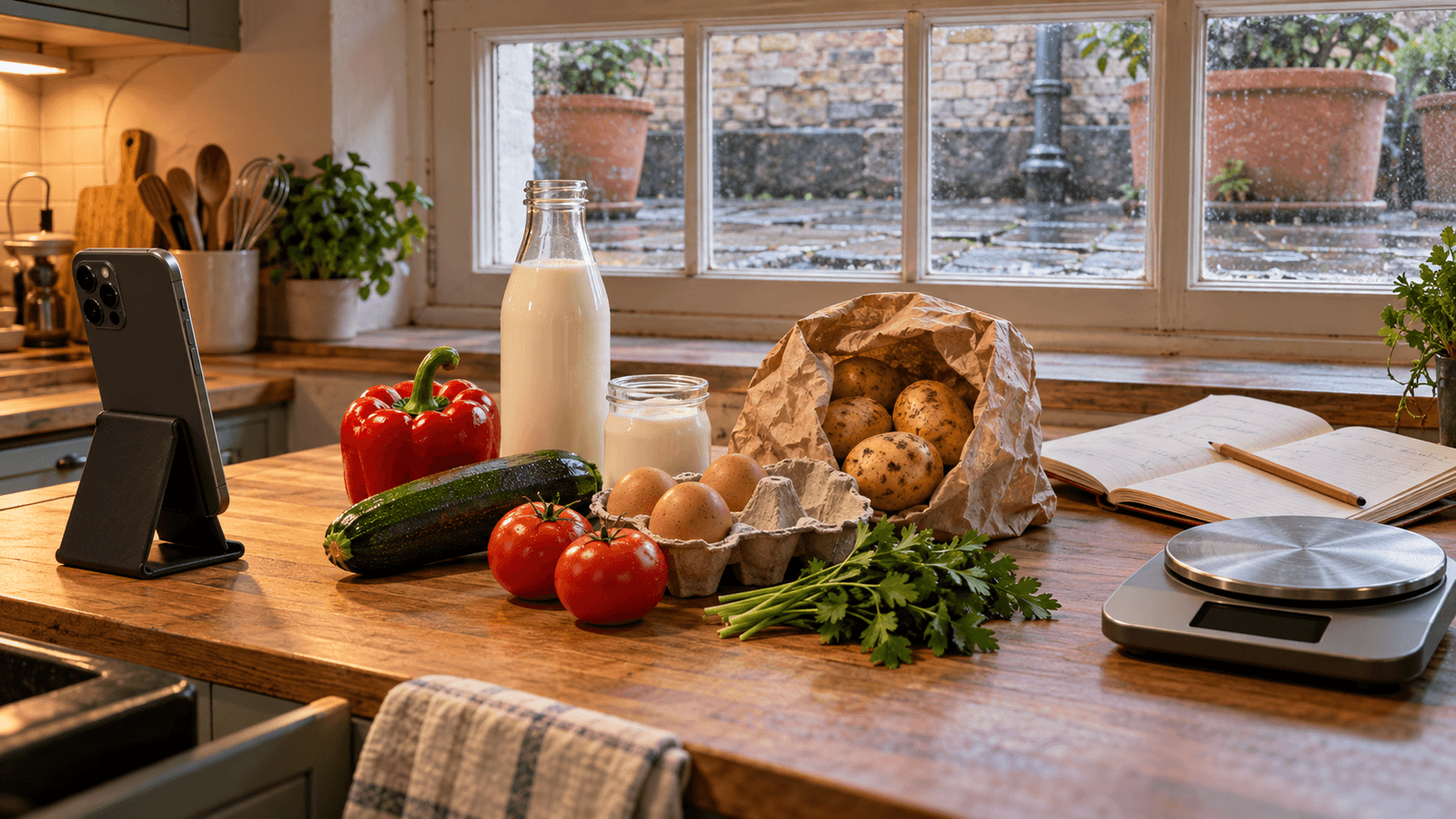
Tracking what you eat can be useful for understanding eating habits, calories, macronutrients, meal timing and recurring patterns.
But there is more than one way to keep a food diary.
Two common approaches are:
- taking photos of food
- logging foods manually in a traditional food diary or nutrition tracker
Both methods can work.
The better choice depends on what you want to learn, how much detail you need and how much effort you are willing to put into tracking.
What is a photo food diary?
A photo food diary records meals, snacks and drinks primarily through photographs.
Instead of immediately searching for every food and entering quantities, you take a photo when you eat.
Depending on the system you use, the photo may simply serve as a visual record or it may be analyzed to estimate:
- foods present
- portion sizes
- calories
- protein
- carbohydrates
- fat
A photo diary can therefore range from a simple visual journal to an AI-assisted nutrition tracker.
See How to Keep a Food Diary With Photos.
What is traditional food logging?
Traditional food logging usually means manually recording what you eat.
This may involve:
- searching a food database
- scanning a barcode
- selecting a saved food
- entering a recipe
- weighing ingredients
- choosing a serving size
- recording calories or macros
The method can provide detailed nutritional information, but it often requires more interaction.
The main difference
The biggest practical difference is where the effort happens.
With traditional logging, you usually identify and enter the food yourself.
With a photo diary, the first step may take only a few seconds: photograph the food.
Any additional identification, correction or nutrition estimation can happen afterward.
That difference can matter because the usefulness of any tracking method depends partly on whether you actually continue using it.
Photo food diary vs traditional logging at a glance
| Factor | Photo food diary | Traditional food logging |
|---|---|---|
| Initial entry | Usually fast | Often requires searching or entering food |
| Visual record | Strong | Usually limited |
| Exact ingredient detail | May require correction | Can be entered directly |
| Portion precision | Depends on photo and estimation method | Can be high when foods are weighed |
| Restaurant meals | Convenient to capture | Can be difficult to enter accurately |
| Mixed dishes | Easy to photograph | May require recipe breakdown |
| Historical context | Photos can help recall meals | Text records can provide structured detail |
| Effort | Often lower at capture | Often higher at capture |
| Nutrition detail | Depends on analysis | Can be highly detailed |
| Corrections | May be needed after recognition | May be needed when database entries are wrong |
Neither method automatically guarantees accurate nutrition data.
Speed
Photo tracking is often faster at the moment of eating.
You open the camera, photograph the food and continue with your meal.
Traditional logging may require several steps:
- search for the food
- choose the correct entry
- select the serving
- enter the amount
- repeat for other ingredients
For a simple packaged food, this may still be quick.
For a mixed meal, it can take longer.
Friction matters
A theoretically detailed food diary is not useful if you regularly forget or avoid using it.
Tracking friction includes anything that makes logging feel inconvenient:
- too many searches
- too many taps
- entering the same foods repeatedly
- estimating complicated dishes
- building recipes
- recording meals when busy
A photo diary reduces some of this friction by making the initial capture very simple.
Traditional logging can reduce friction in other ways, such as saved meals, recent foods and reusable recipes.
Which method is more accurate?
There is no universal answer.
Accuracy depends on how the method is used.
Traditional logging can be very precise when:
- ingredients are weighed
- the correct food entries are selected
- recipes are entered accurately
- cooking changes are handled correctly
- serving sizes are recorded consistently
But manual logging can also be inaccurate when:
- the wrong database entry is selected
- serving sizes are guessed
- oils and sauces are forgotten
- recipes are incomplete
- restaurant nutrition is unknown
Photo tracking has different limitations.
An image may not reveal:
- hidden oil
- exact ingredient quantities
- ingredients underneath other foods
- sugar in a drink
- the exact type of sauce
- preparation method
- recipe proportions
AI recognition may also identify a food incorrectly.
For this reason, photo estimates should be treated as estimates that can be reviewed and corrected.
See How to Correct an AI Food Estimate.
Portion size
Portion size is one of the hardest parts of food tracking.
Traditional logging
If you weigh food with a kitchen scale, manual logging can use that measured quantity.
This can provide a strong basis for estimating nutrition.
If you do not weigh the food, however, you may still be selecting approximate portions such as:
- one serving
- one cup
- one slice
- one medium piece
Photo diary
A photo provides visual information about the portion but does not automatically reveal exact weight.
Estimation can improve when:
- the full portion is visible
- foods are not heavily overlapping
- the image has useful perspective
- recognizable size references are present naturally
- the dish is visually clear
But an image-based portion estimate is still an estimate.
See Can AI Estimate Portion Size From a Photo?.
Mixed dishes
Mixed dishes are a useful example of the trade-off between the two methods.
Consider a homemade casserole.
With traditional logging, you may need to:
- enter each ingredient
- record the amount used
- calculate the finished recipe
- divide the recipe into portions
This can provide useful detail, but it takes time.
With photo tracking, capturing the meal is much faster.
However, the photograph may not reveal exactly how much oil, cheese or sauce was used.
The best method depends on whether speed or ingredient-level detail matters more for that meal.
Restaurant meals
Photo diaries can be especially convenient when eating outside the home.
You may not know:
- exact ingredient weights
- recipe proportions
- cooking oil quantity
- sauce composition
Traditional logging cannot create information that is unavailable.
You can still search for similar dishes or use restaurant nutrition information when available, but the result may remain an estimate.
A photograph at least preserves a visual record of what was served.
Packaged foods
Traditional logging can work very well for packaged foods when reliable nutrition information is available.
You may be able to:
- scan a barcode
- use the nutrition label
- enter the exact amount consumed
A photo of the food alone may provide less information than the package label.
A practical tracking system can therefore use different input methods depending on the food.
Homemade meals
For frequently repeated homemade meals, traditional recipe logging can become efficient after the recipe has been saved.
You enter the recipe once and reuse it.
Photo tracking can still be useful when:
- portions change
- ingredients vary
- you do not want to create a full recipe
- you want a visual history of meals
These methods do not have to be mutually exclusive.
Drinks
Drinks are easy to overlook in both methods.
A photograph may show the drink but not necessarily reveal:
- added sugar
- syrup
- milk quantity
- alcohol content
- exact volume
Traditional logging allows those details to be entered directly if you know them.
Whichever method you use, remember that drinks can contribute to total energy intake.
Oils, sauces and condiments
Small additions can be difficult to see in photographs.
Examples include:
- cooking oil
- butter
- mayonnaise
- salad dressing
- sauces
- spreads
Traditional logging can record these directly when you know the amount.
With photo tracking, you may need to add or correct them manually.
Visual memory
One major advantage of a photo diary is context.
A photograph can help you remember:
- what the meal looked like
- approximate portion relationships
- whether vegetables were included
- whether you ate at home or elsewhere
- how meals changed over time
A list of food names does not always provide the same visual memory.
This can make photo histories useful even when precise calorie tracking is not the main goal.
Structured data
Traditional logging has an advantage when highly structured nutrition data is important.
Manual entries can provide:
- calories
- protein
- carbohydrates
- fat
- fiber
- selected micronutrients
- serving quantities
The usefulness of this information still depends on the quality of the underlying food data and the accuracy of the quantities entered.
Consistency may matter more than theoretical precision
Suppose one tracking method is potentially more precise but takes so much effort that you use it only occasionally.
Another method may be less precise for some meals but easy enough to use consistently.
For understanding patterns, the second method may sometimes produce a more complete record.
This does not mean accuracy is unimportant.
It means accuracy and adherence should be considered together.
Photo diaries and eating patterns
A photo diary can reveal patterns that are easy to miss in individual nutrition entries.
For example:
- meals becoming larger later in the day
- frequent unplanned snacks
- limited food variety
- recurring restaurant meals
- long gaps between meals
- vegetables appearing rarely
- repeated meals
The images can make these patterns visually obvious.
Traditional logging and quantitative goals
Traditional logging may be especially useful when you need detailed numerical information.
Examples include:
- monitoring calorie intake
- tracking protein
- following carbohydrate targets
- comparing portions
- analyzing recipes
This is particularly useful when quantities can be measured reliably.
Photo tracking and calorie goals
A photo diary can also support calorie tracking when images are analyzed and estimates are reviewed.
However, image recognition should not be treated as perfect measurement.
If the estimate matters, check:
- food identity
- portion size
- cooking method
- oils
- sauces
- drinks
- hidden ingredients
Correcting obvious errors can make the record more useful.
Photo tracking and macros
AI systems may estimate protein, carbohydrate and fat after identifying foods and portions.
The macro estimate depends on the earlier steps being reasonably correct.
If the system identifies the wrong food or portion, the macro estimate can also be wrong.
See Can AI Estimate Macros From a Food Photo?.
Which method is easier for beginners?
For someone who has never tracked food before, taking photos may feel simpler.
There is less need to immediately learn:
- food databases
- serving units
- recipe builders
- portion conversions
Traditional logging can require more setup but may teach you more about quantities and nutrition data.
The easier method is the one you can understand and use without excessive effort.
Which method is better for repeated meals?
Traditional logging can become extremely fast for repeated meals when you can reuse:
- recent foods
- saved meals
- saved recipes
- favorite foods
Photo logging is also quick because taking another photograph requires little effort.
If your meals repeat often, both methods can become efficient.
Which method is better for irregular meals?
Photo tracking can be convenient for irregular or difficult-to-describe meals.
Examples:
- restaurant food
- buffet meals
- mixed plates
- meals prepared by someone else
- travel meals
You can preserve the meal immediately without trying to reconstruct every ingredient before eating.
What about forgotten entries?
Both systems can have missing entries.
With traditional logging, you may postpone entering a meal and later forget the details.
With photo tracking, taking the photograph creates an immediate record that can potentially be reviewed later.
However, a photo diary still depends on remembering to take the photo.
What about snacks?
Snacks are easy to miss because they may happen quickly.
Photo tracking can make recording them easier if the camera is immediately accessible.
Traditional logging may be more useful when the snack is packaged and has clear nutrition information.
Again, the methods can be combined.
Hybrid food tracking
You do not need to choose only one method.
A hybrid approach can use the fastest or most informative input for each situation.
For example:
Photo
Use a photo for:
- restaurant meals
- mixed dishes
- meals prepared by someone else
- quick visual capture
Barcode or label
Use package information for:
- yogurt
- protein products
- packaged snacks
- drinks
- other labeled foods
Manual entry
Use manual input for:
- cooking oil
- sauces
- ingredients hidden from the camera
- corrections
- exact measured quantities
Saved recipe
Use a reusable recipe for meals you cook regularly.
This can provide both convenience and detail.
Photo food diary for awareness
You do not need to calculate calories for a photo diary to be useful.
A visual diary alone can help you observe:
- meal frequency
- meal composition
- food variety
- snack patterns
- eating environments
- repeated habits
For some users, that may be enough.
Traditional logging without weighing everything
Traditional food logging does not require weighing every ingredient.
You can use approximate portions when extreme precision is unnecessary.
The important point is to understand the limitations of the resulting estimate.
More effort does not always produce meaningfully better information.
Photo logging without AI
A photo food diary does not require AI.
You can simply photograph your meals and review them later.
AI adds another layer by attempting to identify food and estimate nutrition.
The visual record remains useful even when no automatic analysis is performed.
Privacy considerations
Food photos may contain more than food.
Before storing or sharing them, consider whether images include:
- people
- documents
- addresses
- computer screens
- private surroundings
If privacy matters, frame the photo around the food and avoid unnecessary background details.
When a photo diary may be a good fit
A photo diary may suit you if:
- you want very fast capture
- you often eat mixed or restaurant meals
- you value visual history
- manual entry feels burdensome
- you want to review patterns later
- you prefer correcting estimates instead of building every meal manually
When traditional logging may be a good fit
Traditional logging may suit you if:
- you need detailed numerical data
- you regularly weigh ingredients
- you cook repeatable recipes
- you rely on packaged foods with reliable labels
- exact ingredient entry matters to you
- you do not mind spending more time entering food
When a hybrid approach may work best
A hybrid approach may be useful if your meals vary.
You might photograph lunch at a restaurant, scan a packaged snack, reuse a saved dinner recipe and manually add cooking oil.
There is no requirement that every food be logged through the same input method.
Common mistakes with photo food diaries
Assuming the photo contains every detail
Hidden ingredients may not be visible.
Treating AI estimates as exact measurements
Recognition and portion estimation can be wrong.
Forgetting drinks
Include beverages when they matter to your tracking goal.
Taking photos that hide the food
Clear images generally provide more useful visual information.
Never reviewing the diary
The value of a diary comes partly from what you learn from it.
Common mistakes with traditional food logging
Choosing the first database result
Different entries can represent different products or preparations.
Guessing portions without noticing
Approximation is fine when appropriate, but recognize when you are estimating.
Forgetting cooking ingredients
Oil, sauces and toppings can be missed.
Creating unnecessary complexity
Tracking every minor detail can make the system difficult to maintain.
Abandoning logging because it takes too long
Simplify the method if the effort is preventing consistency.
How Mealisa approaches food tracking
Mealisa is designed around the idea that different foods benefit from different input methods.
A food photo can provide a fast starting point.
When more information is available, the record can be improved through other inputs such as product information, portion adjustments or manual corrections.
The goal is not to pretend that a photograph is a laboratory measurement.
The goal is to reduce unnecessary input while keeping the result useful enough for everyday nutrition tracking.
A practical way to choose
Ask yourself three questions.
1. What do I want to learn?
If you mainly want to observe patterns, a photo diary may be enough.
If you need detailed calorie or macro data, structured logging may be more useful.
2. How much effort will I realistically maintain?
Choose a method you can continue using.
3. How much precision do I actually need?
Not every goal requires the same level of detail.
You can increase precision only where it adds useful information.
Frequently asked questions
Is a photo food diary accurate?
A photo diary is accurate as a record that food was present, but nutrition estimates based on images have uncertainty. Food identification, portion size and hidden ingredients can all affect the estimate.
Is manual food logging more accurate?
It can be, especially when ingredients are weighed and correct food data is used. Manual logging can still contain errors from incorrect database entries, forgotten ingredients and estimated portions.
Can I track calories from food photos?
You can estimate calories from food photos, but the result should be treated as an estimate rather than an exact measurement.
Can a photo diary replace calorie tracking?
If your goal is simply awareness of eating patterns, it may. If you require numerical calorie information, the images need additional nutrition estimation or manual data.
Should I photograph every snack?
That depends on your goal. If snacks are relevant to the pattern you want to understand, recording them can make the diary more complete.
Can I combine photos and manual logging?
Yes. A hybrid approach is often practical because different foods provide different types of information.
Do I need to weigh food if I use photos?
Not necessarily. Weighing can improve quantity information when precision matters, but it also adds effort.
Which method is faster?
Taking a photo is usually faster at the moment of eating. Total time depends on whether you later review or correct the entry.
The bottom line
Photo food diaries and traditional food logging solve the same basic problem in different ways.
A photo diary prioritizes fast capture and visual context.
Traditional logging prioritizes structured food and nutrition data.
Neither method is automatically more accurate in every situation.
Photo tracking can miss hidden ingredients and exact quantities.
Manual tracking can suffer from incorrect database entries, forgotten foods and inconsistent portion estimates.
For many people, the most practical solution is not choosing one method permanently.
Use the method that provides the best balance of:
- speed
- detail
- consistency
- useful accuracy
for the food and situation in front of you.
This article provides general educational information and is not individualized medical or dietary advice.