
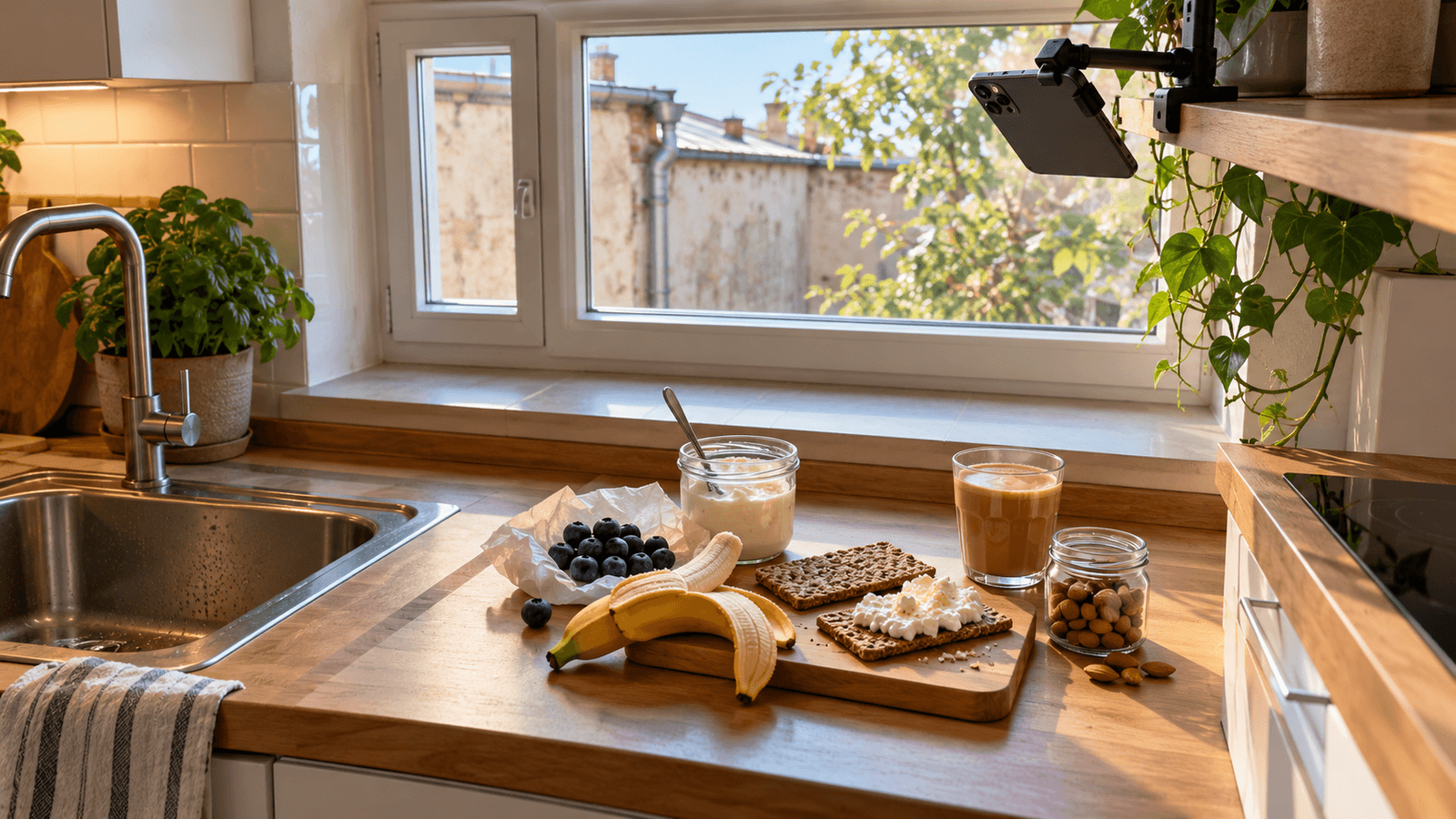
A food diary does not have to begin with weighing every ingredient or typing every meal into a long form.
For many people, the simplest starting point is a photo.
A photo food diary creates a visual record of what you eat and drink. Instead of relying entirely on memory, you capture meals, snacks and relevant drinks as they happen and review them later.
Photos can make food tracking faster, but they do not automatically make it accurate.
The quality of a photo diary depends on what you photograph, how consistently you do it and what you expect the diary to tell you.
What is a photo food diary?
A photo food diary is a chronological collection of food and drink photos used to record eating habits.
At its simplest, the process is:
- take a photo before eating
- include the entire meal or snack
- photograph relevant drinks
- capture additions that may otherwise be forgotten
- review the images later
The diary can be used without calorie counting.
It can also become the starting point for more detailed tracking.
Why use photos instead of relying on memory?
Food is easy to forget.
A person may remember breakfast, lunch and dinner while overlooking:
- a small snack
- milk added to coffee
- a sauce
- cooking oil
- a few bites while preparing food
- a second serving
- a caloric drink
Photos create a visual cue that can make later recall easier.
They also preserve information about the meal's appearance, composition and approximate portion.
A photo diary can reduce logging friction
Traditional food logging can require:
- searching for foods
- entering quantities
- selecting database entries
- calculating recipes
- typing descriptions
That effort can discourage consistent tracking.
Taking a photo usually requires much less immediate input.
You can capture the eating event first and add details later if needed.
This is one reason photo-based tracking can fit naturally into everyday life.
What should you photograph?
Photograph the foods and drinks that are relevant to what you want to understand.
For a general food diary, this usually includes:
- breakfast
- lunch
- dinner
- snacks
- caloric drinks
- desserts
- additional servings
You do not necessarily need to photograph plain water unless doing so serves a specific purpose.
Photograph the meal before eating
The best time to photograph food is usually before you start eating.
This preserves the original portion and composition.
If you remember only after beginning, take the photo anyway.
An imperfect record is often more useful than no record.
Include the whole meal in the frame
Try to capture all important components.
For example, if a meal contains:
- pasta
- sauce
- cheese
- vegetables
- bread
- a drink
the image should ideally show everything relevant.
A close-up of only the main food may omit meaningful additions.
Do not forget drinks
Drinks are easy to miss in a food diary.
Depending on your habits, relevant drinks may include:
- coffee with milk or sugar
- juice
- soft drinks
- smoothies
- milk-based drinks
- alcoholic drinks
A photo diary should reflect what you actually consume, not only solid food.
Photograph sauces and additions
Small additions can be difficult to estimate from the finished appearance of a meal.
Examples include:
- oil
- butter
- mayonnaise
- salad dressing
- creamy sauces
- nut butter
- cheese
- sugar
If accurate tracking matters, photograph or record these additions separately when they are not obvious in the final image.
See How to Track Sauces, Oils and Condiments More Accurately.
What about cooking oil?
Oil can be especially difficult to infer from a finished food photo.
Some oil remains in the pan.
Some may be absorbed by the food.
Some may be shared across several portions.
If you need a more accurate estimate, record the amount used during cooking rather than expecting a final meal photo to reveal it.
Capture second servings
If you eat another portion after the original photo, record it.
Otherwise the diary may show only the first serving.
A quick second photo is often enough to preserve the event for later review.
Record snacks when they happen
Snacks are among the easiest eating events to forget.
If possible, photograph the snack before eating it.
This is particularly useful for foods eaten:
- while working
- while cooking
- while travelling
- directly from a package
- in small amounts throughout the day
The goal is not to make eating more complicated.
It is simply to create a more complete record.
Photograph food eaten from a package
If you eat directly from a package, the photo should help you remember what and roughly how much you consumed.
When practical, photograph the food itself rather than relying only on the packaging.
Packaging can identify the product, but it does not necessarily show the amount eaten.
Portion size still matters
A photo can show relative size, but exact weight is difficult to determine from a single image.
Perspective, camera distance, container size and hidden ingredients all affect visual estimation.
If exact portions are important, you may need additional information such as:
- package quantity
- recipe quantity
- household measure
- food weight
Photo tracking is convenient, but convenience and precision are not the same thing.
See Can AI Estimate Portion Size From a Photo?.
Use a useful camera angle
You do not need professional food photography.
The image only needs to preserve useful information.
Try to:
- keep the meal visible
- avoid extreme close-ups
- avoid very dark images
- avoid hiding foods behind other objects
- include the full container when possible
A slightly angled view often shows both the surface and depth of the food.
Lighting matters more than styling
You do not need to make the meal attractive.
You need to make it visible.
Natural or ordinary room light is usually sufficient if the food can be distinguished clearly.
Very dark lighting can make ingredients and portions harder to interpret later.
One photo or several?
For a simple meal, one image may be enough.
Several images can help when:
- ingredients are hidden
- the meal has multiple courses
- sauces are separate
- you take another serving
- a package contains useful nutrition information
Do not create unnecessary work.
Use additional photos only when they add useful information.
Add context only when it helps
A photo cannot capture every relevant detail.
You may occasionally need a short note for information such as:
- cooking method
- restaurant dish name
- ingredient substitution
- whether a drink contained sugar
- whether the photographed amount was shared
Keep notes minimal.
The purpose of photo tracking is to reduce friction, not recreate a complicated manual diary.
Restaurant meals
Restaurant meals can be difficult to estimate because recipes and ingredient amounts are often unknown.
A useful restaurant photo should capture:
- the full dish
- visible sides
- sauces
- drinks
- additional courses
If a menu description is available, it can provide useful context.
Still, calorie and macro estimates may remain approximate.
Homemade mixed dishes
Mixed dishes can hide ingredients.
Examples include:
- casseroles
- curries
- soups
- stews
- pasta dishes
- homemade sauces
If you prepare the food yourself and want better nutritional estimates, recording the recipe can be more informative than relying only on the final photo.
Shared meals
When food is served family-style, a photograph of the table does not necessarily show how much you personally ate.
Consider photographing your own serving after taking food from the shared dishes.
If you take more later, record the additional serving.
Buffets
Buffets create similar challenges.
A useful approach is to photograph each plate you actually eat rather than the buffet itself.
The diary should represent consumption, not simply food that was available.
Snacks from shared packages
If several people share a package, photographing the package alone may not tell you how much you ate.
If quantity matters, add a rough note or photograph your portion separately.
How often should you review the diary?
You can review it daily or across several days.
A daily review helps identify missing details while memory is fresh.
A longer review can reveal patterns such as:
- meals repeatedly skipped
- frequent late snacks
- low meal variety
- long gaps between meals
- recurring restaurant meals
- repeated foods
- frequent caloric drinks
The useful review period depends on your goal.
Look for patterns, not perfect days
A photo diary becomes more useful when you examine repeated behavior.
One unusual day may not mean much.
Several similar days can reveal a pattern.
For example, you might notice that:
- lunch is consistently small
- snacks become larger on busy days
- vegetables are missing from many meals
- evening eating increases after long gaps
- restaurant meals occur more often than expected
These observations can guide practical changes.
A photo diary does not need to be a calorie diary
You can use photos simply to understand:
- meal frequency
- food variety
- timing
- snack patterns
- meal composition
- consistency
Calorie estimation is optional.
For some people, visual tracking alone provides enough useful information.
Using photos for calorie tracking
If you do want calorie estimates, photos can reduce the amount of manual input.
However, the estimate may still require:
- food identification
- portion estimation
- recipe information
- package information
- clarification of hidden ingredients
A photograph is an input, not a guarantee of exact nutritional data.
See How Accurate Are AI Calorie Trackers?.
Using AI with a photo food diary
AI can potentially help identify foods and estimate portions from photos.
This can make the transition from photo to food log faster.
But AI may misidentify:
- similar-looking foods
- sauces
- cooking fats
- ingredients hidden inside mixed dishes
- portion sizes
Reviewing the estimate remains important.
See How Accurate Is Food Recognition From Photos?.
Correct obvious errors
If an automated estimate says the wrong food, wrong preparation method or clearly unrealistic portion, correct it.
A convenient system should still allow human correction.
See How to Correct an AI Food Estimate.
Do not chase false precision
A photo-based estimate may produce a specific calorie number.
That does not mean the real meal contained exactly that amount.
Treat uncertain inputs as estimates.
This is especially important for:
- restaurant meals
- mixed dishes
- oils
- sauces
- foods with hidden fillings
- meals where the portion is difficult to see
Consistency can be more useful than perfection
A diary that captures most eating events for several days may reveal more than one perfectly documented day.
If you miss a photo, continue with the next meal.
You do not need to abandon the diary because one entry is incomplete.
Make the habit easy
Reduce the number of steps between eating and recording.
A simple routine might be:
- food is ready
- take photo
- eat
- review later if necessary
The less effort required, the easier the habit may be to maintain.
Avoid turning photography into a production
You do not need:
- special lighting
- perfect backgrounds
- decorative plating
- repeated camera angles
- editing
This is a record, not a social media feed.
A useful photo can be ordinary.
Privacy considerations
Food photos may accidentally include:
- people
- documents
- addresses
- computer screens
- personal messages
- location information
Check what is visible in the background, especially if images are uploaded to an online service.
Use services whose privacy practices you understand.
When a photo diary may not be enough
Photos may be insufficient when highly precise nutritional information is required.
For example, someone following a medically prescribed diet may need more exact tracking methods and professional guidance.
The appropriate level of precision depends on the purpose of the diary.
A simple seven-day photo diary experiment
If you want to test the method, try it for seven days.
Before each eating event
Take one quick photo.
During the day
Add photos for relevant drinks, snacks and second servings.
In the evening
Check whether anything obvious is missing.
At the end of the week
Review the images for recurring patterns.
Ask:
- Which meals were most consistent?
- Which eating events were easiest to forget?
- Which foods appeared frequently?
- Were there long gaps between meals?
- Were snacks concentrated at particular times?
- Which photos lacked enough information for later interpretation?
Use the answers to improve the next week rather than trying to make the first week perfect.
Common mistakes
Photographing only main meals
Snacks and drinks can disappear from the record.
Taking extreme close-ups
They can make portion size and context harder to judge.
Photographing only the package
This may identify the food but not the amount eaten.
Forgetting second servings
The diary then underrepresents the eating event.
Expecting the photo to reveal hidden ingredients
Oil, sauces and fillings may not be visible.
Trying to make every photo attractive
This adds unnecessary friction.
Assuming AI estimates are exact
Food recognition and portion estimation remain imperfect.
Stopping after one missed photo
Consistency does not require perfection.
Frequently asked questions
Do I need to photograph everything I eat?
That depends on your goal. If you want a reasonably complete food diary, photographing meals, snacks, relevant drinks and additional servings provides a more representative record.
Do I need to weigh food?
Not necessarily. A photo diary can be used without weighing. If precise calorie or nutrient tracking is important, weights or other quantity information can improve estimates.
Can a photo tell me exactly how many calories are in a meal?
Usually not. A photo can support an estimate, but hidden ingredients, preparation methods and portion uncertainty limit precision.
Should I photograph water?
Usually not for a basic food diary unless tracking water intake is one of your goals.
What if I forget to take a photo?
Continue with the next eating event. If you remember what you ate, you can add a brief manual entry.
Should I take photos at restaurants?
You can. Photograph the full dish and relevant drinks or sides. Restaurant estimates may still be uncertain because exact recipes are usually unknown.
Is a photo diary useful without calorie counting?
Yes. It can help you review meal timing, variety, composition, snacks and recurring eating patterns.
Can AI automatically create a food log from my photos?
AI can assist with food recognition and estimation, but results should be reviewed because foods, portions and hidden ingredients can be interpreted incorrectly.
The bottom line
A photo food diary is a low-friction way to create a visual record of everyday eating.
For a useful diary:
- photograph food before eating when possible
- include the whole meal
- remember snacks and relevant drinks
- capture second servings
- record sauces and hidden additions when accuracy matters
- use simple, clear photos rather than styled photography
- review patterns across several days
- correct obvious automated errors
- treat calorie and macro estimates as estimates when the image does not provide enough information
The best photo diary is not the one with the most beautiful photographs.
It is the one that gives you a realistic record you can actually maintain.
This article provides general educational nutrition information and is not individualized medical or dietary advice.