
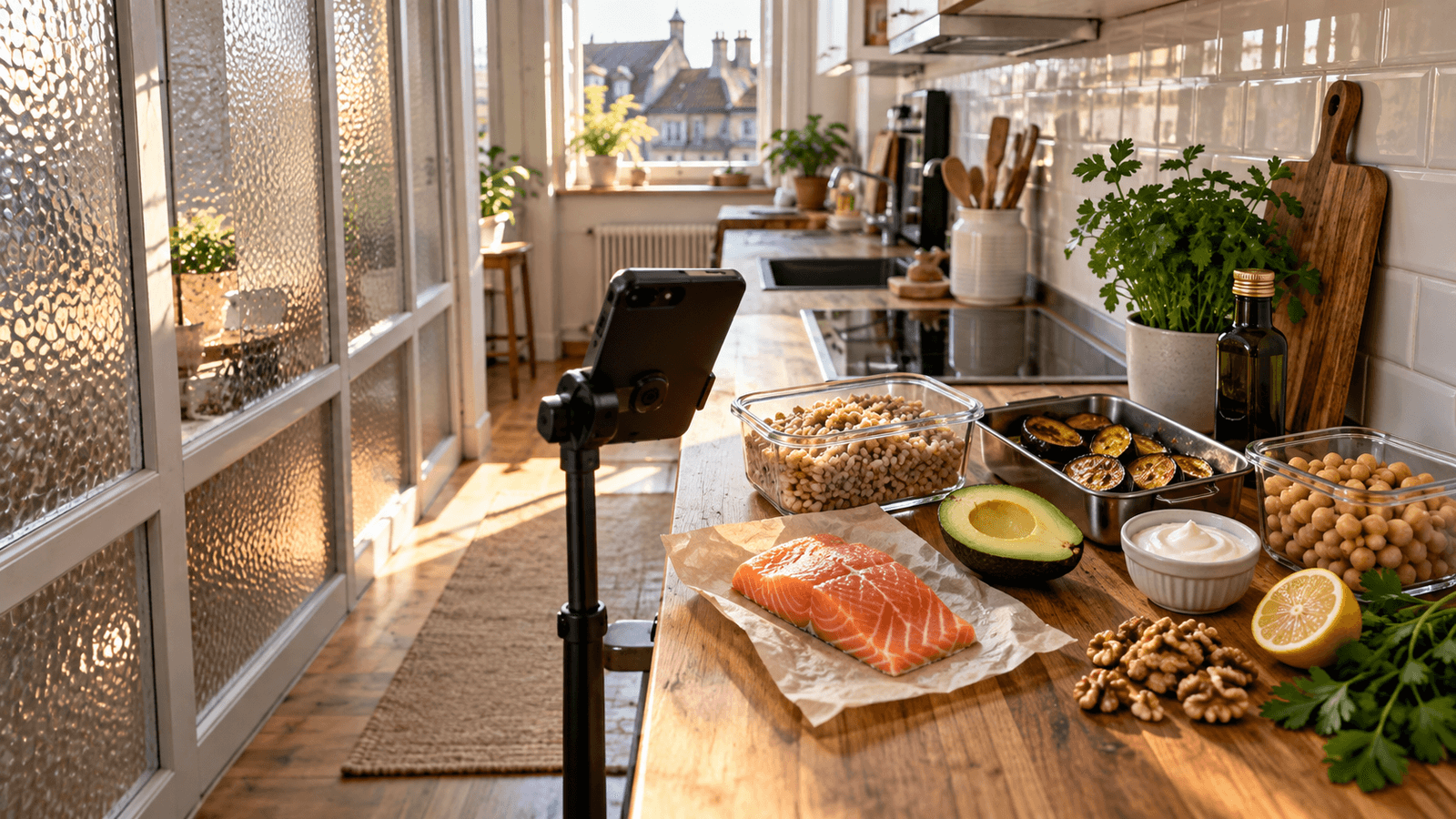
Taking a photo of a meal is much faster than manually searching for every ingredient.
That makes photo-based food tracking attractive for people who want to monitor calories and macronutrients without spending several minutes logging each meal.
But estimating protein, carbohydrates and fat from a photograph is more difficult than simply recognizing that a meal contains chicken, rice and vegetables.
AI has to answer several separate questions:
- What foods are visible?
- How much of each food is present?
- How was each ingredient prepared?
- Are there hidden ingredients?
- Which nutritional reference best matches the food?
The quality of a macro estimate depends on all of these steps.
Can AI estimate macros from a photo?
Yes, AI can generate an estimate of protein, carbohydrates and fat from a food image.
A typical system may:
- identify visible foods
- estimate portion sizes
- match the foods to nutrition data
- calculate estimated calories and macros
- combine the components into a meal total
This can make food logging much faster.
However, the result should generally be treated as an estimate rather than a direct measurement.
A photograph does not contain all of the information required to know the exact nutritional composition of a meal.
Food recognition is only the first step
Recognizing food is important, but it does not automatically produce an accurate macro estimate.
Imagine a photo containing:
- chicken
- rice
- vegetables
Even if all three foods are identified correctly, the system still needs to estimate:
- how much chicken is present
- how much rice is present
- whether the chicken contains skin
- how much cooking oil was used
- whether the rice was cooked with additional fat
- whether a sauce is present
- the composition of any mixed vegetables
Two visually similar meals can therefore have different macro values.
For more detail on recognition itself, see How Accurate Is Food Recognition From Photos?.
Portion size is a major challenge
Macronutrient calculations depend heavily on quantity.
If the food is correctly identified but the portion is overestimated, the calculated protein, carbohydrates, fat and calories may all be too high.
If the portion is underestimated, the opposite can happen.
A single image provides limited information about depth and volume.
This is especially difficult when:
- foods overlap
- part of the food is hidden
- the container size is unknown
- the camera angle distorts size
- there is no familiar reference object
- ingredients are mixed together
See Can AI Estimate Portion Size From a Photo? for a deeper explanation.
Protein can sometimes be easier to infer than hidden fat
Visible protein foods can provide useful clues.
Examples include:
- chicken breast
- fish
- eggs
- tofu
- yogurt
- beans
- lentils
If the food type and approximate amount are recognized reasonably well, AI may be able to produce a useful protein estimate.
But preparation still matters.
A piece of meat may contain different amounts of edible meat depending on:
- bone
- skin
- trimming
- cooking loss
Mixed dishes create additional uncertainty.
Carbohydrates depend strongly on portion size
Foods such as:
- rice
- pasta
- potatoes
- bread
- oats
- couscous
- fruit
can often be recognized visually.
The harder question is how much is present.
A small difference in the estimated amount of rice or pasta can meaningfully change the carbohydrate estimate.
This is one reason why a correct food label alone is not enough.
Quantity matters.
Fat is often the hardest macro to see
Dietary fat can be visually difficult to estimate because a large part of it may be hidden.
Examples include:
- cooking oil
- butter
- mayonnaise
- dressing
- cream
- cheese mixed into a dish
- nut butter
- sauces
- fat absorbed during cooking
A tablespoon of oil does not necessarily remain visually obvious once it is mixed into food.
Two dishes that look nearly identical can therefore contain different amounts of fat.
This hidden-fat problem can also affect calorie estimates because fat is energy-dense.
Mixed dishes are more difficult
A simple meal with clearly separated ingredients is usually easier to interpret than a mixed dish.
Examples of more challenging foods include:
- casseroles
- curries
- stews
- lasagna
- pasta with sauce
- mixed salads
- soups
- sandwiches
- burritos
- homemade baked dishes
The visible surface may reveal only part of the recipe.
AI may need to infer ingredients that cannot be directly seen.
The more inference required, the greater the uncertainty.
Restaurant meals create additional uncertainty
Restaurant food can be particularly difficult because you usually do not know:
- exact ingredient quantities
- amount of cooking oil
- sauce recipe
- added sugar
- butter
- cream
- portion weight
- preparation method
A photo can still provide a useful starting point, but the estimate should not be interpreted as laboratory-level nutrition information.
Homemade food can be easier when you know the recipe
If you prepared the meal yourself, you may have information the photograph cannot provide.
For example, you may know:
- which ingredients were used
- how much oil was added
- whether meat was weighed raw or cooked
- the amount of pasta or rice
- how many portions the recipe produced
Combining photo recognition with this information can improve the usefulness of the estimate.
Does the camera angle matter?
Yes.
A clear image makes recognition and portion estimation easier.
Useful photos generally have:
- good lighting
- most of the food visible
- limited obstruction
- a natural viewing angle
- sufficient image sharpness
Very steep angles can hide food depth.
Very low angles can hide ingredients behind one another.
There is no single perfect angle for every meal.
Does the container matter?
The size and shape of a plate, bowl or container can provide scale information.
If the system knows or can reasonably infer the container dimensions, portion estimation may become easier.
However, unfamiliar or unusually shaped containers can also introduce uncertainty.
The food itself should remain clearly visible.
Can AI distinguish raw and cooked foods?
Sometimes, but this can be important for nutrition calculations.
Cooking changes food weight because water may be lost or absorbed.
For example:
- meat often loses water during cooking
- rice absorbs water
- pasta absorbs water
- vegetables may lose water
Nutrition data must therefore be matched appropriately to the state of the food.
A raw weight and a cooked weight should not automatically be treated as equivalent.
Sauces and oils deserve extra attention
One of the easiest ways to improve a photo-based estimate is to review ingredients that may not be visually obvious.
Ask whether the meal contains:
- cooking oil
- dressing
- mayonnaise
- butter
- cream
- cheese
- sugary sauce
- nut or seed spread
If an important ingredient is missing from the estimate, adding it manually can improve the result.
What about packaged foods?
For packaged foods, a barcode or nutrition label may provide more reliable product-specific information than image recognition alone.
A photo can identify the type of food, but similar-looking products may have different nutrition values.
When product-specific information is available, it can be useful to combine it with the estimated portion.
How to improve an AI macro estimate
Photo-based tracking works best when the user can review the result.
A practical workflow is:
- take a clear photo
- check the recognized foods
- correct any wrong food
- review the estimated portions
- add hidden ingredients
- confirm the preparation method when relevant
- save the meal
This keeps the speed advantage of photo logging while allowing obvious errors to be corrected.
When should you correct the estimate?
Consider reviewing the result more carefully when:
- the wrong food was identified
- the estimated portion looks unrealistic
- a major ingredient is missing
- the dish contains substantial oil or sauce
- the food is homemade and you know the recipe
- the food is packaged and nutrition information is available
- the meal contains bones or inedible parts
- raw and cooked states may have been confused
You do not necessarily need to adjust every small difference.
The appropriate level of precision depends on why you are tracking.
How precise does macro tracking need to be?
Not everyone needs the same level of precision.
Someone using food tracking to understand general eating patterns may be comfortable with approximate values.
Someone following a structured nutrition plan may want to review more of the estimate.
Even manual food logging contains uncertainty.
Common sources include:
- inaccurate portion estimates
- database differences
- recipe variation
- cooking changes
- forgotten ingredients
- restaurant preparation
Photo tracking does not eliminate uncertainty; it changes where the uncertainty occurs.
AI estimates vs manually entering every ingredient
Manual logging can provide more control when:
- exact ingredients are known
- foods have been weighed
- a recipe is available
- product nutrition information is known
But manual entry takes more time.
Photo tracking can reduce friction by generating a starting estimate automatically.
A useful system does not have to choose between the two approaches.
It can allow AI to create the first estimate and let the user correct important details.
What AI should not pretend to know
A responsible food-tracking system should avoid presenting uncertain estimates as exact measurements.
From a single photo, AI may not know:
- exact food weight
- exact amount of oil
- exact recipe
- exact restaurant preparation
- exact brand
- ingredients hidden inside the food
Showing an estimate as though it were perfectly measured can create false precision.
Can photo tracking still be useful?
Yes.
The value of photo tracking is not that every macro number becomes exact.
Its value is that logging can become much faster.
Reducing the effort required to record meals may make tracking more practical for everyday use.
The user can then spend attention on the details that actually matter.
How Mealisa approaches photo-based macro tracking
Mealisa is designed around a photo-first workflow.
A food photo can be used to create an initial estimate of:
- foods
- portions
- calories
- protein
- carbohydrates
- fat
The estimate can then be reviewed and corrected when necessary.
Other information can also help, such as:
- product data
- nutrition labels
- recipes
- previous meals
- user corrections
The goal is not to claim that a camera can directly measure macronutrients.
The goal is to reduce manual work while keeping the result editable.
A practical example
Imagine a photo showing:
- grilled chicken
- cooked rice
- vegetables
- sauce
AI may correctly identify all four components.
The largest remaining uncertainties may be:
- chicken weight
- rice amount
- amount of cooking oil
- sauce quantity and composition
If you know that the meal contains significantly more or less rice than estimated, correcting that amount may improve the carbohydrate estimate.
If the chicken portion is wrong, adjusting it may improve the protein estimate.
If oil or sauce is missing, adding it may improve the fat and calorie estimate.
This is more useful than assuming the original photo estimate must be either completely right or completely wrong.
Common mistakes when using an AI macro tracker
Treating every number as exact
The result is an estimate based on incomplete visual information.
Ignoring hidden ingredients
Oil, sauces and dressings can matter even when they are difficult to see.
Correcting the food but not the portion
Correct recognition does not guarantee correct quantity.
Using a poor photo
Dark, blurry or heavily obstructed images make interpretation more difficult.
Expecting identical results from every angle
Different views reveal different information about the same meal.
Over-correcting insignificant differences
Tracking should remain practical.
Not every minor discrepancy needs manual adjustment.
Frequently asked questions
Can AI calculate protein from a photo?
AI can estimate protein by identifying protein-containing foods and estimating their quantities. The result is still an estimate because exact weight and preparation details may be unknown.
Can AI calculate carbs from a food photo?
It can estimate carbohydrates from recognized foods and estimated portions. Portion uncertainty can significantly affect the result for foods such as rice, pasta and potatoes.
Can AI estimate fat from a photo?
Yes, but fat can be especially difficult because oils, butter, sauces and other fat sources may be partly or completely hidden.
Can AI calculate macros accurately from one photo?
A single image can support a useful estimate, but it cannot reveal every ingredient, exact weight or preparation detail.
Is photo macro tracking better than manual logging?
They have different strengths. Photo tracking is faster, while manual logging can provide more control when exact ingredients and quantities are known.
Should I weigh food as well?
You do not have to weigh every food. If you want greater precision for a particular ingredient, a known weight can improve the estimate.
What should I check after taking the photo?
Review the recognized foods, portions, hidden ingredients and preparation details that could meaningfully affect the result.
Can Mealisa correct an AI estimate?
The useful workflow is to generate an initial estimate and allow important foods, portions or ingredients to be corrected rather than treating the first result as final.
The bottom line
AI can estimate protein, carbohydrates and fat from a food photo by combining food recognition, portion estimation and nutrition data.
The result can be useful, but it is not a direct measurement.
Accuracy depends on:
- correct food recognition
- reasonable portion estimates
- visible and hidden ingredients
- preparation method
- appropriate nutrition data
Photo-based macro tracking works best as a fast starting point that remains editable.
That approach can preserve the convenience of taking a photo while giving you control over the details that matter.
This article provides general educational nutrition information and is not individualized medical or dietary advice.