
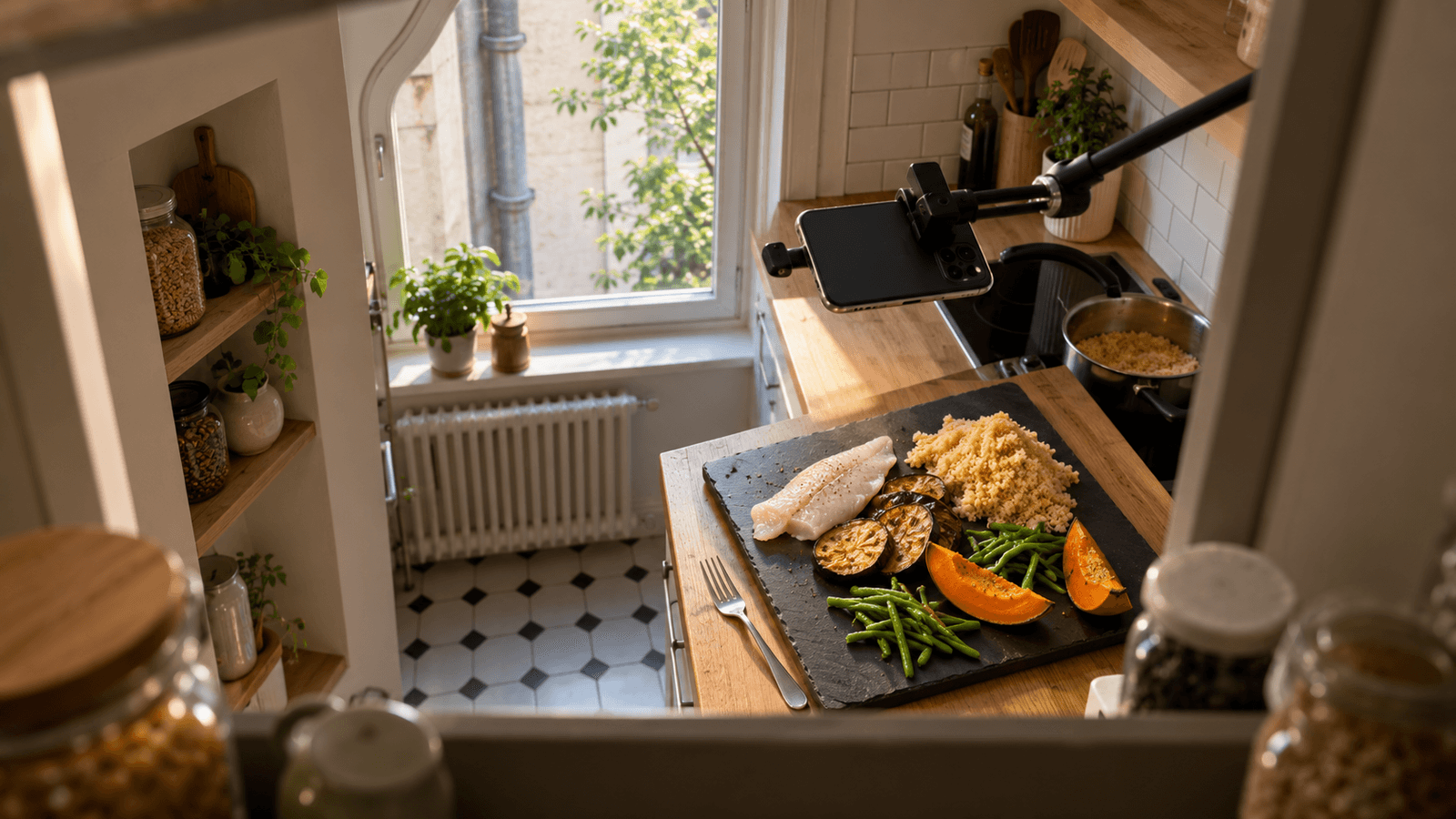
A food photo can contain a surprising amount of information.
An AI system may be able to recognize that a meal contains rice, chicken, vegetables and sauce. But identifying the foods is only part of the problem.
To estimate calories or macronutrients, the system also needs an idea of how much food is actually present.
That makes portion size estimation one of the most important — and difficult — parts of photo-based food tracking.
Can AI estimate portion size from a photo?
Yes, AI can estimate portion size from a food photo, but the result should generally be treated as an estimate rather than an exact measurement.
A photo can provide visual clues about:
- the visible area of the food
- its shape
- its apparent thickness
- the size of nearby objects
- the dimensions of a plate, bowl or container
- perspective
- how different foods overlap
- the type of food being recognized
An AI system can combine these clues with information about typical food density, serving sizes and food geometry to estimate an approximate amount.
The difficulty is that a normal photograph is a two-dimensional image of a three-dimensional meal.
Some information is inevitably missing.
Why portion size matters
Recognizing the correct food is not enough for useful nutrition estimation.
For example, correctly identifying cooked rice does not tell you whether the image contains:
- 80 grams
- 150 grams
- 250 grams
- or considerably more
The nutritional difference can be substantial.
The same applies to pasta, meat, cheese, sauces, nuts, oils and many other foods.
Portion estimation therefore connects food recognition with calorie and macro estimation.
Food recognition and portion estimation are different tasks
These two steps are easy to confuse.
Food recognition asks:
“What food is this?”
Portion estimation asks:
“How much of this food is present?”
An AI system may be confident that it sees pasta while being less certain about the amount.
Or it may estimate the approximate volume correctly while misidentifying an ingredient.
Understanding this distinction is important when evaluating photo-based nutrition tools.
For more on recognition itself, see How Accurate Is Food Recognition From Photos?.
Why a single photo is difficult
A single image does not directly reveal real-world dimensions.
Imagine photographing a bowl of rice.
The rice may appear large because:
- the camera is close
- the bowl is small
- a wide-angle lens exaggerates perspective
Or it may appear small because:
- the camera is farther away
- the bowl is large
- the photograph was taken from a different angle
The AI needs contextual information to separate apparent size from actual size.
Depth is partly hidden
Food has height and depth that may not be visible in a photograph.
A mound of mashed potatoes may look similar from above whether it is relatively flat or piled high.
A thick piece of meat and a thin piece can occupy a similar visible area.
A deep bowl may hide much of its contents.
This is one reason volume estimation from one photograph is inherently uncertain.
Overlapping foods create another problem
Real meals are rarely arranged as isolated objects.
Sauce may cover part of the meat.
Vegetables may sit on top of rice.
Cheese may hide part of a dish.
Ingredients in a stew may be almost completely mixed.
The AI may need to infer portions of food that are only partly visible.
The more hidden the food is, the less visual evidence is available.
Containers can help provide scale
A familiar object can provide useful size context.
Examples include:
- a standard plate
- a fork
- a spoon
- a food container
- a cup
- a can or bottle with known dimensions
If the system understands the approximate dimensions of an object in the scene, it has a reference for estimating the size of the food.
However, not every plate, bowl or utensil has the same dimensions.
A reference object improves context but does not automatically make the estimate exact.
Camera angle matters
Very low camera angles can hide the surface area of food.
Perfectly overhead photographs can make height difficult to judge.
For many meals, a moderate angle provides useful information about both surface area and thickness.
The best angle depends on the food.
A sandwich may be easier to judge from the side.
A mixed bowl may benefit from a higher angle.
There is no single perfect camera angle for every meal.
Distance matters too
If the camera is extremely close, perspective distortion can make foreground items appear disproportionately large.
If the camera is too far away, small ingredients may lose useful visual detail.
A clear photograph taken from a reasonable distance generally gives the system more usable information.
Lighting can affect the estimate indirectly
Poor lighting does not change the actual portion, but it can make boundaries harder to detect.
Deep shadows may hide where one food ends and another begins.
Strong glare can remove surface detail.
Very warm or colored lighting may also make recognition more difficult.
Soft, reasonably even light usually makes the visible structure of the meal clearer.
Mixed dishes are harder
Some foods have clear physical boundaries.
For example:
- a banana
- a slice of bread
- an egg
- a piece of chicken
Mixed dishes can be more difficult.
Examples include:
- casseroles
- curries
- soups
- stews
- pasta with sauce
- mixed rice dishes
The visible volume may be estimated reasonably while the internal ingredient proportions remain uncertain.
A bowl of curry does not visually reveal exactly how much oil, coconut milk or meat was used.
Hidden ingredients cannot be measured visually
Some of the largest nutrition errors may come from ingredients that are barely visible.
Examples include:
- cooking oil
- butter
- mayonnaise
- dressing
- sugar
- cream
- cheese inside a dish
- sauces mixed into food
A photograph may help estimate the visible portion, but it cannot reliably reconstruct every hidden ingredient.
This is an important limitation of photo-based calorie tracking.
Food density matters
Equal volumes of different foods can have very different weights.
A cup of leafy vegetables does not weigh the same as a cup of cooked rice.
A visually similar amount of nuts can contain much more energy than the same visible volume of many vegetables.
An AI system therefore needs more than geometric volume.
It also needs a reasonable estimate of what the food is and how its volume relates to weight.
Can AI estimate grams from a photo?
It can estimate grams in some situations, but those numbers should not be confused with scale measurements.
The system may estimate volume first and then convert that volume into approximate weight using expected food density.
The result can be useful for reducing manual entry.
It is still an inference.
If exact weight is important, a kitchen scale provides information that a photograph alone does not.
Does a second photo help?
Potentially, yes.
A second angle can reveal information hidden in the first image.
For example, one image may show surface area while another reveals thickness.
Multiple views can provide more three-dimensional context.
Whether a specific app uses multiple images in this way depends on how its system is designed.
What kinds of foods are easier to estimate?
Foods with clear boundaries and recognizable shapes can provide stronger visual cues.
Examples may include:
- whole fruit
- slices of bread
- individual pieces of meat or fish
- eggs
- packaged single portions when size is known
- clearly separated foods
This does not mean estimates will always be correct.
It simply means more visual evidence may be available.
What foods are harder to estimate?
Common difficult cases include:
- oils
- sauces
- spreads
- nut butters
- mixed dishes
- soups
- foods hidden underneath other foods
- irregular piles
- foods inside deep opaque containers
- meals where the camera provides no useful size reference
The challenge is not necessarily recognizing the food.
It is determining how much is actually there.
How to take a better photo for portion estimation
A few practical habits can provide more useful visual information.
1. Keep the full meal visible
Avoid cutting off part of the food at the edge of the image.
2. Use a reasonable camera distance
Do not place the camera extremely close to the food.
3. Avoid extreme angles
Choose an angle that shows both the footprint and some depth of the food when possible.
4. Use clear lighting
Avoid deep shadows and strong glare.
5. Avoid unnecessary obstruction
If a napkin, utensil or another object hides a large part of the meal, move it when practical.
6. Keep useful scale context
A familiar plate, bowl, utensil or container may provide useful information about dimensions.
7. Photograph before eating
Estimating the original portion is easier when the meal is intact.
Should you include the plate in the photo?
Usually, some surrounding context is useful.
A tightly cropped image showing only food removes information about scale.
Including the plate, bowl or container can help the system understand the scene.
However, the container itself should not be assumed to have a universal standard size.
What if the AI gets the portion wrong?
Correction is useful when the estimate is obviously inconsistent with what you ate.
For example, you may know that:
- you used an entire 200 g package
- you ate half of a known container
- the portion was one standard packaged serving
- you weighed the ingredient while cooking
- the estimated amount is visibly implausible
In these situations, known information should generally take priority over a visual guess.
You do not need perfect precision for every meal
The appropriate level of precision depends on your goal.
Someone casually trying to understand eating patterns may not need gram-level accuracy.
Someone using nutrition tracking for a more specific purpose may want to correct uncertain portions more often.
The useful question is not whether every estimate is perfect.
It is whether the information is sufficiently useful for the decision you are trying to make.
Portion estimation and calorie estimation
Calories depend on both food identity and quantity.
A simplified process might look like:
food photo → food recognition → portion estimate → nutrition estimate.
An error at either of the first two stages can affect the final result.
Correct food + wrong portion = inaccurate calorie estimate.
Wrong food + plausible portion = inaccurate calorie estimate.
That is why a calorie number generated from an image should not be interpreted as a direct measurement.
Portion estimation and macro tracking
Protein, carbohydrate and fat estimates also depend on quantity.
If the system correctly recognizes chicken but substantially overestimates the portion, the estimated protein will also be too high.
The same applies to rice and carbohydrates or cheese and fat.
Portion estimation therefore matters beyond calories.
What about barcode scanning?
Barcode scanning solves a different problem.
A barcode can identify a packaged product and connect it to stored nutrition information.
It does not necessarily tell the app how much of the package you consumed.
You may still need a serving amount, fraction of the package or another quantity estimate.
Photo analysis and barcode scanning can therefore complement each other rather than replace each other.
How Mealisa approaches photo-based food tracking
Mealisa is designed to reduce the amount of manual input required when logging food.
A food photo can provide a starting estimate of what is present and how much may have been eaten.
The useful workflow is not to pretend that a photograph is a laboratory measurement.
Instead:
- capture the meal;
- let AI produce a practical starting estimate;
- review the result;
- correct obvious food or portion errors when useful;
- continue tracking without manually entering every ingredient.
This keeps the speed advantage of photo-based tracking while allowing the user to correct uncertainty.
When should you correct a portion estimate?
Consider correcting it when:
- the estimated portion is clearly too large or too small
- you know the actual package weight
- you weighed the food
- a large amount of food is hidden
- the dish contains substantial invisible oil or sauce
- the container makes depth difficult to judge
- the estimate would materially affect the information you care about
Small differences may not always justify extra effort.
What AI cannot know from the image alone
A photo alone may not reveal:
- exact ingredient weights
- how much oil was used during cooking
- ingredients hidden inside a mixed dish
- whether all food shown was actually eaten
- the exact recipe
- the precise dimensions of an unfamiliar container
- how much food is hidden underneath another ingredient
Additional context can improve the estimate, but visual analysis has limits.
Is AI portion estimation useful if it is not exact?
It can be.
Manual food logging creates its own problems.
People may forget ingredients, choose the wrong database entry, estimate portions manually or stop tracking because entry takes too long.
Photo-based estimation can trade some measurement precision for speed and convenience.
Whether that trade-off is worthwhile depends on the user's goal.
A practical accuracy hierarchy
When available, stronger quantity information can replace weaker estimates.
For example:
- known measured weight
- known package quantity
- reliable recipe quantity
- visually estimated portion
This does not mean every meal needs to be weighed.
It simply means known information is useful when you already have it.
Frequently asked questions
Can AI tell how many grams of food are in a photo?
AI can estimate weight from visual information, but a single photograph does not directly measure grams. The result should generally be treated as an estimate.
Can a photo accurately measure calories?
A photo can support calorie estimation by helping identify foods and estimate portions. It does not directly measure the calories in a meal.
Is an overhead photo best?
Not always. Overhead images show surface area well but may hide food height. A moderate angle can sometimes provide more three-dimensional information.
Does including a fork help?
A familiar object may provide scale context, but utensils vary in size. It is a useful clue rather than a perfect measuring reference.
Are mixed dishes harder to estimate?
Often, yes. Ingredients can overlap, and hidden oil, sauces or internal ingredient ratios may not be visible.
Should I weigh my food instead?
If exact weight is important, a scale provides stronger quantity information. For everyday convenience, photo-based estimation may reduce manual effort.
Can AI estimate portions without a reference object?
It can still make an estimate using learned visual context, food type, containers and perspective, but uncertainty may be higher when real-world scale is unclear.
Why did two photos of the same meal produce different estimates?
Changes in camera distance, angle, perspective, visibility and lighting can alter the visual evidence available to the system.
The bottom line
AI can estimate portion size from a food photo, but the result is an inference rather than a direct measurement.
Clear food boundaries, useful size context, reasonable camera angles and good visibility can help.
Deep containers, overlapping foods, hidden ingredients, sauces and mixed dishes make the task harder.
For everyday food tracking, the most useful workflow is often to let AI create a fast starting estimate and correct the portion when you have better information or the result is clearly wrong.
That keeps photo tracking convenient without treating visual estimates as exact measurements.
This article provides general educational nutrition information and is not a substitute for individualized medical or dietetic advice.