
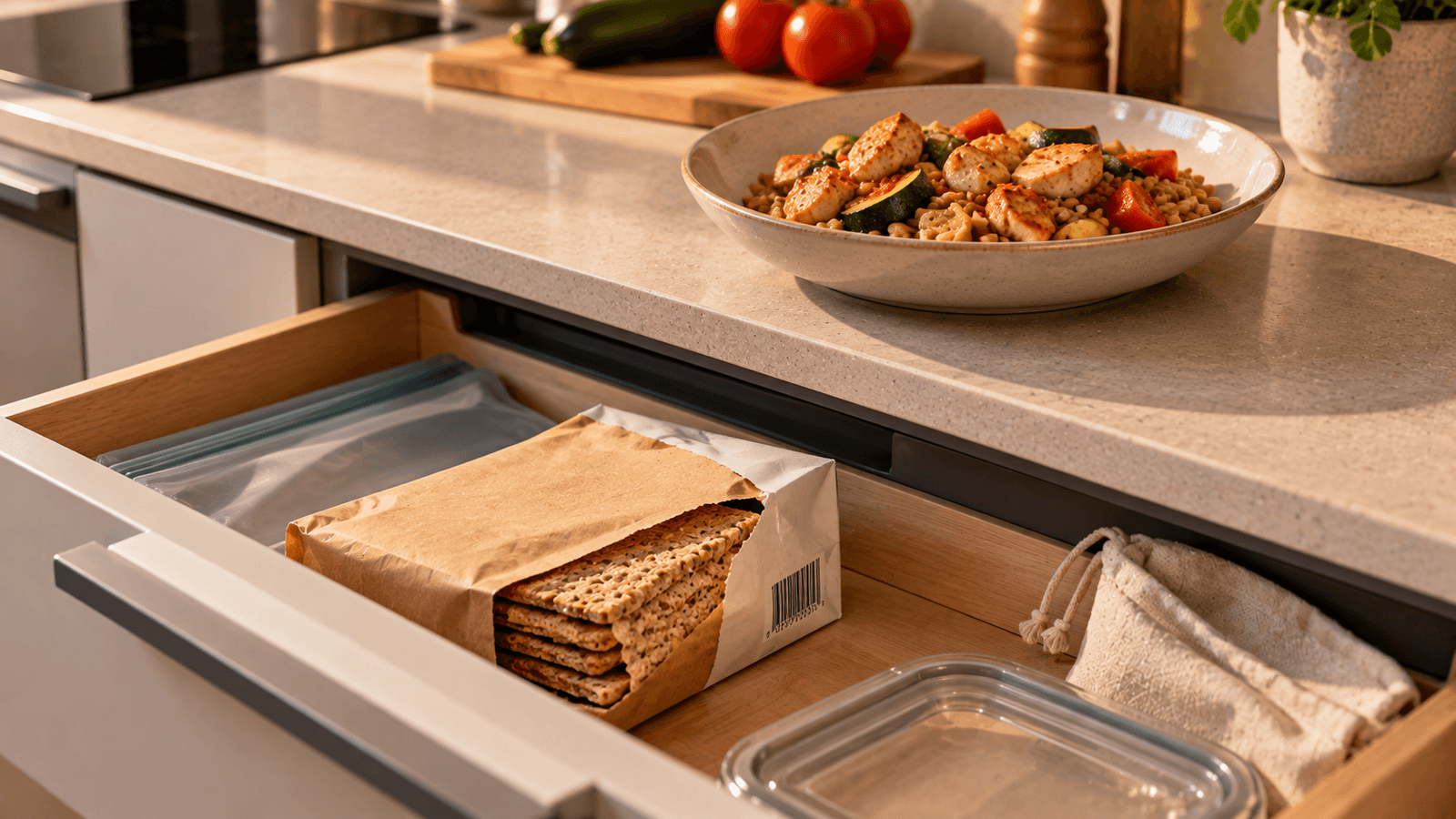
Barcode scanning and photo food tracking can both make food logging faster, but they solve different problems.
A barcode is useful when a food comes in identifiable packaging and the corresponding product data is available.
A photo is useful when the food in front of you is the information source: a cooked meal, a restaurant dish, a plate assembled from several foods or something without a usable barcode.
Neither method is automatically better for every meal.
The practical question is: which input method matches the food you are trying to log?
The core difference
Barcode tracking starts with a product identifier.
Photo tracking starts with what is visually present.
That difference affects nearly every part of the workflow.
| Situation | Barcode scanning | Photo tracking |
|---|---|---|
| Packaged yogurt | Usually a strong fit | Possible, but often unnecessary |
| Box of cereal | Usually a strong fit | Can identify the food, but packaging data may be more useful |
| Homemade pasta | Barcode alone is insufficient | Useful for recognizing the meal |
| Restaurant plate | Usually unavailable | Often the more practical starting point |
| Apple or banana | Usually no useful barcode | Natural fit |
| Mixed salad | Individual ingredient barcodes do not describe the finished plate | Photo can provide a starting estimate |
| Packaged ready meal | Strong when database entry matches | Useful as a fallback or visual check |
| Unknown food on a plate | Little value | Often useful |
The two methods are therefore complementary rather than interchangeable.
What happens when you scan a barcode?
A barcode does not normally contain the complete nutrition profile of a food.
It identifies a product.
The tracking app then needs to match that identifier to a product record containing information such as:
- product name
- serving size
- calories
- protein
- carbohydrate
- fat
- other nutrition data
This distinction matters.
Scanning a barcode successfully does not guarantee that the associated database record is complete, current or correct.
The barcode solves product identification.
The database provides nutrition information.
Where barcode scanning works particularly well
Barcode scanning is convenient when you regularly eat packaged products.
Examples include:
- yogurt
- skyr
- milk
- cereal
- bread
- protein products
- canned foods
- frozen foods
- packaged snacks
- ready meals
Instead of searching manually for the exact product, you scan it and retrieve the corresponding record when available.
This can remove several steps from logging.
The main strength of barcode tracking: product specificity
Suppose you have two yogurts from different manufacturers.
They may look almost identical in a photograph while containing different amounts of:
- calories
- protein
- sugar
- fat
A barcode can distinguish the exact packaged products when both records exist in the database.
A food photo may recognize both simply as yogurt.
For packaged foods, exact product identification can therefore be more useful than visual recognition.
But the barcode does not know how much you ate
This is one of the most important limitations.
Imagine a package contains 500 g of yogurt.
The barcode can identify the yogurt.
It does not automatically tell the app whether you ate:
- 100 g
- 180 g
- 250 g
- the entire package
You still need a portion amount or another way to estimate consumption.
Product identification and portion estimation are separate tasks.
Database quality matters
A successful scan is only as useful as the product record behind it.
Possible problems include:
- missing products
- outdated nutrition information
- incorrect serving sizes
- duplicate entries
- incomplete macro data
- a reformulated product still linked to older values
When something looks implausible, compare the database entry with the nutrition label on the package.
The printed label is particularly useful for verifying the exact product you are holding.
What happens with photo food tracking?
Photo tracking begins with an image rather than a product identifier.
Depending on the system, image analysis may attempt to infer:
- which foods are visible
- whether the image contains one food or several
- approximate portions
- likely ingredients or meal type
Nutrition values then have to be connected to those recognized foods and estimated quantities.
This means photo tracking has a different uncertainty chain from barcode tracking.
Where photo tracking is particularly useful
Photos become valuable when barcode scanning has little or no role.
Examples:
- homemade breakfast
- plate of chicken, rice and vegetables
- bowl of soup
- restaurant meal
- bakery item
- fruit
- salad
- buffet plate
- leftovers
- meal prepared by someone else
You can capture the food that actually exists in front of you instead of searching for every component before logging anything.
The main strength of photo tracking: low-friction input
Consider a plate containing:
- chicken
- rice
- broccoli
- sauce
Logging everything manually might require four or more searches plus portion entry.
A photo can potentially identify several visible components at once.
That can make it a faster starting point.
But faster input does not mean the result should be treated as perfectly measured.
The main challenge with photos: portion size
A two-dimensional image does not automatically reveal exact food mass.
The same apparent plate can be difficult to interpret because of:
- camera angle
- distance
- plate size
- food depth
- overlapping ingredients
- hidden ingredients
- sauces underneath other foods
A photo may correctly recognize rice while still estimating the amount imperfectly.
Recognition accuracy and portion accuracy are separate questions.
Hidden ingredients are another problem
Some calories are difficult or impossible to infer visually.
Examples include:
- oil used during cooking
- butter absorbed into food
- sugar in a sauce
- mayonnaise inside a sandwich
- dressing mixed into a salad
- cheese under other ingredients
The camera sees the finished appearance, not the complete recipe history.
That is why photo tracking often benefits from user correction.
Packaged food: barcode usually has the advantage
Imagine you are logging a 150 g container of skyr.
With a barcode workflow:
- scan the package
- retrieve the exact product
- confirm the amount eaten
With a photo workflow:
- recognize that the food is probably skyr or yogurt
- infer or select a generic food
- estimate the amount
- potentially miss product-specific nutrition differences
When packaging is available and the database entry is correct, the barcode workflow is generally more direct.
Homemade food: photo usually has the advantage as a starting point
Now imagine a homemade bowl containing rice, chicken, vegetables and sauce.
There is no single barcode representing the meal.
You could scan packages for the rice, chicken sauce and other ingredients, but that does not automatically describe:
- how much of each ingredient entered the recipe
- total cooked yield
- how much of the finished dish is on your plate
A photo can instead begin with the finished meal.
For precise homemade recipe tracking, however, ingredient quantities and recipe yield can still provide better information than appearance alone.
Restaurant food: photo has a clearer role
Restaurant meals usually do not provide scannable retail packaging.
A photo can record:
- the visible components
- approximate relative portions
- sides
- sauces that can be seen
- what was actually served
The remaining uncertainty includes recipe composition, cooking fat and hidden ingredients.
That makes a photo useful without making it exact.
For a dedicated restaurant workflow, see How to Track Restaurant Meals With Less Manual Entry.
Which method is faster?
It depends on the food.
Packaged food already in the database
Barcode scanning may take only a few actions.
Mixed homemade meal
A photo may be faster than searching for every visible component.
Product missing from the barcode database
The barcode advantage disappears because you still need another input method.
Repeated meal
Neither may be fastest.
If you already logged the same meal accurately, reusing the previous entry can be quicker than scanning or photographing it again.
See How to Track Repeat Meals Faster.
Which method is more accurate?
There is no useful universal answer.
Accuracy depends on what information is available.
For a packaged food with a correct database record and known portion, barcode tracking can provide highly specific product data.
For a restaurant meal with no product packaging, a barcode offers almost no useful information, while a photo can provide a practical estimate.
For a homemade recipe where every ingredient has been weighed, recipe-based calculation may outperform both.
The strongest method changes with the situation.
Where errors come from
Barcode and photo workflows fail in different ways.
Barcode errors
Common sources include:
- wrong database record
- outdated product information
- incorrect serving size
- user enters the wrong amount eaten
Photo errors
Common sources include:
- wrong food recognition
- incorrect portion estimate
- hidden ingredients
- visually similar foods
- unclear image
- mixed dishes where ingredients cannot be separated
Understanding the error source makes correction easier.
A simple comparison
| Question | Barcode | Photo |
|---|---|---|
| Identifies exact packaged product | Strong | Limited |
| Works without packaging | Weak | Strong |
| Handles mixed plates | Weak | Stronger starting point |
| Knows exact portion automatically | No | Usually no |
| Sees hidden cooking oil | No | No |
| Depends on product database | Yes | Less directly |
| Depends on image quality | No | Yes |
| Useful in restaurants | Rarely | Yes |
| Useful for packaged foods | Yes | Sometimes |
| May need user correction | Yes | Yes |
The key point is that neither method removes the need for judgment.
The best workflow is often hybrid
You do not have to choose one method for every food.
A practical day might look like this:
Breakfast: scan packaged skyr, add banana by photo or search
Lunch: photograph a homemade mixed meal
Snack: scan a packaged snack
Dinner: photograph a restaurant plate
Repeated food: reuse an existing saved entry
Each input method is used where it has the clearest advantage.
Example: breakfast
Suppose breakfast contains:
- packaged skyr
- banana
- oats from a package
- berries
Possible workflow:
Skyr: barcode
Banana: photo or food search
Oats: barcode if exact product information matters, otherwise saved food
Berries: photo, search or saved portion
Trying to force every ingredient through the same input method adds unnecessary work.
Example: homemade dinner
Dinner contains chicken, potatoes, vegetables and olive oil.
A photo can identify the visible meal.
But if you want to improve the estimate, you may need to correct:
- chicken portion
- potato amount
- oil used
- any sauce
The image provides the starting point; your knowledge of preparation supplies information the camera cannot see.
Example: packaged ready meal
A packaged ready meal is a good example of why barcode and photo tracking are not competitors.
The barcode can identify:
- exact product
- nutrition per 100 g
- serving information
A photo can help record:
- how much appears to have been served
- additional side foods
- toppings or extras added after opening
Both inputs can describe different parts of the same eating event.
When a nutrition-label photo is useful
Sometimes a barcode is recognized but the product record is unavailable or questionable.
In that case, the nutrition label on the package can provide the missing information.
A robust workflow can therefore be:
- scan barcode
- use existing product data if reliable
- if unavailable, capture the nutrition label
- verify or enter the relevant values
- save the product for easier future use
This is more useful than repeatedly searching for a product that is not in the database.
What about foods without barcodes?
Many everyday foods do not have a useful consumer barcode:
- loose fruit
- vegetables
- bakery products
- restaurant food
- homemade meals
- food served by another person
Photo tracking is naturally better suited to these situations.
You may still need to adjust the identified food or portion afterward.
What if the photo identifies the wrong food?
Correct the result instead of treating the first prediction as final.
For example, a system might confuse:
- yogurt and skyr
- chicken and turkey
- rice and another grain
- similar sauces
- visually similar baked foods
A useful photo tracker should make correction easier than entering the meal from scratch.
The purpose of AI input is to reduce work, not to prevent the user from editing the estimate.
See How to Correct an AI Food Estimate.
What if the barcode entry looks wrong?
Check the package.
Compare:
- calories per 100 g or 100 ml
- protein
- carbohydrate
- fat
- serving size
If the database record does not match the current label, use the package information rather than assuming the scan result must be correct.
A barcode identifies the product code; it does not independently verify the nutritional values stored in a third-party database.
Do you still need a food scale?
Neither method makes a scale universally necessary.
But if precise portion measurement matters, weighing can reduce uncertainty for foods that are difficult to estimate visually.
For example, a photo might recognize a bowl of pasta but not know whether it contains 180 g or 280 g.
Likewise, a barcode can identify the pasta package but cannot know how much ended up on your plate.
The scale solves a different problem: quantity measurement.
Which method is better for calorie tracking?
Choose based on the food rather than the technology.
Use a barcode when:
- the food is packaged
- the exact product matters
- the database entry is available
- you can confirm the portion
Use a photo when:
- the food is unpackaged
- several foods are on one plate
- you are eating at a restaurant
- manual search would be slow
- you need a fast first estimate
Use manual correction, weighing or recipe calculation when the missing information matters enough to justify the extra effort.
Which method is better for macro tracking?
The same logic applies.
If a packaged product has reliable nutrition data, its barcode record can provide product-specific protein, carbohydrate and fat values.
For a mixed plate, a photo can estimate the visible foods, but macro accuracy depends on recognizing the foods and estimating their quantities correctly.
Hidden ingredients can also affect macros, especially added fats.
So macro tracking does not make one input method universally superior.
Do not confuse convenience with certainty
Both technologies can make logging easier.
Neither turns unknown information into measured information.
A barcode cannot know the amount eaten.
A photo cannot see every ingredient or determine exact weight from appearance alone.
The strongest tracking workflow keeps that distinction clear.
A practical decision rule
When you are about to log food, ask:
1. Is there useful packaging?
If yes, scan the barcode.
2. Is it an unpackaged or mixed meal?
If yes, start with a photo.
3. Is the result already saved from a previous meal?
Reuse it.
4. Does the estimate look wrong?
Correct it.
5. Does precision matter enough to spend more time?
If yes, weigh, check the label or calculate the recipe.
This keeps food logging fast without pretending every input is equally reliable.
Why combining methods matters
Food tracking happens in different environments.
At home, you may have packaging and a kitchen scale.
At work, you may only have the meal in front of you.
At a restaurant, you may have no recipe information at all.
A flexible system should adapt to those situations.
The useful question is not whether barcode scanning or photo tracking wins.
It is whether the tracker can use the best available information with the least unnecessary manual entry.