
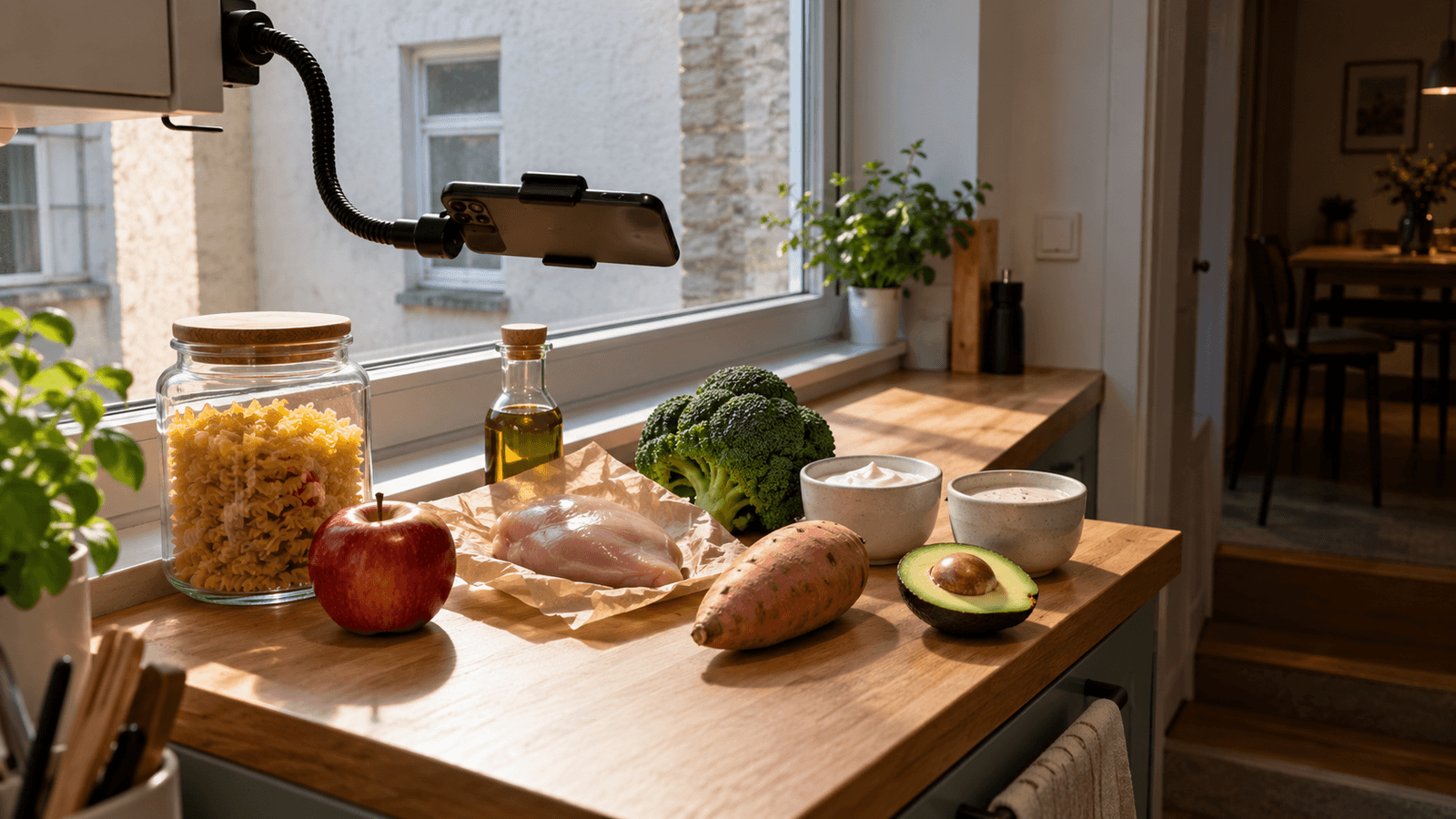
Taking a photo of food can be much faster than searching a database and entering every ingredient manually.
Modern AI systems can often recognize common foods from images, but recognizing a food is not the same as knowing its exact ingredients, weight or nutritional value.
That distinction is important.
A photo may provide useful information about what is visible, while some of the information required for accurate nutrition tracking may not be visible at all.
This guide explains where photo-based food recognition works well, where uncertainty appears and how you can take better photos for more useful estimates.
What is food recognition from photos?
Food recognition uses computer vision and AI to analyze an image and identify foods that may be present.
Depending on the system, a photo may be used to estimate:
- the type of food
- individual visible ingredients
- whether several foods are present
- approximate portion size
- possible preparation method
- estimated calories
- estimated protein, carbohydrates and fat
These are separate tasks.
A system might correctly recognize pasta while still being uncertain about:
- how much pasta is present
- whether oil was added
- how much cheese is mixed into the dish
- whether the sauce contains cream
- the exact recipe
So a correct food label does not automatically mean a precise calorie estimate.
Recognition and nutrition estimation are different problems
Consider a simple apple.
If the image clearly shows an apple, identifying the food may be relatively straightforward.
But calculating calories still requires an estimate of how much edible apple is present.
Now consider lasagna.
The image may clearly show lasagna, but the nutritional value depends on factors such as:
- portion weight
- meat quantity
- cheese quantity
- sauce composition
- pasta quantity
- added oil
- recipe differences
The visual category can be correct while the nutritional estimate remains uncertain.
Which foods are easier to recognize?
Food recognition generally has more useful visual information when foods are:
- clearly visible
- visually distinctive
- separated from other foods
- photographed in good light
- not heavily covered by sauce
- shown at a useful angle
- not hidden inside packaging
Examples may include:
- whole fruit
- eggs
- bread
- rice
- potatoes
- broccoli
- recognizable pasta
- simple pieces of meat or fish
- clearly visible vegetables
Even then, portion size can remain uncertain.
Which foods are harder to recognize?
Recognition becomes more difficult when different foods look similar or ingredients are visually mixed.
Examples include:
- soups
- stews
- curries
- casseroles
- smoothies
- sauces
- mixed bowls
- sandwiches with hidden fillings
- wraps
- baked dishes
- restaurant meals with complex preparation
A photograph can show the surface of a dish but not necessarily everything inside it.
Hidden ingredients are a major limitation
Some ingredients contribute substantial calories while being difficult or impossible to see.
Examples include:
- cooking oil
- butter
- cream
- mayonnaise
- sugar
- cheese mixed into a dish
- dressings
- sauces
- nut butters
- flour used in preparation
A photograph may not reveal whether vegetables were cooked with a teaspoon of oil or several tablespoons.
The visual result can look similar.
This is one reason photo-based calorie estimates should be treated as estimates rather than laboratory measurements.
Portion size is another difficult problem
Recognizing that an image contains rice is different from determining whether it contains 120 grams or 220 grams.
A two-dimensional image does not always provide enough information about:
- depth
- thickness
- volume
- weight
- container size
Perspective can also distort apparent size.
Food closer to the camera appears larger.
A deep container can hide a substantial amount of food below the visible surface.
Why scale references help
An AI system has an easier estimation problem when the image provides information about scale.
Useful references can include familiar objects already naturally present in the scene, such as:
- standard cutlery
- a known food container
- a regular drinking glass
- the dimensions of a recognizable package
You do not need to place special measuring objects beside every meal.
The goal is simply to avoid images where there is no useful size context at all.
Camera angle affects what the system can see
Different angles reveal different information.
Top-down
A top-down image can show the overall area occupied by foods.
However, it may hide food height and container depth.
Side or three-quarter angle
A lower angle may show:
- thickness
- height
- layers
- container depth
But some foods may overlap or hide behind others.
For many meals, a moderate three-quarter angle provides useful information about both area and height.
There is no single perfect angle for every food.
Lighting matters
Poor lighting can make food recognition harder.
Problems include:
- very dark shadows
- strong colored lighting
- blown highlights
- reflections
- heavy backlighting
Neutral, reasonably bright light usually makes colors, boundaries and textures easier to interpret.
Natural daylight can work well when it is not excessively harsh.
Avoid heavy filters
Photo filters can change:
- color
- contrast
- brightness
- saturation
- texture
A strongly filtered photograph may look attractive while making food analysis less reliable.
For tracking, a realistic image is generally more useful than a stylized one.
Make sure the food is actually visible
This sounds obvious, but recognition quality depends heavily on what the camera can see.
Try to avoid:
- food hidden behind containers
- cropped portions
- hands covering the meal
- utensils blocking important areas
- extremely close images that remove context
- photographs taken from very far away
The full portion should ideally be visible.
Multiple foods create additional uncertainty
A meal containing chicken, potatoes and broccoli may be easier to separate visually than a dish where everything is mixed together.
When several foods overlap, the system has to determine:
- which foods are present
- where one food ends and another begins
- how much of each food is present
The more visually mixed the meal becomes, the harder this can be.
Sauces can hide foods
A thick sauce can make different ingredients look similar.
It can also conceal:
- meat
- vegetables
- pasta
- cheese
- added fats
If a dish is heavily mixed, additional information may improve the estimate.
For example, telling the app that the dish contains chicken, rice and coconut sauce can remove some uncertainty that the image alone cannot resolve.
Homemade food can benefit from recipe information
If you cooked the meal yourself, you may know information that a photograph cannot reveal.
For example:
- ingredients used
- quantities
- total cooked weight
- number of servings
For a homemade recipe, combining this information with a photo can be more useful than asking the image alone to infer everything.
Packaged foods can be handled differently
A photo of the food itself may not be the best source when a product has a nutrition label.
For packaged foods, information from:
- barcode
- nutrition label
- package serving information
can provide a stronger basis than visual recognition alone.
The image can still help identify the product or portion, but it does not need to replace available label data.
Restaurant food is especially uncertain
Restaurant meals are difficult because you usually do not know:
- exact ingredient quantities
- cooking oil
- butter
- sauces
- recipe proportions
- portion weight
Even if the AI correctly identifies the dish, nutritional estimates may still have a wide uncertainty range.
This is not unique to AI.
Manual calorie tracking also requires assumptions when restaurant nutrition information is unavailable.
Similar-looking foods can have different nutrition
Two foods can look almost identical while having different nutritional values.
For example:
- regular yogurt and high-protein yogurt
- full-fat and reduced-fat cheese
- sweetened and unsweetened drinks
- different breads
- meat with different fat percentages
- sauces with different recipes
Appearance alone may not reveal the difference.
Food recognition can also confuse visually similar foods
Some foods naturally share similar shapes, colors and textures.
An image model may need to distinguish between:
- yogurt and cream-based sauce
- tofu and some cheeses
- different white fish
- similar breads
- mashed potato and other purees
- meat alternatives and meat
- different soups
Context can help, but uncertainty remains.
What about calorie estimates from photos?
A calorie estimate from a food photo usually depends on several steps:
food identification → portion estimation → nutritional mapping
Error can enter at each stage.
For example:
- the food may be misidentified
- the portion may be estimated incorrectly
- the selected nutrition database entry may not match the actual recipe
This means calorie estimation is a broader problem than food recognition alone.
For more detail, see How Accurate Are AI Calorie Trackers?.
Can AI estimate food weight from one photo?
It can estimate, but a single ordinary image does not directly measure weight.
The same visible volume can have different weights depending on:
- food density
- preparation
- water content
- air spaces
- shape
Visual portion estimation can therefore be useful without being exact.
Can multiple photos help?
In some situations, multiple angles can provide more information about:
- depth
- height
- container shape
- hidden areas
But requiring several photos for every meal reduces convenience.
A practical food tracker has to balance information quality with ease of use.
For everyday tracking, one clear image plus quick corrections may be more useful than a complicated photography process.
User correction is valuable
AI does not need to be perfect to reduce manual work.
A useful workflow can be:
- take a photo
- let the system identify likely foods
- review the result
- correct obvious mistakes
- adjust the portion when necessary
This can be much faster than manually entering every food from scratch.
The important design principle is that uncertain AI output should remain easy to correct.
Confidence should not be mistaken for certainty
AI systems may return a likely answer, but a likely answer is not the same as a verified measurement.
When a dish is ambiguous, a useful system should allow uncertainty rather than pretending that every result is exact.
This is particularly important for:
- mixed dishes
- restaurant meals
- hidden ingredients
- visually similar foods
- uncertain portion sizes
How to take a better food photo
You do not need professional photography.
A few simple habits can help.
1. Show the complete portion
Avoid cropping the edges of the food.
2. Use reasonable lighting
Bright, neutral light is generally preferable to very dark or strongly colored light.
3. Avoid extreme angles
Choose an angle that shows both the food area and some depth when possible.
4. Keep the camera steady
Blur removes useful visual detail.
5. Avoid filters
Use the original image when possible.
6. Do not cover the food
Move unnecessary objects away from important parts of the image.
7. Include useful context
A recognizable container or ordinary utensil can help provide scale.
8. Separate foods when practical
You do not need to rearrange your meal, but clearly visible components are easier to analyze than completely overlapping ones.
For a more detailed photography guide, see How to Take Better Food Photos for Calorie Estimates.
When should you add information manually?
Manual input is particularly useful when you know something the image cannot know.
For example:
- the exact packaged product
- the recipe
- cooking oil quantity
- sauce ingredients
- whether a product is low-fat or full-fat
- portion weight
- restaurant nutrition information
A hybrid approach can combine the speed of image recognition with more reliable information when it is available.
Photo recognition vs barcode scanning
These methods solve different problems.
Photo recognition
Useful for:
- homemade meals
- restaurant meals
- loose foods
- meals without packaging
Barcode scanning
Useful for:
- packaged foods
- products with known nutrition data
- repeat purchases
Neither method is ideal for everything.
A practical tracker can use the most appropriate input source for each situation.
Photo recognition vs nutrition-label scanning
A nutrition label contains information that cannot reliably be inferred from appearance.
If a product has a readable label, scanning the label may provide:
- calories
- protein
- carbohydrates
- fat
- serving information
The photo of the food can then be used for portion context rather than attempting to infer the product's entire nutritional profile visually.
Photo recognition vs manual tracking
Manual tracking can provide more control, but it requires more effort.
Photo recognition can reduce friction, but it introduces uncertainty.
The best choice depends on the situation.
For many people, the practical solution is not choosing one method exclusively.
It is combining them.
Does food recognition need to be perfectly accurate to be useful?
Not necessarily.
Consider a system that correctly identifies most visible components but occasionally needs a quick correction.
If correcting the result takes a few seconds, it may still reduce the total work compared with searching and entering everything manually.
The practical question is:
Does the system reduce effort while keeping mistakes visible and correctable?
That can matter more than expecting perfect automation.
How Mealisa can use food photos
Mealisa is designed around reducing unnecessary manual input.
A photo can help provide an initial interpretation of a meal or food.
When useful, that can be combined with other information such as:
- user corrections
- portion adjustments
- barcode data
- nutrition labels
- recipe information
- previous food entries
The goal is not to claim that a camera can know everything about food.
The goal is to use the photo for the information it can provide and make missing information easy to add.
Food recognition and long-term tracking
For everyday nutrition tracking, consistency can be as important as apparent precision.
If photo recognition makes tracking easy enough that you actually record meals regularly, it may provide more useful long-term information than a highly detailed method that you rarely use.
However, systematic errors still matter.
If a particular food or portion is repeatedly estimated incorrectly, correcting it can improve future tracking decisions.
Common mistakes when using photo food recognition
Treating the estimate as an exact measurement
A photo is not a laboratory analysis.
Photographing only part of the food
The system cannot estimate what is outside the frame.
Ignoring hidden ingredients
Oil, sauces and other ingredients may not be visible.
Using strongly filtered images
Filters alter useful visual information.
Photographing in very poor light
Important boundaries and textures can disappear.
Assuming recognition means correct portion size
Food identity and food quantity are different tasks.
Never reviewing the result
A quick check can catch obvious recognition errors.
Using image recognition when better data exists
For a packaged product, a barcode or nutrition label may provide more useful information.
A practical accuracy hierarchy
When tracking food, use the strongest information that is conveniently available.
For example:
Known recipe or verified nutrition information
→ strong information about ingredients and nutrition.
Barcode or nutrition label
→ useful for packaged products.
Food photo plus user confirmation
→ useful for many everyday meals.
Food photo alone
→ convenient but potentially more uncertain.
Memory or rough guess without any reference
→ often less informative.
This is not a rigid ranking for every situation.
Different inputs answer different questions.
Should you trust AI food recognition?
Use it as a tool, not as an unquestionable measurement.
It can be useful for:
- speeding up logging
- identifying common foods
- reducing database searches
- providing a starting estimate
- making tracking easier
But review results when accuracy matters, especially for:
- mixed dishes
- hidden ingredients
- restaurant meals
- large or unusual portions
- visually ambiguous foods
The bottom line
AI can extract useful information from food photos, particularly when foods are clearly visible and visually recognizable.
But a photograph does not automatically reveal exact weight, hidden ingredients, recipe composition or nutritional values.
Food recognition and calorie estimation are therefore related but different problems.
For better results, use clear photos, show the complete portion, avoid heavy filters and correct obvious mistakes.
When stronger information is available — such as a barcode, nutrition label or known recipe — combine it with the image rather than asking the image to do everything.
The most practical food-recognition system is not one that pretends every photo can produce a perfect answer.
It is one that makes useful automation fast while keeping uncertainty and corrections manageable.
This article provides general educational information about nutrition tracking technology and is not a substitute for individualized medical or dietetic advice.