
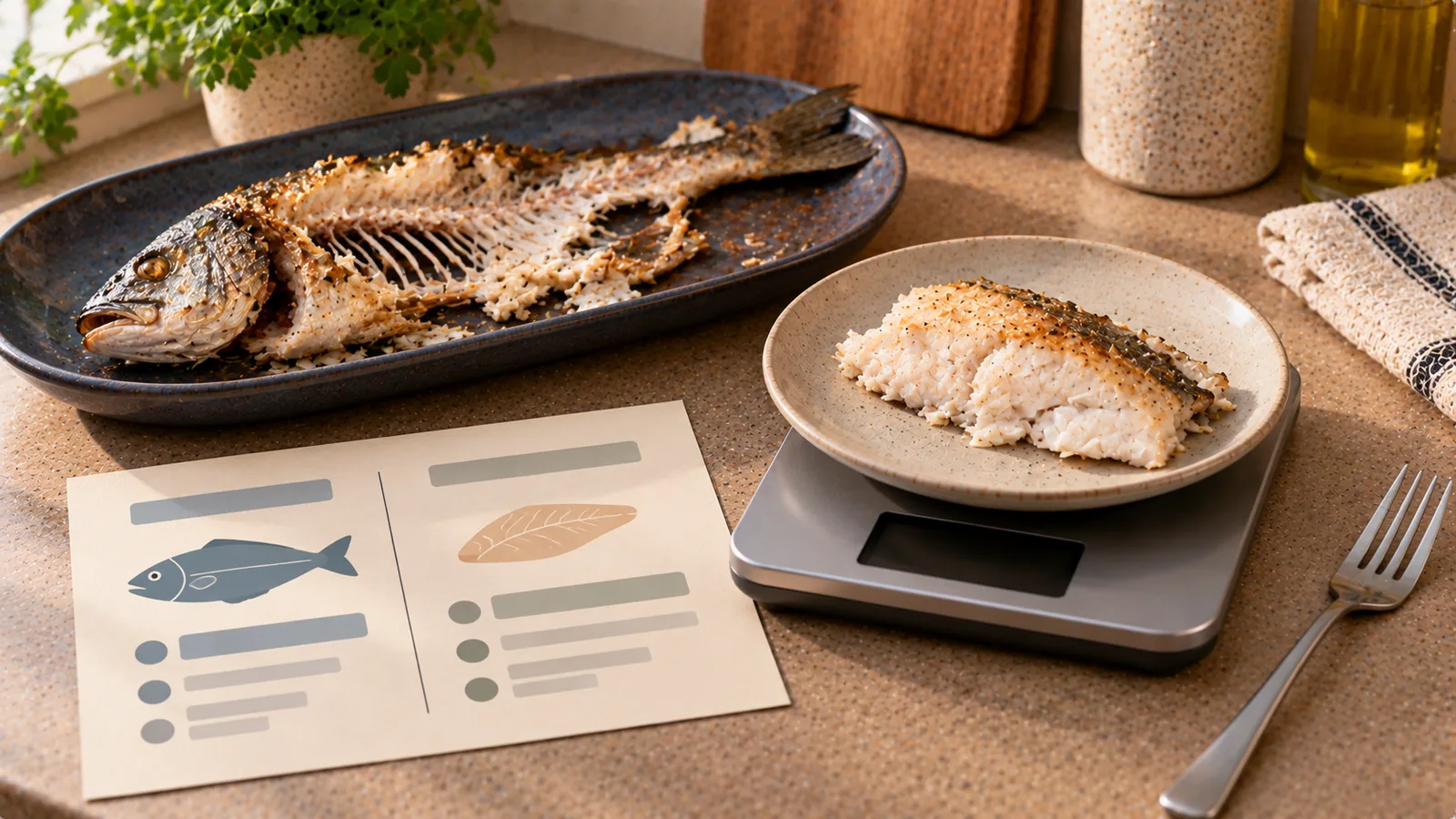
A chicken leg weighs 220 g before you eat it. After the meal, the bones weigh 55 g.
Did you eat 165 g of chicken?
Maybe — but only if the nutrition entry you are using is based on edible meat and your measurements are compatible with that entry.
Foods with bones, shells, pits, peels and other inedible parts create a common food-tracking problem: the weight on the scale is not always the same as the weight represented by the nutrition data.
The key rule is simple:
Match the weight you log to the weight basis of the nutrition entry.
What is an edible portion?
The edible portion is the part of a food that is normally eaten.
Depending on the food, the inedible portion may include:
- bones;
- shells;
- pits;
- stems;
- thick peels;
- cores;
- other discarded material.
For a boneless chicken breast, almost the entire weighed portion may be edible.
For a bone-in chicken leg, whole fish, avocado or unshelled nuts, the total scale weight can include a substantial amount you will not actually eat.
If you log the total weight against a database entry that describes only the edible portion, your calories and nutrients may be overestimated.
The most important question: what does the database entry mean?
Before doing any calculation, look at the food entry.
It may describe:
- edible portion only;
- meat only;
- meat and skin;
- bone-in product;
- whole product as purchased;
- cooked edible portion;
- raw edible portion.
These are not interchangeable.
For example, an entry called:
Chicken drumstick, roasted, meat and skin
may refer to the edible meat and skin rather than the total weight including the bone.
If you weigh the entire drumstick with the bone and enter that full weight, you may count the bone as if it contained the same calories per gram as the meat.
Method 1: weigh the edible food directly
When practical, the simplest method is to weigh only the edible portion.
For example, you remove the meat from a cooked chicken leg and weigh:
145 g edible meat and skin
If your database entry is also for cooked meat and skin, log:
145 g
No bone subtraction estimate is needed.
This method works well when edible and inedible components can easily be separated before eating.
Method 2: weigh before and weigh the waste afterward
For foods that are easier to eat from the bone or shell, you can weigh the entire serving first and the discarded material afterward.
The basic calculation is:
Estimated consumed portion = starting weight − discarded inedible weight − edible leftovers
Suppose a cooked bone-in chicken portion weighs:
260 g before eating
Afterward you have:
- 65 g bones;
- 15 g edible meat left.
Estimated amount consumed:
260 − 65 − 15 = 180 g
If your nutrition entry represents the same cooked edible components, you can log approximately 180 g.
Why subtracting only the bone can be wrong
Suppose you start with 260 g and finish with 65 g of bones.
It is tempting to calculate:
260 − 65 = 195 g eaten
But if 15 g of edible meat is still attached or left on the plate, you did not consume all 195 g.
The more complete calculation is:
260 − 65 − 15 = 180 g eaten
For ordinary tracking, you do not need to scrape every tiny fragment from the bone and weigh it separately. The point is to avoid treating substantial edible leftovers as consumed.
Example: chicken wings
You serve cooked chicken wings weighing:
360 g including bones
After eating, bones and clearly inedible material weigh:
125 g
You also leave approximately:
20 g edible meat and skin
Estimated edible amount consumed:
360 − 125 − 20 = 215 g
If the nutrition entry is for cooked wing meat and skin, approximately 215 g is the relevant weight.
Do not automatically log 360 g against an edible-only entry.
Raw weight and cooked weight must also match
Removing bones is not the only issue.
Cooking changes food weight, primarily through changes in water and sometimes fat.
That means:
200 g raw edible chicken
is not necessarily equivalent to:
200 g cooked edible chicken
If you weigh cooked meat, prefer a nutrition entry representing cooked meat.
If you weigh it raw, use an appropriate raw entry.
Mixing cooked weight with raw nutrition data can create a larger error than the bone calculation itself.
Example: bone-in steak
A cooked steak weighs:
340 g including the bone
After eating:
- bone and inedible material: 75 g;
- edible meat left: 25 g.
Estimated meat consumed:
340 − 75 − 25 = 240 g
If you use a cooked steak entry based on edible meat, log approximately 240 g.
If the entry explicitly includes bone-in weight, follow that entry's stated basis instead.
The database definition controls which weight belongs in the field.
Fish with bones
Whole fish can be particularly confusing because the initial weight may include:
- head;
- spine;
- smaller bones;
- fins;
- skin;
- other parts you may not eat.
Suppose a cooked whole fish weighs:
500 g
After the meal, discarded bones, head and other uneaten parts weigh:
210 g
You also leave 20 g of edible fish.
Estimated edible amount consumed:
500 − 210 − 20 = 270 g
Use 270 g only if the nutrition entry represents the edible cooked fish you consumed.
What about fish skin?
Fish skin is not automatically an inedible component.
Some people eat it and some do not.
If you eat the skin and the nutrition entry includes skin, it belongs in the consumed portion.
If you discard the skin, it belongs with the leftovers.
Again, the useful question is not whether a component is theoretically edible. It is whether you ate it and whether the database entry includes it.
Shrimp and prawns with shells
Shell-on shrimp are another common example.
Suppose the shrimp weigh:
300 g with shells
After eating, the shells weigh:
95 g
No edible shrimp remains.
Estimated edible amount consumed:
300 − 95 = 205 g
If your nutrition entry is for cooked shrimp meat without shell, log approximately 205 g.
If you simply enter 300 g into a shell-free shrimp entry, you would overstate the edible quantity.
Mussels and clams
Shellfish with heavy shells can have a particularly large difference between total and edible weight.
Suppose a serving of mussels weighs:
800 g including shells
After eating, empty shells and discarded material weigh:
590 g
Estimated edible portion plus any liquid or residue removed from the original weight:
800 − 590 = 210 g
However, this method becomes less reliable if the starting weight includes a substantial amount of broth or sauce that is not represented in the shellfish nutrition entry.
In that case, track the edible shellfish and the broth or sauce separately when possible.
Nuts in shells
If you weigh nuts in their shells but use a nutrition entry for shelled kernels, do not log the full shell-on weight.
For example:
Walnuts with shells before eating:
180 g
Empty shells:
105 g
Edible kernels consumed:
180 − 105 = 75 g
If your database entry is for walnut kernels, log approximately:
75 g
This distinction matters because shells can account for a large share of the total weight.
Peanuts in shells
The same principle applies to peanuts.
Starting shell-on weight:
150 g
Empty shells:
45 g
Edible peanuts:
150 − 45 = 105 g
Use 105 g with an entry for shelled peanuts.
Do not enter the entire 150 g unless the database entry specifically uses shell-on weight.
Fruit with pits
Stone fruits can contain pits that are not part of the edible nutrition entry.
Suppose a peach weighs:
180 g
After eating, the pit weighs:
12 g
If no edible fruit remains:
180 − 12 = 168 g edible portion
If your nutrition entry is based on edible peach flesh, approximately 168 g is the relevant amount.
For small pits, the practical difference may be modest. For larger pits, it can matter more.
Avocado
Avocado is a useful example because both the pit and skin are usually discarded.
Whole avocado:
240 g
Pit:
45 g
Skin:
25 g
Edible flesh:
240 − 45 − 25 = 170 g
If your nutrition entry represents avocado flesh, log approximately 170 g.
Logging the full 240 g against an edible avocado entry would count 70 g of material you did not consume.
Mango
A whole mango may include:
- peel;
- a large stone;
- edible flesh.
Suppose:
Whole mango:
420 g
Peel and stone after eating:
145 g
Edible flesh consumed:
420 − 145 = 275 g
If some edible mango remains on the stone or peel, the true consumed amount will be slightly lower.
You do not need perfect laboratory separation; use a reasonable measurement.
Banana peel
If you weigh a banana with the peel but use a database entry based on edible banana, subtract the peel.
Example:
Whole banana:
190 g
Peel:
65 g
Edible banana:
190 − 65 = 125 g
An easier option is simply to peel the banana and weigh the edible fruit before eating.
Citrus peel
For oranges, mandarins and similar fruit, the database entry often refers to the edible portion.
Whole orange:
230 g
Peel and other discarded material:
55 g
Edible portion:
230 − 55 = 175 g
Again, checking the database definition is preferable to assuming how the weight is defined.
Apple cores
Some people weigh the entire apple before eating and leave the core.
Example:
Whole apple:
210 g
Remaining core and stem:
24 g
Estimated amount eaten:
210 − 24 = 186 g
If the nutrition entry is based on edible apple, approximately 186 g is the relevant amount.
If you eat nearly the entire core as well, your discarded weight will naturally be smaller.
Watermelon rind
Watermelon can have a substantial inedible rind.
Suppose a slice weighs:
600 g
Rind after eating:
190 g
Edible watermelon consumed:
600 − 190 = 410 g
If the nutrition data is for edible watermelon flesh, use approximately 410 g.
Logging the entire 600 g would substantially overstate the amount of fruit eaten.
Pineapple
A whole pineapple includes a large amount of peel, crown and core depending on how it is prepared.
If you track pineapple using an edible-flesh entry, the easiest method is usually to weigh the prepared pieces rather than the whole fruit.
For example:
Prepared edible pineapple:
320 g
Log 320 g.
There is no need to calculate the percentage of the whole fruit that became waste unless you specifically need that information.
Thick vegetable peels
Many vegetable peels are edible, but people may choose to remove them.
For example, if you peel a vegetable and your database entry describes the edible prepared portion, weigh the food after removing the parts you will discard.
The key is what you actually consume, not a universal classification of every peel as edible or inedible.
Corn on the cob
Corn on the cob creates a clear difference between total weight and kernels consumed.
Suppose cooked corn on the cob weighs:
260 g
The cob after eating weighs:
105 g
Estimated kernels consumed:
260 − 105 = 155 g
If your nutrition entry is for cooked corn kernels, approximately 155 g is the relevant weight.
Meat with skin
Skin requires a different decision from bones because skin may be eaten.
Suppose you have a chicken thigh with meat, skin and bone.
If you eat the meat and skin but discard the bone, choose an entry for:
meat and skin
If you remove and discard the skin, an entry for:
meat only
may better represent what you consumed.
The correct food entry can be as important as the correct weight.
What if the database entry does not say?
If the weight basis is unclear, avoid pretending you know exactly what it represents.
You can:
- look for another entry with a clearer description;
- prefer a reputable database entry that specifies edible/raw/cooked status;
- use a reasonable estimate if no better information exists.
A clearly defined entry is usually more useful than a superficially precise but ambiguous one.
Do not apply a generic edible-percentage rule to every food
You may encounter tables that provide average edible yield percentages.
These can be useful when direct measurement is impossible, but they are averages.
Actual yield can vary because of:
- food size;
- trimming;
- preparation;
- cooking;
- how much meat remains on a bone;
- how closely fruit is cut around a pit;
- personal eating habits.
If you can directly weigh the discarded portion, that measurement is usually more relevant to your specific serving than a generic percentage.
When an edible-percentage estimate is useful
Suppose you only know that you ate:
300 g of a bone-in food as served
and you no longer have the bones to weigh.
If a reliable reference indicates an approximate edible yield for that specific food and preparation, you can use it as an estimate.
For example, if the estimated edible yield were 70%:
300 × 0.70 = 210 g estimated edible portion
But treat 210 g as an estimate, not a measured fact.
Do not subtract the same waste twice
A common mistake occurs when someone:
- chooses a database entry that already represents the food as purchased or bone-in;
- manually subtracts the bone again.
That can underestimate intake.
The opposite mistake is:
- choose an edible-only entry;
- enter the full bone-in weight.
That can overestimate intake.
Always match the weight basis to the entry.
Edible leftovers are different from inedible waste
Suppose you start with:
300 g bone-in chicken
After eating, the plate contains:
- 70 g bone;
- 30 g edible chicken.
The 70 g is inedible waste.
The 30 g is edible food you simply did not eat.
Both must be excluded from your consumed amount if your starting measurement included them.
Estimated consumed portion:
300 − 70 − 30 = 200 g
This distinction is particularly useful when logging unfinished meals.
Containers and packaging
Do not include packaging weight when logging food.
For example, if a container plus food weighs 520 g and the empty container weighs 40 g:
Food weight:
520 − 40 = 480 g
The same principle applies to:
- takeaway boxes;
- jars;
- bowls;
- wrappers;
- disposable trays.
Use the food weight, not the gross weight.
Liquids around the food
Some foods are packed in:
- water;
- brine;
- oil;
- syrup.
The nutrition entry may refer to:
- drained food;
- food plus liquid;
- a specified serving as sold.
Check the label or database description.
If you drain a can of food but use nutrition data based on the drained product, weigh the drained food.
If you consume the packing liquid as well, the appropriate entry may be different.
Example: canned tuna
Suppose a can contains tuna packed in water.
After draining, the tuna weighs:
145 g
If the nutrition information is stated for drained tuna, log:
145 g
Do not automatically use the original gross can weight.
If the product label gives nutrition per drained weight, follow that basis.
Example: canned food in oil
Oil-packed foods require additional care because some oil may remain with the food even after draining.
If the label provides values for the drained product, use the label's stated basis.
If you separately add or consume additional packing oil, account for it when practical.
Do not assume that every gram removed during draining is pure oil or that every gram remaining has the same composition.
A practical workflow
For foods with bones, peels or shells:
Step 1: identify the nutrition entry.
Does it represent raw or cooked food? Edible portion or whole product? Meat only or meat and skin?
Step 2: choose a compatible weighing method.
Whenever possible, weigh the same form of the food described by the entry.
Step 3: separate significant waste.
Bones, shells, pits and other discarded parts should not be counted as edible food when using an edible-only entry.
Step 4: subtract substantial edible leftovers.
Food you could have eaten but left behind was not consumed either.
Step 5: accept reasonable uncertainty.
You do not need to scrape every bone or weigh every tiny peel fragment.
Worked example
You eat two cooked chicken thighs.
Starting total weight:
410 g
After eating:
- bones: 92 g;
- discarded skin: 28 g;
- edible meat left: 15 g.
You ate the remaining:
410 − 92 − 28 − 15 = 275 g
If you use a cooked chicken-thigh entry for meat only, approximately 275 g may be appropriate if the remaining 275 g corresponds to meat represented by that entry.
But if some of the starting weight included components not represented by the entry, make sure those are also excluded.
This is why the database definition matters as much as the arithmetic.
Another worked example: avocado
Whole avocado:
265 g
After eating:
- pit: 48 g;
- peel: 31 g;
- edible flesh left: 6 g.
Consumed flesh:
265 − 48 − 31 − 6 = 180 g
If the avocado entry is for edible flesh, log approximately:
180 g
If the entry lists 160 kcal per 100 g:
180 × 160 ÷ 100 = 288 kcal
When weighing after eating is impossible
If the bones or peels have already been discarded and you did not weigh them, do not invent an exact number.
Possible alternatives:
- use a reliable edible-yield estimate;
- estimate the edible portion visually;
- use a serving-based entry;
- choose a database item specifically defined by the whole serving you ate.
Record the best reasonable estimate available.
When the difference is tiny
Not every peel or stem needs a calculation.
If the discarded material weighs only a few grams and the original food estimate already contains uncertainty, correcting it may make almost no practical difference.
Focus precision where the inedible portion is substantial.
Examples where it often matters more include:
- bone-in meat;
- whole fish;
- shell-on seafood;
- nuts in shells;
- avocado;
- mango;
- watermelon rind;
- corn on the cob.
Why consistency matters
Suppose you regularly eat bone-in chicken.
One day you log total bone-in weight against an edible-only entry.
Another day you subtract the bones.
A third day you use a serving estimate.
Even if none of these methods is perfect, switching methods constantly can make trends harder to interpret.
Choose a sensible method and apply it consistently when possible.
The practical rule
For foods with bones, shells, peels, pits or other discarded parts, do not automatically enter the total scale weight.
First determine what the nutrition entry represents.
If it represents the edible portion, log the edible amount you actually consumed.
A useful calculation is:
Consumed edible amount = starting weight − inedible waste − edible leftovers
But this formula only works when the starting and final measurements are compatible with the nutrition entry.
The most accurate-looking number is not always the most accurate entry.
Matching the food's form, preparation state and edible portion to the database definition is what makes the calculation useful.