
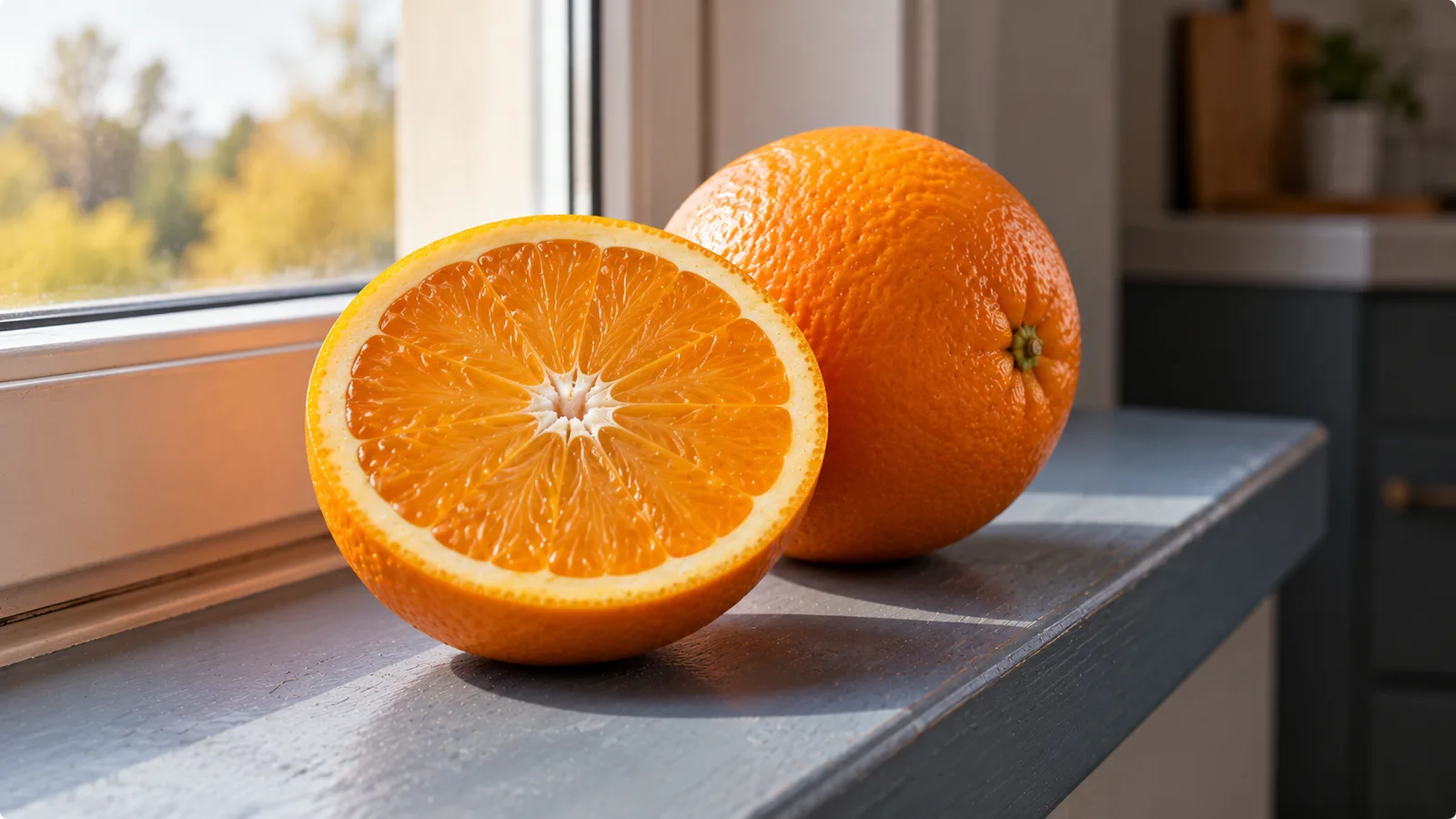
An orange is a citrus fruit that provides carbohydrates, water, fibre and vitamin C. Its calorie content depends mainly on the weight of the edible fruit.
A medium orange containing approximately 131 g of edible flesh provides about 62 calories. A smaller orange contains fewer calories, while a larger one contains more.
For nutrition tracking, the most accurate method is to weigh the peeled orange and calculate its calories from the edible portion.
How many calories are in an orange?
Raw oranges contain approximately 47 kcal per 100 g of edible fruit, according to commonly used food-composition reference values.
The following table uses that figure to calculate calories for different edible weights.
| Edible orange weight | Approximate calories |
|---|---|
| 50 g | 24 kcal |
| 75 g | 35 kcal |
| 100 g | 47 kcal |
| 125 g | 59 kcal |
| 150 g | 71 kcal |
| 175 g | 82 kcal |
| 200 g | 94 kcal |
| 250 g | 118 kcal |
The values are rounded. Actual composition varies by orange variety, maturity and growing conditions.
These figures refer to the fruit without its peel.
Calories in small, medium and large oranges
Orange size is convenient for everyday estimates, but fruit weight can vary considerably.
The following commonly used reference portions provide a practical guide.
| Orange size | Approximate edible weight | Calories |
|---|---|---|
| Small | 96 g | 45 kcal |
| Medium | 131 g | 62 kcal |
| Large | 184 g | 86 kcal |
A large orange is not necessarily twice as caloric as a small one. The difference depends on the edible weight.
If your orange is unusually small or large, use its measured weight rather than the size category.
Orange nutrition per 100 g
The following values are approximate for raw oranges.
| Nutrient | Per 100 g |
|---|---|
| Energy | 47 kcal |
| Carbohydrates | 11.8 g |
| Sugars | 9.4 g |
| Fibre | 2.4 g |
| Protein | 0.9 g |
| Fat | 0.1 g |
| Vitamin C | 53 mg |
| Potassium | 181 mg |
Oranges contain relatively little fat and protein.
Most of their calories come from carbohydrates, including naturally occurring sugars.
They also provide dietary fibre and vitamin C.
These are reference values, not guaranteed laboratory measurements of a particular orange.
Nutrition in one medium orange
Using an edible weight of 131 g, a medium orange provides approximately:
| Nutrient | Approximate amount |
|---|---|
| Calories | 62 kcal |
| Carbohydrates | 15.5 g |
| Sugars | 12.3 g |
| Fibre | 3.1 g |
| Protein | 1.2 g |
| Fat | 0.2 g |
| Vitamin C | 69 mg |
The figures are calculated from approximate values per 100 g and rounded.
A medium orange can contribute a meaningful amount of vitamin C to a varied diet.
How much sugar is in an orange?
An orange contains naturally occurring sugars, including fructose, glucose and sucrose.
At approximately 9.4 g sugars per 100 g, a medium orange with 131 g of edible flesh contains around 12.3 g sugars.
This is not the same as adding 12.3 g of table sugar to a drink.
Whole oranges also provide water, fibre and other nutrients.
For most people, whole fruit can be part of a healthy eating pattern.
People who need to manage carbohydrate intake for a medical reason should consider the actual portion and their individual guidance.
Orange carbohydrates and fibre
A medium orange contains approximately 15.5 g total carbohydrates and 3.1 g fibre.
Fibre is one reason whole fruit differs nutritionally from fruit juice.
When an orange is juiced, much of the pulp and fibre may be removed, depending on the method.
The total carbohydrate content also matters for people tracking their intake.
In European nutrition labelling, carbohydrate values generally exclude fibre, whereas some US database values use total carbohydrate definitions that include fibre. Avoid mixing these systems without checking the definitions.
How much vitamin C is in an orange?
Raw oranges provide approximately 53 mg vitamin C per 100 g.
A medium orange with 131 g of edible flesh therefore provides around 69 mg vitamin C using that reference value.
Vitamin C contributes to normal immune function, collagen formation and the absorption of non-haem iron from plant foods.
The actual vitamin C content can vary with storage, ripeness and variety.
An orange does not need to be unusually large to make a useful contribution to daily vitamin C intake.
Whole orange vs orange juice
Whole oranges and orange juice are not nutritionally identical.
Juice can contain similar types of naturally occurring sugars, but it usually provides less fibre than whole fruit.
For illustration:
| Food or drink | Typical reference quantity | Approximate calories |
|---|---|---|
| Medium whole orange | 131 g edible flesh | 62 kcal |
| Orange juice | 100 ml | 45 kcal |
| Orange juice | 200 ml | 90 kcal |
| Orange juice | 250 ml | 113 kcal |
The juice values are illustrative; check the label for the specific product.
A glass of orange juice can contain the juice of multiple oranges.
It is also generally quicker to drink juice than to eat the equivalent quantity of whole fruit.
For people prioritising fibre and portion awareness, whole oranges are often the more practical choice.
Fresh orange vs canned oranges
Fresh orange segments are usually sold without added ingredients.
Canned orange segments may be packed in water, juice or syrup.
The packing liquid changes the product's sugar and calorie content.
When comparing canned products, check whether the nutrition declaration includes the liquid and whether the listed weight is the drained weight.
Segments packed in syrup should not automatically be assigned the same calories as fresh orange flesh.
Orange varieties and calorie differences
Navel, Valencia, blood oranges and other sweet orange varieties may differ in sweetness, acidity, water content and size.
However, the weight of the edible fruit is usually more useful for calorie tracking than the variety name alone.
A sweet-tasting orange is not necessarily dramatically higher in calories than a more acidic one.
The flavour depends on both sugar and acidity.
If you have a reliable variety-specific nutrition entry, use it. Otherwise, a general raw-orange entry is a reasonable estimate.
Does peeling an orange change the calories?
Peeling does not meaningfully change the energy content of the flesh itself.
However, it changes the weight being measured.
For example, suppose an orange weighs 200 g with its peel but provides 145 g of edible flesh.
At 47 kcal per 100 g:
145 × 47 ÷ 100 = 68 kcal.
Calculating calories from the full 200 g would overestimate the edible portion.
For accuracy, weigh the orange after peeling.
Calories in two or three oranges
Using a medium orange at approximately 62 kcal:
| Quantity | Approximate calories |
|---|---|
| 1 medium orange | 62 kcal |
| 2 medium oranges | 124 kcal |
| 3 medium oranges | 186 kcal |
| 4 medium oranges | 248 kcal |
These values assume the oranges are similar in edible weight.
For oranges of different sizes, calculate each portion separately or weigh the combined edible fruit.
Can oranges fit into a weight-loss diet?
Yes. Whole oranges can fit into a diet designed for weight management.
They provide water, fibre and sweetness for a relatively modest amount of energy.
However, no single fruit causes weight loss.
Changes in body weight depend on the overall energy balance and dietary pattern over time.
An orange can be eaten as a snack, added to a meal or used in a recipe.
The appropriate quantity depends on personal preferences, energy needs and the rest of the diet.
How to track orange calories accurately
For a whole orange:
- Peel the orange.
- Remove any parts you will not eat.
- Weigh the edible fruit.
- Select a raw-orange nutrition entry.
- Calculate the calories from the edible weight.
Formula: calories = edible weight in grams × 47 ÷ 100.
Example: 165 g edible orange flesh.
165 × 47 ÷ 100 = 78 kcal after rounding.
If using oranges in a fruit salad, weigh the amount actually added to the recipe.
For orange juice, record the volume and use the juice product's nutrition information instead.
Frequently asked questions
How many calories are in one orange?
A medium orange with approximately 131 g edible flesh contains about 62 calories.
How many calories are in 100 g of orange?
Approximately 47 calories for raw sweet orange flesh.
How many calories are in a large orange?
A large orange with approximately 184 g edible flesh provides about 86 calories.
Is an orange high in sugar?
An orange contains natural sugars, but it also provides fibre, water and vitamin C. Portion size and the overall diet matter.
Does orange juice have the same calories as an orange?
Not necessarily. The calories depend on the volume of juice and the quantity of fruit used.
Should I weigh an orange with or without the peel?
For accurate tracking of the edible fruit, weigh it without the peel.
Sources and calculation notes
- USDA FoodData Central — reference composition of raw oranges and orange juice.
- NIH Office of Dietary Supplements: Vitamin C — vitamin C functions and dietary reference information.
- World Health Organization: Healthy diet — general guidance on fruit consumption and healthy dietary patterns.
All values are approximate. Calculations use reference food-composition figures and rounded serving weights.