
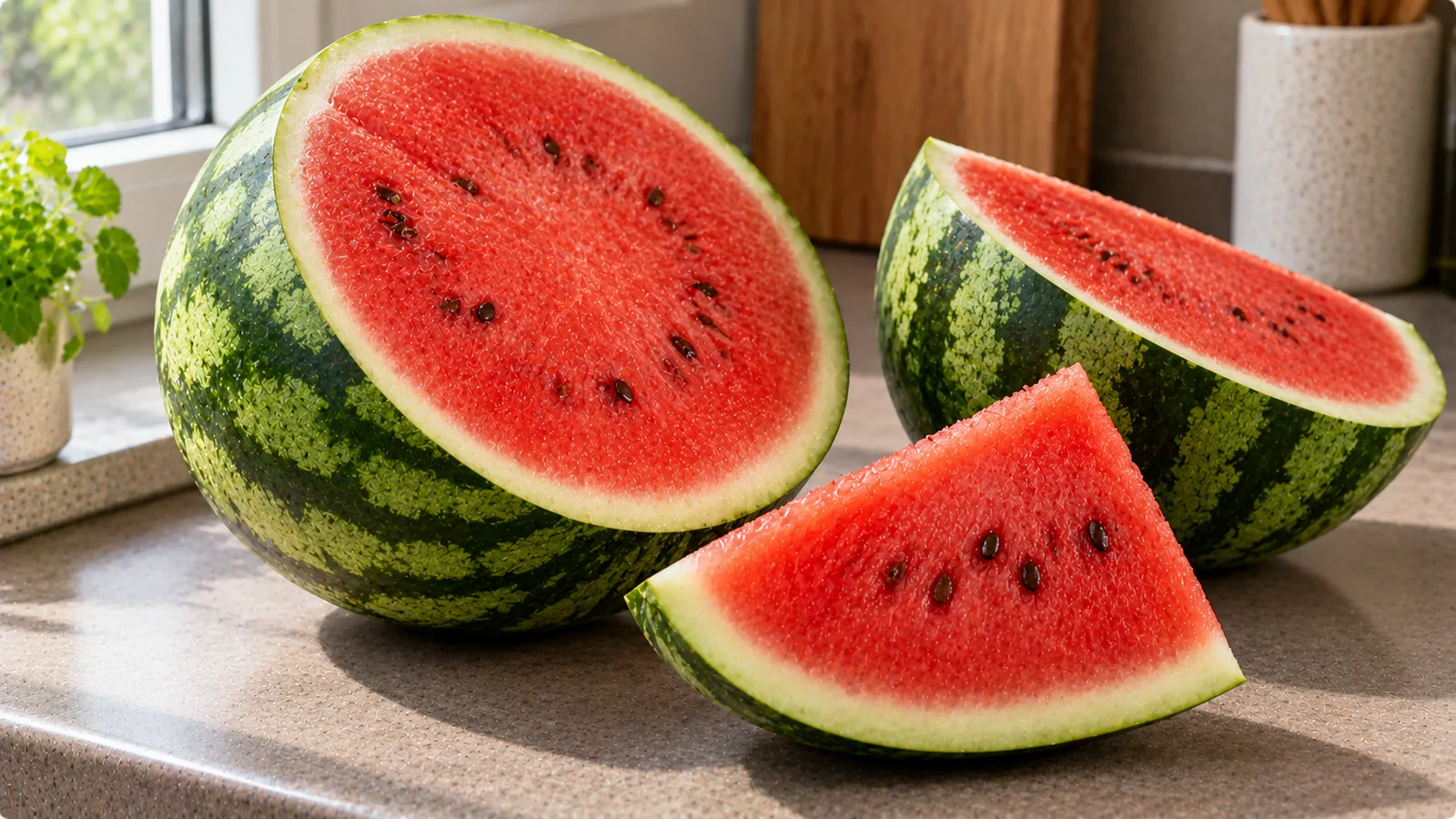
Fresh raw watermelon contains approximately 30 calories per 100 g of edible flesh.
That makes it relatively low in calories by weight, largely because watermelon contains a high proportion of water.
However, a watermelon serving can range from a few small cubes to several large slices. The total calories depend on how much edible flesh you actually consume.
For accurate calorie tracking, the most important distinction is between the weight of the whole watermelon, including its rind, and the weight of the edible portion.
Watermelon calories by weight
| Edible watermelon flesh | Approximate calories |
|---|---|
| 50 g | 15 kcal |
| 75 g | 23 kcal |
| 100 g | 30 kcal |
| 125 g | 38 kcal |
| 150 g | 45 kcal |
| 200 g | 60 kcal |
| 250 g | 75 kcal |
| 300 g | 90 kcal |
| 400 g | 120 kcal |
| 500 g | 150 kcal |
| 750 g | 225 kcal |
| 1,000 g | 300 kcal |
These values use approximately 30 kcal per 100 g of raw watermelon flesh.
They are estimates rather than exact values for every fruit. Watermelon composition can vary with variety, maturity and growing conditions.
Reference: USDA FoodData Central.
Watermelon nutrition facts per 100 g
Representative values for raw watermelon are:
| Nutrient | Per 100 g | Per 200 g |
|---|---|---|
| Energy | 30 kcal | 60 kcal |
| Water | 91.45 g | 182.90 g |
| Protein | 0.61 g | 1.22 g |
| Fat | 0.15 g | 0.30 g |
| Total carbohydrate, US definition | 7.55 g | 15.10 g |
| Dietary fiber | 0.4 g | 0.8 g |
| Total sugars | 6.20 g | 12.40 g |
| Vitamin C | 8.1 mg | 16.2 mg |
| Potassium | 112 mg | 224 mg |
Source: USDA FoodData Central.
The values are rounded and describe a representative food composition, not the exact nutrient content of an individual watermelon.
Why carbohydrate figures sometimes differ
American food databases commonly include dietary fiber in total carbohydrate.
European nutrition labeling generally lists available carbohydrate and fiber separately.
Using the representative values above:
7.55 g total carbohydrate − 0.4 g fiber = approximately 7.15 g available carbohydrate per 100 g.
This difference reflects reporting conventions.
It does not mean watermelon sold in different countries necessarily has different carbohydrate content.
Reference: Regulation (EU) No 1169/2011.
How many calories are in one watermelon slice?
There is no standard weight for a slice of watermelon.
A narrow wedge from a small watermelon may contain much less edible flesh than a thick wedge cut from a large fruit.
The most useful approach is to weigh the flesh after removing the rind.
| Example slice size | Edible flesh | Approximate calories |
|---|---|---|
| Small slice | 100 g | 30 kcal |
| Medium slice | 200 g | 60 kcal |
| Large slice | 300 g | 90 kcal |
| Very large slice | 400 g | 120 kcal |
These are illustrative serving sizes, not official definitions of small, medium or large slices.
For example, a slice weighing 350 g with the rind attached does not necessarily contain 350 g of edible watermelon.
The rind weight must be excluded if you do not eat it.
How many calories are in a cup of watermelon?
A commonly used reference for one US cup of diced watermelon is approximately 152 g.
At 30 kcal per 100 g, that provides about 46 kcal.
| Diced watermelon | Approximate edible weight | Calories |
|---|---|---|
| Quarter cup | 38 g | 11 kcal |
| Half cup | 76 g | 23 kcal |
| One cup | 152 g | 46 kcal |
| One and a half cups | 228 g | 68 kcal |
| Two cups | 304 g | 91 kcal |
| Three cups | 456 g | 137 kcal |
Cup measurements are approximate because the size of the cubes and the way they are packed affect the weight.
A kitchen scale is more reliable than a volume estimate when precision matters.
How many calories are in a whole watermelon?
The answer depends on the edible flesh yield.
Watermelons vary widely in size, rind thickness and the proportion of fruit that is eaten.
A whole watermelon weighing 4 kg is not the same as 4 kg of edible flesh.
To calculate calories, remove or subtract the rind and any other discarded parts.
Example: A 3 kg watermelon
Suppose a watermelon weighs 3,000 g before cutting.
After preparation, the edible flesh weighs 1,800 g.
1,800 × 0.30 = 540 kcal.
Example: A 5 kg watermelon
Suppose a 5,000 g watermelon provides 3,000 g of edible flesh.
3,000 × 0.30 = 900 kcal.
These examples use hypothetical edible yields.
They should not be interpreted as a universal rule that every watermelon has the same proportion of flesh.
Example: A large 8 kg watermelon
If the edible portion weighs 5,200 g:
5,200 × 0.30 = 1,560 kcal.
That is the estimated energy content of all the edible flesh, not necessarily the amount eaten by one person.
If the fruit is divided into ten equal edible portions, each portion would contain approximately 156 kcal.
How to weigh watermelon correctly
The easiest method is to weigh the edible flesh.
- Wash the outside of the watermelon before cutting.
- Cut the fruit with a clean knife.
- Remove the rind if you will not eat it.
- Place the edible flesh in a bowl.
- Weigh the flesh on a kitchen scale.
- Record the weight as fresh raw watermelon.
If you eat only part of the prepared fruit, weigh the portion you actually consume.
Weighing by subtraction
You can also weigh a slice before eating and then weigh the discarded rind afterward.
For example:
- Watermelon slice with rind: 420 g.
- Discarded rind: 130 g.
- Edible portion: 290 g.
290 × 0.30 = 87 kcal.
This method is particularly convenient when eating watermelon wedges.
Be aware that discarded flesh left attached to the rind will affect the estimate.
How to calculate watermelon calories
Use the formula:
Calories = edible watermelon weight in grams × 0.30
Examples:
- 80 g = 24 kcal.
- 120 g = 36 kcal.
- 180 g = 54 kcal.
- 225 g = approximately 68 kcal.
- 350 g = 105 kcal.
- 600 g = 180 kcal.
- 900 g = 270 kcal.
This formula applies to fresh raw watermelon flesh.
It should not automatically be used for sweetened watermelon drinks, candy, dried watermelon or mixed desserts.
How much sugar is in watermelon?
Raw watermelon contains approximately 6.2 g of naturally occurring sugars per 100 g.
| Edible watermelon | Approximate sugars |
|---|---|
| 100 g | 6.2 g |
| 150 g | 9.3 g |
| 200 g | 12.4 g |
| 250 g | 15.5 g |
| 300 g | 18.6 g |
| 400 g | 24.8 g |
| 500 g | 31.0 g |
These sugars occur naturally in the fruit.
Public-health guidance distinguishes sugars naturally present in intact whole fruit from free sugars, including added sugars and sugars in fruit juices.
Source: World Health Organization — Healthy diet.
That distinction does not mean watermelon contains no carbohydrates or calories.
Serving size still matters when calculating carbohydrate intake.
Is watermelon high in sugar?
Per 100 g, watermelon contains approximately 6.2 g of sugars and 30 kcal.
However, a large portion can contain considerably more sugar than a small one.
For example:
- 100 g provides about 6.2 g sugars.
- 300 g provides about 18.6 g.
- 500 g provides about 31 g.
The relevant question is the quantity eaten, rather than whether the fruit is labeled simply high-sugar or low-sugar.
For people managing diabetes or other conditions requiring carbohydrate monitoring, individualized dietary advice may be appropriate.
Watermelon carbohydrates and blood glucose
Watermelon contains carbohydrates, including naturally occurring sugars.
Its high water content means that a 100 g portion provides a relatively modest amount of carbohydrate.
However, a large serving can provide substantially more.
For example, using the USDA total-carbohydrate definition:
- 100 g: approximately 7.55 g.
- 200 g: approximately 15.10 g.
- 300 g: approximately 22.65 g.
- 500 g: approximately 37.75 g.
Glycemic index and glycemic load are different concepts.
A food's glycemic index alone does not describe the carbohydrate quantity in the portion eaten.
Individual blood-glucose responses also vary.
Watermelon should not be described as automatically suitable or unsuitable for everyone with diabetes.
Does watermelon contain fiber?
Watermelon contains approximately 0.4 g of dietary fiber per 100 g.
That means:
- 100 g provides about 0.4 g.
- 200 g provides about 0.8 g.
- 300 g provides about 1.2 g.
- 500 g provides about 2.0 g.
Watermelon can contribute to dietary fiber intake, but it is not a particularly concentrated fiber source.
Legumes, whole grains, vegetables, nuts and seeds can provide additional fiber.
The European Food Safety Authority considers 25 g of dietary fiber per day an adequate intake for normal laxation in adults.
Source: EFSA — Dietary Reference Values.
Water content and hydration
Raw watermelon is approximately 91% water by weight.
For example, 300 g of watermelon flesh contains roughly 274 g of water, based on representative USDA values.
This water contributes to total fluid intake.
However, watermelon does not replace the need for suitable drinks throughout the day.
Hydration requirements depend on factors such as climate, activity level, health and individual circumstances.
Watermelon can be one component of a varied diet that supports normal hydration.
Vitamins and minerals in watermelon
Watermelon provides vitamin C and potassium, among other nutrients.
Typical values per 100 g include:
- Vitamin C: approximately 8.1 mg.
- Potassium: approximately 112 mg.
Watermelon also contains carotenoids, including lycopene, with concentrations varying by variety and ripeness.
These compounds are of nutritional interest, but their presence does not establish that eating watermelon prevents or treats a specific disease.
Source: USDA FoodData Central.
Red watermelon versus yellow watermelon
Red and yellow watermelon varieties differ in their pigment composition.
Red varieties commonly contain lycopene, while yellow varieties have different carotenoid profiles.
However, color alone does not provide a reliable calorie calculation.
For ordinary food tracking, a representative raw-watermelon value can be used when a variety-specific database entry is unavailable.
If you have reliable nutrition information for the exact variety, use that instead.
Seedless versus seeded watermelon
Seedless watermelon and seeded watermelon are not automatically different calorie categories.
The presence of seeds does not establish a consistent difference in the calories of the surrounding flesh.
For practical tracking, weigh the edible flesh.
If you remove and discard seeds, do not deliberately add their weight to the consumed portion.
The calorie impact of a few small swallowed seeds is generally minor in the context of an ordinary serving.
Fresh watermelon versus watermelon juice
Whole watermelon and watermelon juice are not nutritionally identical in every respect.
Juicing can change the amount of fiber retained and make it easier to consume a large quantity of fruit in a short time.
Packaged watermelon drinks may also contain added sugar or other ingredients.
For bottled products, use the nutrition label per 100 ml.
For homemade juice, calculate the ingredients and the amount consumed.
If pulp is removed, the finished drink's nutrient composition may differ from the whole fruit.
Do not automatically apply the whole-fruit value per 100 g to 100 ml of a processed drink.
Watermelon in fruit salads and desserts
Watermelon is often combined with other ingredients.
For example:
Watermelon and feta salad: Include watermelon, feta, olive oil and any other ingredients.
Fruit salad: Calculate watermelon and the other fruits separately.
Watermelon smoothie: Include any milk, yogurt, juice or sweeteners.
Watermelon sorbet: Use the complete recipe or packaged nutrition values.
Grilled watermelon: Plain grilled watermelon may remain close to the raw-fruit estimate, but added oil, sugar or sauces change the total calories.
For mixed dishes, the calories of the whole recipe matter more than the watermelon content alone.
Is watermelon good for weight management?
At approximately 30 kcal per 100 g, watermelon is relatively low in energy density.
It can be used as a snack, dessert ingredient or part of a meal.
Replacing a more energy-dense snack with a suitable portion of fresh watermelon may reduce calories at that eating occasion.
However, watermelon does not independently cause weight loss.
Changes in body weight depend on overall energy balance and other factors.
Eating a large amount of watermelon in addition to an otherwise unchanged diet does not guarantee weight loss.
A useful approach is to consider the portion and the entire eating pattern.
Practical tracking examples
Example 1: Watermelon after lunch
You eat 250 g of fresh watermelon flesh.
250 × 0.30 = 75 kcal.
Example 2: Two watermelon wedges
After eating, you weigh the discarded rinds.
The two wedges weighed 700 g before eating, and the discarded rinds weigh 220 g.
Edible flesh consumed:
700 − 220 = 480 g.
480 × 0.30 = 144 kcal.
This assumes no significant amount of edible flesh was discarded.
Example 3: A bowl of watermelon cubes
The bowl contains 350 g of edible cubes.
350 × 0.30 = 105 kcal.
Example 4: Watermelon and feta salad
A salad contains:
- Watermelon flesh: 300 g.
- Feta: 60 g.
- Olive oil: 10 g.
- Mint and other seasonings.
The watermelon contributes approximately 90 kcal.
Feta and olive oil add further calories and must be included separately.
Example 5: Sharing a whole watermelon
A prepared watermelon yields 3,600 g of edible flesh.
The entire edible portion contains approximately:
3,600 × 0.30 = 1,080 kcal.
If six people eat equal portions, each receives 600 g of flesh, or approximately 180 kcal.
Food safety when cutting watermelon
Wash the outside of the watermelon before cutting, even if you will not eat the rind.
Use clean knives and cutting boards.
Cutting through an unwashed rind can transfer contamination to the edible flesh.
Refrigerate cut watermelon promptly in a clean, covered container.
Keep the refrigerator at approximately 4°C or below.
Discard cut fruit that has been stored under unsafe conditions.
General guidance: FDA — Selecting and Serving Produce Safely.
Frequently asked questions
How many calories are in 100 g of watermelon?
Approximately 30 kcal of fresh raw edible flesh.
How many calories are in 200 g of watermelon?
Approximately 60 kcal.
How many calories are in 300 g of watermelon?
Approximately 90 kcal.
How many calories are in 500 g of watermelon?
Approximately 150 kcal.
How many calories are in one cup of watermelon?
About 46 kcal if the cup contains approximately 152 g of diced flesh.
How many calories are in one watermelon slice?
It depends on the edible weight. A slice containing 200 g of flesh provides approximately 60 kcal.
Do you count the rind?
Not if you discard it. Calculate calories using only the part consumed.
Is watermelon mostly water?
Yes. Representative raw watermelon composition is approximately 91% water.
Sources and calculation methodology
- USDA FoodData Central — representative raw watermelon nutrient composition.
- Regulation (EU) No 1169/2011 — European carbohydrate and fiber labeling conventions.
- World Health Organization — Healthy diet — guidance on dietary sugars.
- EFSA — Dietary Reference Values — dietary fiber reference values.
- FDA — Selecting and Serving Produce Safely — safe produce handling.
Calculations use approximately 30 kcal per 100 g of edible fresh raw watermelon. Portion weights and calories are rounded. Whole-fruit examples use illustrative edible yields rather than a fixed rind percentage.