
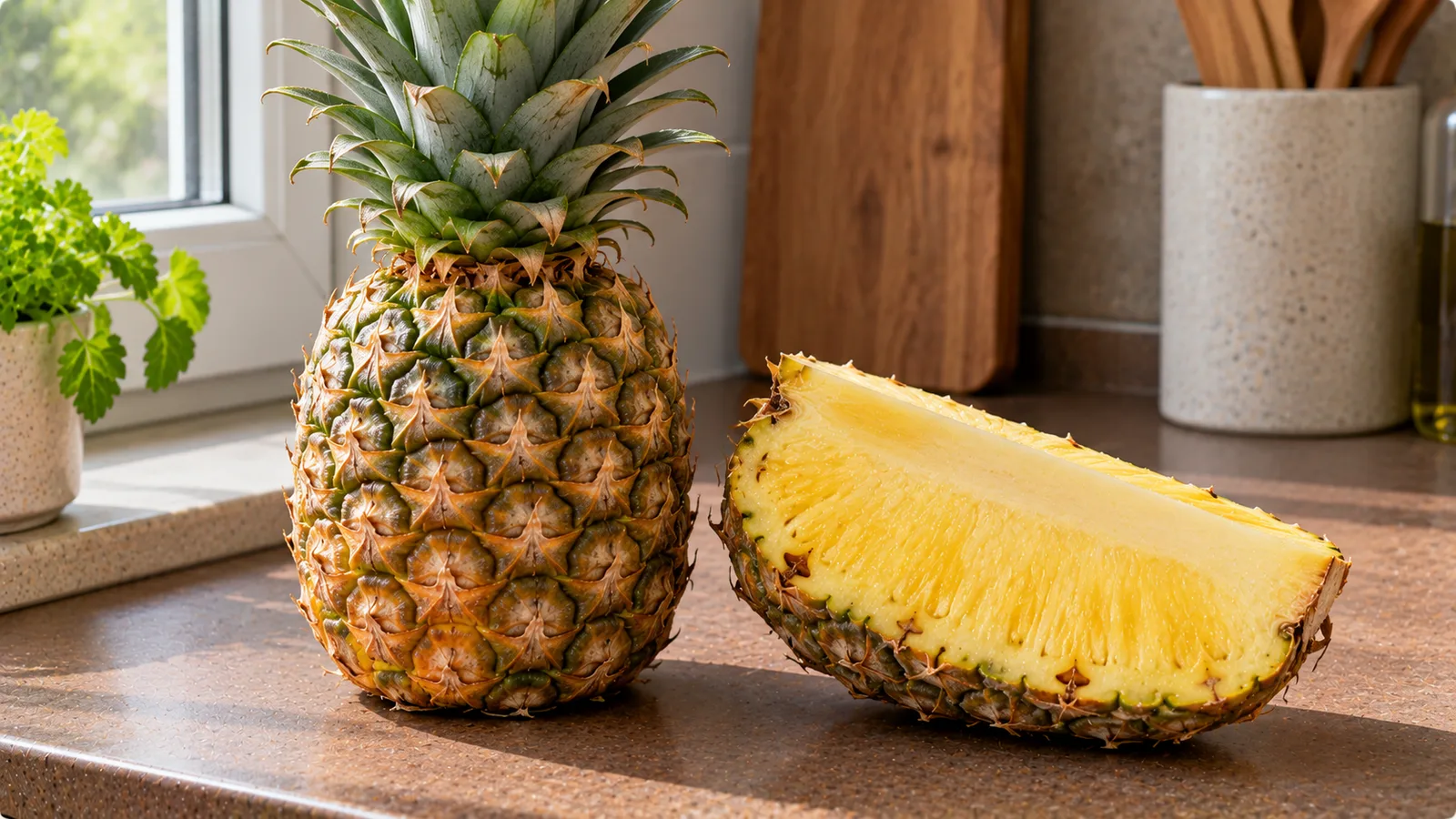
Fresh raw pineapple contains approximately 50 calories per 100 g of edible fruit.
A 150 g portion provides about 75 calories, while 200 g provides approximately 100 calories.
These values apply to the edible yellow flesh, not the entire pineapple with its crown, tough skin and central core removed.
The distinction matters when weighing pineapple for calorie tracking. Canned pineapple packed in juice or syrup, dried pineapple and pineapple desserts can have different nutritional values.
Pineapple calories by serving size
| Fresh pineapple, edible weight | Approximate calories |
|---|---|
| 25 g | 13 kcal |
| 50 g | 25 kcal |
| 75 g | 38 kcal |
| 100 g | 50 kcal |
| 125 g | 63 kcal |
| 150 g | 75 kcal |
| 165 g | 83 kcal |
| 200 g | 100 kcal |
| 250 g | 125 kcal |
| 300 g | 150 kcal |
These estimates use 50 kcal per 100 g of raw pineapple and are rounded to whole calories.
A cup of pineapple chunks is commonly estimated at approximately 165 g, giving about 83 kcal. Actual cup weights depend on how the fruit is cut and packed.
A thick slice and a thin slice cannot be assigned the same calorie value without knowing their weight.
Source: USDA FoodData Central.
How many calories are in one pineapple slice?
The calorie content of a slice depends on its edible weight.
| Example slice | Edible weight | Calories |
|---|---|---|
| Small thin slice | 40 g | 20 kcal |
| Medium slice | 70 g | 35 kcal |
| Large thick slice | 100 g | 50 kcal |
| Two medium slices | 140 g | 70 kcal |
These are illustrative portions, not standardized slice sizes.
For accurate tracking, weigh the slice after removing the skin and any discarded core.
If you eat the softer part of the core, include that consumed portion in the edible weight.
Calories in a cup of pineapple chunks
A cup of fresh pineapple chunks weighing approximately 165 g contains about 83 kcal.
Half a cup at approximately 82.5 g provides about 41 kcal.
Two such cups at 330 g provide about 165 kcal.
The volume-to-weight conversion is approximate. Larger chunks leave more empty space than finely diced fruit.
Using a kitchen scale is more reliable than relying on cup volume.
Pineapple nutrition facts per 100 g
The following figures represent typical values for raw pineapple.
| Nutrient | Per 100 g | Per 150 g |
|---|---|---|
| Energy | 50 kcal | 75 kcal |
| Protein | 0.54 g | 0.81 g |
| Fat | 0.12 g | 0.18 g |
| Total carbohydrate, US definition | 13.12 g | 19.68 g |
| Dietary fiber | 1.4 g | 2.1 g |
| Total sugars | 9.85 g | 14.78 g |
| Water | 86 g | 129 g |
| Vitamin C | 47.8 mg | 71.7 mg |
| Potassium | 109 mg | 164 mg |
The figures are rounded estimates. Nutrient composition varies with cultivar, ripeness and growing conditions.
Reference: USDA FoodData Central.
Why carbohydrate figures may differ
US food composition tables often report total carbohydrates including dietary fiber.
European nutrition labels generally report available carbohydrates and dietary fiber separately.
Using the values above:
13.12 g total carbohydrate − 1.4 g fiber = approximately 11.72 g available carbohydrate per 100 g.
This difference in labeling conventions does not mean the fruit itself has changed.
When comparing food entries, check whether fiber is included in the carbohydrate number.
Reference: Regulation (EU) No 1169/2011.
Calculate pineapple calories from weight
For fresh raw pineapple, a useful approximation is:
Calories = edible weight in grams × 0.50
Examples:
- 85 g: approximately 43 kcal.
- 120 g: approximately 60 kcal.
- 180 g: approximately 90 kcal.
- 225 g: approximately 113 kcal.
- 350 g: approximately 175 kcal.
Use the weight of the fruit you actually eat.
Do not automatically use this calculation for dried pineapple, sweetened pineapple rings, canned pineapple in syrup or pineapple cake.
Those foods require their own nutrition entries.
Whole pineapple versus edible pineapple
A whole pineapple includes substantial material that is commonly discarded:
- Crown and leaves.
- Thick outer skin.
- Tough surface eyes.
- Sometimes the central core.
A pineapple weighing 1 kg in the shop does not necessarily provide 1 kg of edible fruit.
The usable amount depends on the fruit and how it is trimmed.
For example, suppose a whole pineapple weighs 1,200 g but yields 650 g of edible pieces after preparation.
The calories in those pieces would be approximately:
650 × 0.50 = 325 kcal.
Calculating calories from the original 1,200 g would incorrectly include discarded material.
The example yield is illustrative, not a fixed conversion percentage.
How to weigh pineapple accurately
- Remove the crown and skin.
- Cut away any parts you will not eat.
- Remove the core if you normally discard it.
- Place the edible pineapple on a kitchen scale.
- Record the weight in grams.
- Select a raw pineapple entry in your nutrition tracker.
For a prepared fruit salad, weigh the pineapple before mixing it with other ingredients.
This makes the recipe calculation easier.
Fresh pineapple versus canned pineapple
Canned pineapple can be packed in its own juice, another fruit juice, water or syrup.
The packing liquid changes how the product should be measured.
| Pineapple product | What to check |
|---|---|
| Fresh raw pineapple | Weight of edible flesh |
| Canned pineapple in juice, drained | Nutrition for drained solids |
| Canned pineapple in juice, including liquid | Nutrition for solids and liquid consumed |
| Canned pineapple in light syrup | Product-specific calories and sugar |
| Canned pineapple in heavy syrup | Product-specific calories and sugar |
| Unsweetened frozen pineapple | Nutrition label or raw-fruit equivalent |
| Dried pineapple | Product-specific value per 100 g |
A drained serving of pineapple in juice should not automatically be treated as identical to the same weight of pineapple plus its packing liquid.
Likewise, pineapple canned in heavy syrup may contain additional sugars.
Different products have different formulations, so there is no single reliable calorie number for all canned pineapple.
Drained weight versus total can weight
Suppose a can has:
- Net weight: 565 g.
- Drained pineapple weight: 340 g.
If you eat only the drained fruit, the relevant portion is measured from the 340 g of solids, not the full 565 g.
If you also drink the liquid, its energy contribution must be included.
Use the label's serving basis carefully. Some labels refer to drained solids, while others describe the product as sold.
Example using a product label
Imagine a canned pineapple product states 65 kcal per 100 g of drained fruit.
If you eat 170 g drained pineapple:
170 × 65 ÷ 100 = approximately 111 kcal.
The 65 kcal value is hypothetical and demonstrates the calculation. It is not a universal value for canned pineapple.
Always use the actual product label.
Pineapple in juice versus pineapple in syrup
The words juice and syrup describe different packing liquids, but calorie content must still be checked on the label.
Pineapple in its own juice may contain naturally occurring fruit sugars without added table sugar.
Pineapple in syrup may contain additional sugar.
However, the exact calorie difference varies by manufacturer, concentration and whether the liquid is consumed.
A practical comparison should use:
- Calories per 100 g.
- Sugars per 100 g.
- Whether the values describe drained fruit.
- Ingredients, including added sugar.
- Actual portion weight.
Do not assume that all products labeled in juice have identical nutrition.
How much sugar is in pineapple?
Fresh raw pineapple contains approximately 9.85 g of naturally occurring sugars per 100 g.
That corresponds to:
| Fresh pineapple | Approximate sugars |
|---|---|
| 50 g | 4.9 g |
| 100 g | 9.9 g |
| 150 g | 14.8 g |
| 200 g | 19.7 g |
| 250 g | 24.6 g |
Naturally occurring sugars in intact whole fruit are treated differently from free sugars in public-health guidance.
The World Health Organization distinguishes free sugars from sugars naturally present within the cellular structure of intact fruit.
Source: WHO — Healthy diet.
This distinction does not mean pineapple has no carbohydrates or calories.
Portion size still matters when tracking overall intake.
Is pineapple a good source of vitamin C?
Raw pineapple provides approximately 47.8 mg vitamin C per 100 g.
A 150 g serving provides around 71.7 mg.
Vitamin C contributes to normal immune function, normal collagen formation and the protection of cells from oxidative stress.
These established nutrient functions do not mean that pineapple prevents or cures infections.
Vitamin C content may change with storage and processing.
Reference: USDA FoodData Central.
Pineapple and dietary fiber
Raw pineapple contains approximately 1.4 g of dietary fiber per 100 g.
A 150 g serving provides about 2.1 g, and 200 g provides approximately 2.8 g.
Pineapple contributes some fiber, but it is not among the most fiber-dense fruits.
For comparison, a varied diet can also include berries, legumes, whole grains, vegetables, nuts and seeds.
The European Food Safety Authority considers 25 g of total dietary fiber per day adequate for normal laxation in adults.
Source: EFSA — Dietary Reference Values.
A serving of pineapple can contribute to that total but does not supply the entire daily amount.
Dried pineapple calories
Dried pineapple contains much less water than fresh pineapple.
Its calories and sugars are therefore more concentrated per 100 g.
Some dried pineapple products also contain added sugar.
A 30 g serving of dried pineapple may represent substantially more original fruit material than 30 g of fresh pineapple.
For accurate tracking:
- Check whether the dried pineapple is sweetened.
- Read the nutrition label.
- Weigh the actual portion.
- Use calories per 100 g from the specific product.
Do not apply the fresh-pineapple value of 50 kcal per 100 g to dried pineapple.
Pineapple juice and smoothies
Pineapple juice is not nutritionally identical to whole pineapple.
Juicing can remove much of the fiber found in the whole fruit.
Commercial juices and mixed drinks may also contain additional ingredients.
For pineapple juice, use calories per 100 ml from the label or a juice-specific food database entry.
For smoothies, calculate the contribution of each ingredient.
For example, a smoothie containing 150 g fresh pineapple receives approximately 75 kcal from the pineapple alone.
Milk, yogurt, banana, nut butter or sweeteners add their own calories.
Pineapple in meals and desserts
Pineapple is used in fruit salads, yogurt bowls, savory dishes, smoothies and desserts.
The calories of the complete dish depend on all ingredients.
Examples include:
Pineapple with plain yogurt: Count the fruit and yogurt separately.
Grilled pineapple: Plain pineapple retains roughly the same ingredient energy, but cooking can change its water content and weight.
Pineapple with sugar or syrup: Include the added sweetener.
Pineapple on pizza: Count the pizza ingredients and toppings, not just the fruit.
Pineapple cake: Use a complete recipe calculation or the packaged product's nutrition label.
A food containing pineapple should not automatically be assigned the calories of plain pineapple.
Is pineapple suitable for weight management?
At approximately 50 kcal per 100 g, fresh pineapple can fit into many balanced eating patterns.
Its high water content can make it a convenient fruit snack or dessert ingredient.
However, pineapple does not independently cause fat loss.
Body-weight changes depend on overall energy balance and other factors.
Replacing a high-calorie dessert with a portion of fresh fruit may reduce calories in that particular eating occasion, depending on what is replaced.
Adding pineapple to an otherwise unchanged diet does not guarantee weight loss.
For tracking, focus on realistic portions and the complete meal.
Pineapple, bromelain and digestion
Pineapple contains bromelain, a group of protein-degrading enzymes.
Bromelain is one reason fresh pineapple can affect the texture of certain foods, such as gelatin-based desserts.
The presence of an enzyme in a food does not establish that eating ordinary pineapple portions treats digestive disorders or causes weight loss.
Claims about bromelain supplements should not automatically be applied to fresh pineapple.
For general nutrition tracking, the most relevant information remains the portion's calories, carbohydrates and other nutrients.
Food safety and storage
Wash the pineapple's exterior before cutting to reduce the risk of transferring surface contamination to the edible flesh.
Use clean utensils and a clean cutting board.
Refrigerate cut pineapple promptly in a covered container.
Keep the refrigerator at approximately 4°C or below.
Discard cut fruit that has been left at unsafe temperatures for too long, and follow applicable local food-safety recommendations.
General guidance: FDA — Selecting and Serving Produce Safely.
Practical calorie-tracking examples
Example 1: Fresh pineapple snack
You eat 180 g of peeled pineapple.
180 × 0.50 = 90 kcal.
Example 2: Pineapple fruit bowl
A bowl contains:
- Pineapple: 120 g.
- Strawberries: 100 g.
- Plain yogurt: 150 g.
The pineapple contributes approximately 60 kcal.
The other ingredients must be calculated using their own nutrition values.
Example 3: Canned pineapple
You eat 200 g of drained canned pineapple.
The label states 60 kcal per 100 g drained fruit.
200 × 60 ÷ 100 = 120 kcal.
The label value in this example is illustrative.
Example 4: Whole pineapple purchased by weight
You buy a 1,500 g pineapple.
After removing discarded parts, you obtain 800 g of edible fruit.
800 × 0.50 = approximately 400 kcal for all the prepared pieces.
This does not mean every 1,500 g pineapple yields exactly 800 g.
Key questions
How many calories are in 100 g of pineapple?
Approximately 50 kcal for fresh raw edible pineapple.
How many calories are in 150 g of pineapple?
Approximately 75 kcal.
How many calories are in 200 g of pineapple?
Approximately 100 kcal.
How many calories are in one cup of pineapple?
About 83 kcal if the cup contains approximately 165 g of fresh chunks.
Is canned pineapple higher in calories?
It depends on the packing liquid, formulation and whether the liquid is consumed. Check the product label.
Is pineapple high in sugar?
It contains approximately 9.85 g of naturally occurring sugars per 100 g of fresh fruit.
Should pineapple skin be included in the weight?
No, not if it is discarded. Record the edible portion.
Sources and methodology
- USDA FoodData Central — representative raw pineapple nutrient values.
- Regulation (EU) No 1169/2011 — European carbohydrate and fiber labeling definitions.
- WHO — Healthy diet — dietary sugar guidance.
- EFSA — Dietary Reference Values — dietary fiber reference intake.
- FDA — Selecting and Serving Produce Safely — safe handling of fresh produce.
Fresh pineapple calorie estimates are based on approximately 50 kcal per 100 g of edible raw fruit and rounded. Canned and processed products require product-specific values.