
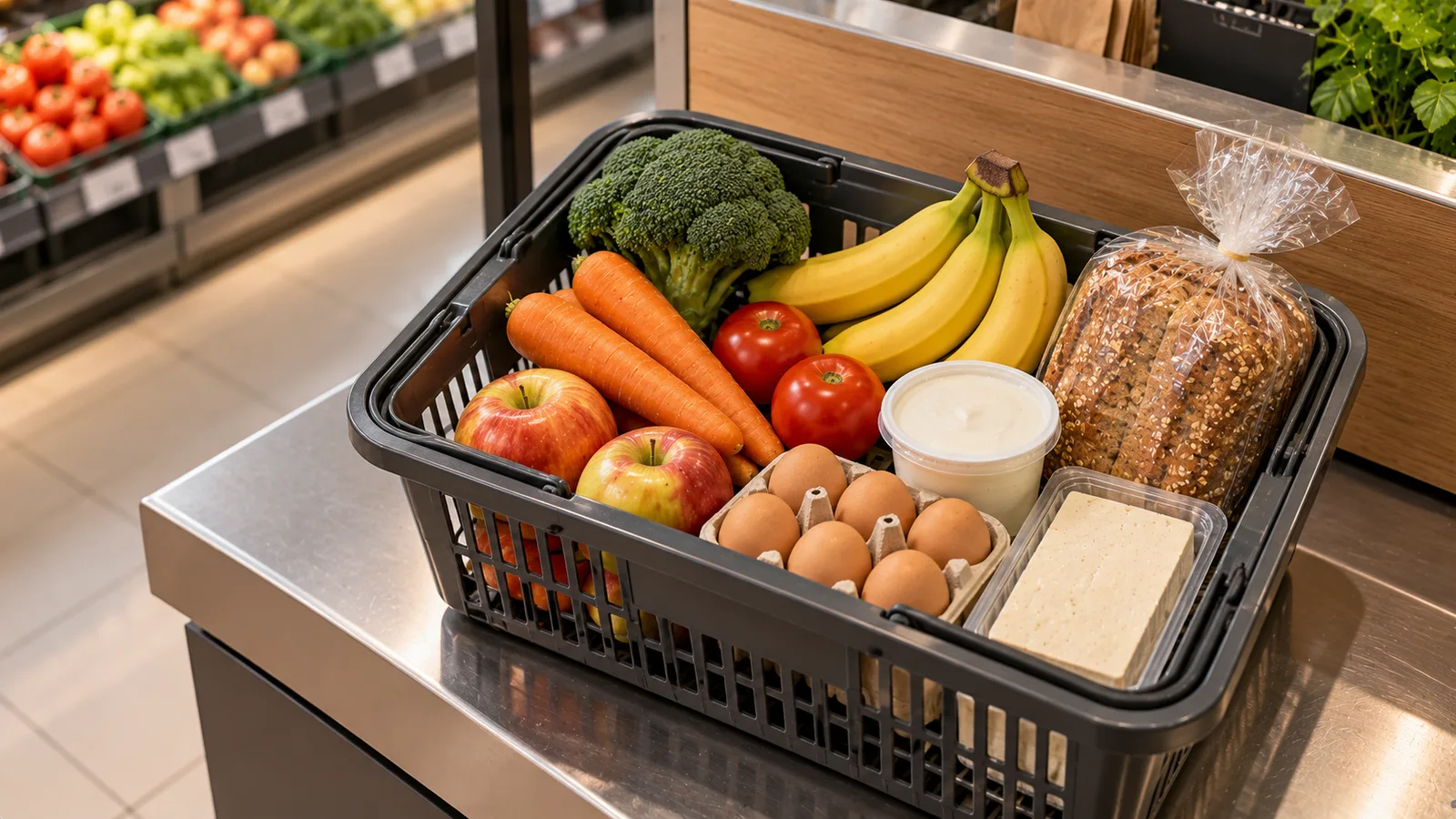
A balanced grocery basket does not require a perfect list of “healthy foods.”
The more useful goal is to bring home enough different building blocks to create balanced meals throughout the next several days.
That usually means having reliable sources of vegetables and fruit, protein foods, carbohydrate-rich staples, some unsaturated fats, and a few convenient foods that make the ingredients practical to use.
Think in food groups before individual products
Instead of starting with dozens of specific foods, check whether your basket covers the main roles you need for meals.
A simple framework is:
| Grocery group | Examples | Why it is useful |
|---|---|---|
| Vegetables | Broccoli, carrots, peppers, tomatoes, spinach, frozen vegetables | Fiber, micronutrients and meal volume |
| Fruit | Apples, bananas, berries, oranges, frozen fruit | Fruit, fiber and convenient snacks |
| Protein foods | Eggs, fish, chicken, tofu, beans, lentils, yogurt | Protein and meal structure |
| Carbohydrate staples | Potatoes, oats, rice, pasta, bread, other grains | Energy and flexible meal bases |
| Fats and flavor | Olive oil, nuts, seeds, avocado | Flavor, texture and dietary fats |
| Practical extras | Herbs, spices, canned tomatoes, sauces | Make basic ingredients easier to turn into meals |
You do not need something from every row in every meal.
The purpose is to make sure your kitchen has enough variety to build different combinations.
Start with vegetables
Look at your basket and ask a simple question:
Do I have vegetables for several different meals?
You might choose a combination such as:
- one leafy vegetable;
- one or two vegetables for cooking;
- one vegetable that can be eaten raw;
- one frozen option.
For example:
- spinach;
- broccoli;
- peppers;
- carrots;
- frozen mixed vegetables.
Frozen vegetables are useful because they reduce the pressure to use everything immediately.
Fresh, frozen and canned vegetables can all have a place in a balanced grocery basket.
Add fruit you will actually eat
Buying fruit is useful only if it gets eaten.
Choose fruit based on how you normally use it.
For example:
- bananas for breakfast or snacks;
- apples for portable snacks;
- berries for yogurt or oats;
- oranges or mandarins for an easy dessert;
- frozen fruit for smoothies or yogurt.
You do not need a large number of varieties every week.
Two or three options you reliably use can be more practical than a large assortment that spoils.
Make sure protein is represented
A common grocery-shopping problem is buying plenty of side ingredients but not enough foods that can anchor a meal.
Protein options can include:
- eggs;
- chicken or turkey;
- fish;
- tofu or tempeh;
- beans;
- lentils;
- Greek yogurt;
- cottage cheese;
- other protein foods that fit your preferences.
You can combine fresh and longer-lasting options.
For example, fresh fish may be intended for an early-week meal while canned beans, lentils, eggs or frozen protein foods provide flexibility later.
Choose carbohydrate staples deliberately
A balanced basket does not need to eliminate bread, rice, pasta or potatoes.
These foods can provide useful meal bases.
Options include:
- oats;
- potatoes;
- brown or white rice;
- whole-grain or regular pasta;
- whole-grain bread;
- couscous;
- bulgur;
- other grains.
When practical, including whole-grain options can increase fiber and provide a different nutrient profile.
But a balanced diet is determined by the overall pattern, not whether every carbohydrate food is whole grain.
If you want help evaluating packaged grain products, see How to Choose Whole-Grain Foods: A Practical Label Guide.
Include fats without letting them become invisible
Foods such as:
- olive oil;
- nuts;
- seeds;
- avocado;
- nut butter
can be useful parts of a balanced diet.
They are also energy-dense, so the amount used matters if you are tracking calories.
The goal is not to avoid them. It is simply to recognize their role rather than pouring oil or adding toppings without noticing how much is being used.
Check whether your basket can create actual meals
A basket can contain many nutritious foods and still be difficult to turn into dinner.
Before checking out, mentally combine the ingredients.
For example:
Meal 1
Chicken + potatoes + broccoli + yogurt-herb sauce
Meal 2
Lentils + rice + tomatoes + spinach
Meal 3
Eggs + whole-grain bread + tomatoes + fruit
Meal 4
Tofu + frozen vegetables + rice + simple sauce
If you cannot easily identify several meals, you may be buying isolated ingredients rather than a usable set of foods.
Use overlap between ingredients
You do not need a completely different ingredient list for every meal.
Ingredient overlap can make a grocery basket easier to use.
For example, spinach might appear in:
- eggs at breakfast;
- a lentil dish;
- pasta;
- a side salad.
Yogurt might become:
- breakfast;
- a snack;
- a sauce for dinner.
Tomatoes might be used in:
- sandwiches;
- salads;
- pasta sauce;
- bowls.
This kind of overlap helps create variety without requiring dozens of products.
Mix fresh foods with longer-lasting foods
If everything in the basket is highly perishable, the week can become a race against spoilage.
Combine different storage lives.
Use sooner
- fresh fish;
- delicate leafy vegetables;
- ripe berries;
- fresh herbs.
Moderate shelf life
- yogurt;
- eggs;
- carrots;
- peppers;
- apples.
Longer-lasting or backup foods
- oats;
- rice;
- pasta;
- canned beans;
- canned tomatoes;
- frozen vegetables;
- frozen fruit.
This gives you more flexibility when plans change.
Convenience foods can make the basket more useful
“Balanced” does not mean every ingredient must be completely unprocessed or require significant preparation.
Useful convenience foods can include:
- frozen vegetables;
- canned beans;
- pre-cooked lentils;
- plain yogurt;
- canned fish;
- whole-grain bread;
- microwaveable grains;
- washed salad leaves.
A convenient food that helps you assemble a balanced meal can be more useful than an ingredient that repeatedly spoils because you never have time to prepare it.
Packaged foods: check what matters
For packaged products, the nutrition label and ingredient list can help you compare options.
Depending on the food, useful things to examine include:
- serving size;
- energy;
- protein;
- fiber;
- saturated fat;
- sugars;
- salt or sodium;
- ingredients.
You do not need to optimize every number simultaneously.
The relevant comparison depends on the product and how it fits your overall diet.
For a detailed guide, see How to Read a Nutrition Label.
A balanced basket for breakfast
If you eat breakfast regularly, check whether you have combinations rather than only one isolated breakfast food.
Examples:
- oats + yogurt + fruit + nuts;
- eggs + bread + tomatoes;
- yogurt + berries + oats;
- cottage cheese + fruit + bread.
The exact combination can vary, but having more than one component usually makes it easier to create a complete meal.
A balanced basket for lunch
Lunch ingredients might include:
- a protein source;
- vegetables;
- bread, potatoes, rice or another carbohydrate source;
- a sauce or flavor component.
For example:
Chicken + rice + vegetables + yogurt sauce
or:
Lentils + bread + tomatoes + salad
The same ingredients can often be used for dinner, reducing the need for separate “lunch foods.”
A balanced basket for dinner
Dinner does not require special ingredients either.
A practical dinner combination might be:
Protein + vegetables + carbohydrate + flavor
For example:
- salmon + green beans + potatoes + herbs;
- tofu + vegetables + rice + sauce;
- beans + tomatoes + vegetables + bread;
- chicken + roasted vegetables + couscous.
The formula is flexible enough to work with many cuisines and preferences.
Do not forget snacks if you actually eat them
If snacks are part of your normal routine, leaving them out of the grocery basket can result in buying something unplanned later.
Useful snack components might include:
- fruit;
- yogurt;
- nuts;
- vegetables;
- hummus;
- eggs;
- whole-grain crackers;
- cottage cheese.
A snack does not need to contain all food groups.
For ideas on combining snack components, see Healthy Snacks: How to Build a More Satisfying Snack.
Drinks also belong in the shopping pattern
A balanced grocery basket is not only about solid food.
Depending on your habits, drinks may contribute meaningful calories, sugar or other nutrients.
Water can remain the default drink for hydration, while milk, coffee, tea and other beverages can fit according to your preferences.
The useful step is simply to remember that drinks are part of the overall eating pattern rather than an invisible category.
What if you dislike certain “healthy” foods?
You do not need to buy foods simply because they appear on generic healthy-shopping lists.
If you dislike quinoa, buy another grain.
If you do not eat fish, use other protein sources.
If raw salads are unappealing, choose vegetables you prefer cooked.
A grocery basket is only useful when its contents become actual meals.
Vegetarian grocery basket
A vegetarian basket can use protein foods such as:
- lentils;
- beans;
- chickpeas;
- tofu;
- tempeh;
- eggs;
- dairy foods where appropriate.
Combine them with vegetables, fruit, grains and other staples according to your preferences.
Variety across the overall diet is more useful than trying to make every individual meal nutritionally identical.
A quick basket audit before checkout
Before paying, take 30 seconds to check the basket.
Ask:
- Do I have several vegetables?
- Do I have fruit I will realistically eat?
- Do I have enough protein foods for my planned meals?
- Do I have useful carbohydrate staples?
- Do I have some sources of dietary fat and flavor?
- Can these ingredients become several actual meals?
- Do I have at least a few longer-lasting foods?
If one category is obviously missing, you can correct it before leaving the store.
Example balanced grocery basket
For one household, a simple basket might contain:
Vegetables
- broccoli;
- carrots;
- tomatoes;
- spinach;
- frozen mixed vegetables.
Fruit
- apples;
- bananas;
- frozen berries.
Protein foods
- eggs;
- chicken;
- lentils;
- Greek yogurt;
- tofu.
Carbohydrate staples
- oats;
- potatoes;
- rice;
- whole-grain bread.
Fats and flavor
- olive oil;
- nuts;
- herbs and spices.
Flexible extras
- canned tomatoes;
- beans;
- yogurt-based sauce ingredients.
This is an example, not a universal shopping list.
Quantities depend on household size, eating frequency, preferences and what is already at home.
Balanced shopping is not the same as budget shopping
A balanced grocery basket focuses primarily on having a useful nutritional mix of foods.
Saving money is a different optimization problem.
The two goals can overlap, but questions such as:
- which store is cheapest;
- whether bulk packs save money;
- how much to spend per week;
- which foods have the lowest unit price
belong to budget planning rather than defining nutritional balance.
Keeping these goals separate makes shopping decisions clearer.
Balanced shopping is not the same as building a meal-plan grocery list
If you already have a detailed meal plan, your shopping list should be derived from the meals and quantities you intend to prepare.
A balanced-basket check can then act as a final review, but it should not replace the meal-plan calculation.
For that workflow, see How to Make a Grocery List From Your Meal Plan.
The practical rule
A more balanced grocery basket is not the basket with the largest number of “healthy” products.
It is one that gives you enough useful components to repeatedly build meals containing vegetables or fruit, protein foods, suitable carbohydrate sources and appropriate fats while matching your preferences.
Before adding another isolated product, ask a better question:
What meal will I make with this?
That simple check can turn grocery shopping from collecting individual foods into building a practical eating pattern.