
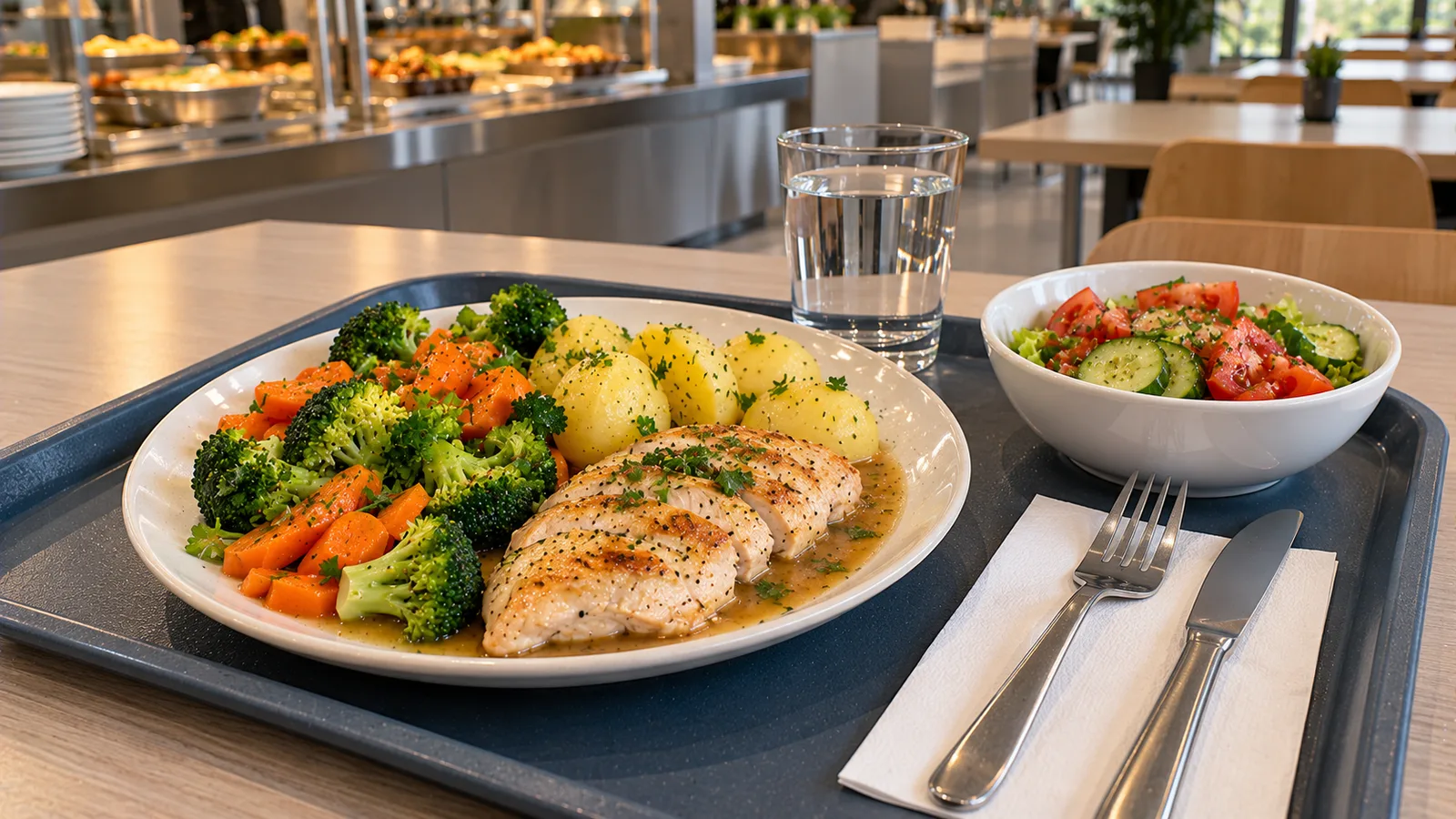
At a German workplace canteen (Kantine), university dining hall (Mensa) or public-service cafeteria, the headline price on the hot-meal board often tells you only part of the story. A main dish may have no vegetables; a cheap-looking entrée can become expensive after a salad, beverage and dessert. Equally, a vegetarian menu can be substantial without costing the most. The useful question is: what is on the entire tray, and what is the final price you actually pay?
This guide works through four illustrative German canteen trays, including serving amounts and itemised prices. All euro amounts are constructed examples, not surveyed or current prices at any German canteen. Your actual employee, student or guest price, subsidies, portion sizes and what is included may differ. Do not treat these examples as typical German price averages or as nutrient-certified menus.
A practical method at the serving counter
Before you collect food, scan the board and serving line in this order:
- Main and protein component. Identify what the dish contains: lentils, beans, tofu, eggs, fish, poultry or another food. A sauce or a dish name alone does not tell you how much protein is served.
- Vegetables or salad. Look for a meaningful vegetable component. If the main dish has little, check the price of a warm vegetable side or side salad. A small garnish is not the same as a side serving.
- Filling base. Potatoes, rice, grains or pasta supply a substantial part of the meal. If available and suitable, try a wholegrain option. Choose according to appetite rather than assuming one universal plate size.
- Sauce, drink and extras. Ask whether sauce or side dishes are included; check beverage, dessert, bread, refill and any deposit separately. Water is an option where available, but do not assume tap water is provided free.
- Payable total. Add everything on your tray at your own price tier before comparing offers.
The German Nutrition Society (DGE) recommendations emphasize vegetables and fruit, legumes and wholegrain foods across the diet. Its quality standards for institutional catering guide canteen operators. These are not a rule that each tray must contain an exact number of grams or that one menu can be officially certified from its appearance. The DGE's five daily portions of vegetables and fruit are a whole-day recommendation, not five portions at lunch.
Four worked trays: ingredients and checkout total
Each portion below is a hypothetical food amount as served and edible, not the raw recipe weight or a promise about a particular canteen. The drink line assumes water available at €0.00 in these scenarios only. If your canteen charges for water, add the listed price.
| Canteen tray | What is on the tray (illustrative served amounts) | Itemised example price | Total |
|---|---|---|---|
| A. Lentil-vegetable stew | Lentil stew with roughly 180 g cooked lentils and 200 g vegetables; 80 g wholegrain roll; water | Stew €5.40 + roll €0.80 + water €0.00 | €6.20 |
| B. Chicken, potatoes and vegetables | 120 g cooked chicken; 200 g cooked potatoes; 180 g vegetable side; water | Chicken-and-potato main €6.20 + vegetables €1.40 + water €0.00 | €7.60 |
| C. Tomato pasta, salad and yoghurt | 240 g cooked pasta in 150 g tomato sauce; 150 g salad; 150 g plain yoghurt; water | Pasta €5.20 + salad €1.60 + yoghurt €1.10 + water €0.00 | €7.90 |
| D. Breaded cutlet combo | 150 g breaded cutlet; 180 g fries; 330 ml sweetened drink; 100 g dessert | Cutlet €6.80 + fries €2.00 + drink €2.20 + dessert €1.50 | €12.50 |
Check the arithmetic: A = 5.40 + 0.80 = €6.20; B = 6.20 + 1.40 = €7.60; C = 5.20 + 1.60 + 1.10 = €7.90; D = 6.80 + 2.00 + 2.20 + 1.50 = €12.50. In this controlled example, D is €4.90 more than B. The difference is not a claim that any specific German canteen sells these meals for these amounts or that two plates provide identical calories.
Tray A: a vegetarian main that already contains vegetables and pulses
Lentil stew is convenient because its legumes, vegetables and broth or sauce can be in the same main. Check the real serving: a ladle of thin soup is not equivalent to the illustrative 180 g cooked lentils. The wholegrain roll is an optional filling base; omit it if you are comfortably satisfied with the stew. The total is €6.20 only if the main and roll cost the hypothetical amounts above.
A dish labelled vegetarisch simply tells you something about ingredients; it does not guarantee a high fibre content, protein quantity, vegetable serving, low salt level or low price. Ask what the lentil-to-broth balance looks like. For an at-home plate composition guide rather than the canteen purchase decision, see a budget balanced plate you can assemble at home.
Tray B: a familiar main that needs a vegetable side
The chicken-and-potato main starts at €6.20, but here it has no substantial vegetable serving. Adding the €1.40 vegetables makes the €7.60 tray easier to assess as a meal than the main-price label alone. The example uses 120 g cooked chicken and 200 g cooked potatoes; portions at the counter may be larger or smaller. Sauces and cooking fats can differ substantially, so do not invent a calorie or protein total without the recipe or reliable nutrition data.
Check whether the hot vegetable side is already part of a different daily special. Sometimes changing the main rather than purchasing another side is better value. If vegetables are included at no extra charge, the comparison changes to the canteen's actual checkout price.
Tray C: inexpensive pasta is not automatically the cheapest complete lunch
The €5.20 tomato pasta looks cheapest as a main. After adding a €1.60 salad and €1.10 plain yoghurt, the tray costs €7.90. The yoghurt adds a dairy component, but its actual protein depends on the product and 150 g portion; the plain pasta and tomato sauce should not be advertised as a high-protein meal. If a bean topping, lentil bolognese or vegetable-rich version is offered, compare the fully assembled price rather than buying extras automatically.
For those who cannot eat dairy, leave out the yoghurt and consider a suitable alternative if available. That changes both the nutritional profile and the receipt; it is not correct to retain €7.90 for a different tray.
Tray D: recognise extras without judging a single choice
The breaded-cutlet tray is €12.50 largely because it combines four priced items, not simply because it includes a breaded main. Fries, a sweetened beverage and dessert together cost €5.70 in this hypothetical bill. A different portion or drink could change the total immediately. This is not a prohibition on fried foods, desserts or a favourite meal; use it to identify which additions you want and which were selected out of habit.
A cost comparison cannot prove which tray fits an individual's calorie needs or medical requirements. If vegetables are not in the main, assess whether a side is available; you can also balance choices across the remainder of the day rather than trying to make a single cafeteria lunch perfect.
Compare a posted meal deal fairly
A Tagesgericht (daily special), Menü or Kombi-Angebot may include potatoes, side salad or a drink—or only the listed entrée. Some businesses show Mitarbeiterpreis (employee price), Gastpreis (guest price) and separate student rates. A subsidised staff lunch is not comparable with the guest price of another canteen without noting the difference.
Write the components in one line: main + essential sides + selected drink + optional additions + any mandatory charges − applicable discount = your actual total. Do not count a refundable Pfand deposit as the final food cost unless it is not returned, but remember it affects the amount you pay at the till. Avoid subtracting a staff subsidy twice if the displayed price already includes it.
Here is a miniature receipt example: main €5.20, side €1.60, drink €1.80 means €8.60, not €5.20. If a meal deal includes the side and drink for €7.50, that deal saves €1.10 compared with buying those three listed items separately—only if the portions and included items are actually the same.
Common situations on a German canteen menu
Only one vegetarian dish is offered. Check whether it has vegetables and a substantial protein-containing ingredient. If it is cheese-heavy pasta with few vegetables, a small salad might help, but check whether the extra cost is worthwhile. Vegetarian is a food category, not a nutritional rating.
The vegetable side is tiny or expensive. Compare a dish with vegetables already built in, such as a pulse stew, vegetable curry with beans or rice bowl. Asking for an extra scoop is reasonable, but confirm whether it changes the price.
A salad bar charges by weight. Price the full bowl at the scale. A large amount of dressing, cheese, seeds or other toppings may be useful, but it also changes both the bill and the meal; a plate-size estimate is not a checkout calculation.
You eat in a Mensa. Check student, employee and guest eligibility. Meal names and prices can change daily; posted menus are the authoritative source for that location. Do not use a price seen at another university as your own price.
You have little time. Decide on two questions before joining the queue: “Where is the vegetable serving?” and “What is the total with any needed sides?” A tray does not become balanced merely by choosing the cheapest main or by adding every extra.
How to use the answer without overclaiming
The German DGE recommends a predominantly plant-rich dietary pattern, with vegetables, whole grains and legumes playing important roles. Its catering guidance primarily addresses planning and quality across an institutional offer, rather than certifying the nutrient content of each menu line you see. For a different task—planning a balanced lunch during weight management rather than choosing a subsidised canteen meal—read building a balanced lunch for weight management.
Keep the takeaway simple: choose a main you like, see whether a genuine vegetable portion and suitable filling or protein component are already included, then compare the entire tray at the prices applicable to you. The hypothetical difference between €7.60 and €12.50 is €4.90 here, but another canteen may reverse the ranking. Food preference, allergies, hunger and the rest of the day's meals matter too.
Sources
- DGE: Gut essen und trinken — vegetables and fruit — dietary pattern and five daily portions of fruit/vegetables.
- DGE: Quality standards for institutional catering — guidance for canteens and other institutional catering operations.
- DGE: Nutrition recommendations overview — food-group context, wholegrains and pulses.
Price and weight disclosure: All four trays, gram amounts, € prices and calculations are constructed teaching examples, not primary research, live menus, supermarket prices or DGE-certified nutrient estimates.