
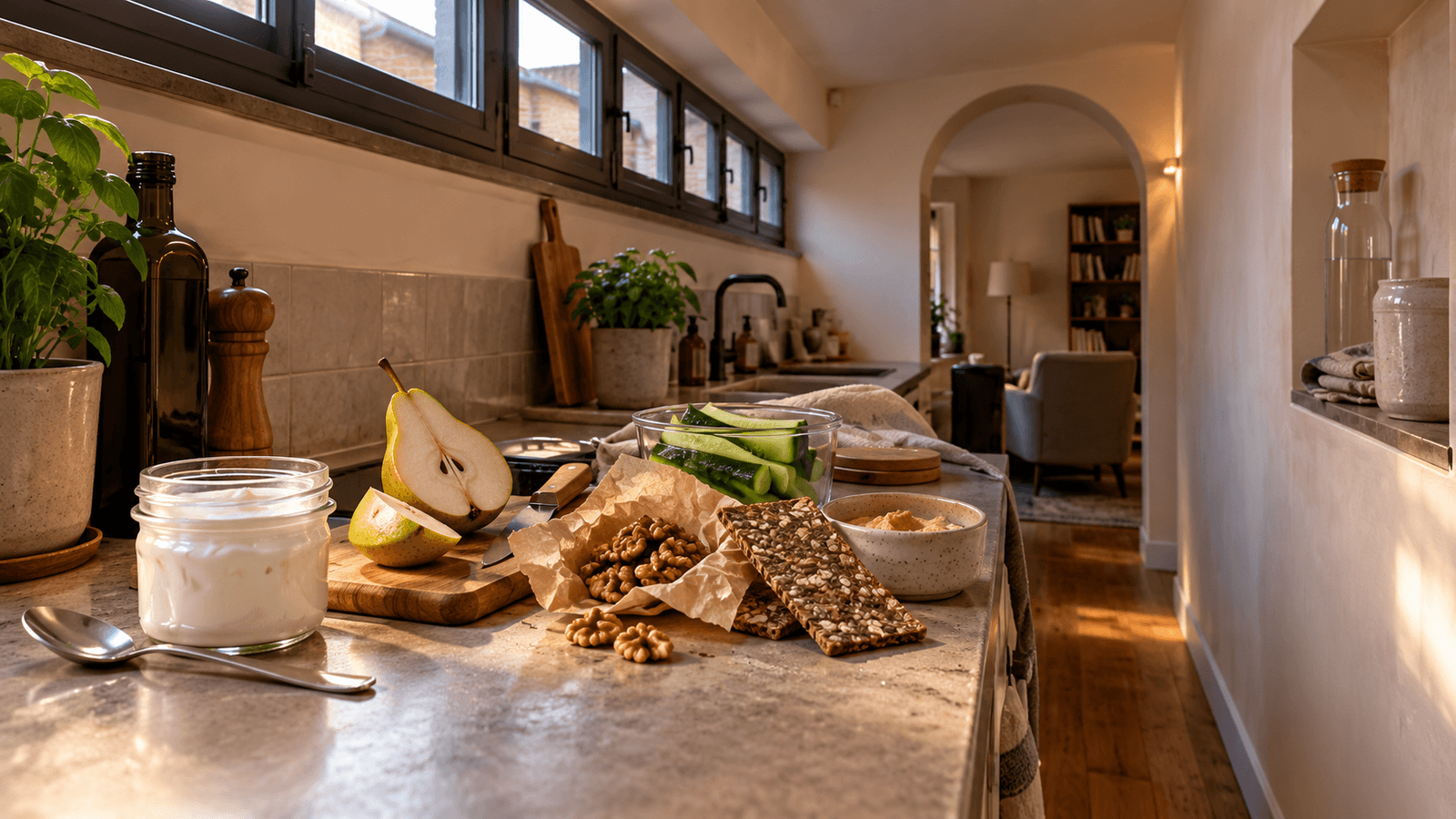
A snack can be much more than something small to eat between meals.
A well-chosen snack can help bridge a long gap between meals, contribute useful nutrients and make it easier to arrive at the next meal comfortably hungry rather than extremely hungry.
But there is no single formula that every snack needs to follow.
The most useful snack depends on your appetite, schedule, activity, preferences and what the rest of your day looks like.
What makes a snack satisfying?
A satisfying snack usually has enough substance to match the reason you are eating it.
That might involve a combination of:
- protein
- fiber-rich foods
- carbohydrates
- fat
- fluid
- enough overall food for your appetite
Not every snack needs all of these components.
The idea is to build a snack that serves its purpose rather than automatically choosing the smallest possible option.
Start by asking why you need the snack
Before choosing food, consider what the snack needs to do.
Are you:
- slightly hungry before dinner?
- facing several hours until your next meal?
- eating before exercise?
- eating after exercise?
- looking for something portable?
- trying to add more protein?
- trying to eat more fruit or vegetables?
The answer can change what makes sense.
Protein can make a snack more substantial
Protein is one component that can help make snacks more substantial.
Possible protein-containing snack foods include:
- yogurt
- skyr
- cottage cheese
- eggs
- tofu
- edamame
- beans
- hummus
- milk
- fortified soy alternatives
- nuts and seeds
The amount needed depends on the snack and the rest of your diet.
You do not need to turn every snack into a high-protein meal.
For broader guidance, see How Much Protein Do You Need Per Day?.
Fiber can add volume and structure
Fiber-rich foods can make snacks more nutritionally useful and may contribute to fullness.
Examples include:
- fruit
- vegetables
- whole-grain bread
- oats
- legumes
- nuts
- seeds
Rather than focusing only on a fiber number, think about including minimally processed plant foods regularly across the day.
See How Much Fiber Do You Need Per Day?.
Carbohydrates can be useful
Carbohydrates are not something that automatically needs to be removed from snacks.
Foods such as:
- fruit
- whole-grain bread
- oats
- crackers
- dairy products
- legumes
can provide carbohydrates along with other nutrients.
The amount that makes sense depends on your needs and the context of the snack.
Fat can contribute to satisfaction
Foods containing fat can add flavor, texture and energy.
Examples include:
- nuts
- seeds
- nut butter
- avocado
- cheese
- yogurt
- olive-based spreads
A small amount may be enough depending on the food and portion.
Because fat is energy-dense, portion size can matter if you are tracking energy intake.
See How Much Fat Do You Need Per Day?.
A simple way to build a snack
One practical approach is to combine two useful components.
For example:
- fruit + yogurt
- vegetables + hummus
- whole-grain bread + cottage cheese
- apple + nut butter
- skyr + berries
- crackers + cheese
- fruit + nuts
- oats + yogurt
These are examples rather than rules.
A single food can also be a perfectly reasonable snack when it matches your hunger and circumstances.
Fruit as a snack
Fruit is portable, convenient and can contribute fiber, vitamins and minerals.
Examples include:
- apples
- pears
- oranges
- berries
- grapes
- bananas
- peaches
If fruit alone does not keep you satisfied for long, you can pair it with another food such as yogurt, nuts or cheese.
Vegetables as a snack
Vegetables can work well when you enjoy them in snack form.
Examples include:
- carrots
- cucumber
- peppers
- cherry tomatoes
- radishes
They can be paired with hummus, yogurt-based dips or another food that adds protein or fat.
There is no need to force raw vegetables as a snack if you do not enjoy them.
Yogurt and skyr
Plain yogurt and skyr can provide protein and work well with:
- fruit
- oats
- nuts
- seeds
Different products vary in protein, fat, sugar and calorie content.
Choose according to your preferences and needs rather than assuming one type is always superior.
Nuts and seeds
Nuts and seeds provide fat, some protein, fiber and micronutrients.
They are compact and easy to carry.
Because they are energy-dense, a visually small amount can contain substantial energy.
That is not inherently a problem, but it can matter if you are trying to estimate your intake accurately.
Bread and crackers
Whole-grain bread or crackers can provide a convenient carbohydrate base.
Possible additions include:
- cottage cheese
- hummus
- cheese
- egg
- nut butter
Check the actual product when tracking calories because slices and crackers can vary considerably in size.
Eggs as a snack
Cooked eggs can be a convenient source of protein and fat.
They can be eaten alone or combined with vegetables, bread or another food depending on appetite.
For nutrition and portion details, see Calories in an Egg: Nutrition and Serving Sizes.
Hummus and legumes
Hummus can add flavor, some protein and fat to vegetables, bread or crackers.
Beans, chickpeas and edamame can also work as snack ingredients.
Prepared products vary, particularly in added oil and other ingredients.
Cottage cheese
Cottage cheese can provide protein and can be combined with sweet or savory ingredients.
For example:
- fruit
- berries
- cucumber
- tomatoes
- whole-grain bread
Choose combinations based on preference rather than trying to create a theoretically perfect snack.
Tofu as a snack ingredient
Tofu can also be used in snacks, particularly in savory preparations.
Different tofu products vary in water content, firmness and nutrition.
See Calories in Tofu: Nutrition, Portions and Common Serving Sizes.
What about packaged snack foods?
Packaged foods can fit into a balanced diet.
A snack does not become unhealthy simply because it comes in a package.
However, products vary substantially.
If you are choosing between options, useful information may include:
- portion size
- protein
- fiber
- added ingredients
- energy content
- how satisfying you personally find it
The nutrition label can help when these details matter.
Do healthy snacks need to be low in calories?
No.
A useful snack should match your needs.
A very small low-calorie snack may be insufficient if you have several hours until your next meal or have higher energy needs.
On the other hand, a large energy-dense snack may be more than you need if dinner is soon.
Context matters.
Snacks and weight loss
Snacks can fit into a weight-loss plan.
There is no requirement to snack, and there is no requirement to avoid snacks.
The important question is whether snacks help your overall eating pattern.
For some people, a planned snack helps manage hunger between meals.
For others, frequent snacks add energy without improving satisfaction.
See How to Build a Filling Meal for Weight Loss.
Should you snack if you are not hungry?
Not necessarily.
If there is no practical or nutritional reason to eat, you do not need to snack simply because it is a certain time of day.
However, hunger is not the only possible reason to eat.
For example, someone may choose a planned snack before a long period without access to food.
What if you get hungry soon after a snack?
Consider whether the snack was large enough and whether it contained enough substance for the situation.
For example, if a piece of fruit alone leaves you hungry quickly, you might try adding:
- yogurt
- nuts
- cheese
- cottage cheese
- hummus
You can also consider whether the previous meal was sufficiently satisfying.
Snacks before exercise
A pre-exercise snack may emphasize easily tolerated carbohydrates, particularly when eaten relatively close to activity.
The ideal choice depends on:
- exercise type
- duration
- intensity
- timing
- individual digestion
Large amounts of fat, fiber or protein immediately before some forms of exercise may be uncomfortable for some people.
Snacks after exercise
After exercise, a snack may help bridge the gap until the next meal.
Protein and carbohydrate-containing foods can be practical choices, depending on the activity and when you will eat next.
If a normal meal is coming soon, a separate recovery snack may not be necessary.
Portable snack ideas
Useful portable options can include:
- fruit
- nuts
- whole-grain crackers
- shelf-stable milk or soy drink where appropriate
- simple sandwiches
- packaged roasted legumes
- other foods that can be stored safely
Food safety matters when carrying dairy products, eggs, cooked foods or other perishable items.
Snacks at work
Keeping a few practical options available can reduce reliance on whatever happens to be nearby.
Depending on storage facilities, examples could include:
- fruit
- nuts
- whole-grain crackers
- oats
- yogurt
- skyr
- hummus and vegetables
Choose foods that you will realistically eat.
Snacks for long gaps between meals
If several hours separate meals, a more substantial snack may be appropriate.
Combining protein with a carbohydrate or fiber-rich food can be a useful starting point.
Examples include:
- yogurt + fruit
- bread + cottage cheese
- hummus + vegetables + crackers
- fruit + nuts
Again, portion size should reflect your appetite and schedule.
Snacks when the next meal is soon
If the next meal is relatively close, a smaller snack may be enough.
You might choose:
- fruit
- yogurt
- a small amount of nuts
- vegetables with a small amount of dip
There is no reason to build a large snack if you only need a small bridge to the next meal.
Sweet snacks can fit too
A balanced eating pattern does not require every snack to look like a nutrition textbook.
Chocolate, biscuits and other sweet foods can fit.
If a sweet snack alone is not very satisfying, you might combine it with another food such as:
- fruit
- yogurt
- milk
- nuts
This is optional, not a rule.
Savory snack ideas
Possible savory combinations include:
- cucumber + hummus
- whole-grain bread + cottage cheese
- egg + tomatoes
- crackers + cheese
- tofu + vegetables
- edamame
- yogurt-based dip + vegetables
Use foods that fit your preferences and practical situation.
Portion size
There is no universal snack portion.
A useful portion depends on:
- hunger
- time until the next meal
- body size
- activity
- total energy needs
- the foods chosen
A snack can range from something very small to something closer to a mini-meal.
Snack or mini-meal?
The distinction is not especially important.
If you need enough food to comfortably cover a long gap, a mini-meal may make more sense than trying to force the food into a tiny “snack” portion.
What matters is whether it works within your overall eating pattern.
How to make snacks more convenient
Convenience can make a large difference.
Helpful habits include:
- keeping fruit visible
- portioning foods when useful
- having yogurt or other easy protein foods available
- keeping a few shelf-stable options
- washing vegetables ahead of time when practical
Do not prepare so much in advance that the food is likely to be wasted.
Use what you already have
Before buying special snack products, look at what is already available.
A snack can often be assembled from ordinary foods already used for meals.
For example:
- leftover bread + cheese
- yogurt + fruit
- vegetables + hummus
- oats + milk
- fruit + nuts
This can also help reduce unnecessary grocery spending and food waste.
Snacks and meal planning
Snacks can be included in meal planning without scheduling every bite.
If you regularly become hungry at a certain point in the day, keeping suitable foods available can make the plan more realistic.
If you rarely snack, there is little reason to buy large quantities of dedicated snack foods.
Common mistakes
Choosing the smallest possible snack
A snack that is too small may not solve the hunger that prompted it.
Assuming every snack needs protein
Protein can be useful, but not every eating occasion needs to be optimized.
Ignoring energy-dense additions
Nuts, nut butter, cheese and oils can be nutritious but contribute substantial energy in relatively small amounts.
Buying special “healthy snack” products unnecessarily
Ordinary foods can work perfectly well.
Eating by the clock regardless of appetite
A fixed snack schedule is not necessary for everyone.
Making snacks too complicated
A satisfying snack can be as simple as two familiar foods.
A practical snack framework
When you want a more substantial snack, try this process:
Step 1: assess your hunger
How hungry are you, and how long until the next meal?
Step 2: choose a base
This might be:
- fruit
- vegetables
- bread
- oats
- crackers
Step 3: add substance if needed
Possible additions include:
- yogurt
- skyr
- cottage cheese
- egg
- hummus
- tofu
- nuts
- seeds
- cheese
Step 4: choose an appropriate amount
Use your appetite and schedule rather than a universal serving size.
Step 5: keep it practical
The best snack is one you can actually prepare, carry and enjoy.
Example snack combinations
Practical combinations include:
- apple + plain yogurt
- berries + skyr
- pear + nuts
- carrots + hummus
- cucumber + cottage cheese
- whole-grain bread + egg
- crackers + cheese
- oats + yogurt
- banana + nut butter
- edamame + fruit
These examples are flexible.
You can substitute foods according to availability, preferences, allergies and dietary needs.
How Mealisa-style planning can help
A nutrition and meal-planning system can make snacks easier to manage when it considers them as part of the whole day rather than isolated foods.
Useful features can include:
- recording snacks quickly
- estimating portions
- seeing how snacks contribute to daily intake
- planning snack options around available foods
- adjusting the rest of the day when needed
The purpose is not to make every snack mathematically perfect.
It is to make everyday food decisions easier to understand.
Frequently asked questions
What is the healthiest snack?
There is no single healthiest snack. A useful choice depends on your nutritional needs, appetite, schedule and preferences.
Should every snack contain protein?
No. Protein can make some snacks more substantial, but it is not mandatory at every snack.
Is fruit enough for a snack?
It can be. If fruit alone does not keep you satisfied for long, you can combine it with another food such as yogurt, nuts or cheese.
Are nuts a healthy snack?
Nuts can provide unsaturated fats, protein, fiber and micronutrients. They are also energy-dense, so the amount can matter depending on your goals.
Can I eat snacks while losing weight?
Yes. Snacks can fit into a calorie deficit. Whether they are useful depends on your overall eating pattern.
Should I avoid carbohydrates in snacks?
No. Carbohydrate-containing foods can be useful parts of snacks.
How many snacks should I eat per day?
There is no universal number. Some people rarely snack, while others find one or more snacks practical.
What if I am always hungry between meals?
Look at both the snacks and the meals around them. Meal size, protein, fiber, energy intake, activity and meal timing can all influence hunger.
The bottom line
A satisfying snack does not need to follow a perfect formula.
A practical approach is to:
- consider why you need the snack
- choose enough food for the situation
- include protein when useful
- include fiber-rich plant foods regularly
- use carbohydrates and fats according to your needs
- keep portions appropriate to your appetite
- choose foods you actually enjoy
Sometimes a piece of fruit is enough.
Sometimes yogurt and berries make more sense.
Sometimes you need something closer to a small meal.
The best snack is the one that fits the gap it needs to fill and works within your overall eating pattern.
This article provides general educational nutrition information and is not individualized medical or dietary advice.