
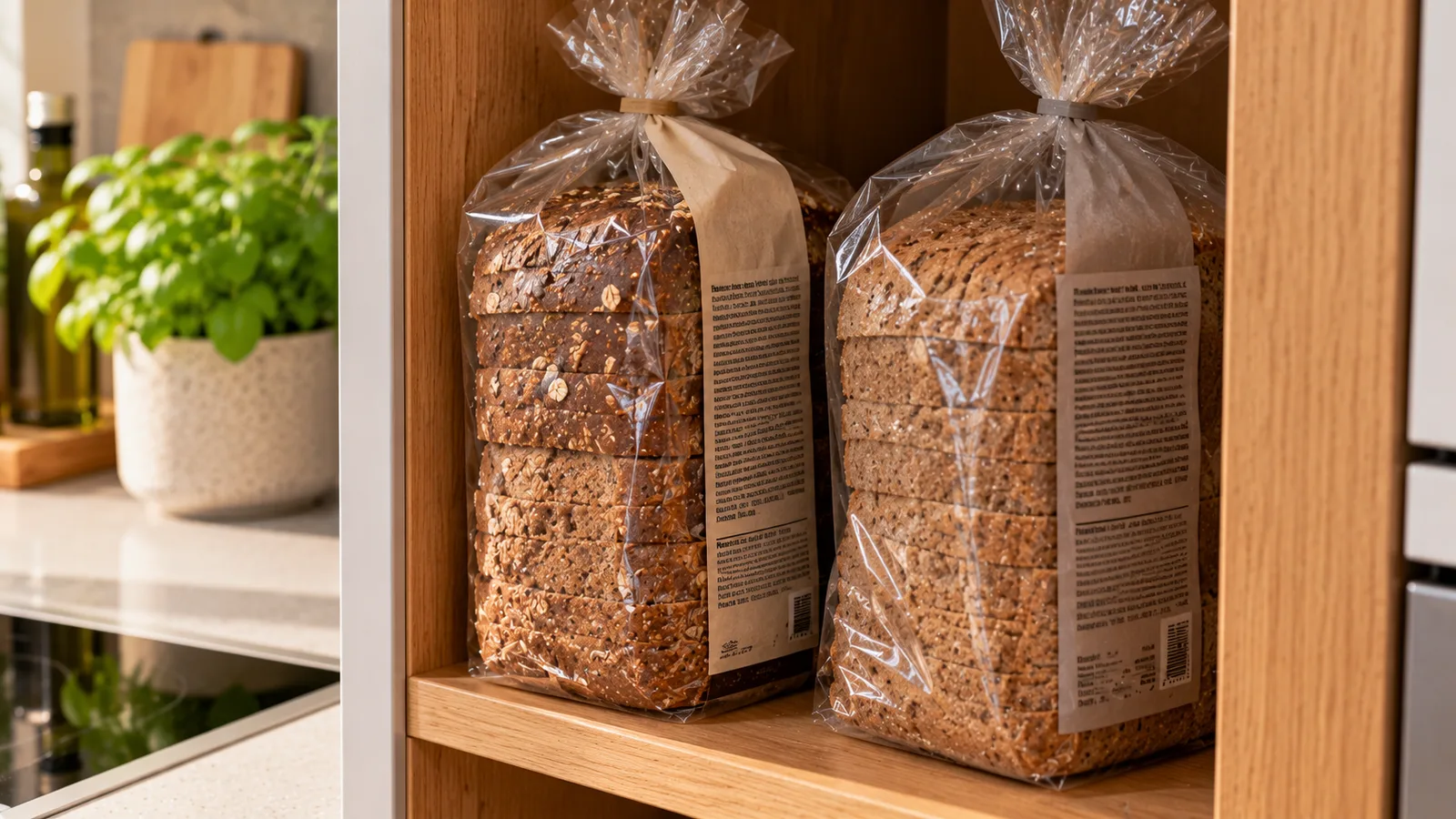
Choosing a whole-grain food can be surprisingly confusing.
A dark loaf of bread is not automatically whole grain. A package covered with seeds may still be made mostly from refined flour. Words such as “multigrain,” “wheat” or “with grains” do not necessarily tell you how much of the grain is whole.
The most reliable approach is to look beyond the front of the package and check what the product is actually made from.
What is a whole grain?
A grain kernel has three main parts:
- bran;
- germ;
- endosperm.
Whole-grain foods retain these components in approximately the same proportions as the intact grain.
Refining typically removes much of the bran and germ, changing the grain's fiber and micronutrient profile.
Common whole grains include:
- whole wheat;
- oats;
- rye;
- barley;
- brown rice;
- buckwheat;
- bulgur;
- quinoa;
- millet.
Some of these are botanically classified differently, but they are commonly grouped with whole grains in everyday nutrition guidance.
Start with the ingredient list
When choosing a packaged grain product, the ingredient list is often more informative than the design on the front.
Ingredients are generally listed in descending order by weight.
That means the first few ingredients can tell you what makes up most of the product.
For example, compare:
Product A
Whole-grain wheat flour, water, yeast, salt.
Product B
Wheat flour, water, seeds, whole-grain wheat flour, yeast, salt.
Product A clearly uses whole-grain flour as its primary grain ingredient.
Product B contains some whole grain, but refined wheat flour appears first.
Look for explicit whole-grain wording
Useful ingredient terms can include:
- whole-grain wheat flour;
- whole wheat;
- whole rye;
- whole oats;
- brown rice;
- whole barley.
Exact terminology differs between countries and products.
The important point is that the ingredient should explicitly identify the grain as whole rather than merely naming the grain.
“Wheat flour” and “whole-grain wheat flour” are not necessarily the same thing.
Why package color is unreliable
Manufacturers can make bread darker using ingredients such as:
- malt;
- caramelized ingredients;
- molasses;
- seeds;
- darker flours.
Color alone therefore does not establish that a product is predominantly whole grain.
The same applies in reverse: some whole-grain products can look relatively light.
Use the ingredient list rather than color as your primary check.
“Multigrain” does not automatically mean whole grain
Multigrain simply indicates that more than one type of grain may be present.
A multigrain bread could contain several refined grains.
For example:
- wheat flour;
- rye flour;
- oat flakes.
That may be a multigrain product, but the word itself does not tell you whether the main flours are whole grain.
Check the actual ingredients.
“Wheat” is not the same as “whole wheat”
A product labeled as wheat bread may still use refined wheat flour as its main ingredient.
The word “wheat” identifies the grain.
The word “whole” tells you more about how much of the grain kernel has been retained.
This distinction is especially useful when comparing similar breads.
Seeds do not make bread whole grain
Seeds can add flavor, texture and nutrients.
But a bread covered with sunflower, sesame, flax or pumpkin seeds can still have refined flour as its main grain ingredient.
Treat seeds and whole grains as separate characteristics.
A bread can be:
- whole grain with seeds;
- whole grain without seeds;
- refined grain with seeds;
- refined grain without seeds.
Use fiber as a supporting clue
The nutrition label can provide another useful piece of information.
Whole-grain products often contain more fiber than comparable refined products, although the amount varies substantially.
Fiber should not be used as the only test.
A manufacturer can add isolated fiber to a product made largely from refined grains.
Instead, use fiber together with the ingredient list.
A practical sequence is:
- identify the main grain ingredients;
- check whether they are whole grain;
- compare fiber between similar products;
- then consider calories, salt, sugar and other factors relevant to you.
Compare similar products, not unrelated foods
Fiber values are most useful when comparing products in the same category.
For example:
- two sandwich breads;
- two breakfast cereals;
- two crispbreads;
- two pasta products.
Comparing bread with oatmeal is much less useful because their serving sizes, water content and typical uses differ.
Whole-grain bread: what to check
For bread, begin with the first ingredient.
A strong whole-grain candidate might list:
- whole-grain wheat flour;
- whole rye flour;
- water;
- yeast;
- salt.
A different loaf might list refined wheat flour first and a smaller amount of whole-grain flour later.
Both can contain whole grains, but they are not equivalent.
Also check:
- fiber;
- salt;
- added sugars when relevant;
- serving size.
Whole-grain pasta
Whole-grain pasta is usually easier to identify because the primary flour can often be clearly stated.
Look for wording equivalent to:
- whole durum wheat;
- whole-grain durum wheat semolina;
- whole wheat flour.
Then compare the ingredient list with standard pasta made from refined durum wheat semolina.
The calorie difference may be relatively small.
The main reason to choose the whole-grain version is not necessarily that it has dramatically fewer calories, but that its grain composition and fiber content differ.
Brown rice vs white rice
Brown rice retains more of the original grain structure than white rice.
Both can fit into a balanced diet.
Choosing brown rice does not mean white rice becomes a “bad” food.
Whole-grain choices are best viewed as one way to increase the proportion of minimally refined grain foods in your overall diet.
Oats
Plain oats are a straightforward whole-grain option.
However, oat-based products can vary greatly.
Compare:
- plain rolled oats;
- sweetened instant oatmeal;
- granola;
- oat cereal;
- oat bars.
The presence of oats does not make the complete product nutritionally identical to plain oats.
Check the full ingredient list and nutrition information.
Breakfast cereals
Breakfast cereal labels can be particularly confusing because a product may contain:
- whole grains;
- refined grains;
- added sugars;
- added fiber;
- nuts;
- dried fruit;
- chocolate;
- other ingredients.
Do not judge the cereal from one front-of-pack claim.
Instead:
- check the first ingredients;
- identify which grains are whole;
- review fiber;
- check added or total sugars as appropriate for the label in your country;
- compare products per 100 g or equivalent serving information.
Crackers and crispbreads
A brown cracker with visible seeds is not necessarily whole grain.
Use the same method:
- read the ingredients;
- identify the main flour;
- look for explicit whole-grain wording;
- compare fiber with similar products.
This is more reliable than visual appearance.
What about sourdough?
“Sourdough” describes a fermentation method, not whether the flour is whole grain.
Sourdough bread can be made from:
- refined flour;
- whole-grain flour;
- a mixture of both.
A sourdough loaf and a whole-grain loaf therefore describe different characteristics.
If whole grain is your priority, check the flour ingredients.
Organic does not mean whole grain
Organic describes how ingredients are produced under the applicable organic standards.
It does not automatically indicate that the grain is whole.
An organic product can still be made from refined flour.
Likewise, a non-organic product can use whole-grain flour.
Treat these as separate questions.
Gluten-free does not automatically mean whole grain
Gluten-free products can be based on ingredients such as:
- rice flour;
- corn starch;
- potato starch;
- buckwheat;
- oats certified as appropriate for gluten-free use;
- other grains and starches.
Some are predominantly whole grain; others are highly refined.
If you need a gluten-free product and also want more whole grains, inspect the ingredient list rather than relying on the gluten-free label alone.
Whole grain does not automatically mean low calorie
Whole-grain bread, pasta or cereal can have a similar calorie density to refined versions.
The benefit of choosing whole grains should not be reduced to a claim that they always contain fewer calories.
For weight management, portions and the rest of the meal still matter.
A large amount of whole-grain bread with calorie-dense toppings can contain more calories than a smaller meal built with refined bread.
The overall meal matters.
Whole grain does not automatically mean low sugar
A breakfast cereal can contain whole grains and still contain substantial added sugar.
A snack bar can contain whole oats and also include syrups, chocolate or other sweet ingredients.
Whole grain is one characteristic of a food.
It does not automatically determine every other nutritional characteristic.
Whole grain does not automatically mean low salt
Bread and other grain products can contribute meaningful amounts of salt.
If sodium or salt intake matters to you, compare that information separately.
Do not assume a whole-grain product is automatically lower in salt than a refined alternative.
A practical supermarket comparison
Imagine three breads.
Bread A
First ingredient: whole-grain wheat flour.
Fiber: relatively high compared with the other breads.
Bread B
First ingredient: wheat flour.
Whole-grain flour appears later.
Fiber: moderate.
Bread C
First ingredient: wheat flour.
The bread is dark and covered with seeds.
Fiber: similar to Bread B.
If your goal is specifically to choose the product with the strongest whole-grain basis, Bread A is the clearest candidate.
The appearance of Bread C should not override its ingredient list.
A simple five-step label check
When comparing grain products:
1. Ignore the package design initially
Turn the product around.
2. Read the first few ingredients
Identify the primary grain or flour.
3. Look for explicit whole-grain terms
Do not assume that “wheat,” “multigrain” or a dark color means whole grain.
4. Check fiber
Use it as supporting information, especially when comparing similar products.
5. Consider the rest of the nutrition label
Depending on your needs, compare:
- calories;
- salt or sodium;
- sugars;
- protein;
- serving size.
This takes much less time once you have done it a few times.
When a product contains a mixture of whole and refined grains
Not every product is entirely whole grain or entirely refined.
Many contain both.
For example:
Whole-grain wheat flour, wheat flour, water, yeast, salt.
This product clearly contains a meaningful amount of whole-grain flour, but it also contains refined flour.
You do not need to classify every food as perfect or worthless.
Instead, compare available options and choose according to your preferences, budget and overall diet.
Does every grain food need to be whole grain?
No.
A balanced diet does not require every serving of bread, rice, pasta or cereal to be whole grain.
A practical approach is to make whole grains a regular part of your diet while still allowing refined grain foods when you prefer them or when they suit a particular meal.
This is usually more realistic than treating refined grains as forbidden.
Choosing whole grains on a budget
Whole-grain products are not always more expensive.
Useful lower-cost options can include:
- plain oats;
- brown rice;
- whole-grain pasta;
- store-brand whole-grain bread;
- bulgur;
- barley.
Compare unit prices rather than assuming one package is cheaper because its total price is lower.
Also consider waste.
A product you actually enjoy and finish can be a better purchase than one you buy for nutritional reasons but regularly throw away.
Whole grains when eating out
Restaurant menus may not provide enough detail to determine whether a grain is truly whole.
Terms such as:
- brown rice;
- whole-wheat pasta;
- whole-grain bread
are relatively informative when explicitly stated.
For other foods, exact grain composition may be impossible to know.
You do not need perfect information at every meal.
Focus on choices you can control consistently.
Common mistakes when choosing whole-grain foods
Choosing by color
Dark does not automatically mean whole grain.
Choosing by visible seeds
Seeds and whole grains are different characteristics.
Assuming multigrain means whole grain
Multiple grains can all be refined.
Looking only at fiber
Added fiber can increase the number without changing the primary flour.
Assuming whole grain means fewer calories
Calorie content may be similar to refined versions.
Ignoring the rest of the product
A food can be whole grain while also containing substantial sugar, salt or calorie-dense additions.
How to compare two products quickly
If you have only a few seconds:
First: compare the first ingredient.
Second: check whether the main grain is explicitly whole.
Third: compare fiber.
If both products have a similar whole-grain basis, then compare the factors that matter most to you, such as:
- price;
- salt;
- sugar;
- calories;
- taste;
- serving size.
This keeps the decision practical.
Using Mealisa when comparing grain foods
When logging packaged grain foods, product-specific information is often more useful than a generic database entry.
For example, two breads can differ in:
- calories;
- fiber;
- protein;
- salt;
- serving weight.
Using the nutrition label or barcode data can therefore provide a more accurate picture of the product you actually ate.
Mealisa can also help compare foods in the context of the rest of your day rather than treating one ingredient as the sole measure of diet quality.
The practical takeaway
To choose whole-grain foods, do not rely on package color, seeds or words such as “multigrain.”
Instead:
- read the ingredient list;
- identify the main grain ingredients;
- look for explicit whole-grain wording;
- use fiber as supporting evidence;
- compare other nutrition information according to your needs.
The goal is not to find a perfect package.
It is to make it easier to recognize products that genuinely contain more whole grain and choose them regularly when they fit your meals.