
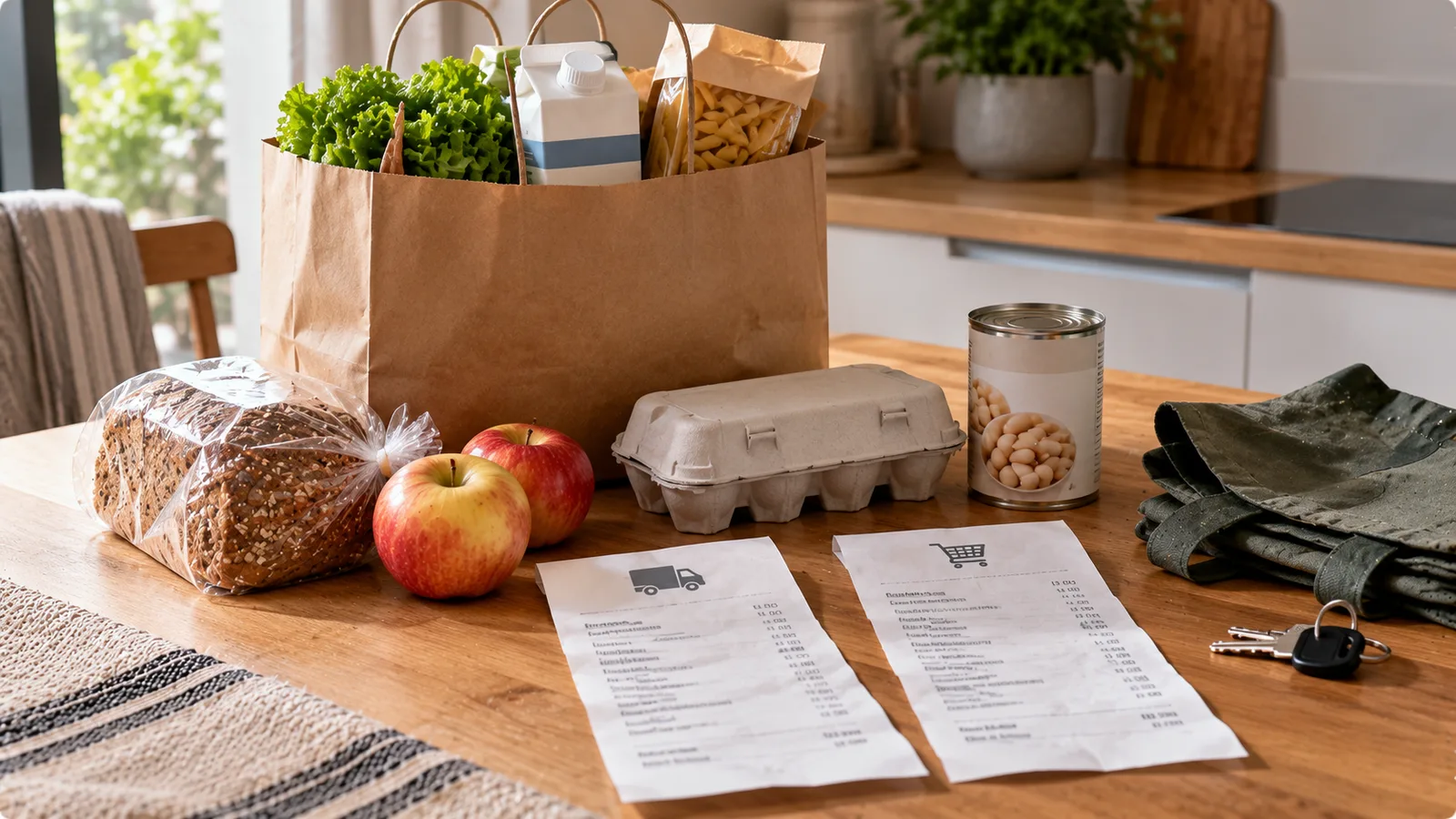
Grocery delivery can save time and travel, but the delivery fee alone does not tell you whether it costs more than visiting a supermarket.
The real comparison includes the prices of the groceries, delivery or pickup charges, service fees, tips, discounts, transport costs and the value of your time.
Sometimes delivery is clearly more expensive. Sometimes the difference is small. And for a household that would otherwise make a special car journey, delivery can occasionally cost less in direct out-of-pocket expenses.
The answer depends on the same basket of groceries, the same quantities and the actual charges available to you.
The complete cost comparison
Start with two separate calculations.
Delivery cost = delivered item prices + delivery fee + service charges + tip + other charges − discounts.
In-store cost = in-store item prices + transport expenses + parking + other trip expenses − discounts.
If you want an economic comparison rather than a cash-only comparison, add the value of time spent ordering, receiving, traveling and shopping.
Do not count the same expense twice. For example, if a subscription eliminates a delivery fee, use the actual fee charged and account for the subscription separately.
What changes the price?
| Cost component | Grocery delivery | Shopping in store |
|---|---|---|
| Grocery prices | May include online-specific prices or markups | Shelf or loyalty prices |
| Delivery charge | Often applies unless waived | Usually none |
| Service or handling charge | May apply | Usually none |
| Tip | May apply depending on market and service | Usually none |
| Small-order surcharge | Possible | Usually none |
| Bags or packaging | May be charged | May be charged |
| Promotions | Online offers and vouchers | In-store offers and loyalty discounts |
| Transport | Usually no shopping trip | Fuel, transit, parking or vehicle costs |
| Time | Ordering and receiving | Travel, shopping and checkout |
| Substitutions | May affect final bill | You choose alternatives yourself |
The fee structure varies by retailer, location, delivery window and membership.
Some retailers use the same item prices online and in store. Others do not.
That is why a retailer's advertised delivery fee is not enough to calculate the total difference.
Example 1: delivery costs more
Imagine a household buying the same groceries through two channels.
| Expense | Delivery | In store |
|---|---|---|
| Grocery basket | €82.00 | €78.00 |
| Delivery fee | €4.99 | €0 |
| Service fee | €2.50 | €0 |
| Tip | €3.00 | €0 |
| Transport | €0 | €2.50 |
| Discounts | −€5.00 | −€3.00 |
| Total | €87.49 | €77.50 |
Delivery costs €9.99 more.
The difference is not simply the €4.99 delivery fee.
It also reflects higher basket prices, a service fee, a tip and different discounts.
However, the example does not assign a monetary value to shopping time.
Example 2: delivery can be cheaper in cash terms
Now consider someone who would need a special car trip to reach a supermarket.
| Expense | Delivery | In store |
|---|---|---|
| Grocery basket | €65.00 | €63.00 |
| Delivery fee | €3.99 | €0 |
| Service fee | €0 | €0 |
| Tip | €0 | €0 |
| Transport and parking | €0 | €8.00 |
| Discounts | −€4.00 | −€1.00 |
| Total | €64.99 | €70.00 |
Delivery is €5.01 cheaper in this hypothetical example.
That does not mean delivery is generally cheaper.
The result depends on the unusually high cost of a dedicated shopping trip and the available discounts.
If the supermarket visit is combined with an existing journey, the incremental transport cost may be much lower.
Compare identical baskets, not similar-looking totals
A €70 delivery order and a €65 supermarket receipt may not contain the same quantity of food.
For a meaningful comparison, match:
- Product type and brand.
- Package size.
- Quantity purchased.
- Edible or usable weight.
- Product quality and relevant dietary requirements.
- Actual final price after discounts.
For example, a 750 g bag of frozen vegetables for €2.40 is not directly comparable with a 1 kg bag for €2.90.
Calculate the unit price:
Unit price = product price ÷ package quantity.
For the examples:
- €2.40 ÷ 0.75 kg = €3.20/kg.
- €2.90 ÷ 1 kg = €2.90/kg.
The second bag is cheaper per kilogram, even though its package price is higher.
Unit prices are especially useful when online and physical stores sell different package sizes.
The hidden cost of item markups
Suppose your in-store basket costs €80.
If the same groceries cost 5% more through the delivery platform, the online basket becomes:
€80 × 1.05 = €84.
That is a €4 markup before delivery fees.
Add a €4.99 delivery fee and a €2 service charge:
€84 + €4.99 + €2 = €90.99.
The difference from the €80 shelf-price basket is €10.99, before considering travel costs or discounts.
A small percentage markup can therefore matter more than a visible delivery charge.
Not every delivery service marks up item prices. Check the actual basket.
Delivery fees, service fees and minimum orders
Delivery services may charge several different amounts.
Delivery fee
This is the charge for bringing groceries to your address.
It may depend on delivery time, order value, distance or membership.
Service fee
A separate charge may cover platform or order processing costs.
A promotion that removes the delivery fee may not remove the service fee.
Small-order surcharge
Orders below a minimum threshold may incur an additional charge.
Adding unnecessary products merely to avoid a surcharge is not automatically a saving.
If you spend €12 on products you do not need to avoid a €4 fee, your spending still increases.
Tips
Tips depend on local practices and the service model.
Include any tip you actually expect to pay.
Subscription
A delivery membership may reduce per-order fees but introduces a fixed monthly or annual cost.
Its value depends on how frequently you order.
Is a grocery delivery subscription worth it?
Consider a hypothetical subscription costing €9.99 per month.
Without membership, the delivery fee is €4.99 per order.
With membership, that fee is waived for eligible orders.
Ignoring other benefits and charges:
Break-even orders = subscription price ÷ fee saved per order.
€9.99 ÷ €4.99 ≈ 2.0 orders.
You would need roughly three eligible orders per month to produce a clear saving on delivery fees alone.
But the calculation changes if:
- A minimum order value applies.
- Some delivery windows remain chargeable.
- Service fees are not waived.
- Membership changes promotions.
- You already receive free delivery through another offer.
A subscription is not automatically economical just because it advertises free delivery.
What does shopping in store really cost?
Walking to a nearby supermarket may cost almost nothing in direct transport expenses.
Driving to a distant store is different.
For a dedicated car trip, relevant costs can include:
- Fuel or electricity.
- Parking.
- Road tolls, if applicable.
- Incremental vehicle wear.
- Public transport fares when relevant.
Avoid treating the full purchase price of your car or your entire monthly transit pass as the cost of one shopping trip.
Instead, estimate the additional cost caused by that trip.
For a shopping stop made during an existing commute, only the extra distance, parking or fare may be relevant.
How should you value shopping time?
Time is not a cash expense, but it can influence your decision.
Imagine:
- In-store shopping takes 65 minutes including travel.
- Ordering groceries takes 15 minutes.
- Receiving and putting away the delivery takes 10 minutes.
Delivery saves approximately 40 minutes.
If you personally value that time at €12 per hour:
40 ÷ 60 × €12 = €8.
A delivery option costing €6 more in cash could still be worthwhile to you.
This is a personal opportunity-cost calculation, not a claim that every saved minute creates income.
For some people, the time saved is valuable because of work or caregiving. Others may enjoy shopping or prefer selecting produce themselves.
What about impulse purchases?
Online ordering may help some households stick to a list.
For others, delivery platforms encourage extra spending through suggested products, minimum-order thresholds and promotions.
In-store shopping also exposes customers to impulse purchases.
Neither channel automatically prevents overspending.
Compare your actual receipts over several orders rather than assuming one method always produces better spending behavior.
Substitutions, missing items and refunds
Delivery orders sometimes arrive with substitutions or unavailable products.
These changes can affect both cost and usefulness.
Consider:
- Was the replacement more expensive?
- Was a smaller package supplied?
- Was the original discount retained?
- Was the missing item refunded?
- Will you need another shopping trip to replace it?
A refund may correct the financial charge but not eliminate the inconvenience of a missing ingredient.
For an accurate comparison, use the final charged amount, not only the initial order estimate.
Fresh food and edible cost
For produce, meat and other perishable foods, the lowest sticker price is not always the lowest cost per usable serving.
For example:
- Store A sells 1 kg of vegetables for €3.
- Store B sells 1 kg for €3.50.
- You use 900 g from Store A and all 1 kg from Store B.
The edible-cost comparison becomes:
- Store A: €3 ÷ 0.9 kg = €3.33 per usable kg.
- Store B: €3.50 ÷ 1 kg = €3.50 per usable kg.
Store A remains cheaper in this example, but the difference is smaller.
Food quality, ripeness and shelf life can influence waste.
Do not assume delivery always produces more waste or that in-store shopping always produces less.
A practical comparison worksheet
Use this table for your next grocery order.
| Input | Delivery | In store |
|---|---|---|
| Same-item basket total | € | € |
| Delivery charge | € | €0 |
| Service and small-order fees | € | €0 |
| Expected tip | € | €0 |
| Transport and parking | €0 | € |
| Bags and other charges | € | € |
| Discounts | −€ | −€ |
| Cash total | € | € |
| Time required | Minutes | Minutes |
Then calculate:
Cash difference = delivery cash total − in-store cash total.
A positive result means delivery costs more in direct spending.
A negative result means delivery costs less.
If time matters to your decision, compare it separately rather than hiding it inside the grocery bill.
How to compare costs over a month
One order can be misleading because promotions and shopping circumstances change.
A more useful test is to compare four weeks of similar shopping.
Record:
- Basket value before fees.
- Delivery and service fees.
- Discounts.
- Tips.
- Transport costs.
- Subscription cost allocated to the month.
- Extra purchases caused by missing items.
- Total spending.
Suppose you order delivery four times per month and pay an average of €7 more per order.
4 × €7 = €28 extra per month.
Across twelve months:
€28 × 12 = €336.
If you save a total of four hours each month, you can decide whether that trade-off is worthwhile.
A single unusually large voucher should not be treated as a permanent discount.
When each option may make more sense
Delivery may be useful when
- You would otherwise make an expensive dedicated trip.
- You have limited mobility or transport options.
- You need to reduce time spent shopping.
- You can combine purchases into orders that avoid small-order fees.
- Your retailer offers competitive item prices and predictable charges.
In-store shopping may be useful when
- The supermarket is nearby.
- You want to choose fresh produce personally.
- You can compare discounted products on the shelf.
- Online markups and fees are substantial.
- You already pass the store during another journey.
These are practical considerations, not universal rules.
Common calculation errors
The most important errors are easy to avoid:
- Comparing different basket sizes.
- Looking only at the delivery fee.
- Ignoring online item markups.
- Forgetting tips and service charges.
- Counting the full cost of a trip that would happen anyway.
- Treating a subscription as free.
- Assuming discounts will always be available.
- Ignoring final substitutions and refunds.
A fair comparison uses the same products and the actual total cost of obtaining them.
Sources and further reference
Retailer-specific fees and prices change frequently. Always verify them in the checkout screen and at the relevant store.
For general consumer-price and unit-price context:
- European Commission — Price indication
- European Commission — Consumer rights
- US Bureau of Labor Statistics — Consumer Expenditure Surveys
The numerical examples in this article are illustrative calculations, not current quotations from particular retailers.
The most useful decision rule is simple: compare the final price of the same basket, then consider the transport and time required to obtain it. Delivery is not always more expensive, and shopping in store is not automatically cheaper.