
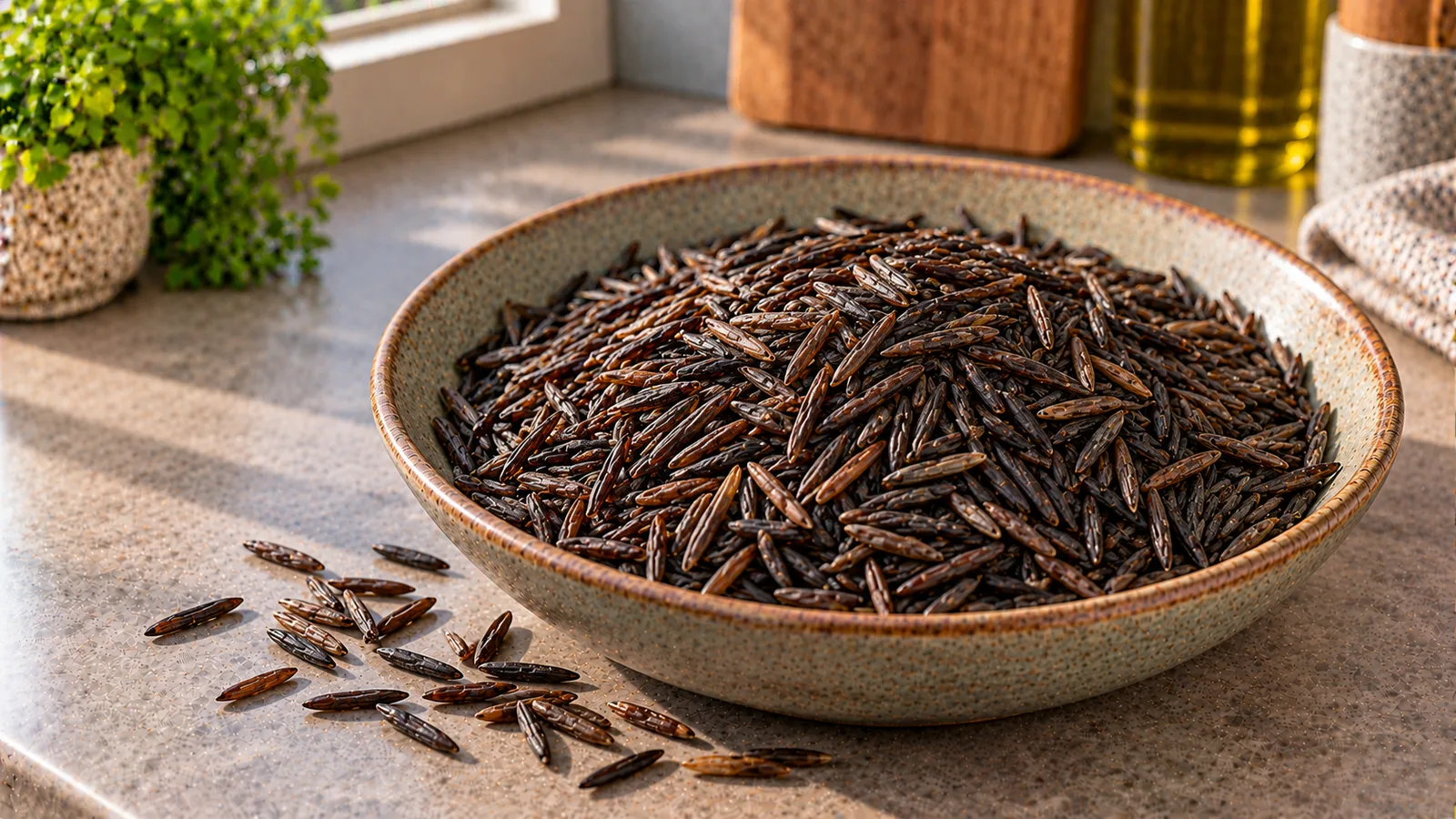
Wild rice has 357 calories per 100 g when dry and 101 calories per 100 g when cooked in water, according to two USDA FoodData Central SR Legacy references. Both figures can be correct: the cooked grains absorb water, so 100 g of cooked wild rice contains less dry grain than 100 g from the packet. Plain cooked wild rice also provides about 4.0 g protein and 1.8 g fibre per 100 g. These numbers apply to edible grains without oil, butter, dressing or other additions.
The important practical question is not which of the two numbers is “the true one”. It is when you weighed the food and whether your product is pure wild rice or a mixture. A dry weight, a bowl after cooking and a ready-made rice blend require different entries. The examples below use measured grams and clearly separate the two states.
Wild rice nutrition per 100 g: dry versus cooked
USDA SR Legacy lists the dry grain as FDC 169726 and the cooked grain as FDC 168897. The carbohydrate figures below are USDA carbohydrate by difference, which includes dietary fibre; do not add the fibre value to the carbohydrate figure again. Numbers are population-level reference foods, not an exact analysis of a particular brand.
| Wild rice state, per 100 g | Calories | Protein | Fat | Carbohydrate | Fibre | Sodium |
|---|---|---|---|---|---|---|
| Dry, raw | 357 kcal | 14.70 g | 1.08 g | 74.90 g | 6.20 g | 7 mg |
| Cooked in water | 101 kcal | 3.99 g | 0.34 g | 21.30 g | 1.80 g | 3 mg |
The underlying USDA records are wild rice, raw, FDC 169726 and wild rice, cooked, FDC 168897. They describe two states rather than tracking one individual batch before and after cooking. The values for a branded or flavoured product may differ, particularly if its package includes added fat or a mixture of grains.
Notice how the protein falls from 14.7 g per 100 g dry to 3.99 g per 100 g cooked. Water increases the weight but does not provide protein or calories. The concentration therefore changes. Some nutrients can also move into discarded cooking liquid, and laboratory references have their own natural variation.
Calories in a cooked serving of wild rice
This table assumes plain cooked edible wild rice at 101 kcal per 100 g. Every line is calculated from the same USDA cooked reference and rounded to the nearest whole calorie. A “cup” is less dependable than a scale because the grain can be packed loosely or tightly.
| Cooked portion | Approximate calories | Approximate protein |
|---|---|---|
| 50 g | 51 kcal | 2.0 g |
| 75 g | 76 kcal | 3.0 g |
| 85 g | 86 kcal | 3.4 g |
| 100 g | 101 kcal | 4.0 g |
| 125 g | 126 kcal | 5.0 g |
| 150 g | 152 kcal | 6.0 g |
| 164 g | 166 kcal | 6.5 g |
| 200 g | 202 kcal | 8.0 g |
| 250 g | 253 kcal | 10.0 g |
For a typical example, a 150 g cooked side dish is about 152 kcal before any sauce. A larger 200 g cooked bowl is about 202 kcal. The 164 g entry approximates a USDA cup measure; it is not a promise that every cup in your kitchen weighs exactly 164 g. If you add mushrooms, chicken, beans or cheese, their calories belong to the assembled dish, not to the plain wild-rice entry.
For a fuller explanation of why a labelled serving does not necessarily match what you eat, see portion size versus serving size. Weigh the cooked food once you have drained any excess water. A wet spoonful of cooking liquid is not the same as additional grain.
Calories in dry wild rice portions
Packages usually specify amounts for uncooked grains. Use the dry values when you have weighed the ingredient before adding water. These estimates do not include seasonings, oil or broth solids.
| Dry portion | Approximate calories | Approximate protein |
|---|---|---|
| 30 g | 107 kcal | 4.4 g |
| 40 g | 143 kcal | 5.9 g |
| 50 g | 179 kcal | 7.4 g |
| 60 g | 214 kcal | 8.8 g |
| 75 g | 268 kcal | 11.0 g |
| 80 g | 286 kcal | 11.8 g |
| 100 g | 357 kcal | 14.7 g |
| 125 g | 446 kcal | 18.4 g |
A recipe starting with 60 g dry wild rice contributes approximately 214 kcal from the grain. Do not multiply the cooked weight of that same grain by 357 kcal per 100 g after it absorbs water. Also do not count both the dry entry and a cooked entry for one portion: that would record the same food twice.
A realistic home-cooking calculation
Imagine weighing 160 g dry wild rice. At 357 kcal per 100 g, the starting grain provides about 571 kcal. After simmering and draining, suppose your particular batch weighs 560 g. That yield is an illustrative measurement, not a guaranteed cooking ratio. If you divide all 560 g into four equal bowls of 140 g, each receives about 143 kcal of the original dry grain.
If the recipe also contains 10 g oil that is actually eaten, the oil contributes about 90 kcal at the usual approximate rate of 9 kcal per gram. That makes about 661 kcal for the whole batch, or 165 kcal per quarter, before other ingredients. If some oil remains in the pan, the eaten amount is smaller. If you used only water and no oil, do not add the 90 kcal.
Here is why your result may not reproduce the USDA cooked-table value exactly. The hypothetical yield gives 571 ÷ 560 × 100, or about 102 kcal per 100 g cooked, while the separate USDA cooked-food reference is 101 kcal. Those similar figures are a coincidence of the chosen yield. A different absorption rate, spilled grains or liquid discarded after cooking changes the actual yield. For a homemade recipe, the dry-ingredient method is often the clearest approach; for food already on a plate, the cooked-weight reference is practical. Use one consistently.
Wild rice is not the same plant as white or brown rice
Despite its name, wild rice comes from aquatic grasses of the genus Zizania rather than the cultivated rice genus Oryza. The University of Minnesota’s wild-rice history explains the plant and its importance in the Great Lakes region, including its cultural significance for Indigenous communities. The grains are long, dark, nutty and often slightly chewy when cooked.
This botanical distinction matters to nutrition tracking because a database entry for ordinary white rice or brown rice should not automatically replace one for wild rice. For those foods, use our regular rice calorie guide and brown rice nutrition guide, respectively. Even when cooked portions look similar, the protein, fibre and moisture content can differ.
Some European packs say Wildreis-Mischung or mélange de riz sauvage. These may contain much more ordinary rice than Zizania. The ingredient list, rather than the product name or colour of a few dark grains, tells you what you are actually weighing.
Protein, fibre and carbohydrates: what the numbers mean
Dry wild rice has 14.7 g protein and 6.2 g fibre per 100 g in this USDA record. After cooking, 100 g provides 3.99 g protein and 1.8 g fibre. It remains predominantly a carbohydrate food, even though the dry profile looks relatively protein-rich compared with some refined grains. A side dish is not usually an adequate protein source for an entire meal by itself.
At 150 g cooked, the USDA values correspond to about 6 g protein and 2.7 g fibre. If you want a meal with more protein or fibre, add beans, tofu, vegetables, eggs or another food that fits your needs; include each addition in the calculation. The related quinoa calorie and serving guide gives a separate grain-like option, but its values should not be treated as interchangeable with wild rice.
Wild rice itself is naturally gluten-free, but packaged blends or shared processing equipment can introduce ingredients or cross-contact relevant to coeliac disease. Check the label and any appropriate certified gluten-free indication instead of assuming every wild-rice product is safe. No individual grain should be described as a treatment for diabetes, cholesterol or weight management based on its fibre content alone.
How preparation and ready-made products change the total
The University of Minnesota Extension cooking directions use water and simmer wild rice until the kernels open, then drain remaining liquid. Cooking time varies with the grain, processing and desired texture. A ready-cooked pouch, soup or restaurant pilaf is a different nutritional product when it contains oil, butter, cream, nuts or mixed grains.
For a packaged product, compare its label per 100 g as sold with your weighed portion, and check whether the label is for dry or prepared food. If instructions ask for butter, the dry nutrition table does not automatically contain that butter. Conversely, a seasoned ready meal may already incorporate the fat in its declared numbers: adding the same oil again would overcount it.
Refrigerate cooked leftovers promptly. FoodSafety.gov’s food-safety guidance advises refrigeration of perishable foods within two hours, with faster cooling in shallow containers. Do not leave a large pot of cooked grain at room temperature all afternoon before using it in tomorrow’s lunch.
What to enter in a food diary
If you weighed the dry grains, enter wild rice, raw and the number of grams used, then divide the completed recipe among the portions eaten. If you weighed only the finished grains, use wild rice, cooked and the edible cooked weight. For a blend or ready-made dish, prefer its own label and ingredient list. Track oil, sauces and extras separately only when they are not already included in the selected entry.
The two headline numbers answer different questions: 357 kcal per 100 g dry helps measure the ingredient going into a pan; 101 kcal per 100 g cooked helps estimate a serving on a plate. They are not numbers to add together.
Sources: USDA wild rice dry, FDC 169726; USDA wild rice cooked, FDC 168897; University of Minnesota: wild rice as a plant; UMN Extension cooking directions; FoodSafety.gov: safe cooling. Portion figures are rounded calculations, not separate laboratory tests.