
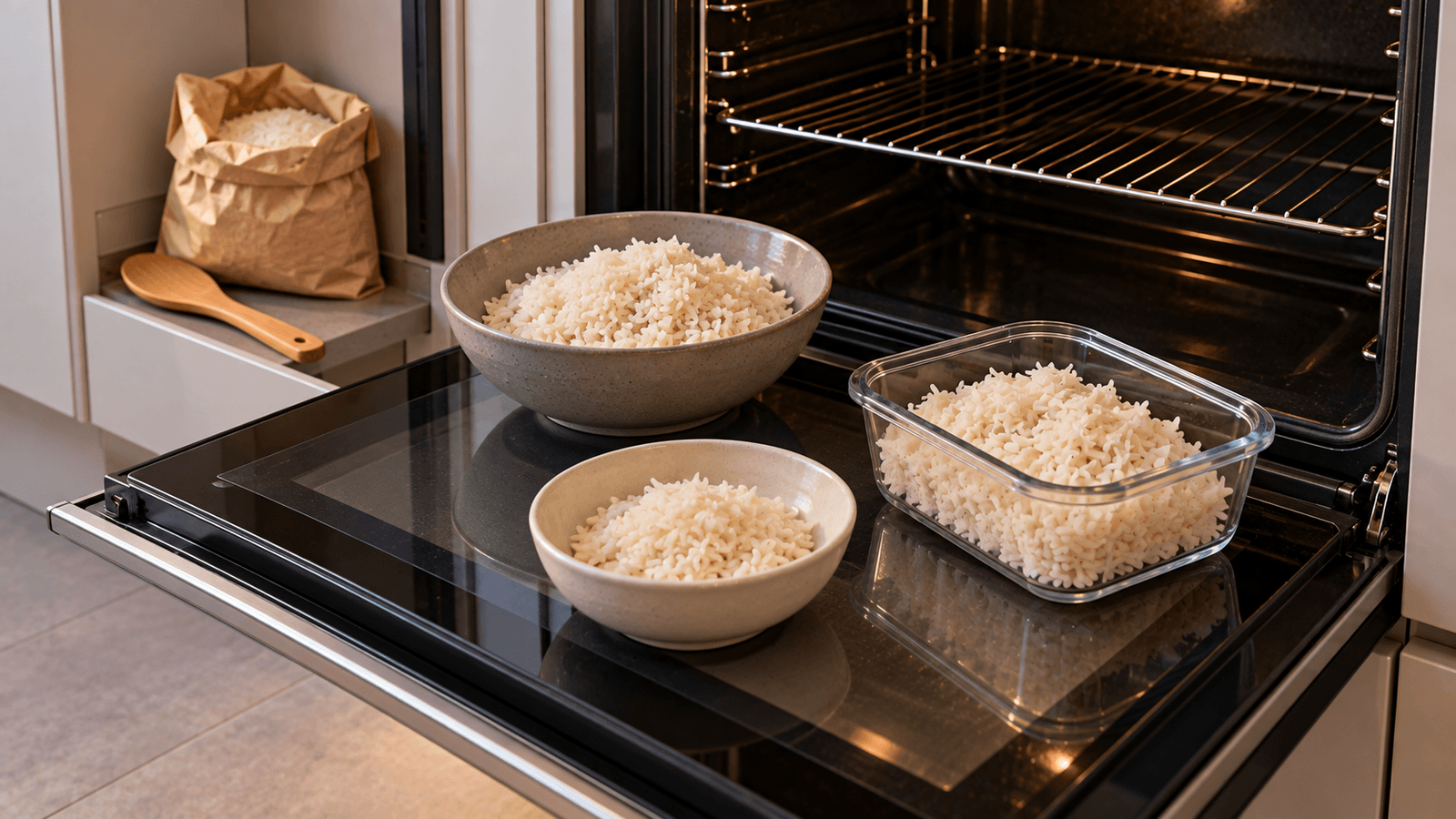
Rice calories are easiest to understand when you separate dry rice from cooked rice.
Rice absorbs water during cooking. The cooked portion becomes much heavier, but water does not add calories.
That means 100 g of dry rice and 100 g of cooked rice are very different portions.
Calories in cooked white rice
Plain cooked white rice commonly provides roughly 125–140 kcal per 100 g, depending on the rice variety, cooking method and amount of water absorbed.
A practical reference value of about 130 kcal per 100 g gives:
| Cooked rice | Approx. calories |
|---|---|
| 50 g | 65 kcal |
| 100 g | 130 kcal |
| 150 g | 195 kcal |
| 200 g | 260 kcal |
| 250 g | 325 kcal |
| 300 g | 390 kcal |
These are approximate examples, not universal values.
If you are using packaged precooked rice or a nutrition database entry for a specific rice variety, use the value that matches that product.
Calories in dry rice
Dry white rice is much more calorie-dense by weight because it has not yet absorbed cooking water.
Many dry white rice products provide approximately 350–370 kcal per 100 g.
Using 360 kcal per 100 g as an example:
| Dry rice | Approx. calories |
|---|---|
| 30 g | 108 kcal |
| 40 g | 144 kcal |
| 50 g | 180 kcal |
| 60 g | 216 kcal |
| 75 g | 270 kcal |
| 100 g | 360 kcal |
The package label should be your primary reference when tracking a specific product.
Why 100 g dry rice has more calories than 100 g cooked rice
Cooking does not remove most of the calories from rice.
Instead, the rice absorbs water.
Imagine you cook:
- 100 g dry rice
- water
If the dry rice contains 360 kcal, the whole cooked batch still contains approximately 360 kcal from the rice.
Suppose it weighs 280 g after cooking.
The calorie density becomes:
360 ÷ 280 × 100 = about 129 kcal per 100 g cooked
The total calories did not disappear.
They are simply distributed across a heavier food because of the absorbed water.
How much cooked rice comes from dry rice?
There is no fixed conversion that works for every rice and cooking method.
Final weight depends on factors such as:
- rice variety
- cooking method
- cooking time
- amount of water
- whether excess water is drained
- how long the rice rests after cooking
For example, 100 g dry rice might produce substantially more than 200 g cooked rice, but the exact yield can vary.
For accurate personal tracking, measure the actual batch rather than relying on one universal dry-to-cooked conversion.
The easiest way to track rice before cooking
If you cook rice yourself, weighing it dry is often the simplest approach.
For example:
- 80 g dry rice
- label value: 360 kcal per 100 g
Calculation:
80 × 360 ÷ 100 = 288 kcal
If the rice is cooked only with water, the entire cooked amount still contains approximately 288 kcal from the rice.
You can then eat the whole batch or divide it into portions.
How to calculate calories from the cooked batch weight
Suppose you cook:
- 200 g dry rice
- water
The rice contains 360 kcal per 100 g.
Total:
200 × 360 ÷ 100 = 720 kcal
After cooking, the batch weighs 560 g.
Calories per 100 g of your cooked rice:
720 ÷ 560 × 100 = about 129 kcal
If you serve 180 g:
720 ÷ 560 × 180 = about 231 kcal
This method is useful when you cook a large batch and portion it after cooking.
Cooked portion sizes
The amount of rice people eat varies considerably.
For practical tracking, common cooked quantities might include:
100 g cooked
At approximately 130 kcal per 100 g:
about 130 kcal
150 g cooked
about 195 kcal
200 g cooked
about 260 kcal
250 g cooked
about 325 kcal
The right portion for a meal depends on the rest of the meal, appetite, energy needs and personal goals.
A serving size is not a universal prescription.
Cups vs grams
Rice is often described in cups, but grams are more reliable for calorie tracking.
The weight of a cup can vary because of:
- rice variety
- how tightly the rice is packed
- moisture
- cooking method
- measuring cup size
If you regularly use the same bowl or cup, weigh your usual portion once.
For example, if your normal scoop of cooked rice weighs 165 g, you can use that as a personal reference for future meals prepared in a similar way.
Basmati rice calories
Plain cooked basmati rice is in a similar general calorie range to other cooked white rice varieties.
Exact values depend on the product and how much water it absorbs.
Do not assume that the name "basmati" alone determines the calories in your finished portion.
For accurate tracking, use:
- the dry package value if weighing before cooking, or
- an appropriate cooked basmati entry if weighing after cooking.
Jasmine rice calories
Plain jasmine rice also falls within a broadly similar calorie range when compared in equivalent cooked portions.
Again, water absorption affects calories per 100 g after cooking.
A 150 g serving of one cooked batch may therefore differ slightly from 150 g of another.
The difference is often smaller than the error created by confusing dry and cooked weights.
Does rinsing rice remove calories?
Rinsing rice before cooking removes some surface starch and debris, but it does not turn a normal portion of rice into a meaningfully low-calorie food.
For routine calorie tracking, you generally do not need to make a special calorie deduction because rice was rinsed.
Use the nutrition value that matches the rice and measurement method you are using.
Does boiling rice change its calories?
Cooking with water changes the calories per 100 g because the rice becomes heavier.
It does not create calories.
If nothing caloric is added, the total energy in the batch primarily comes from the amount of dry rice used.
The important distinction is therefore:
total calories in the batch
versus
calories per 100 g after cooking.
Rice cooked with oil or butter
Oil and butter change the calculation.
If you cook:
- rice
- water
- 10 g oil
the oil must be included in the total recipe.
For example, if the dry rice contributes 720 kcal and the oil contributes approximately 90 kcal, the complete batch contains approximately:
810 kcal
before considering any other calorie-containing ingredients.
Do not use a plain cooked-rice entry for rice prepared with a substantial amount of oil or butter if you want a more accurate estimate.
Fried rice
Fried rice is a mixed dish, not simply plain cooked rice.
It may contain:
- oil
- eggs
- vegetables
- meat or seafood
- sauces
- sugar-containing seasonings
Two 250 g portions of fried rice can therefore have very different calorie totals.
When cooking it yourself, calculate the ingredients as a recipe.
For restaurant fried rice, an estimate is usually unavoidable unless nutrition information is available.
Rice with sauce
The rice portion and the sauce should normally be considered separately.
For example:
150 g cooked rice: approximately 195 kcal using a 130 kcal/100 g reference.
Then add the sauce based on:
- ingredients
- amount served
- oil or cream content
- meat or other additions
A visually similar bowl can vary substantially depending on the sauce.
Rice in curries and mixed dishes
If rice is mixed directly into a dish, weighing the final mixed portion does not tell you how much rice it contains.
For homemade recipes, a better method is:
- record the dry rice
- record all other ingredients
- calculate the whole recipe
- weigh the finished dish if useful
- divide by portions or final weight
This works for dishes such as:
- rice casseroles
- rice and bean dishes
- biryani-style meals
- rice soups
- stuffed vegetables with rice
White rice nutrition
Rice is primarily a carbohydrate-rich food.
Plain cooked white rice typically contains:
- mostly carbohydrate
- a smaller amount of protein
- very little fat when no fat is added
Exact nutrient values vary by variety and enrichment or fortification practices.
Rice can be part of meals containing vegetables, legumes, eggs, fish, meat, tofu or other foods depending on the overall diet.
White rice vs brown rice
Brown rice retains more of the grain's bran and germ layers than white rice.
This changes its fiber and micronutrient profile.
The calorie difference between comparable portions is not necessarily large enough to make calories the only useful distinction.
If your question is specifically about brown rice, use the dedicated guide rather than assuming every rice entry is interchangeable.
The brown-rice guide is intentionally separate because "calories in brown rice" is a distinct single-food search intent.
Rice vs potatoes
Rice and potatoes can both be carbohydrate sources, but their cooked calorie density differs substantially because of differences in water content and composition.
Comparing equal weights can therefore produce very different calorie totals.
For a direct comparison, see Rice vs Potatoes: Calories, Nutrition and Fullness.
Leftover rice and calorie tracking
Cooling rice does not make the original calories in the ingredients disappear.
Changes in starch structure can occur during cooking and cooling, but for ordinary personal tracking it is not useful to subtract a large number of calories from leftover rice based on this effect.
Use a consistent food entry and portion measurement.
More importantly, handle cooked rice safely: cool it promptly, refrigerate it appropriately and reheat according to food-safety guidance.
Restaurant rice portions
Restaurant portions can be difficult to estimate because you may not know:
- cooked weight
- dry quantity
- added oil or butter
- whether the rice was prepared as part of a mixed recipe
If plain rice is served separately, estimating its cooked weight is usually more useful than trying to infer the dry amount.
If the restaurant provides nutrition information, use it when appropriate.
Example: tracking a rice bowl
Suppose your meal contains:
- 180 g cooked white rice
- 120 g chicken
- 150 g vegetables
- sauce
Using 130 kcal per 100 g for the rice:
180 × 130 ÷ 100 = 234 kcal from rice
The chicken, vegetables and sauce are then tracked separately.
This is more accurate than selecting one generic "chicken rice bowl" entry when the actual ingredient quantities are known.
Example: family batch
Suppose you cook:
- 300 g dry rice
- water
The package shows 360 kcal per 100 g.
Total rice calories:
300 × 360 ÷ 100 = 1,080 kcal
After cooking, the rice weighs 840 g.
One family member eats 210 g.
Their share of the batch is:
210 ÷ 840 = 25%
Calories from rice:
1,080 × 0.25 = 270 kcal
This method automatically accounts for the actual water absorption of your batch.
When the package lists nutrition "as prepared"
Check what the label actually describes.
A package may provide values:
- per 100 g dry
- per serving dry
- per 100 g prepared
- per prepared serving
These numbers cannot be used interchangeably.
If you weighed dry rice, use a dry value.
If you weighed cooked rice, use a cooked value or calculate your own cooked value from the batch.
Quick reference
Using approximately 130 kcal per 100 g for plain cooked white rice:
| Cooked portion | Approx. calories |
|---|---|
| 100 g | 130 kcal |
| 150 g | 195 kcal |
| 200 g | 260 kcal |
| 250 g | 325 kcal |
| 300 g | 390 kcal |
Using approximately 360 kcal per 100 g dry:
| Dry portion | Approx. calories |
|---|---|
| 40 g | 144 kcal |
| 50 g | 180 kcal |
| 60 g | 216 kcal |
| 75 g | 270 kcal |
| 100 g | 360 kcal |
The most important rule is simple:
match the nutrition value to the form you actually weighed — dry rice with a dry value, cooked rice with a cooked value.
Nutrition data sources
The tables use 130 kcal per 100 g cooked and an illustrative 360 kcal per 100 g dry.
The USDA references below describe the particular foods and preparation states named in their records; they do not establish every rounded example or product variation in this article. Check the label of a specific product when available.
- USDA FoodData Central — Rice, white, long-grain, regular, enriched, cooked (FDC 168878; 130 kcal/100 g).
- USDA FoodData Central — Rice, white, long-grain, regular, raw, enriched (FDC 168877; 365 kcal/100 g).