
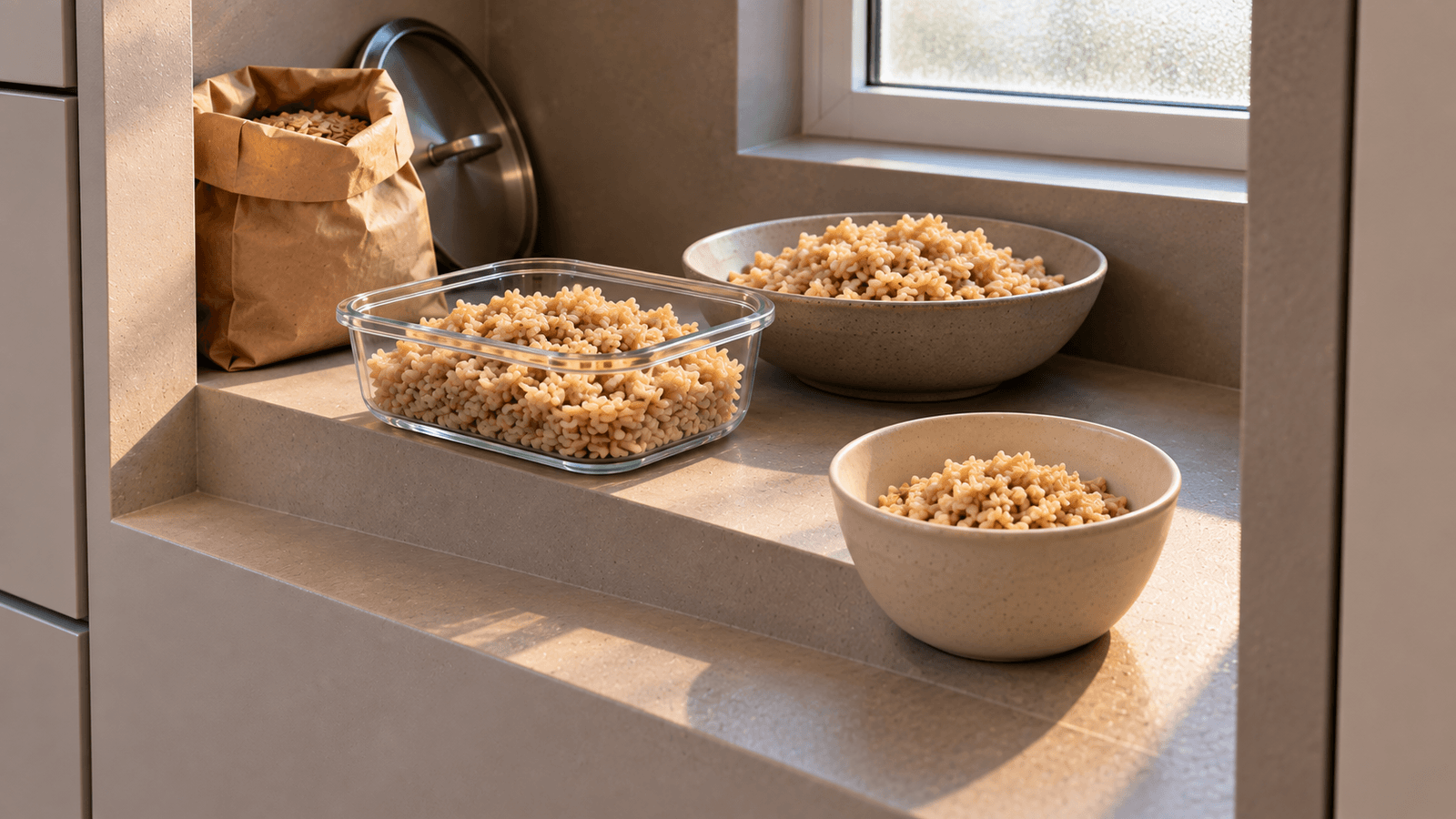
Brown rice is a whole grain that retains the bran and germ layers of the grain.
For calorie tracking, the most important distinction is between dry brown rice and cooked brown rice.
Rice absorbs water during cooking, so its weight increases substantially without the water adding calories.
Calories in cooked brown rice
A USDA reference for cooked long-grain brown rice provides about 123 kcal per 100 g.
Using that value:
| Cooked brown rice | Approx. calories |
|---|---|
| 50 g | 62 kcal |
| 100 g | 123 kcal |
| 150 g | 185 kcal |
| 200 g | 246 kcal |
| 250 g | 308 kcal |
| 300 g | 369 kcal |
These values describe plain cooked brown rice.
Different products and cooking methods can produce somewhat different values because the final water content varies.
Calories in dry brown rice
Dry long-grain brown rice is much more calorie-dense by weight.
A USDA reference for raw long-grain brown rice provides about 367 kcal per 100 g.
That gives:
| Dry brown rice | Approx. calories |
|---|---|
| 30 g | 110 kcal |
| 40 g | 147 kcal |
| 50 g | 184 kcal |
| 60 g | 220 kcal |
| 75 g | 275 kcal |
| 100 g | 367 kcal |
When you have the package in front of you, use its nutrition label because individual products can differ.
Why dry and cooked brown rice have different calories per 100 g
The difference is mainly water.
Suppose you start with:
- 100 g dry brown rice
- water
If the dry rice contains 367 kcal, the entire batch contains approximately 367 kcal from the rice before any calorie-containing ingredients are added.
After cooking, the rice might weigh substantially more because it has absorbed water.
If the final weight were 300 g:
367 ÷ 300 × 100 = about 122 kcal per 100 g cooked
The calories did not disappear.
They are now distributed across a heavier food.
A practical cooked portion
There is no single correct serving size for everyone.
For illustration:
150 g cooked brown rice
150 × 123 ÷ 100 = about 185 kcal
200 g cooked brown rice
200 × 123 ÷ 100 = about 246 kcal
250 g cooked brown rice
250 × 123 ÷ 100 = about 308 kcal
The amount that fits a particular meal depends on appetite, energy needs, the other foods in the meal and personal preferences.
Weighing brown rice before cooking
If you cook the rice yourself, weighing it dry is often the most reproducible method.
Suppose your package lists 367 kcal per 100 g and you use 80 g.
80 × 367 ÷ 100 = about 294 kcal
If you cook those 80 g with water only, the entire cooked amount still contains approximately 294 kcal from the rice.
The final weight may change, but the starting amount of rice has not.
Tracking a batch after cooking
If several people will eat from the same pot, you can calculate the calories per gram of the finished batch.
Example:
- 250 g dry brown rice
- 367 kcal per 100 g
- water
Calories in the dry rice:
250 × 367 ÷ 100 = about 918 kcal
Suppose the cooked batch weighs 750 g.
Calories per 100 g:
918 ÷ 750 × 100 = about 122 kcal
A 180 g portion would contain:
918 ÷ 750 × 180 = about 220 kcal
This method automatically reflects the actual amount of water absorbed by your batch.
Brown rice nutrition
Brown rice is primarily a carbohydrate-rich food.
A USDA reference for 100 g cooked long-grain brown rice provides approximately:
- 123 kcal
- 25.6 g carbohydrate
- 2.7 g protein
- 1.0 g fat
- 1.6 g fiber
Values vary by rice type, product and preparation.
Brown rice also contains minerals including magnesium, phosphorus and manganese.
Why brown rice contains more of the grain
White rice and brown rice come from the same basic grain.
Brown rice retains the bran and germ after the inedible hull is removed.
White rice is milled further, removing these layers.
This is why brown rice and white rice differ in fiber and some micronutrients even though their calorie content can be relatively similar when comparable portions are examined.
Is brown rice much lower in calories than white rice?
Not necessarily.
Using common USDA reference foods, cooked long-grain brown rice is around 123 kcal per 100 g, while a common cooked long-grain white-rice reference is around 130 kcal per 100 g.
But the exact comparison depends on the specific rice and its water content after cooking.
A small difference in calories per 100 g should not be confused with a large difference in total calories.
The amount served still matters.
The dedicated comparison Brown Rice vs White Rice: Nutrition and Calories should be used for the full comparison once available.
Brown rice vs plain white rice when tracking
If you know which rice you ate, use the matching entry.
Do not record brown rice as white rice simply because both look like similar portions after cooking.
Likewise, do not use a dry-rice value for a cooked portion.
The measurement state often creates a larger tracking error than the difference between the two rice types.
For the general white-rice guide, see Calories in Rice: Nutrition, Portions and Common Serving Sizes.
Brown rice and fiber
Because the bran remains on the grain, brown rice generally provides more fiber than refined white rice.
However, a serving of brown rice should not be treated as the only source of fiber in a meal.
A meal can combine brown rice with foods such as:
- beans
- lentils
- vegetables
- peas
- fruit
- nuts
- seeds
This can provide fiber from several sources rather than relying on rice alone.
Brown rice with beans
Brown rice and beans are commonly eaten together.
For calorie tracking, calculate each ingredient separately.
Example:
- 180 g cooked brown rice
- 150 g cooked beans
- vegetables
- sauce
Using 123 kcal per 100 g:
180 g brown rice = about 221 kcal from the rice
The beans, vegetables, sauce and any oil are then added separately.
Do not search for a generic "rice and beans" entry if you know the actual ingredients and amounts.
Brown rice bowls
A brown-rice bowl can vary dramatically in total calories even when the amount of rice stays the same.
For example:
- brown rice
- chicken or tofu
- vegetables
- avocado
- seeds
- dressing
The rice may account for only part of the total energy.
Oil-based dressings, avocado, nuts and seeds can add substantial energy in relatively small quantities.
Track them separately when accuracy matters.
Brown rice cooked in broth
Cooking rice in broth instead of water may add some energy depending on the broth.
The amount can vary substantially by product and recipe.
If the broth contains meaningful calories and you want a precise estimate, include it as part of the recipe.
The same applies to:
- coconut milk
- butter
- oil
- stock concentrates containing energy
- other cooking liquids
Brown rice with oil or butter
Added fat changes the total.
Suppose the rice itself contributes 600 kcal to a batch and you add 10 g of oil.
That oil contributes additional energy and should be included.
The finished dish is therefore not equivalent to plain brown rice cooked only with water.
This is particularly relevant for restaurant rice, where added fat may not be visible.
Fried brown rice
Fried brown rice is a mixed dish.
It may contain:
- cooking oil
- egg
- vegetables
- meat or tofu
- sauces
- sugar-containing seasonings
Its calories cannot be determined accurately from the rice weight alone.
For homemade fried rice, calculate the complete recipe.
For restaurant meals, use available nutrition information or make a reasonable estimate based on the portion and ingredients.
Brown rice in meal prep
Brown rice works well for batch cooking because one cooked batch can be divided by weight.
For example, after cooking you might portion the batch into:
- 150 g
- 180 g
- 200 g
- 220 g
If you have already calculated the calories per gram of that batch, each container can be calculated without guessing the original dry amount again.
This can make repeat-meal tracking faster.
See How to Track Repeat Meals Faster.
Cups vs grams
Household cups are convenient, but gram measurements are more precise.
Cup weights can differ because of:
- how the rice is packed
- grain size
- moisture
- cooking yield
- the measuring vessel
If you use the same serving spoon regularly, weigh one normal spoonful once.
That gives you a useful personal reference.
For example, if one usual spoonful weighs 70 g, two similar spoonfuls are approximately 140 g.
Restaurant portions
When eating out, you usually do not know the dry starting weight.
If the brown rice is served separately, estimate the cooked portion instead.
Useful approaches include:
- compare it with a portion you have weighed at home
- estimate the number of familiar serving spoonfuls
- use restaurant nutrition information when available
Precision will be lower than at home, but keeping dry and cooked entries separate prevents a major source of error.
Brown rice in mixed recipes
For dishes such as:
- casseroles
- stuffed vegetables
- rice-and-lentil dishes
- soups
- rice salads
the finished weight includes ingredients other than rice.
A better homemade method is:
- record the dry brown rice
- record the other ingredients
- calculate the complete recipe
- weigh the finished recipe if useful
- divide by servings or final weight
This is more accurate than assuming the entire finished dish has the calorie density of plain brown rice.
Does cooling brown rice remove calories?
Cooling cooked rice does not make the original calories in the ingredients disappear.
Cooking and cooling can change starch structure, but for ordinary calorie tracking it is not useful to make a large arbitrary calorie deduction from refrigerated rice.
Use a consistent cooked-rice value or your calculated batch value.
Food safety should also be considered when cooling, storing and reheating cooked rice.
Example: one dinner
Suppose dinner contains:
- 200 g cooked brown rice
- 150 g tofu
- 200 g vegetables
- sauce
Using 123 kcal per 100 g:
200 × 123 ÷ 100 = 246 kcal from brown rice
The tofu, vegetables and sauce are separate parts of the calculation.
This prevents the calorie value of the rice from being confused with the calorie value of the entire meal.
Example: family batch
Suppose you use:
- 300 g dry brown rice
- 367 kcal per 100 g
- water
Total rice calories:
300 × 367 ÷ 100 = 1,101 kcal
After cooking, the batch weighs 900 g.
One person eats 225 g.
225 g is 25% of the batch.
Their portion therefore contains approximately:
1,101 × 0.25 = 275 kcal
This approach works even if your particular rice absorbs more or less water than a generic database example.
Quick reference
Using the USDA reference of approximately 123 kcal per 100 g cooked:
| Cooked brown rice | Approx. calories |
|---|---|
| 100 g | 123 kcal |
| 150 g | 185 kcal |
| 200 g | 246 kcal |
| 250 g | 308 kcal |
| 300 g | 369 kcal |
Using approximately 367 kcal per 100 g dry:
| Dry brown rice | Approx. calories |
|---|---|
| 40 g | 147 kcal |
| 50 g | 184 kcal |
| 60 g | 220 kcal |
| 75 g | 275 kcal |
| 100 g | 367 kcal |
The simplest tracking rule is:
use a dry nutrition value for dry rice and a cooked nutrition value for cooked rice. Do not treat the two weights as interchangeable.
Nutrition data sources
Reference values below are per 100 g of the specified food. Product varieties and preparation methods can differ.
- USDA FoodData Central — Rice, brown, long-grain, cooked (Includes foods for USDA's Food Distribution Program) (FDC 169704; 123 kcal/100 g).
- USDA FoodData Central — Rice, brown, long-grain, raw (Includes foods for USDA's Food Distribution Program) (FDC 169703; 367 kcal/100 g).